
INDIAN PAPER MONEY RESEARCH
Indian Banknote Guides
Explore Indian banknote guides, historical research and collecting advice covering British India, British Burma, Republic India and related paper money. Learn about rare varieties, identification, values and monetary history.
A COLLECTOR’S REFERENCE LIBRARY
Research, Identify and Collect Indian Banknotes
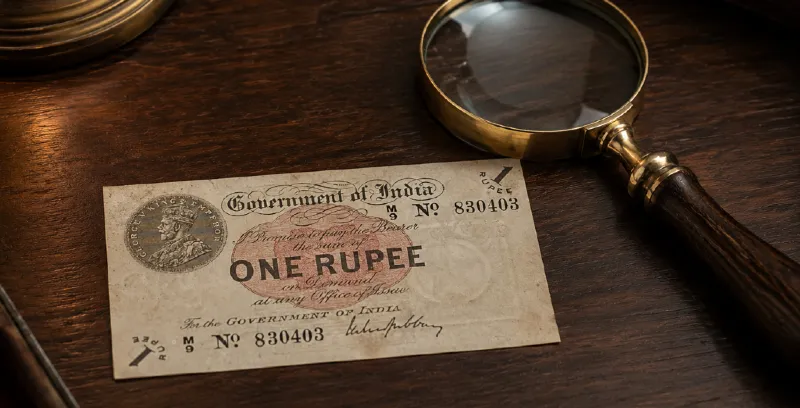
Indian paper money offers an extraordinary record of monetary history. From the Presidency Banks and early Government of India uniface notes to the portraits of King George V and King George VI, British Burma currency, the transition to independence and the banknotes of Republic India, every period offers distinctive collecting opportunities. Understanding these issues requires more than recognising a familiar design or denomination.
Our Indian Banknote Guides help collectors understand the details that distinguish banknote issues and varieties. These include issuing authorities, signatures, serial-number prefixes, watermarks, printing characteristics, denominations, catalogue references and historical circumstances. Certain details may appear insignificant at first glance but can establish whether a note belongs to a common issue or a much less frequently encountered variety.
Alongside historical research, we publish practical information about banknote grading, authentication, collecting themes, unusual serial numbers, printing errors, market values and proper preservation. These subjects are closely connected. Accurate identification helps establish what a banknote is, while careful assessment of its condition and originality helps collectors understand its desirability.
Our reference library is intended for collectors at different stages of experience. Beginners can explore essential terminology, grading principles and collecting methods. More experienced numismatists can investigate specific signatures, scarce varieties, historical overprints and the monetary circumstances behind particular issues.
Whether you are studying a rare British India issue, researching an early Republic India variety or comparing historical currency notes, these Indian banknote guides provide a starting point for further investigation. Explore the historical and practical collecting resources below to develop your knowledge.
HISTORY OF INDIAN PAPER MONEY
Understanding the Different Periods of Indian Paper Money
The history of Indian banknotes spans several issuing authorities, political transitions and monetary systems. For collectors, understanding these historical periods is an important first step towards identifying banknotes correctly. Changes in issuing authority, portraits, inscriptions, signatures and printing arrangements often reflect wider developments in Indian history.
Presidency Banks and Early Government of India Notes
Before the Government of India assumed a central role in paper currency issuance, institutions such as the Bank of Bengal, Bank of Bombay and Bank of Madras issued their own notes. The Paper Currency Act of 1861 established a government monopoly over note issuance, marking an important transition in India’s monetary history. Early Government of India notes, including uniface designs, remain a significant collecting field because of their historical importance and the variety of issuing circles and denominations.
Collectors interested in these early issues can explore our research on Presidency Banknotes of British India and Private Banknotes of British India.
British India: King George V and King George VI
Portrait banknotes issued during the reigns of King George V and King George VI represent an important period in the development of Indian paper currency. The establishment of the Reserve Bank of India in 1935 introduced another major change in issuing authority. Collectors distinguish these notes through their designs, signatures, denominations, serial prefixes, watermarks and other issue-specific characteristics.
Explore our British India banknotes reference and specialist sections covering King George V banknotes and King George VI banknotes.
British Burma Banknotes
Burma’s monetary history was closely connected to British India. Indian currency circulated in Burma, and the separation of Burma from British India in 1937 was followed by distinctive currency arrangements. Collectors encounter Indian banknotes overprinted for Burma, King George VI portrait issues, wartime currency, Military Administration notes and later Burma Currency Board issues. These banknotes reflect important political and monetary transitions.
Explore our British Burma banknotes reference and specialist articles on King George V Burma overprints, British Burma King George V 100 Rupee quarter-cut notes and RBI Burma Peacock banknotes.
Independence, Partition and Republic India
Independence and Partition in 1947 brought significant changes to the monetary systems of India and Pakistan. Transitional issues included Pakistan provisional banknotes of 1948, featuring Government of Pakistan inscriptions incorporated into amended Indian printing plates. India subsequently introduced its own national designs, followed by changes in denominations, signatures and security features.
Our Republic India banknotes section introduces this extensive collecting field, while the article on Republic India 1 Rupee notes examines individual types and varieties in greater detail.
Indian Currency Used Overseas
Indian Rupees circulated beyond India in several regions, reflecting historical trade and monetary connections. Special issues included Persian Gulf Rupees, introduced in 1959 for circulation in designated Gulf territories, and Haj notes intended for Indian pilgrims travelling to Saudi Arabia. Indian currency also circulated historically in parts of East Africa. These issues offer collectors an opportunity to explore the international influence of Indian paper money.
Explore our Persian Gulf Rupees guide to learn more about this distinctive overseas issue of Indian currency.
These historical periods form the foundation of many specialist collections. Some collectors concentrate on a particular issuing authority or monarch, while others study denominations, signatures, overprints or transitional issues across several periods. The Indian Banknote Guides below provide further resources for exploring these subjects.
GLOBAL INTEREST
Why Indian Banknotes Are Popular Worldwide
Indian banknotes represent more than 250 years of monetary history, spanning early private banking issues, British colonial currency, wartime notes, princely state paper money and modern Reserve Bank of India designs. Few collecting fields bring together such a wide range of political, economic and cultural transitions within a single numismatic subject.
Collectors are drawn to Indian paper money for its remarkable variety of portraits, signatures, historical overprints, multilingual inscriptions, unusual serial numbers and regional issues. Our Indian Banknote Guides explore these characteristics and the historical developments that make them significant.
Colonial & Historical Depth
From uniface notes and British India portrait issues to independence, partition and Republic India currency, Indian banknotes document changes in government, commerce and monetary policy.
Exceptional Collecting Variety
Collectors can specialise in portraits, signatures, princely state currency, wartime overprints, fancy serial numbers, printing errors and scarce varieties across different historical periods.
International Collector Interest
British India, British Burma, Persian Gulf and Republic India notes appeal to collectors worldwide. Professional grading and published research help connect collectors across different markets.
Today, Indian banknotes are collected across Asia, Europe, the Middle East and North America by both world paper money enthusiasts and specialist Indian numismatists. Their historical diversity allows collectors to develop collections around particular periods, denominations, issuing authorities or design characteristics.
For further collecting perspectives, read Why Collect Indian Banknotes?.
FEATURED RESEARCH
Essential Reading
Begin with selected Indian banknote guides examining important denominations, historical varieties and the signatures that help distinguish individual issues.
British India 1000 Rupee Note
Discover the history, issuing circles, rarity and varieties of one of British India’s most important high-denomination banknotes, including differences between issues.
Read Guide → REPUBLIC INDIARepublic India 1000 Rupee Note
Study the Ashoka Pillar and Mahatma Gandhi issues, their historical designs, signature varieties and the circumstances surrounding demonetisation.
Read Guide → RBI SIGNATURESRBI Governors & Banknote Signatures
Explore the Governors of the Reserve Bank of India and understand how their signatures help collectors identify and classify historical banknote varieties.
Read Guide →NEW RESEARCH & ARTICLES
Explore More Indian Banknote Articles
Our article archive brings together collecting advice, detailed banknote studies, historical research and specialist reference material. Topics range from individual denominations and signatures to collecting techniques, unusual varieties and the monetary history of the Indian subcontinent. Explore our Indian banknote guides and articles to deepen your knowledge of historical paper money.
Browse All Articles →PRACTICAL COLLECTING & IDENTIFICATION
How to Research and Collect Indian Banknotes
Identifying an Indian banknote accurately involves examining several characteristics together. The denomination and main design provide an initial indication of the issue, but they may not be sufficient to determine its precise variety. Our Indian banknote guides encourage collectors to follow a consistent identification process rather than relying on appearance alone.
Identify the Issuing Authority and Historical Period
Begin by establishing whether the note was issued by a Presidency Bank, the Government of India, the Reserve Bank of India or another historical authority. Consider whether it belongs to British India, British Burma, Republic India or a related regional issue. The issuing authority and historical period establish the context for more detailed identification.
Examine Signatures, Prefixes and Printing Details
Compare the signature with recognised references and examine the serial-number format, prefix, watermark and relevant printing characteristics. These details can help distinguish notes that otherwise appear similar. For some issues, changes in signatories or numbering conventions provide important evidence of the correct type or variety. Our article on RBI Governors and banknote signatures provides a useful starting point.
Explore Printing Errors and Fancy Serial Numbers
Not all collectible Indian banknotes are distinguished by their historical issue or signature. Some attract attention because of unusual serial-number patterns, while others are collected for genuine production errors. Fancy serial numbers may include solid numbers, repeaters, radars, ladders and other distinctive arrangements. Their appeal depends on the exact pattern, the underlying banknote and collector demand. Explore our guide to fancy serial numbers to understand the principal collecting categories.
Indian banknote errors form another specialist collecting field. Examples may involve printing misalignments, missing or misplaced elements, cutting mistakes and numbering irregularities. Genuine production errors must be distinguished from damage, alterations and fabricated anomalies. The significance of an error depends on its type, severity, authenticity and the particular banknote involved. Our guide to Indian banknote errors explains these varieties and how collectors can distinguish genuine production mistakes from alterations.
Assess Condition and Originality
Condition is not determined solely by the number of folds or the general appearance of the paper. Collectors should also consider handling, staining, tears, repairs, pressing, washing and other alterations. A banknote that looks unusually fresh may not necessarily retain its original paper characteristics. Understanding these differences is essential when comparing examples. Read our Banknote Grading Scale and the article on How to Grade Banknotes for further guidance.
Consult Catalogues and Specialist Research
Established catalogues, historical references, auction archives and published research can help confirm identification. However, descriptions and classifications may differ between sources, and new information can refine earlier conclusions. Comparing several reliable references is particularly useful when researching scarce varieties or complicated transitional issues. Our Indian Banknote Glossary explains terminology commonly encountered in catalogues and specialist descriptions.
How to Start Collecting Indian Banknotes
Beginning collectors can start by choosing a historical period, denomination, issuing authority or collecting theme. Some prefer British India portrait notes, while others concentrate on Republic India signatures, unusual serial numbers or professionally graded banknotes. A focused approach makes it easier to compare examples, understand varieties and develop specialist knowledge. Collectors should also establish a realistic budget and maintain records of acquisitions, including catalogue references, condition and provenance where available.
For practical advice, read our guide on How to Start Collecting Indian Banknotes.
Understanding Rarity and Banknote Values
Rarity and market value are related but distinct concepts. A banknote may be scarce because relatively few examples were issued or survived, yet its market value also depends on collector demand, condition, originality and the particular variety. Conversely, a widely available note may attract interest because of an unusual serial number or exceptional condition. Collectors should compare genuinely equivalent examples rather than relying on a single advertised price.
Read Understanding Banknote Values for further discussion of the factors influencing desirability and market value.
How to Preserve Indian Banknotes
Proper storage helps protect banknotes from unnecessary deterioration. Collectors should use archival-quality, banknote-safe holders and avoid direct sunlight, excessive humidity, adhesive materials and unnecessary handling. Banknotes should not be washed, pressed or otherwise altered in an attempt to improve their appearance, as such treatments can affect originality and collector desirability. Careful storage and handling are especially important for fragile historical notes and high-grade examples.
For further advice, see How to Preserve and Store Banknotes.
COLLECTOR REFERENCE TOOLS
Essential Resources
Accurate identification and careful assessment of condition are fundamental to informed Indian banknote collecting. Understanding terminology, originality, grading conventions and historical varieties helps collectors make better decisions when studying or acquiring paper money.
Professional certification can help establish a banknote’s authenticity and condition. Collectors can consult grading standards published by Paper Money Guaranty (PMG) and research resources from the International Bank Note Society (IBNS). For practical guidance, read Should You Submit Indian Banknotes to PMG?
Indian Banknote Glossary
Understand numismatic terminology relating to uniface notes, serial numbers, grading, printing errors, paper characteristics and historical Indian currency. A reference when reading descriptions and catalogues.
View Glossary →Banknote Grading Scale
Learn how banknote condition is assessed, how numerical grades work and why folds, repairs and paper quality matter. Understanding grading terminology helps collectors compare notes more consistently.
Explore Grading Scale →COLLECTOR-LED KNOWLEDGE
Why Collectors Read Our Guides
IndiaBanknotes shares numismatic knowledge informed by collecting roots dating to 1972 and professional numismatic activity beginning in 1988. Our Indian banknote guides emphasise careful identification, historical context and practical collecting advice, supported by decades of experience with Asian paper money.
Collector-Focused Research
Articles designed to help collectors understand Indian banknotes, recognise important characteristics and make informed collecting decisions.
Historical & Monetary Context
Research connecting Indian currency designs and varieties with their issuing authorities, historical periods and monetary developments.
Specialist References
Detailed attention to signatures, serial prefixes, recognised cataloguing systems, printing characteristics, grading standards and condition terminology.
CONTINUE YOUR COLLECTING JOURNEY
Explore Indian Banknotes with Confidence
Whether building your first collection, researching a particular note or considering selling historically important paper money, IndiaBanknotes provides specialist collecting resources and selected inventory. Use our Indian banknote guides to deepen your knowledge before exploring the market.
Ready to Start Collecting?
Explore British India, British Burma, Republic India and historically related banknotes available in our collection.
Browse Collection →Looking to Sell Banknotes?
We consider rare British India, British Burma, early Republic India and related paper money.
See What We Buy →