Indian banknote errors are among the most fascinating specialties in Indian paper money collecting. A banknote with a missing design, mismatched serial numbers, an unusual fold or an incorrectly cut edge can reveal something about the complex process of manufacturing currency. Some errors are immediately recognizable, while others require detailed examination and knowledge of the printing methods used for a particular issue.
Collectors are often attracted to error banknotes because each unusual defect can distinguish a note from ordinary examples of the same denomination. A genuine production mistake may occur on only one banknote, affect several notes within a sheet or continue briefly before the problem is detected and corrected.
However, not every unusual-looking Indian banknote is a genuine production error. Some apparent mistakes are plate errors or design varieties reproduced consistently across an issue. Others are caused by circulation damage, chemical treatment or deliberate alterations intended to imitate valuable errors.
One important example from early Republic India currency is the incorrect Hindi denomination inscription using the singular form Rupaya instead of the appropriate plural Rupaye. Although commonly described as a plate error, this was a design-level oversight reproduced on issued banknotes rather than a random printing accident.
This comprehensive guide combines our original three-part series on Indian banknote errors into a single reference. It explains the principal types of errors, how they arise, the difference between genuine production defects and design mistakes, the risks of artificially created errors, and the factors influencing rarity and collector value.
Table of Contents
What Are Indian Banknote Errors?
A genuine banknote production error is an unintended defect introduced during the manufacturing process. Depending on the stage affected, the mistake may involve security paper, printing, alignment, numbering, folding or cutting.
Currency manufacturing involves precision machinery and multiple quality-control procedures. Nevertheless, unusual mistakes can occasionally escape inspection and enter circulation or the collector market.
Some production errors are relatively minor, such as a small shift in a printed element. Others can be dramatic, including substantial missing printing, severely displaced serial numbers or notes carrying portions of adjacent banknote designs.
Genuine Errors Versus Normal Banknote Varieties
A normal variety is a distinguishable version of an issued banknote, often involving an officially adopted design, signature, watermark, security feature or other production specification. Such differences do not necessarily indicate mistakes.
For example, two notes bearing different RBI Governor signatures may represent recognized varieties rather than errors. Similarly, a denomination inscription corrected between printings may create collectible varieties even when the earlier wording was technically incorrect.
By contrast, a banknote with an accidentally missing serial number or unintended printing displacement may be classified as a genuine production error.
Production Errors Versus Circulation Damage
Damage occurring after production is not a genuine printing error. A note may be torn, washed, faded, stained, folded or chemically affected during circulation or later handling.
Such damage can create appearances resembling missing printing, wrong colours or unusual paper characteristics. A convincing error identification must therefore establish that the abnormal feature originated during authorized manufacturing rather than after the note was produced.
This distinction becomes especially important when a common banknote is advertised at a substantial premium merely because it looks different from normal examples.
How Indian Banknotes Are Produced and Why Errors Occur
Identifying Indian banknote errors becomes easier when collectors understand the principal stages of currency production. Manufacturing technologies have changed considerably between British India, early Republic India and modern RBI banknotes, but the broad processes provide a useful framework.
Design Preparation and Printing Surfaces
The designs, inscriptions and security elements of a banknote must first be prepared for reproduction. Engraved plates, offset printing surfaces and other specialized equipment may be used depending on the issue.
A mistake incorporated into the original design can be repeated consistently across a printing. This differs from an accidental malfunction occurring while individual sheets are being printed.
Security Paper and Embedded Features
Traditional Indian banknotes use specialized paper incorporating security features appropriate to their period. These can include watermarks and embedded security threads.
Irregularities involving the paper or embedded features may arise independently of the later application of printed designs. A misplaced security thread, for example, is not the same type of defect as a printed line appearing in the wrong location.
Printing and Registration
Many banknotes require several separate printing operations. Background colours, principal designs and additional elements may be applied at different stages.
Accurate registration is necessary to ensure that the printed components align correctly. Problems involving sheet feeding, positioning, ink application or machinery can result in missing, displaced, inverted or duplicated impressions.
Numbering and Cutting
Serial numbers are applied according to the numbering arrangements used for the particular issue. Problems involving numbering equipment can create mismatched digits, missing characters or displaced serial impressions.
Printed sheets must also be cut into individual banknotes. Incorrect cutting can produce unusual dimensions, uneven borders or portions of adjacent notes.
The manufacturing sequence differs among banknote series. Collectors should therefore avoid assigning a precise mechanical cause without evidence about the issue’s actual production method.
Folding and Cutting Errors
Folding and cutting errors are among the most visually recognizable production mistakes. They affect the position or shape of the paper and sometimes interrupt the printed design.
Gutter Fold Errors
A gutter fold error occurs when a portion of the paper is folded during a printing operation. The folded area may prevent ink from reaching part of the intended surface.
When the fold is opened, a blank strip or interrupted design may become visible. The affected area can range from a narrow band to a substantial gap across the banknote.
PMG identifies gutter folds as a recognized category of paper money errors. The important diagnostic characteristic is the relationship between the paper fold and the printing interruption, rather than the mere presence of a crease.
For further technical examples, see PMG’s explanation of gutter fold errors.
Fold-Over Errors
A fold-over error occurs when part of the paper folds over another area during printing. The folded portion may conceal part of the sheet, receive printing in an unusual position or produce a blank area when opened.
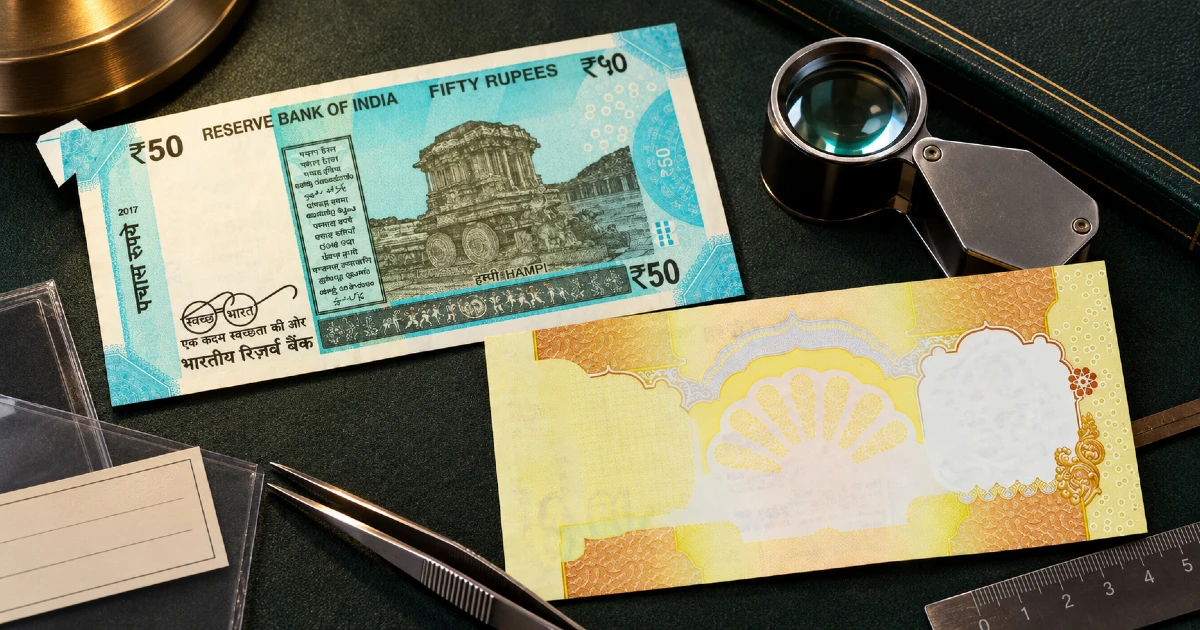
Some examples retain a folded flap, allowing collectors to understand how the abnormal paper position affected the design.
A genuine printed fold differs from a fold introduced after circulation. The printing should show a relationship consistent with the paper having been folded during manufacture.
Paper Jam and Crumpling Errors
Paper jams can cause a sheet to become crumpled, folded or displaced while passing through printing equipment. The resulting banknote may exhibit several related abnormalities, including interrupted printing, irregular alignment or unusual folds.
These should be distinguished from ordinary circulation creases. The affected printing can provide evidence that the paper was already distorted during production.
Cutting and Mis-Cut Errors
A cutting error occurs when a printed sheet is divided incorrectly. The resulting note may have an unusually narrow margin, an excessively wide border, an irregular shape or part of another note visible along its edge.
Severe cutting errors are often more visually impressive because they reveal the original arrangement of multiple banknotes on a sheet.
However, collectors must distinguish genuine cutting mistakes from later trimming. A note cut from an uncut sheet outside the authorized production process is not automatically a genuine cutting error.
Extra Paper and Attached Flaps
Some production errors leave additional paper extending beyond the intended shape of the banknote. This may result from a fold, irregular trimming or another problem involving the sheet.
The nature of the extra section matters. A folded corner that escaped cutting differs from a separate foreign object caught during printing.
Paper continuity, fibres, printing alignment and the shape of the extension can help determine the likely origin of the defect.
Misaligned and Inverted Printing Errors
Misalignment errors occur when a printing component is placed incorrectly relative to the paper or other design elements. These defects reveal the importance of accurate positioning during currency manufacture.
Underprint Shifts
An underprint shift occurs when a background or foundational printing layer is displaced from its intended position. The banknote may show unusual colour boundaries, exposed blank paper or a mismatch between the background and main design.
The appearance depends on the printing system used for that particular note. Collectors should compare the suspected error with normal examples of the same variety.
Overprint Shifts
An overprint shift involves displacement of a separately applied printing component. This might affect serial numbers, signatures, seals or other design elements, depending on the issue.
The shifted printing can appear too high, too low or partly outside its intended area. Significant shifts may cause overlap with other design features.
Misaligned Main Designs
A misaligned main design appears out of position relative to the paper or another printing layer. The banknote may have unusual margins or overlapping design elements.
Printing misalignment must be distinguished from incorrect cutting. In one case, the design is misplaced during printing; in the other, a correctly printed sheet may have been cut in the wrong position.
Inverted Underprints and Overprints
An inverted printing error involves one printing component appearing upside down relative to the rest of the design. Such defects may result from an incorrect relationship between a sheet and a particular printing operation.
Collectors should establish the normal orientation of the affected element before accepting an error description. An unusual-looking inscription is not necessarily inverted printing.
Inverted Front or Back Designs
An inverted front or back error involves an unintended orientation between the two sides of a banknote. One design may appear rotated relative to its normal relationship with the other side.
Such claims require careful comparison because different currencies and banknote types use different normal front-to-back orientations.
When a genuine inversion is established, it may represent a significant production anomaly. The exact mechanical explanation should not be assumed without evidence from the relevant manufacturing process.
Missing Print and Blank Banknote Errors
Missing-print errors occur when an expected printing component is wholly or partly absent. They can be especially dramatic, but they are also among the categories most easily confused with artificially altered notes.
Blank Front or Blank Back
A genuine blank-front or blank-back error occurs when the intended design is absent from one side of the banknote. The opposite side may retain its normal printing.
Because deliberate treatment can remove or obscure printing, authentication is particularly important. The remaining ink, security paper and other manufacturing characteristics should be consistent with a genuine production omission.
Missing Printing on Both Sides
Some extraordinary notes may be missing important printing components on both sides. In certain cases, selected elements remain visible while most of the expected design is absent.
Such items require careful examination to determine whether they represent an actual production error, an unfinished item, an altered note or another form of material not intended for ordinary circulation.
Missing Underprint or Background Colours
A missing underprint error occurs when an expected background layer is not applied. The note may appear unusually pale while retaining its principal design and other printed elements.
This differs from fading caused by sunlight, moisture or chemicals. Genuine missing printing should show characteristics consistent with a specific omitted production stage rather than general deterioration.
Missing Serial Numbers or Other Overprints
A banknote may be missing an expected numbering impression, signature or other separately printed element. The absence may affect one area or a complete printing operation.
Collectors must establish that the element should appear on the particular historical issue. Not all Indian notes have identical numbering or signature arrangements.
Missing Portions of the Design
Some notes exhibit incomplete portraits, borders, denomination elements or decorative designs. These defects may result from insufficient ink, obstruction or a problem affecting the relevant printing operation.
The visual absence of an element does not independently identify the cause. The surrounding printing must be examined to determine the most plausible explanation.
Inking, Offset and Double-Printing Errors
Inking errors involve abnormal ink application or transfer. They can create faint printing, excess ink, smears, ghost impressions or unintended additional images.
Insufficient Inking Errors
Insufficient inking occurs when too little ink reaches part of the printing surface. The affected design may appear weak, incomplete or substantially lighter than normal.
A genuine example may show one poorly printed component while other layers remain unaffected. This selective pattern can help distinguish a manufacturing defect from ordinary fading.
Excess Inking Errors
Excessive ink may produce dark patches, blurred lines or areas where fine details become obscured. Minor differences in ink density are not necessarily significant errors, however, and should be evaluated against normal production variation.
Ink Smears and Solvent Smears
An ink smear occurs when ink is unintentionally spread during production. Solvent-related smears may disturb printed areas and create irregular streaks or incomplete impressions.
Collectors should distinguish genuine manufacturing smears from stains, abrasions and later chemical damage. Similar appearances can have very different origins.
Offset Printing Errors
An offset printing error can produce an unintended reversed image of part or all of a design on the wrong side of the banknote.
In certain printing arrangements, ink transferred to an intermediate surface can subsequently be deposited onto another sheet. The resulting impression may resemble a mirror image or ghost of the intended design.
Depending on the extent of the defect, collectors may describe partial or complete front-to-back or back-to-front offset impressions.
These should not automatically be confused with identical-face errors, where a complete design appears on both sides rather than an unintended reversed transfer.
Wet Ink Transfer
Wet ink transfer occurs when incompletely dried ink is transferred through unintended contact during production. It may create a faint or displaced impression.
Although collectors sometimes use offset and wet-ink transfer interchangeably, the mechanisms are not necessarily identical. Accurate classification requires consideration of how the particular printing was produced.
Double Printing and Multiple Impressions
A double-printing error involves an unintended additional impression of a design or printing component. Two impressions may overlap or appear slightly displaced, producing a doubled appearance.
Multiple impressions can also involve serial numbers or other separately applied elements. Their authenticity should be assessed carefully because later added printing can imitate such errors.
Wrong Colour Printing
A claimed wrong-colour error involves a printing component appearing in an unexpected ink colour. Such cases are difficult to identify confidently because ink colours may change through ageing, environmental exposure or chemical treatment.
Reliable identification requires comparison with authenticated examples and an explanation consistent with the printing process.
Identical Front and Back Printing Errors
Some extraordinary banknote errors involve the same principal design appearing on both sides. These may be described as identical fronts, identical backs or related wrong-side printing anomalies.
Such errors must be distinguished from ordinary offset impressions. An offset usually produces a reversed or ghost-like transfer, while an identical-face claim involves the appearance of a more complete design on the unexpected side.
The production mechanism cannot be determined merely from the visible result. Claims involving identical faces or backs should therefore be supported by strong evidence and specialist authentication.
Collectors should be especially cautious when an apparently extraordinary example has no convincing provenance or has not been independently examined.
Plate Errors and Design Mistakes on Indian Banknotes
Plate errors on Indian banknotes are a particularly interesting category because the term is often used by collectors to describe mistakes incorporated into a banknote’s design or inscriptions. Unlike genuine production errors, these mistakes may be reproduced consistently across an entire printing or recognized issue.
In this context, a plate error is not simply a damaged printing plate or an accidental ink defect. It is an error in the approved design, lettering or engraving that becomes part of the reproduced banknote.
For clarity, such notes are often better described as design errors, inscription errors or design varieties. They are historically important, but they should not automatically be classified as conventional production errors.
How Design-Level Plate Errors Differ from Genuine Production Errors
A genuine production error arises when the manufacturing process departs unintentionally from the approved design or specifications. It may affect an individual banknote, several notes or a limited quantity before the problem is corrected.
A design-level plate error, by contrast, is already incorporated into the printing artwork or approved inscription. Every banknote produced from that design may reproduce the same mistake.
For example, if a denomination inscription contains an incorrect word and the same wording appears consistently across an issued series, the mistake is part of the design rather than a random failure during printing.
Both types may interest collectors, but their classification and rarity should be assessed differently.
The Famous Rupaya and Rupaye Error
One of the best-known examples of a design-level inscription mistake in Indian paper money concerns the Hindi denomination wording on early Republic India banknotes.
Following independence, Hindi was introduced prominently into banknote designs. Some early issues used the singular Hindi form रुपया (Rupaya) in denomination inscriptions where the plural रुपये (Rupaye) was considered appropriate.
The problem appeared on early Republic India denominations such as 2 Rupees, 5 Rupees and 10 Rupees. Collectors commonly distinguish notes with the earlier incorrect Hindi wording from later notes bearing the corrected inscription.
The Reserve Bank of India’s historical account records that in 1953, Hindi was displayed prominently on the new notes and the debate over the plural of Rupaya was settled in favour of Rupiye.
See the Reserve Bank of India’s history of Republic India banknotes for the official historical background.
Although the original inscription was linguistically incorrect, the banknotes themselves were not accidentally misprinted. They were produced according to a design that included the incorrect wording. The mistake was subsequently corrected in later issues.
Consequently, collectors generally treat the earlier Rupaya and corrected Rupaye notes as identifiable inscription or design varieties rather than individual printing errors.
Why the Incorrect Hindi Is Not a Conventional Printing Error
Suppose one banknote unexpectedly lacks part of its denomination inscription because ink failed to transfer. That may be a genuine production error because the note differs from the intended design.
Now consider an entire issue carrying the same incorrect Hindi wording. Each note reproduces the approved inscription consistently. The printing machinery has not necessarily malfunctioned; the mistake was already present in the design.
The second case therefore represents a design oversight. Its numismatic interest comes from the history of the inscription, the period of issue and the later correction rather than a unique printing accident.
Furthermore, the existence of an incorrect inscription does not automatically make every affected note rare. If many examples were printed and circulated, the variety may be relatively obtainable despite its historical significance.
Other Language and Inscription Varieties
The Rupaya and Rupaye distinction is not the only example of linguistic changes in Indian paper money. Collectors also study corrected inscriptions and language-panel variations across different historical issues.
These include changes in regional-language text, denomination wording and other inscriptions that were modified between printings or design versions.
Some corrections reflect genuine mistakes, while others may result from changes in spelling conventions, official terminology or design arrangements. It is important to establish the reason for a variation before describing it as an error.
Our Languages on Indian Notes: History of the 17-Language Panel guide explores these developments in greater detail, including the evolution of Hindi and regional-language inscriptions.
Do Plate Errors Have Collector Value?
Design-level plate errors can be collectible because they document an identifiable stage in the development of Indian banknotes. A corrected inscription may allow collectors to assemble a chronological sequence showing the transition from an earlier design to a revised one.
However, the presence of a design mistake alone does not establish rarity. Value depends on the denomination, signature, printing period, surviving population, condition and demand for the specific variety.
A rare historical banknote carrying an inscription mistake may be highly desirable, while a common note bearing the same standardized mistake may attract only a modest premium.
Can a Plate Mistake Also Be a Genuine Error?
Classification depends on the origin and distribution of the defect. If a mistake is incorporated into the main design and reproduced consistently across an issue, it is usually treated as a design variety rather than a conventional production error.
However, a defect introduced into an individual printing surface or printing position during production may affect only a limited group of notes. Such recurring localized flaws can be studied separately from both approved design mistakes and isolated mechanical errors.
In other words, collectors should distinguish design-level plate mistakes, localized printing-surface flaws and random production errors. These may all be called plate errors informally, but they do not represent the same numismatic phenomenon.
The important question is not merely whether a plate or printing surface was involved, but whether the anomaly formed part of the intended reproduced design or arose unintentionally during manufacture.
Security Feature Errors
Security feature errors concern characteristics intended to help establish the authenticity of currency. Because these features also play a role in identifying counterfeits, unusual examples require particularly careful examination.
Misplaced Security Threads
A security thread may appear outside its expected position because of a manufacturing irregularity. The displacement may be slight or substantial.
Collectors should compare the note with genuine examples of the same issue because thread designs and locations vary among Indian banknote series.
Watermark Misplacement and Inversion
An apparent watermark error may involve unusual positioning or orientation relative to the printed design.
Since watermarks are created during paper manufacture, their relationship to printing and cutting must be considered carefully. A displaced watermark does not necessarily arise from the same mechanism as a displaced printed element.
Missing Security Features
A banknote apparently lacking an expected watermark or security thread may be described as an error. However, absence of a security feature can also indicate counterfeit paper, an incorrectly identified variety or damage.
Professional authentication may be necessary before a missing-feature claim can be accepted.
Extra or Duplicated Security Features
Some unusual notes appear to contain additional embedded features. Such claims require evidence that the extra element originated during paper manufacture rather than being an optical effect, an applied marking or an alteration.
Serial Number and Numbering Errors
Serial numbering errors are particularly attractive to collectors because they affect one of the most distinctive identifying features of a banknote.
Mismatched Serial Numbers
A mismatched serial number error occurs when two printed serial numbers that should be identical contain different digits or prefix elements.
The discrepancy may involve one digit or several characters. In some cases, a numbering mechanism may advance incorrectly or print a character that does not correspond with the other impression.
Collectors must verify that the note normally has matching serials in the relevant positions and that neither number has been deliberately altered.
Duplicated Serial Numbers
A duplicated serial number error involves different banknotes bearing the same complete identifier where they should have been uniquely numbered.
Two notes sharing the same numerical digits but carrying different legitimate prefixes are not necessarily errors. Their complete numbering details must be considered.
Missing or Partial Serial Numbers
A genuine missing-number error occurs when an expected numbering impression is absent. A partial-number error may involve missing characters or incomplete impressions.
These may result from numbering equipment, ink application or obstructions. However, deliberate erasure or chemical alteration can create similar appearances.
Stuck Digits and Misaligned Numbering
A stuck-digit error occurs when part of the numbering mechanism fails to advance correctly. It may cause an unexpected numerical sequence or mismatch.
Other defects include digits printed higher or lower than neighbouring characters, unusual spacing and displaced numbering impressions.
Minor positioning variations should be assessed carefully because they may fall within normal manufacturing tolerances.
Inverted and Multiple Numbering Impressions
Some numbering errors involve an inverted impression or an unintended second application of serial numbers. These can be visually dramatic but should be distinguished from later added printing.
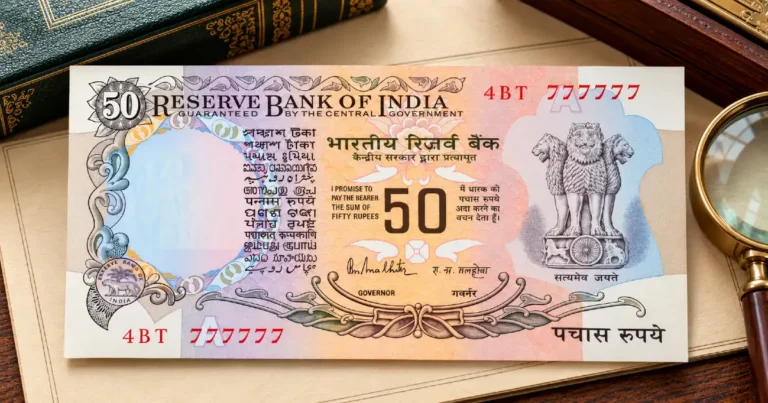
Serial number errors must also be distinguished from fancy serial numbers on Indian banknotes. A solid number such as 777777 is an unusual but normally printed sequence. A mismatched or accidentally duplicated number is a production defect.
Obstruction and Multiple Errors
Obstruction errors occur when foreign material interferes with printing. Multiple errors involve more than one production anomaly affecting the same banknote.
Obstructed Printing Errors
A foreign object or piece of material may prevent ink from reaching part of the paper. The affected area can remain blank or show an incomplete design.
The outline of the obstruction may be visible in the missing-print area. This differs from insufficient inking, where ink application itself is inadequate.
Retained Obstructions
A retained obstruction occurs when the material responsible for the printing anomaly remains associated with the banknote.
Such examples can be especially interesting when the material and affected printing provide convincing evidence of the original manufacturing event.
However, material attached after production can imitate this appearance. Provenance and physical examination are important.
Multiple Errors on a Single Note
A multiple-error banknote may display two or more distinct defects, such as a cutting error combined with displaced numbering.
Collectors should determine whether the abnormalities represent independent errors or several consequences of one malfunction. For example, a single paper jam may produce folding, printing interruptions and cutting irregularities.
Artificially Created Errors and Altered Banknotes
Artificially created errors represent one of the greatest risks in collecting Indian banknote errors. These are unusual appearances introduced outside the authorized currency-production process, sometimes deliberately to make ordinary notes resemble valuable manufacturing mistakes.
Importantly, an artificially altered note may still be a genuine Indian banknote. The problem lies in the authenticity of the supposed error, not necessarily in the underlying currency.
What Are Artificial Errors?
An artificial error is a modification or abnormality created after production, or otherwise outside the authorized process, that imitates a genuine manufacturing defect.
Not every artificial-looking condition involves deliberate deception. Some arise through ordinary accidental damage. However, intentional alterations can be especially problematic when the resulting banknote is sold as a rare production error.
Chemically Treated and Artificially Faded Notes
One common source of misidentification involves notes that have lost colour or printing through chemical exposure, washing or other treatment.
Such notes may resemble missing-print or insufficient-inking errors, but the abnormal appearance originated after production.
Collectors should examine the affected ink, paper fibres and security features for evidence of alteration or deterioration. Where the origin is uncertain, specialist authentication is advisable.
Artificial Cutting and Folding Errors
Unusual paper dimensions or folds can be created after a banknote has been produced. Such modifications may imitate genuine cutting errors, fold-over defects or gutter folds.
A genuine manufacturing fold generally affects how the design was printed. A later fold does not recreate the original relationship between the paper position and printing operations.
Likewise, a banknote cut unusually from an uncut sheet outside official production should not automatically be treated as an authentic cutting error.
Altered Serial Numbers
A genuine banknote may have individual digits modified to imitate a mismatched-number error or a desirable fancy serial number.
Such alterations can be difficult to detect without magnification and comparison with original numbering impressions. Ink consistency, character alignment, paper disturbance and printing texture may provide useful evidence.
The authenticity of the banknote itself does not establish that the serial number remains original.
Artificially Added Printing and False Overprints
Printing or markings applied after issue may imitate doubled impressions, unusual overprints, specimen markings or other collectible varieties.
Historical notes carrying allegedly rare overprints require especially careful examination because a small added inscription can significantly affect the claimed rarity and value.
The added feature must be authenticated independently from the banknote on which it appears.
Ordinary Damage Mistaken for Errors
Accidental damage may also create misleading appearances. Tears, stains, abrasions, water damage, fading and ordinary circulation folds can sometimes resemble manufacturing anomalies.
Collectors should avoid describing a damaged note as deliberately altered unless the evidence supports that conclusion. A note can be incorrectly identified as an error without anyone having intended to deceive.
How to Avoid Artificial Errors
Start by identifying the exact banknote type and comparing it with a normal example. Examine the location, appearance and physical characteristics of the claimed defect.
Ask whether the anomaly could reasonably have originated during the printing or finishing processes used for that issue. Be especially cautious when a common modern banknote is offered at an extraordinary price because of a missing colour, unusual fold or apparently altered numbering.
For expensive or technically complicated examples, independent examination may provide valuable reassurance. A seller’s description alone is not sufficient evidence that an unusual appearance represents a genuine error.
How to Identify Genuine Indian Banknote Errors
Accurate identification requires knowledge of both the banknote and the claimed production mistake. No single test can confirm every type of Indian banknote error, particularly across different historical issues.
Identify the Banknote and Its Normal Variety
Determine the issuing authority, denomination, design, signature, watermark, prefix and relevant catalogue variety.
Establish what the note should look like before assessing the abnormality. A missing element may actually be normal for an earlier design, while an unusual inscription may represent a recognized plate or design variety.
Compare with Authenticated Examples
Compare the suspected error with a genuine normal note of the same variety. Examine both sides under suitable lighting and, where appropriate, magnification.
For design-level plate mistakes, comparison can establish whether the anomaly appears consistently on other notes from the same issue.
For genuine production errors, comparison helps identify the specific departure from the intended design.
Understand the Likely Production Mechanism
Consider which manufacturing stage could plausibly account for the defect. A missing ink layer differs from chemical fading. A printing shift differs from an incorrect cut. A design inscription mistake differs from a randomly omitted word or letter.
If the explanation does not fit the physical characteristics of the note, further investigation is necessary.
Look for Post-Production Alterations
Examine the affected area for unusual ink, damaged fibres, unnatural discolouration, disturbed printing or evidence of later modification.
These observations may raise concerns, but complex alterations can require expert examination. The absence of obvious damage does not conclusively prove an error is genuine.
Professional Authentication and Grading
Professional grading services such as Paper Money Guaranty (PMG) can provide independent authentication and condition assessment. Recognized production errors may also receive appropriate descriptions on certification labels.
Certification can be particularly useful for expensive errors, unusual numbering anomalies and notes where artificial alteration is a concern.
However, certification costs should be considered, and not every unusual note will qualify for an error designation. A recognized design variety should not automatically be submitted or described as though it were a unique printing defect.
Our PMG Graded Banknotes collection provides further information about professionally certified Indian paper money.
How Rare and Valuable Are Indian Banknote Errors?
The value of Indian banknote errors depends on the type, authenticity, severity and desirability of the abnormality, together with the characteristics of the underlying banknote.
Not every genuine error is rare or valuable. Similarly, a well-known design mistake may be historically significant without being particularly scarce.
Type and Severity of the Error
Dramatic errors, such as substantial missing printing or severe cutting mistakes, often attract attention because their unusual appearance is immediately recognizable.
Minor border irregularities or faint inking variations may generate less interest, particularly when similar examples are relatively common.
However, severity alone does not establish value. Genuine authentication and collector demand remain essential.
Scarcity and Surviving Population
A limited number of surviving examples may increase collector interest. However, the original production quantity and current population of many error types are difficult to establish.
Collectors should be cautious about descriptions such as unique or extremely rare unless supported by documented evidence.
Historical Period, Denomination and Signature
A genuine error on a scarce British India issue may be especially desirable because the underlying banknote already has historical value.
Republic India error notes can also be highly collectible, particularly where the defect is clear and authenticated.
Denomination, watermark, signature, prefix and catalogue variety should all be considered when evaluating an individual example.
The Value of Plate and Design Varieties
Plate errors in the sense of standardized design mistakes require a different approach to valuation. The important question is how scarce the particular design variety is, not how many individual notes happened to suffer a random malfunction.
Early Republic India notes bearing the incorrect Rupaya inscription may be collectible because they represent a documented stage in currency design. Their value nevertheless depends on the denomination, issue, condition and surviving population.
A standardized design mistake should not automatically receive the same premium as a rare authenticated production error.
Condition and Originality
Condition remains important, although some genuine errors involve unusual folds or irregular shapes. A fold created during manufacturing should be distinguished from ordinary circulation damage.
Original paper quality and the absence of subsequent repairs or manipulation may improve collector confidence and market desirability.
Actual Selling Prices Versus Asking Prices
Advertised prices are not reliable evidence of market value. Some common damaged notes are offered online at exaggerated prices simply because they look unusual.
Collectors should compare completed transactions involving similar authenticated errors, grades and underlying banknote types.
For design varieties, comparisons should involve the same inscription, denomination and issue rather than unrelated production errors.
Banknote collecting may provide financial rewards, but resale returns are uncertain and can be affected by grading costs, dealer margins, auction commissions and changing collector demand.
Collecting and Preserving Indian Banknote Errors
Indian banknote error collecting can be organized around production methods, historical periods, denominations or particular error categories.
Choose a Collecting Focus
Some collectors pursue dramatic folding, cutting and missing-print errors. Others concentrate on numbering mistakes or unusual authenticated defects on British India notes.
Design and inscription varieties can form a related but distinct collecting theme. A chronological set illustrating the correction from Rupaya to Rupaye, for example, provides insight into the development of early Republic India currency.
Beginning with a small number of clearly identified examples allows collectors to develop expertise before attempting to acquire more complicated material.
Maintain Accurate Documentation
Record the denomination, issuing authority, signature, prefix, complete serial number, condition and catalogue reference of each note.
Describe the abnormality precisely. For a genuine production error, record the likely manufacturing stage involved. For a design-level plate mistake, identify the particular incorrect inscription and the later corrected variety.
Retain photographs of both sides, acquisition records, professional grading details and relevant research references.
Preserve the Error in Its Original Condition
Use suitable archival-quality holders that accommodate the banknote without damaging unusual folds, attached flaps or extended paper edges.
Never attempt to flatten, trim, wash or repair a production error. Such intervention may destroy important diagnostic features and reduce collector confidence.
For general advice on collecting and preservation, read How to Start Collecting Indian Banknotes.
Conclusion: Understanding Indian Banknote Errors
Indian banknote errors provide an opportunity to study the technology, quality control and historical development of Indian paper money. Genuine production mistakes, including folding, cutting, misalignment, missing printing and numbering errors, can make ordinary notes unusually collectible.
Equally important is understanding what does not constitute a conventional production error. Plate errors in the sense of standardized design mistakes, such as the early Republic India Rupaya inscription, are better understood as design or inscription varieties. They may be historically important without representing accidental misprints on individual notes.
Artificially created errors present a separate challenge. Chemical treatment, altered serial numbers, false overprints and post-production modifications can imitate genuine manufacturing mistakes, making authentication essential.
Successful error collecting depends on accurate identification, reliable comparisons, realistic assessments of rarity and appropriate preservation. By understanding the distinctions between genuine errors, design varieties and altered notes, collectors can build more meaningful and trustworthy collections of Indian paper money.
Frequently Asked Questions About Indian Banknote Errors
What are Indian banknote errors?
Indian banknote errors are unintended abnormalities associated with currency manufacture. Genuine production errors may involve printing, numbering, security paper, alignment, folding or cutting. Standardized design mistakes and post-issue damage should be distinguished from conventional production errors.
What are the main types of Indian banknote errors?
Major types include gutter folds, fold-over errors, cutting errors, missing printing, underprint and overprint shifts, ink smears, offset impressions, mismatched serial numbers, security-feature anomalies and obstructed printing. Design-level plate errors and artificially created errors require separate classification.
What is a plate error on an Indian banknote?
In Indian banknote collecting, the term plate error is sometimes used for a mistake incorporated into a design or inscription and reproduced consistently across an issue. Such mistakes are generally better classified as design errors or inscription varieties rather than random production defects.
What is the Rupaya and Rupaye plate error?
Some early Republic India notes used the singular Hindi denomination form Rupaya where the plural Rupaye was appropriate. The inscription was later corrected. Collectors distinguish the earlier and corrected versions as design or inscription varieties rather than individual printing errors.
Are plate errors genuine banknote errors?
A standardized mistake incorporated into the approved design is generally not treated as a conventional production error. However, an unintended localized flaw arising during printing may be a genuine production defect. The classification depends on how the abnormality originated and whether it was reproduced consistently.
What is a gutter fold error?
A gutter fold occurs when part of the paper folds during printing, preventing ink from reaching the intended area. When opened, the fold can reveal a blank strip or interrupted design. It differs from an ordinary fold caused during circulation.
How can I identify a genuine cutting error?
Examine the relationship between the printing and cut edges on both sides. A genuine cutting error originates during official sheet finishing. Unusual trimming performed after production should not be represented as a manufacturing mistake.
What is a mismatched serial number error?
A mismatched serial number error occurs when two number impressions that should agree contain different digits or identifying characters. The correct numbering format must be verified, and deliberate alteration should be ruled out.
What are artificially created banknote errors?
Artificially created errors are abnormal appearances introduced outside the authorized production process that imitate genuine manufacturing defects. Examples may include altered serial numbers, chemical treatment, false printing and post-production cutting or folding.
Can a genuine Indian banknote have a fake error?
Yes. A genuine banknote may be altered after production to imitate a rare printing or numbering defect. Authentication must therefore establish that the unusual feature itself is original, not merely that the underlying note is genuine.
Are missing-colour Indian banknotes valuable?
A genuine missing-ink or missing-print error may be collectible. However, fading and chemical treatment can create similar appearances. The note should be authenticated before assigning a premium based on missing colour.
What determines the value of an Indian error note?
Important factors include authenticity, error type, severity, rarity, denomination, signature, condition, historical significance and actual market demand. Completed transactions involving comparable authenticated examples are more useful than unsupported asking prices.
Should Indian banknote errors be professionally graded?
Professional grading can be useful for valuable or technically complex errors, especially where alteration is a concern. However, certification involves costs and does not guarantee that a note will receive a recognized error designation.
Are error banknotes different from fancy serial number notes?
Yes. A fancy serial number is an unusual but normally printed numerical sequence, such as 777777 or 123321. A numbering error involves a manufacturing mistake, such as mismatched impressions, missing digits or unintended duplicated numbering.