
GRADED INDIAN PAPER MONEY
PMG Graded Banknotes
Explore PMG graded banknotes, specializing in certified British India and British Burma currency, including historic portraits, scarce denominations, official overprints and collectible varieties.
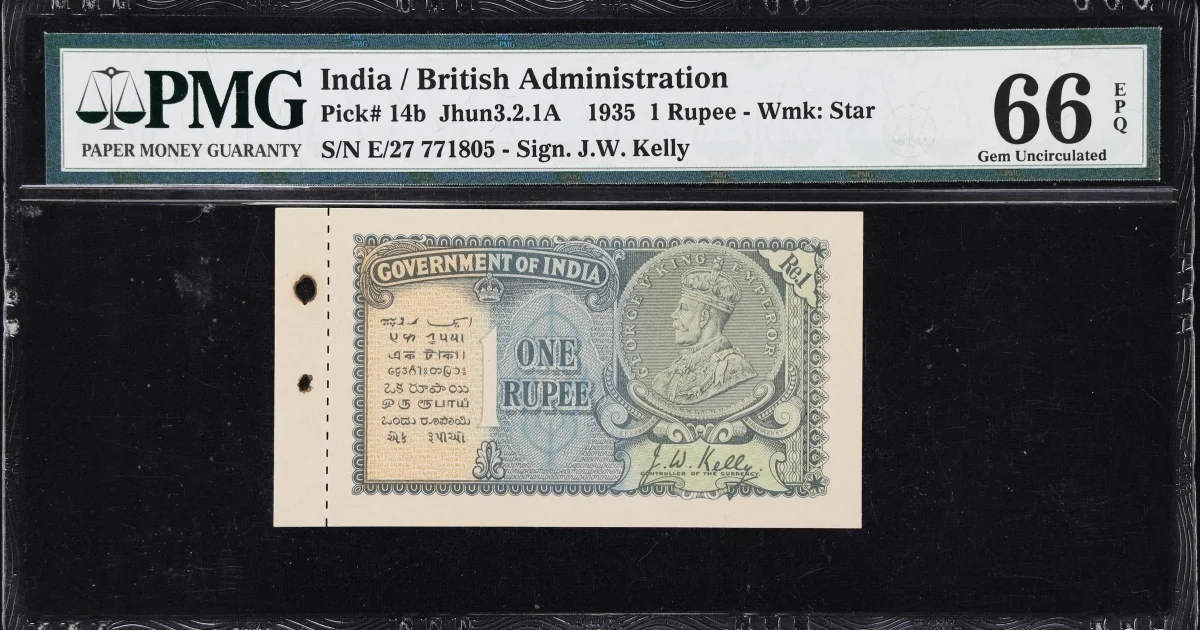
COLLECTING CERTIFIED BANKNOTES
Discover PMG Certified Indian Paper Money
PMG graded banknotes are collectible paper currency independently authenticated and graded by Paper Money Guaranty (PMG). Certified notes are examined by professional graders, assigned a condition grade where applicable and encapsulated in protective holders displaying their identifying information.
Professional certification is particularly useful for historical Indian paper money, where authenticity, originality and preservation can significantly influence collector interest. Early Government of India uniface notes, King George V and King George VI portraits, scarce high denominations and unusual official overprints are important examples.
IndiaBanknotes specializes primarily in PMG graded British India and British Burma banknotes. These collecting fields include early Government of India currency, royal portrait issues, distinctive Reserve Bank of India designs, official Burma overprints and numerous catalogue varieties.
Our interests also extend to certified Republic India banknotes, Persian Gulf Rupees, Hajj Rupees, Pakistan provisional issues, French India, Portuguese India, Hyderabad and selected specimen banknotes.
Whether you are collecting a particular denomination, researching a scarce signature or seeking an independently authenticated historical note, this page introduces PMG certification and the principal collecting areas represented in our inventory.
OUR CERTIFIED COLLECTION
Explore PMG Graded Banknotes for Sale
Discover certified British India and British Burma paper money, together with selected historical Indian-related issues and collectible varieties.
Browse available PMG graded banknotes, including British India uniface issues, King George V and King George VI portraits, British Burma currency, official overprints and selected certified rarities. Inventory changes as individual notes and collections are acquired or sold.
AUTHENTICATION & CONDITION
Understanding PMG Banknote Certification
How independent authentication, condition grading and certification help collectors evaluate historical paper money.
What Is PMG?
Paper Money Guaranty (PMG) is an independent third-party banknote authentication and grading service established in 2005. It examines collectible paper money from different countries and issuing authorities, providing professional opinions on authenticity and condition.
When a banknote is submitted, specialists examine its design, paper, printing and identifying characteristics. Following assessment, qualifying notes are encapsulated in protective holders with labels recording details such as the issuing authority, denomination, catalogue reference and grade.
Certification can be especially valuable for rare British India and British Burma notes, where unusual printing varieties, altered banknotes and counterfeit overprints require careful authentication.
The PMG 70-Point Grading Scale
PMG uses a numerical grading scale from 1 to 70 to describe the condition of collectible banknotes. Higher grades generally indicate better preservation, while lower grades reflect increasing circulation wear, folds, handling and other physical characteristics.
Uncirculated notes are assessed according to their originality, centering, handling and overall condition. Circulated notes are classified according to the degree of wear and any relevant damage or restoration.
Although grade is important, it does not determine collectible desirability by itself. A scarce nineteenth-century British India banknote in circulated condition may be considerably more significant than a common modern note in a very high grade.
For a detailed explanation of the numerical grades and condition terminology, read our Banknote Grading Scale guide.
Authentication and Certification Verification
One of the most important benefits of PMG certification is independent authentication. Collectors of historical Indian banknotes may encounter altered signatures, counterfeit overprints, repaired notes and other problems that are not immediately obvious from photographs.
Each PMG holder carries a certification number that can be checked through PMG’s official certification verification service. The recorded description, grade and available images can be compared with the banknote being offered.
Verification is particularly useful when buying valuable notes, but collectors should also inspect the physical holder, banknote design, serial number and overall condition. A matching certification record should not replace careful examination of the actual item.
The PMG Population Report
The PMG Population Report records the number of banknotes certified by PMG according to type and grade. It is a useful reference for collectors studying how frequently particular denominations, varieties and grades appear among certified examples.
For example, a collector researching a scarce British India signature or British Burma overprint may examine the certified population and compare the number of examples recorded at different grades.
However, population figures do not represent the total number of surviving banknotes. Many historical notes have never been submitted for grading, and the available population data should be considered alongside catalogue research, historical information and market experience.
When Is PMG Certification Most Useful?
Professional grading is especially useful for scarce or historically significant banknotes, including Government of India uniface notes, high-denomination portrait issues, British Burma overprints, rare signatures and specimen banknotes.
Certification may also be worthwhile for exceptionally well-preserved examples, where a recognized numerical grade helps collectors compare condition. For more common banknotes, the cost of grading should be considered in relation to the note’s rarity, condition and collecting purpose.
Collectors should therefore regard PMG certification as an additional source of confidence and information rather than a guarantee of rarity or future market value.
OUR COLLECTING SPECIALTIES
PMG Graded Banknotes by Collecting Area
Our principal specialties are British India and British Burma, supported by selected historical Indian and related paper currency.
PMG Graded British India Banknotes
British India is one of our two principal specialties. Its paper money history encompasses early Government of India uniface currency, King George V portrait banknotes and the King George VI issues introduced by the Reserve Bank of India.
Government of India uniface notes offer numerous collectible varieties involving issuing circles, signatures, watermarks, language panels, serial prefixes and distinctive Green and Red Underprint designs. Their age and complex classification make professional authentication particularly valuable.
King George V notes include the 1917 One Rupee, the unusual 2 Rupees 8 Annas denomination, the regular King’s Portrait Series and high-value issues. Collectors may specialize in signatures, printing differences, watermark types or currency-circle varieties.
King George VI banknotes introduced further design and security developments, including profile and frontal portraits, revised watermarks and wartime printing variations. Notes bearing different Reserve Bank Governor signatures provide additional collecting opportunities.
Certified 1,000 and 10,000 Rupees banknotes are particularly important specialist issues because of their original high face values, scarcity and historical significance. Authentication, provenance and physical condition are essential considerations when evaluating such notes.
Our British India graded collection therefore appeals to collectors of early Indian paper money, royal portrait banknotes, rare denominations and significant historical varieties.
PMG Graded British Burma Banknotes
British Burma is our other principal specialty. Its banknotes document the close monetary relationship between India and Burma, including currency issued during the transition to separate colonial administration.
The 1937 King George V provisional issues consisted of Indian portrait banknotes officially overprinted for Burma. The recognized denominations were 5, 10 and 100 Rupees, with authentic overprint varieties forming an important specialist collecting category.
The King George VI Peacock Series introduced distinctive Burma-specific designs, including local wildlife, cultural motifs and elaborate security printing. Its five denominations were 5, 10, 100, 1,000 and 10,000 Rupees.
Following the Second World War, further Indian King George VI banknotes were officially overprinted under the Military Administration of Burma and subsequently the Burma Currency Board. These issues require careful identification of the underlying note, official wording, signature and serial prefix.
PMG certification can be especially helpful for British Burma banknotes because of the importance of overprint authenticity, scarce varieties and condition. Collectors may pursue individual historical issues or assemble a broader certified Burma collection.
PMG Graded Republic India Banknotes
Republic India paper money includes the first post-independence Government of India One Rupee issue, early Ashoka Pillar banknotes, commemorative designs and the later Mahatma Gandhi portrait series.
Collectors study Governor signatures, denominations, replacement notes, fancy serial numbers, genuine printing errors and high-grade examples. The 1,000, 5,000 and 10,000 Rupees issues introduced in 1954 are also important historical collectibles.
PMG graded Republic India notes provide opportunities to collect authenticated examples of both scarce historical issues and modern banknotes with unusual or desirable characteristics.
PMG Graded Persian Gulf Rupees
Persian Gulf Rupees were special Indian banknotes introduced in 1959 for circulation in certain Gulf territories. Their four denominations were 1, 5, 10 and 100 Rupees, distinguished from domestic Indian notes by special colours, Z-prefix serial numbers and other identifying features.
Certified Gulf Rupees appeal to collectors of Indian overseas currency, unusual regional monetary systems and historically important banknotes. Correct identification of the denomination, prefix, signature and underlying design is essential.
PMG Graded Pakistan Provisional Banknotes
Following Partition in 1947, Pakistan initially relied on Indian monetary arrangements while establishing its own central bank and national currency. In April 1948, five provisional King George VI denominations were introduced: 1, 2, 5, 10 and 100 Rupees.
Commonly known as Pakistan overprints, these notes were produced using amended printing plates incorporating Government of Pakistan inscriptions in English and Urdu. They were not ordinary completed Indian banknotes subsequently stamped with new wording.
Professional authentication is particularly important because counterfeit Pakistan inscriptions have been added to genuine Indian notes. Collectors should consider the original note type, authorized serial-prefix range and printing characteristics when evaluating examples.
PMG Graded French India Banknotes
French India paper money reflects the history of French-administered settlements in the Indian subcontinent. Issues associated with the Banque de l’Indochine feature distinctive designs, inscriptions and colonial monetary arrangements.
Certified French India banknotes appeal to collectors of European colonial currency, scarce Indian-related issues and historically significant denominations.
PMG Graded Portuguese India Banknotes
Portuguese India paper money includes currency issued for Goa, Daman and Diu, particularly notes associated with the Banco Nacional Ultramarino. These feature Portuguese inscriptions, distinctive designs and historical denomination systems.
PMG certification can be useful for rare varieties, important signatures and well-preserved examples of Portuguese India’s colonial currency.
PMG Graded Hyderabad Banknotes
The princely state of Hyderabad issued its own distinctive paper money under the Osmania Sicca monetary system. These notes differ from ordinary British India currency in their inscriptions, designs, issuing arrangements and historical background.
Certified Hyderabad banknotes appeal to collectors of princely-state currency, scarce signatures and important historical varieties.
PMG Graded Specimen Banknotes
Specimen banknotes are another important collecting category, particularly for rare historical Indian and related currency issues. Genuine specimens may feature special inscriptions, perforations, cancelled serial numbers or other production-related characteristics.
Their significance depends on the issuing authority, purpose, original banknote type and documented authenticity. PMG certification can assist collectors in distinguishing genuine production specimens from altered or unofficially marked notes.
Specimen examples from British India, British Burma and other Indian-related monetary systems can be particularly interesting when ordinary issued varieties are scarce or historically significant.
THE BENEFITS OF CERTIFICATION
Why Collect PMG Graded Banknotes?
Explore the practical advantages of independently authenticated and professionally graded historical paper money.
Independent Authentication
PMG provides professional opinions on the authenticity of certified banknotes. This is particularly valuable for scarce historical issues, unusual varieties and official overprints where counterfeits or alterations may be encountered.
Standardized Condition Grading
The PMG numerical grading scale provides a consistent framework for comparing condition. Collectors can assess examples of the same type while considering originality, rarity and visual appearance.
Protective Encapsulation
Certified holders protect banknotes from unnecessary handling and provide tamper-evident encapsulation. Careful storage remains important for preserving fragile or historically significant paper currency.
High-Grade Collecting
PMG graded notes allow collectors to pursue exceptionally well-preserved examples of particular denominations, signatures and designs. High-grade British India and British Burma banknotes may be challenging to obtain.
Population Report Research
PMG population data helps collectors investigate certified quantities and grade distributions. It is especially useful when researching uncommon types, scarce varieties and particularly high-grade examples.
Greater Buying Confidence
Independent authentication, documented identification and recognized grading can help buyers compare collectible notes and assess condition more consistently, especially when purchasing important historical banknotes.
Historical and Specialist Collecting
Certified banknotes can be collected by period, issuing authority, denomination, monarch, signature or catalogue variety. PMG holders provide a convenient way to organize and identify a specialist historical collection.
COMMON COLLECTOR QUESTIONS
PMG Graded Banknotes FAQs
Answers to common questions about PMG certification, authentication and collecting historical Indian paper money.
What are PMG graded banknotes?
PMG graded banknotes are collectible paper currency independently authenticated and graded by Paper Money Guaranty. Certified notes are encapsulated in protective holders displaying their identifying information, assigned grade and applicable designations.
What does PMG stand for?
PMG stands for Paper Money Guaranty, a third-party banknote authentication and grading service established in 2005.
How does PMG grade banknotes?
PMG uses a numerical scale from 1 to 70, with higher grades generally indicating better preservation. The assessment considers circulation wear, folds, handling, paper quality and other condition characteristics.
How can I verify a PMG certified banknote?
Collectors can use the certification number on a PMG holder to check the corresponding record through PMG’s official verification service. The description, grade and available photographs should be compared with the physical banknote.
What is the PMG Population Report?
The PMG Population Report records how many examples of particular banknote types have been certified at different grades. These figures are useful for research but do not represent the total number of surviving notes.
Which PMG graded banknotes does IndiaBanknotes specialize in?
Our principal specialties are British India and British Burma, including Government of India uniface currency, King George V and King George VI portrait notes, Peacock Series banknotes and historical overprints. We also collect selected Republic India and other Indian-related issues.
Are rare British India banknotes worth grading?
Professional grading can be particularly helpful for early uniface notes, scarce denominations, valuable signatures, unusual varieties and important King George V or King George VI issues. The decision depends on the individual note’s rarity, condition and collecting significance.
Are PMG graded banknotes always more valuable?
No. Certification provides independent authentication and a recognized condition assessment, but value still depends on the note’s type, rarity, originality, demand and preservation. A high numerical grade alone does not guarantee exceptional collectible value.
Does IndiaBanknotes buy PMG graded banknotes?
IndiaBanknotes is interested in acquiring collectible PMG graded banknotes, particularly British India and British Burma issues. We also consider Republic India, Persian Gulf Rupees, Hajj issues, Pakistan provisional notes, French India, Portuguese India, Hyderabad and important specimen banknotes. Please contact us with photographs, certification numbers and relevant details.
Looking for a Specific PMG Graded Banknote?
Share your want list with our specialists, including the issuing authority, denomination, catalogue variety and preferred PMG grade. British India and British Burma are our principal interests, together with selected Indian-related historical notes.
Submit Your Want List →Collect PMG Graded Banknotes?
Explore certified British India, British Burma and selected Indian-related historical paper money, including scarce varieties and high-grade examples.
Want to Sell PMG Banknotes?
We are interested in acquiring PMG certified British India and British Burma notes, historical overprints and specialist Indian paper money collections.