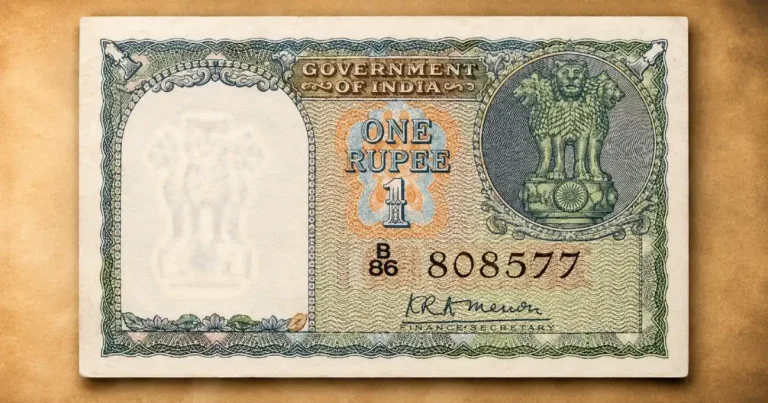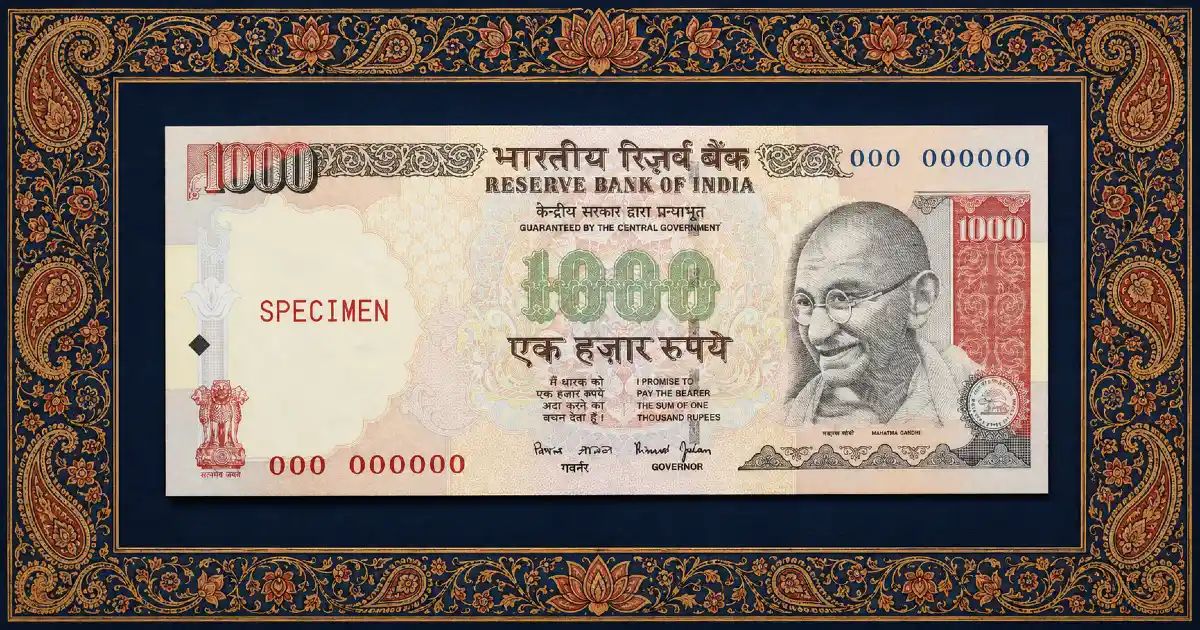
The Republic India 1000 Rupee note has a distinctive history spanning two very different periods of Indian paper currency. First introduced in 1954, the denomination was initially represented by large-format Ashoka Pillar banknotes featuring the Brihadeeswarar Temple at Thanjavur. After their withdrawal in 1978, the denomination remained absent until its reintroduction in 2000 as part of the Mahatma Gandhi series.
For collectors, the earlier Ashoka Pillar 1000 Rupee banknotes are particularly significant. Their varieties include differences in Hindi inscriptions, language panels, issuing offices, Governor signatures and design details. These distinctions are essential for identifying individual notes and understanding their relative rarity.
This guide examines the eight principal catalogue types of Republic India 1000 Rupee paper money, with particular emphasis on the four Ashoka Pillar types, their historical background, identification features and collectibility.
Table of Contents
- History of the Republic India 1000 Rupee Note
- Eight Types of Republic India 1000 Rupee Notes
- Ashoka Pillar 1000 Rupee Notes
- The Tanjore Temple Design
- Issuing Offices and Serial Prefixes
- Four Ashoka Pillar Types and Varieties
- The 1978 Demonetisation
- Mahatma Gandhi 1000 Rupee Notes
- The 2016 Demonetisation
- Rarity, Collectibility and Value
- Conclusion
- Frequently Asked Questions
History of the Republic India 1000 Rupee Banknotes
The history of the 1000 Rupee denomination began long before Indian independence. British India had issued high-denomination banknotes featuring Queen Victoria, Government of India uniface designs, King George V and King George VI. However, the denomination was withdrawn on 12 January 1946 as part of the first major demonetisation of high-value Indian currency.
Following independence in 1947, the Reserve Bank of India continued issuing existing designs for a transitional period before introducing new banknotes representing the Republic of India. The Lion Capital of Ashoka replaced the British monarch as the principal emblem on the new currency.
On 1 April 1954, the RBI reintroduced the 1000 Rupee denomination alongside the 5000 Rupee and 10000 Rupee currency notes. These high-denomination banknotes were primarily intended for substantial financial transactions rather than ordinary retail use.
The new 1000 Rupee note featured the Lion Capital of Ashoka on the obverse and the Brihadeeswarar Temple on the reverse. This design remained in use, with modifications, until the denomination was demonetised in January 1978.
More than two decades later, the 1000 Rupee denomination returned in October 2000 as part of the Mahatma Gandhi series. Unlike the earlier issues, these notes were produced for widespread circulation and remained in use until November 2016.
For the colonial history of the denomination, see our companion article on the British India 1000 Rupee Note.
Eight Types of Republic India 1000 Rupee Notes
The Republic India 1000 Rupee currency notes comprise eight principal Banknote Book (BNB) catalogue types, divided equally between the Ashoka Pillar and Mahatma Gandhi series.
| BNB | Pick | Series | Distinguishing Feature |
|---|---|---|---|
| B227 | P46 | Ashoka Pillar | Incorrect Hindi Rupaya inscription |
| B228 | P47a–e | Ashoka Pillar | Corrected Rupaye, seven languages |
| B229 | P47f | Ashoka Pillar | Corrected Rupaye, thirteen languages |
| B230 | P65 | Ashoka Pillar | Two-column legal tender panel |
| B278 | P94 | Mahatma Gandhi | Undated reverse |
| B285 | P100 | Mahatma Gandhi | Dated reverse without ₹ symbol |
| B291 | P107a–n | Mahatma Gandhi | Dated reverse with ₹ symbol |
| B297 | P107o–t | Mahatma Gandhi | Ascending-size serial numbers |
Although the two series share the same denomination, their historical significance and collecting characteristics differ considerably. The Ashoka Pillar notes are scarce, large-format historical issues, while ordinary Mahatma Gandhi notes are much more readily available.
Ashoka Pillar 1000 Rupee Notes
The Ashoka Pillar 1000 Rupee banknote was among the highest denominations issued by the Reserve Bank of India during the early decades of the Republic. Introduced in 1954, it combined the national emblem with a prominent architectural landmark, reflecting India’s transition from colonial to independent currency designs.
The banknotes measure approximately 203 × 127 mm, making them substantially larger than the later Mahatma Gandhi ₹1000 notes. Their predominant colour is brown, with additional purple, blue and green tones contributing to the complex printed design.
Obverse Design and Security Features
The obverse features the Lion Capital of Ashoka, replacing the portraits of British monarchs used on earlier high-denomination banknotes. The design also incorporates the denomination, the Reserve Bank of India seal, a promise to pay the bearer and the Governor’s signature.
Unlike modern Indian banknotes, the Ashoka Pillar ₹1000 issues identify their issuing offices on the obverse. This feature is particularly important because several varieties share similar designs but were issued through different RBI offices.
Security features include a solid security thread and a watermark incorporating the Lion Capital and RESERVE BANK OF INDIA lettering. The watermark should be examined together with the paper and printed details when assessing authenticity.
Reverse Design and Language Panel
The reverse features the Brihadeeswarar Temple at Thanjavur, together with denomination inscriptions, the RBI seal and a multilingual panel. The temple vignette remained a consistent feature throughout all four Ashoka Pillar types.
However, the language panel changed during the series. Earlier notes contained seven regional languages, while later issues expanded the panel to thirteen. This difference provides an important method of distinguishing otherwise similar varieties.
The combination of architectural imagery, multilingual inscriptions and issuing-office identification makes the Ashoka Pillar 1000 Rupee series particularly interesting for collectors studying the development of Republic India paper currency.
The Tanjore Temple 1000 Rupee Note
Collectors commonly refer to the Ashoka Pillar issues as the Tanjore Temple 1000 Rupee notes, after the prominent temple depicted on their reverses. Tanjore is the former English name of Thanjavur, a historic city in Tamil Nadu.
The vignette depicts the Brihadeeswarar Temple, one of the most celebrated monuments of the Chola dynasty. Built during the reign of Rajaraja I in the early eleventh century, the temple is renowned for its monumental Dravidian architecture and towering granite vimana.
The temple forms part of the Great Living Chola Temples, a UNESCO World Heritage Site recognised for its architectural and cultural significance.
All four Ashoka Pillar ₹1000 types share the temple vignette. Consequently, collectors cannot identify the exact catalogue type from the temple design alone; the Hindi inscription, language panel and legal tender text must also be examined.
Issuing Offices and Serial Prefixes
One of the most important features of early Republic India 1000 Rupee notes is their identification by issuing office. Five RBI offices are recorded for the earliest Ashoka Pillar type, each associated with a particular serial prefix.
| Serial Prefix | Issuing Office |
|---|---|
| A | Bombay |
| H | Calcutta |
| Q | Madras |
| U | Kanpur |
| X | Delhi |
The issuing-office name appears on the banknote, allowing collectors to compare it directly with the serial prefix. This system resembles the issuing-circle arrangements found on earlier British India high-denomination notes.
However, not every office issued every Ashoka Pillar type. The earliest B227 notes are recorded for all five offices, whereas subsequent types have fewer documented issuing-office combinations.
For this reason, a complete identification should include the catalogue type, issuing office, serial prefix and Governor’s signature. A note’s rarity cannot be assessed reliably from the prefix alone.
Four Ashoka Pillar 1000 Rupee Types and Varieties
The four Ashoka Pillar types are distinguished primarily by changes in the Hindi denomination inscription, the number of languages on the reverse, and the arrangement of the legal tender text. Their signatures and issuing-office combinations provide additional collectible varieties.
For a complete list of signatories and their terms in office, see our RBI Governor List.
Incorrect Hindi “Rupaya” Inscription
Catalogue: BNB B227 / Pick P46
The first Ashoka Pillar 1000 Rupee note, introduced in 1954, contains one of the most interesting inscription varieties in Republic India paper currency.
The Hindi denomination reads एक हज़ार रुपया (Ek Hazaar Rupaya), using the singular form Rupaya instead of the grammatically appropriate plural Rupaye. This inscription was subsequently corrected, creating a clear distinction between the earliest type and later issues.
The incorrect inscription is a recognised design variety rather than an accidental printing error affecting individual notes. All notes of this type share the same wording.
The reverse contains a seven-language panel comprising Bengali, Gujarati, Kannada, Odia, Tamil, Telugu and Urdu. All recorded B227 varieties bear the signature of B. Rama Rau, who served as RBI Governor from 1949 to 1957.
| Governor | Issuing Office | Prefix |
|---|---|---|
| B. Rama Rau | Bombay | A |
| B. Rama Rau | Calcutta | H |
| B. Rama Rau | Delhi | X |
| B. Rama Rau | Kanpur | U |
| B. Rama Rau | Madras | Q |
The five issuing-office varieties provide an important collecting distinction. While all belong to the same principal catalogue type, their surviving availability may differ considerably.
For identification, the combination of the incorrect Rupaya inscription, seven-language panel and B. Rama Rau signature establishes the B227 type. The issuing-office name and prefix then identify the individual variety.
Corrected “Rupaye” with Seven Languages
Catalogue: BNB B228 / Pick P47a–e
The B228 type corrected the Hindi denomination to एक हज़ार रुपये (Ek Hazaar Rupaye), replacing the singular wording found on B227.
Apart from this correction, the basic design remained largely unchanged. The reverse continued to display the Brihadeeswarar Temple and the original seven-language panel.
This makes the Hindi inscription the most important visual distinction between B227 and B228. Collectors examining these notes should pay particular attention to the final word of the Hindi denomination rather than relying solely on the overall appearance.
Three RBI Governors are represented among the recorded B228 varieties: B. Rama Rau, H. V. R. Iengar and P. C. Bhattacharya.
| Governor | Issuing Office | Prefix |
|---|---|---|
| B. Rama Rau | Bombay | A |
| B. Rama Rau | Calcutta | H |
| H. V. R. Iengar | Bombay | A |
| P. C. Bhattacharya | Bombay | A |
The signature varieties demonstrate that the corrected design continued through successive RBI administrations. Collectors should therefore distinguish notes signed by different Governors even when the issuing office and prefix are identical.
Corrected “Rupaye” with Thirteen Languages
Catalogue: BNB B229 / Pick P47f
The B229 type introduced another significant change: the expansion of the reverse language panel from seven to thirteen languages. The corrected Hindi inscription, Ek Hazaar Rupaye, was retained, as were the principal obverse design and the Tanjore Temple vignette.
The expanded language panel reflected the broader multilingual presentation of Indian currency as the Republic’s banknote designs evolved. This change provides the clearest means of distinguishing B229 from the preceding B228 type.
Only one combination is recorded: P. C. Bhattacharya, Bombay issuing office, prefix A.
Although B228 and B229 may appear similar at first glance, the number of languages on the reverse is decisive. The Governor’s signature alone is insufficient because P. C. Bhattacharya also signed the preceding type.
For a broader explanation of Indian currency language panels, see our guide to Languages on Indian Currency Notes.
Two-Column Legal Tender Panel
Catalogue: BNB B230 / Pick P65
The B230 type represents the final major design of the Ashoka Pillar 1000 Rupee series before its withdrawal in 1978.
Its principal distinguishing feature is the revised bilingual legal tender panel on the obverse, with English and Hindi text arranged in two columns. This layout differs from the earlier Ashoka Pillar types and provides a convenient identification feature.
The basic design, including the Lion Capital and Brihadeeswarar Temple, remained unchanged. However, the redesigned text arrangement gives B230 a noticeably different appearance when compared directly with earlier issues.
Two signature varieties are recorded, both associated with the Bombay issuing office and prefix A.
| Governor | Issuing Office | Prefix |
|---|---|---|
| N. C. Sen Gupta | Bombay | A |
| K. R. Puri | Bombay | A |
The K. R. Puri variety also features a modified background pattern beneath the BOMBAY issuing-office name, distinguishing it from the N. C. Sen Gupta variety. This difference is of particular interest to specialist collectors because it provides an additional design characteristic beyond the Governor’s signature.
Although B230 is generally more accessible than the earlier Ashoka Pillar types, it remains a scarce historical banknote, particularly in well-preserved condition.
The 1978 Demonetisation of Ashoka Pillar 1000 Rupee Notes
On 16 January 1978, the Government of India announced the demonetisation of ₹1000, ₹5000 and ₹10000 banknotes. These denominations ceased to be legal tender after that date under the High Denomination Bank Notes (Demonetisation) Ordinance, 1978.
The measure was intended to address concerns about unaccounted wealth and illicit financial transactions. Holders of the affected notes were required to follow prescribed declaration and exchange procedures.
For collectors, the withdrawal marked the end of the Ashoka Pillar 1000 Rupee currency notes. However, demonetisation alone does not establish the rarity of a particular variety, which also depends on original issuance, historical survival, and condition.
For the legal background and exchange arrangements, read our detailed History of Demonetisation in India.
Mahatma Gandhi 1000 Rupee Notes
The Mahatma Gandhi 1000 Rupee note was introduced in October 2000, restoring the denomination after more than two decades. Unlike the earlier Ashoka Pillar issues, these banknotes were intended for widespread circulation and were produced in much larger quantities.
Measuring approximately 176 × 73 mm, the Mahatma Gandhi notes were smaller and incorporated more advanced security features.
Design and Security Features
The obverse features Mahatma Gandhi’s portrait, the Lion Capital of Ashoka, the RBI seal and denomination inscriptions. Security features include a watermark, security thread, microlettering, see-through registration and other anti-counterfeiting elements.
The reverse depicts India’s economic development through agricultural, industrial and technological imagery, including a combine harvester, offshore oil platform, satellite and industrial facilities. A fifteen-language panel appears alongside the design.
Successive issues introduced modifications to the printed year, rupee symbol, security features and serial-number presentation, resulting in four principal catalogue types.
Four Mahatma Gandhi 1000 Rupee Types
| BNB | Pick | Identification Feature | Recorded Signatures |
|---|---|---|---|
| B278 | P94 | Undated reverse | Bimal Jalan, Y. V. Reddy |
| B285 | P100 | Dated reverse without ₹ symbol | Y. V. Reddy, D. Subbarao |
| B291 | P107a–n | Dated reverse with ₹ symbol | D. Subbarao, R. G. Rajan |
| B297 | P107o–t | Ascending-size serial numbers | R. G. Rajan |
The easiest way to distinguish these types is to examine the reverse for a printed year, check whether the ₹ symbol is present and inspect the serial-number style. The Governor’s signature provides further identification.
Among the final B297 issues, the RBI identified a production batch of 756 notes with prefixes 5AG and 3AP, inset letter L, lacking the windowed security thread. Such errors require careful authentication because missing security features may also result from alteration.
For collectors, the Mahatma Gandhi series offers opportunities to study signature varieties, fancy serial numbers, uncirculated examples, specimen notes and authenticated printing errors. Ordinary circulated examples, however, are generally much more common than the Ashoka Pillar issues.
The 2016 Demonetisation of 1000 Rupee Notes
On 8 November 2016, the Government of India announced the withdrawal of existing ₹500 and ₹1000 Mahatma Gandhi Series banknotes, effective from 9 November, subject to specified temporary exceptions.
The decision ended the circulation of the ₹1000 denomination. Unlike the earlier Ashoka Pillar series, however, Mahatma Gandhi notes had been produced in substantial quantities, and many examples were retained after demonetisation.
Consequently, demonetisation does not make ordinary Mahatma Gandhi 1000 Rupee notes particularly rare. Their collectibility depends on specific varieties, condition and collector demand.
Further details are available in our article on Demonetisation in India.
Rarity, Collectibility and Value of Republic India 1000 Rupee Notes
The collector value of a Republic India 1000 Rupee note depends on its series, catalogue type, variety, condition and market demand. The Ashoka Pillar and Mahatma Gandhi issues should be assessed separately because their surviving availability differs considerably.
Rarity of Ashoka Pillar Notes
Ashoka Pillar 1000 Rupee notes are scarce historical banknotes, with the earliest B227, B228 and B229 types generally more difficult to acquire than the later B230 issue.
However, rarity also depends on the issuing office, Governor’s signature and individual variety. Some combinations may be considerably scarcer than others within the same catalogue type.
Published catalogues, auction records and authenticated surviving examples can help collectors assess relative scarcity. The absence of recent sales, however, does not necessarily establish that a particular variety is unique.
Collectibility of Mahatma Gandhi Notes
Ordinary circulated Mahatma Gandhi 1000 Rupee notes are generally more accessible and attract limited collector premiums. Uncirculated notes, scarce signature-and-date combinations, distinctive serial numbers, specimen notes and authenticated errors may be more desirable.
For further guidance, see Understanding Banknote Values and Should You Submit Indian Banknotes to PMG?.
Conclusion
The Republic India 1000 Rupee note reflects two distinct periods in India’s monetary history. The Ashoka Pillar series is particularly important for its historical designs, issuing-office varieties, Hindi inscription changes and evolving language panels. The later Mahatma Gandhi series provides a contrasting example of modern, widely circulated high-denomination currency.
For collectors, accurate identification of the catalogue type and individual variety is essential, particularly when evaluating the scarce Ashoka Pillar issues.
Frequently Asked Questions
When was the first Republic India 1000 Rupee note issued?
The first Republic India 1000 Rupee note was introduced on 1 April 1954 by the Reserve Bank of India. It belonged to the Ashoka Pillar series and featured the Brihadeeswarar Temple on the reverse.
What is the Tanjore Temple 1000 Rupee note?
It is the popular collector name for the Ashoka Pillar 1000 Rupee notes issued between 1954 and 1978. The reverse depicts the Brihadeeswarar Temple at Thanjavur, formerly known as Tanjore.
How many Ashoka Pillar 1000 Rupee types exist?
Four principal BNB catalogue types are recognised: B227, B228, B229 and B230. They differ in their Hindi inscriptions, language panels, legal tender text, and recorded varieties.
What is the difference between Rupaya and Rupaye varieties?
The earliest Ashoka Pillar 1000 Rupee note used the singular Hindi inscription रुपया (Rupaya). Later issues corrected this to रुपये (Rupaye). The difference is a recognised design variety rather than an individual printing error.
How can collectors identify an Ashoka Pillar 1000 Rupee note?
Examine the Hindi denomination inscription, number of languages on the reverse, legal tender panel, issuing-office name, serial prefix and Governor’s signature. These features distinguish the four principal types and their varieties.
Which RBI Governors signed Ashoka Pillar 1000 Rupee notes?
Recorded signatories include B. Rama Rau, H. V. R. Iengar, P. C. Bhattacharya, N. C. Sen Gupta and K. R. Puri. Not every Governor signed every variety.
When were Republic India 1000 Rupee notes demonetised?
The Ashoka Pillar notes were demonetised in January 1978. The Mahatma Gandhi 1000 Rupee notes were withdrawn with effect from 9 November 2016.
Are Republic India 1000 Rupee notes valuable?
Some are highly collectible, particularly scarce Ashoka Pillar varieties. Ordinary Mahatma Gandhi notes are generally much more common. Collector value depends on the exact type, signature, variety, condition and demand rather than denomination or demonetisation alone.