Understanding banknote values is one of the most important skills for collectors of Indian paper money. Two banknotes of the same denomination can have remarkably different levels of collectibility because of their rarity, condition, signature, watermark, prefix, serial number, or historical significance. Even notes that appear almost identical may belong to different catalogue varieties.
Indian banknotes offer an extraordinary range of collecting opportunities, from early British India uniface issues and King George V portrait notes to Republic India currency, special regional issues, fancy serial numbers, and printing errors. Each collecting field has its own characteristics, and the factors influencing desirability can vary between them.
Many people assume that an old banknote must be valuable simply because it is no longer in circulation. Others believe that a high denomination, an unusual serial number or professional certification automatically makes a note rare. In reality, understanding banknote values requires examining several interrelated factors rather than relying on a single characteristic.
Rarity is important, but a rare note must also attract collectors. Condition can make a substantial difference, particularly when exceptionally well-preserved examples are difficult to obtain. Historical significance may create enduring interest, while signatures and prefixes can distinguish desirable varieties from more common issues.
Another important aspect of understanding banknote values is distinguishing catalogue estimates, dealer asking prices, auction results and actual market value. These figures serve different purposes and should not automatically be treated as interchangeable.
This comprehensive guide explains what determines banknote value, how rarity and demand interact, why condition matters, which special features influence collectibility, and how to research the value of individual Indian banknotes. It also explores the long-term collecting and investment potential of rare Indian paper money.
If you are new to the hobby, our How to Start Collecting Indian Banknotes guide explains the fundamentals of building a collection. This article concentrates on evaluating the desirability and market value of the notes themselves.
Table of Contents
Understanding Banknote Values: The Main Factors
Understanding banknote values begins with recognizing that a collectible banknote has characteristics extending beyond the monetary denomination printed on it. Its market value reflects what collectors are willing to pay for a particular example, taking into account rarity, condition, authenticity, historical importance and demand.
These factors are closely connected. A scarce variety in exceptional condition may appeal to both specialist collectors and buyers seeking high-grade examples. A historically important note in circulated condition may still attract considerable interest because relatively few examples survive.
Likewise, a common modern banknote may become more desirable when it carries an unusual serial-number pattern or a genuine printing error. The significance of such features depends on the specific note and the market for that collecting specialty.
The following table summarizes the principal factors influencing Indian banknote values.
| Factor | Why It Matters |
|---|---|
| Rarity | How difficult the exact banknote type or variety is to obtain |
| Condition | The preservation and physical grade of the individual note |
| Collector Demand | The level of interest among buyers seeking the issue |
| Variety | Differences distinguishing one issue from otherwise similar notes |
| Historical Significance | Connections with monetary reforms, political changes and notable events |
| Special Features | Fancy serial numbers, printing errors, specimens, and overprints |
| Authenticity | Confidence that the banknote and its identifying features are genuine |
| Market Evidence | Comparable transactions and current collector interest |
The relative importance of each factor differs among collecting fields. For an early Government of India uniface note, surviving rarity and authenticity may be especially important. For a common Republic India issue, an exceptional grade or desirable serial number may be the principal reason for a collector premium.
A reliable assessment therefore begins by identifying the exact banknote before considering what makes that particular example collectible.
Rarity: One of the Most Important Factors in Banknote Values
Rarity plays a central role in understanding banknote values. A scarce note may be difficult to acquire because relatively few were printed, fewer survived, or a particular combination of characteristics is encountered infrequently.
However, rarity must be established for the exact banknote variety. A denomination may be common overall, while a particular signature, issuing circle, or prefix is exceptionally difficult to find.
Original Printing Quantity Versus Surviving Population
The number of banknotes originally printed does not necessarily indicate how many examples survive today.
Banknotes may have been redeemed and destroyed, withdrawn from circulation, lost through everyday use or affected by war and political upheaval. Conversely, some issues were retained in large numbers because collectors or members of the public recognized their significance.
For understanding banknote values, the availability of surviving collectible examples is generally more useful than the original printing quantity alone.
Rarity Within an Individual Series
Indian banknotes frequently exist in multiple varieties involving design changes, signatures, prefixes, and issuing-circle arrangements.
For example, early Government of India 5 Rupee uniface notes include numerous variations. The Green Underprint 5 Rupee notes and Red Underprint 5 Rupee notes differ in language panels, signatures, issuing circles and serial-number configurations.
Two notes belonging to the same general design may therefore have very different collecting characteristics. One combination may be comparatively obtainable, while another is recorded only infrequently.
This is why accurate catalogue identification is fundamental when researching rare Indian banknotes.
Condition Rarity
Some banknotes are reasonably obtainable in circulated condition but exceptionally difficult to find in high grades.
For example, certain King George VI notes may survive in substantial numbers overall, while examples in uncirculated condition are much less frequently encountered.
This is known as condition rarity. It helps explain why two examples of the same catalogue variety may attract very different collector interest.
Understanding banknote values therefore requires considering both the scarcity of the issue and the scarcity of the particular condition grade.
Rarity and Desirability Are Different
A banknote can be extremely scarce yet attract interest from only a small number of specialist collectors. Another note may survive in larger quantities but remain highly desirable because it belongs to a popular collecting field.
Rarity establishes limited availability, while demand influences the competition among collectors seeking that availability.
The most desirable rare Indian banknotes often combine genuine scarcity with historical importance, attractive designs and an established collector audience.
Collector Demand and Its Influence on Banknote Values
Collector demand is another essential consideration in understanding banknote values. It reflects the interest collectors have in a particular issue, denomination, series or collecting theme.
Demand may arise from historical importance, the popularity of a monarch, artistic design, the challenge of completing a set or the limited availability of desirable varieties.
Popular Fields of Indian Banknote Collecting
British India portrait notes, early Government of India currency, scarce Republic India varieties and special regional issues attract established collector interest.
Within these fields, demand may concentrate on particular denominations, signatures, watermarks or unusual issues rather than every note in the series.
For example, collectors assembling a complete King George V signature or issuing circle collection may compete for a difficult-to-find combination even when more common notes from the same period are readily available.
Demand Changes as Collecting Interests Develop
Collecting preferences evolve as new research appears, specialist catalogues improve and more collectors become interested in particular historical periods.
Greater awareness of an overlooked variety can increase collector interest. Similarly, a growing emphasis on exceptional condition may influence demand within an established series.
Understanding banknote values involves following these developments rather than relying exclusively on older catalogue descriptions.
International Demand for Indian Paper Money
Some Indian banknotes appeal to collectors well beyond India because of their connections with British colonial history, international trade, monetary administration and regional currency systems.
British Burma, Persian Gulf Rupees, Hajj notes and Pakistan transitional issues are examples of collecting fields with historical connections extending beyond present-day India.
International demand can increase the potential collecting audience for certain issues, particularly when they are historically significant and genuinely scarce.
How Condition and Grading Affect Indian Banknote Values
Condition is a major consideration in understanding banknote values because collectors generally prefer examples showing fewer folds, stains, tears and other signs of handling.
However, condition must be assessed alongside rarity. A heavily circulated example of a scarce nineteenth-century issue may still be more desirable than an uncirculated example of a very common modern note.
Comparing the Same Banknote in Different Grades
Consider two genuine examples of the same Indian banknote variety. One is in Very Fine condition, while the other is Uncirculated.
Provided the notes are otherwise comparable, the uncirculated example will appeal more strongly to condition-focused collectors.
The extent of the difference depends on how commonly the particular issue survives in each grade. Where uncirculated examples are exceptionally scarce, condition may have a substantial influence on desirability.
Traditional and Numerical Grading Systems
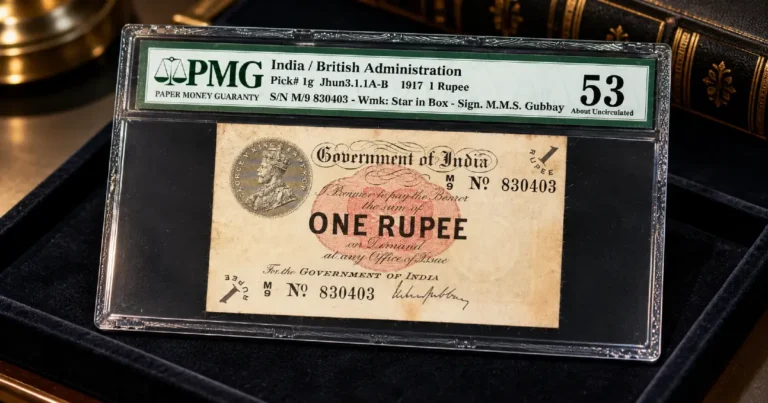
Banknote condition is commonly described using traditional grades such as Uncirculated, About Uncirculated, Extremely Fine, Very Fine and Fine.
Professional grading services also use numerical grading systems that allow more precise distinctions between individual examples.
For detailed explanations, consult our Banknote Grading Scale. Our How to Grade Banknotes article provides practical advice on examining folds, corners, margins and other condition characteristics.
Understanding banknote values does not require memorizing every numerical grade, but collectors should be able to recognize the differences between broadly circulated and well-preserved examples.
High-Grade Historical Banknotes
Exceptional preservation can be especially significant for historical notes that were widely circulated or commonly subjected to handling practices such as stapling.
High-grade King George V and King George VI notes, early Republic India issues and certain unusual varieties can attract strong specialist interest when few comparable examples are available.
For collectors pursuing condition rarity, a particularly well-preserved note may become an important addition to a carefully assembled collection.
Damage, Repairs and Preservation
Tears, staining, repairs, missing sections and other damage may affect the desirability of a banknote beyond its general grade.
Collectors comparing market transactions should consider these characteristics carefully rather than assuming that two notes with similar descriptive grades are directly equivalent.
Proper preservation helps maintain existing condition. Our How to Preserve and Store Banknotes guide explains suitable archival materials and long-term storage practices.
Historical Significance and the Value of Indian Banknotes
Historical importance adds another dimension to understanding banknote values. Indian paper money records political transitions, changes in issuing authorities, currency reforms and the development of national identity.
Some issues are particularly desirable because they represent an important stage in monetary history. Others are notable for their unusual designs, regional circulation or connections with significant events.
Early British India Paper Currency
Early Government of India uniface notes document the development of centralized paper currency issuance during the nineteenth century.
Many surviving examples are historically important, and particular denominations, issuing circles, or signatures can be difficult to obtain.
Their appeal combines age, design, historical significance, and the challenge of finding authentic examples in desirable condition.
King George V and King George VI Banknotes
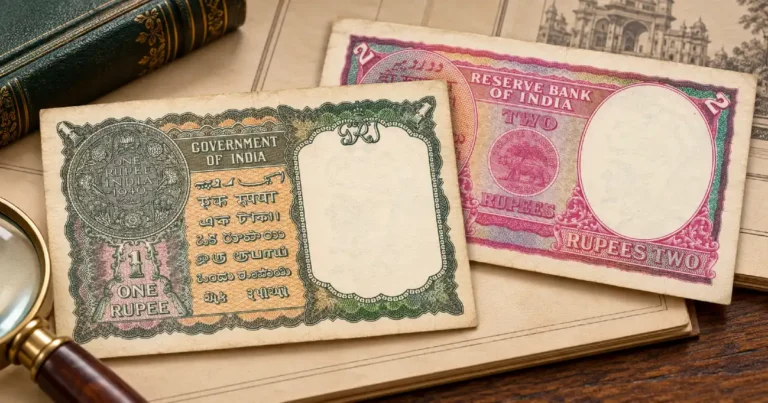
British India portrait notes provide opportunities to collect by monarch, denomination, issuing official, and design variety.
Some varieties are relatively obtainable, while others are scarce. Exceptional condition may further distinguish certain banknotes, particularly when high-grade survivors are limited.
Accurate identification is essential because notes carrying the same portrait may belong to significantly different issues.
British Burma Currency
British Burma currency reflects changing monetary arrangements, administrative developments and wartime conditions.
Some notes contain distinctive official inscriptions or overprints. Their authenticity and precise variety may be particularly important to their collector value.
Persian Gulf, Hajj and Pakistan Issues
Indian monetary history extends beyond the borders of present-day India. Special currency issues and transitional notes associated with the Persian Gulf, Hajj pilgrims and Pakistan form important collecting fields.
Distinctive prefixes, inscriptions, and issuing circumstances may be essential for identifying these notes.
Collectors should distinguish genuine special issues from ordinary Indian currency with similar designs.
Republic India Banknotes
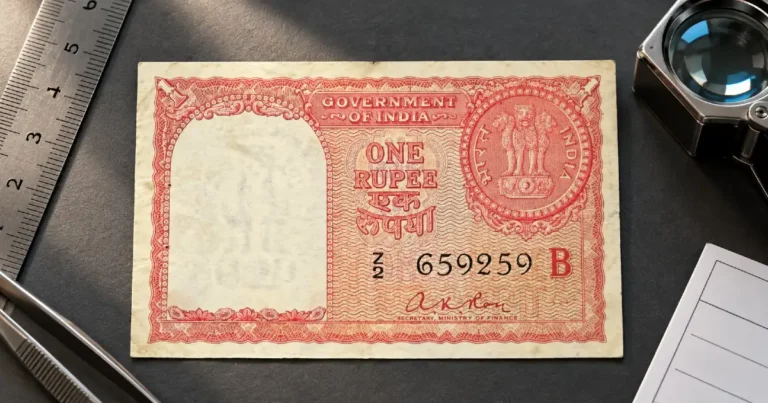
Republic India banknotes offer numerous collecting opportunities involving design revisions, signatures, and special serial-number patterns.
Within a common denomination, certain varieties may be far more desirable than standard examples.
Understanding banknote values is particularly useful when studying Republic India currency because small differences can distinguish readily obtainable notes from important collectible varieties.
Signatures, Prefixes, and Banknote Varieties
Recognizing the exact variety is often the most important step in understanding Indian banknote values. A denomination and approximate date may not provide sufficient information to establish how collectible a note really is.
Official Signatures
Government of India and Reserve Bank of India notes bear signatures of the relevant officials.
Some signatures are represented by numerous surviving notes, while others may be difficult to find on particular denominations or varieties.
The signature should always be considered together with the design and other identifying features rather than treated as an independent measure of rarity.
Serial-Number Prefixes
Prefixes may distinguish production sequences or identify special banknote issues. They are especially important where catalogue classifications depend partly on numbering arrangements.
A prefix that is rare on one denomination may be common on another. The correct comparison must therefore involve the exact note type.
For rare Indian banknotes, the combination of signature, issuing circle and prefix may be more important than any one of these features individually.
Design Variations
Inscriptions and other design elements changed over time, creating recognized collecting varieties.
Some differences are subtle and require careful comparison with specialist catalogues or authenticated examples.
Understanding banknote values involves distinguishing recognized design varieties from ordinary production differences and accidental defects.
Special Features That Can Increase Collector Interest
Some banknotes are desirable because of features beyond their standard denomination and issue variety. Fancy serial numbers, genuine printing errors, and specimen status can create additional collecting interest.
Fancy Serial Numbers
Fancy serial numbers contain distinctive numerical patterns such as solids, radars, repeaters, ladders and unusually low serial numbers.
For example, a six-digit number such as 333333 is a solid number, while 193391 is a radar, and 158158 is a repeater.
These patterns can attract collectors who specialize in serial-number combinations. The desirability of an individual note depends on its pattern, condition, denomination and the level of collector interest.
Read our Fancy Serial Numbers on Indian Banknotes guide for a detailed explanation.
Genuine Banknote Errors
Manufacturing errors may produce notes with missing printing, displaced designs, cutting irregularities or mismatched serial-number impressions.
Genuine printing errors can be desirable because of their unusual appearance and distinctive production history.
However, collectors should distinguish authentic manufacturing defects from ordinary circulation damage, design-level mistakes and artificially created alterations.
Our Indian Banknote Errors guide explains these distinctions in detail.
Specimen Banknotes
Specimen notes were prepared for official, institutional or reference purposes rather than ordinary circulation.
They may carry specimen overprints, distinctive serial-number arrangements or other identifying characteristics.
Authentic specimens of important historical issues can be attractive to specialist collectors. Their collectibility depends on the exact type, surviving rarity, condition, and authenticity of the specimen features.
Does Age or Denomination Determine Banknote Value?
Understanding banknote values also means recognizing that neither age nor denomination is a reliable measure of rarity on its own.
Older Does Not Always Mean Rarer
Age provides historical context, but it does not establish how many examples survive.
Some old banknotes were retained in substantial quantities. Others were heavily circulated, redeemed or destroyed, leaving relatively few surviving examples.
A more recent note from a genuinely scarce variety may therefore be more difficult to obtain than a considerably older but common issue.
Higher Denomination Does Not Automatically Mean Higher Value
The face value printed on a banknote represents its original monetary denomination, not its present numismatic scarcity.
A scarce historical 1 Rupee note may be highly desirable, while some higher-denomination issues may be relatively easy to obtain.
Conversely, certain historical high denominations are genuinely scarce and important because of their issuing circumstances or limited survival.
The exact issue and variety matter more than the denomination alone.
Demonetisation and Collector Value
Demonetisation may influence the surviving availability of certain banknotes when large quantities are returned and destroyed.
However, some withdrawn notes are retained in significant numbers, particularly when the public anticipates future collecting interest.
A demonetised note can be collectible, but the most desirable examples are generally those distinguished by genuine rarity, condition or other recognized characteristics.
Catalogue Values Versus Actual Market Value
Specialist catalogues are indispensable for identifying banknotes and researching their varieties. However, understanding banknote values requires distinguishing catalogue classifications from the prices that individual notes achieve in the marketplace.
The Role of Specialist Banknote Catalogues
Publications such as The Banknote Book and the Standard Catalog of World Paper Money provide information about issuing authorities, denominations, varieties, signatures and other identifying features.
These references help collectors determine exactly what they own before researching rarity and market demand.
Where catalogues provide values, these should be treated as reference estimates rather than guaranteed transaction prices.
Why Catalogue Values May Differ from Market Results
Published catalogue estimates may not immediately reflect changes in collector demand, newly discovered varieties or recent transactions.
For rare Indian banknotes that appear infrequently in the market, reliable comparisons may be limited.
Collectors should therefore use catalogues primarily for accurate identification and supplement them with relevant market evidence.
Auction Results, Dealer Prices and Market Evidence
A key part of understanding banknote values is distinguishing an advertised asking price from the amount a collector actually pays in a completed transaction.
Dealer Asking Prices
A dealer’s asking price reflects the amount at which a note is offered for sale. It may include acquisition costs, business expenses, inventory considerations and expectations about collector demand.
However, an advertised price does not establish that a buyer has agreed to pay that amount.
Collectors researching Indian banknote values should therefore consider asking prices alongside actual completed sales.
Completed Auction Results
Completed auctions provide evidence of transactions involving identifiable banknotes at particular points in time.
For meaningful comparisons, the denomination, catalogue variety, signature, prefix, condition and certification status should be as similar as possible.
An exceptional high-grade example may not provide a suitable comparison for a heavily circulated note of the same general type.
Hammer Prices and Buyer’s Premiums
The hammer price is the final accepted bid at an auction. Many auction houses charge a buyer’s premium in addition to the hammer price, while shipping fee, taxes and other fees may also apply.
Published results should therefore be interpreted consistently, with attention to whether the stated amount includes the buyer’s premium, as well as, the shipping fee of that particular auction house.
How to Estimate the Value of an Indian Banknote
Understanding banknote values becomes most useful when collectors apply that knowledge to an actual note. A practical valuation begins with accurate identification and progresses through condition, rarity, demand, and comparable market evidence.
Identify the Issuing Authority and Historical Period
Begin by identifying the issuing authority, general period, denomination, and design.
Determine whether the note belongs to British India, Republic India or another historical currency system associated with Indian monetary history.
Establish the Exact Catalogue Variety
Examine the signature, watermark, prefix, inscription, issuing circle, serial-number format and other relevant details.
Use specialist references to identify the exact variety before researching comparable transactions.
This is particularly important when learning how to value old Indian banknotes, because small design or administrative differences may distinguish genuinely scarce varieties.
Assess the Banknote’s Condition
Determine whether the note is Uncirculated, About Uncirculated, Extremely Fine, Very Fine or another appropriate grade.
Record any folds, tears, staining, repairs or other significant condition characteristics.
For certified notes, record the grading service, numerical grade and relevant label information.
Research Rarity and Demand
Investigate how often the exact variety appears in specialist collections, dealer inventories and auction records.
Consider whether the note belongs to a popular collecting category and whether particular signatures or grades are difficult to obtain.
Understanding banknote values requires considering surviving availability and collector demand together.
Find Comparable Completed Sales
Look for completed transactions involving the same variety in a similar condition.
Record the transaction date, grade, certification status and any relevant differences between the examples.
Where an exact comparison is unavailable, use related varieties cautiously and recognize that the resulting valuation may be less precise.
Consider Individual Differences
Even comparable notes can differ in eye appeal, restoration, certification, or other details that affect collector interest.
The objective is to arrive at a realistic assessment supported by the available evidence rather than relying on an isolated asking price.
Form a Reasonable Valuation
After identifying the note and reviewing comparable transactions, form an estimate reflecting its rarity, condition and current demand.
For widely traded varieties, several comparable sales may provide a useful range. For historically important or seldom-seen notes, specialist expertise may be particularly valuable.
This process is central to understanding banknote values and can be applied to both individual acquisitions and larger collections.
Practical Examples of Understanding Banknote Values
The following hypothetical examples illustrate how different valuation factors interact. They are intended to explain the process rather than represent specific current transactions.
Two Notes with Different Signatures
Suppose two early Republic India notes have the same denomination and principal design but different official signatures.
If one signature is represented by substantially fewer surviving examples, it may be more difficult to obtain and attract stronger specialist interest.
Comparing the notes solely by denomination would overlook this important variety distinction.
Two King George V Notes in Different Conditions
Consider two King George V banknotes with identical denominations, signatures, prefixes, and catalogue numbers.
One is heavily circulated, while the other is exceptionally well preserved.
The higher-grade example may be more desirable, especially when surviving notes in comparable condition are uncommon.
This illustrates how condition rarity can influence the value of the same historical issue.
A Modern Note with a Fancy Serial Number
Imagine a modern Republic India note bearing the six-digit solid serial number 888888.
The underlying issue may be common, but its distinctive numbering pattern can attract specialist collectors.
The appropriate comparison would involve similar fancy-number notes rather than ordinary examples of the same denomination.
A Rare British India Uniface Variety
Suppose a particular Government of India uniface variety has appeared only infrequently in documented sales.
Its scarcity and historical significance may make it attractive to specialist collectors, although limited transaction data can complicate valuation.
In such cases, accurate attribution, authentication and specialist market knowledge become especially important.
Professional Grading and Population Reports
Professional authentication and grading can provide useful information when researching Indian banknote values, particularly where the issue is scarce or the condition is difficult to assess.
How Third-Party Certification Helps Collectors
A professionally authenticated note may inspire greater buyer confidence, especially when dealing with important historical issues or complicated varieties.
Independent grading also provides a recognized condition reference, allowing collectors to compare examples more consistently.
For collectors of rare Indian banknotes, accurate authentication and attribution can be as important as the numerical grade itself.
Our Should You Submit Indian Banknotes to PMG? guide explains when professional certification may be worthwhile.
Using Population Reports
The PMG Population Report provides information about banknotes recorded in its certification database, grouped by issue and grade.
These figures can help collectors compare the relative availability of certified examples, particularly at higher grade levels.
However, population reports do not include every surviving banknote. Many examples remain uncertified, and additional submissions can change the recorded figures.
Population information is therefore most useful when considered alongside catalogue research, known surviving examples and collector demand.
Visit the official PMG Population Report for current certification data.
Are Indian Banknotes a Good Investment?
Indian banknotes can be attractive collectibles from both historical and investment perspectives. Rare issues, desirable varieties, exceptional grades and historically significant notes may appreciate in value as collector interest develops and quality examples become more difficult to acquire.
Unlike many modern collectibles, historical Indian banknotes are tangible pieces of monetary history. Their appeal extends beyond financial considerations, combining rarity, artistic craftsmanship, historical importance and the satisfaction of building a meaningful collection.
For collectors interested in long-term financial appreciation, understanding banknote values provides a foundation for recognizing which issues have genuine collecting significance.
Investment Potential of Rare Indian Banknotes
Scarce British India uniface notes, King George V issues, high-grade King George VI banknotes, British Burma banknotes, and other important historical varieties can attract strong interest from collectors in India and internationally.
The investment appeal of these notes often comes from the combination of limited surviving availability and sustained collector demand.
As collections develop and desirable examples enter long-term holdings, opportunities to acquire comparable notes may become less frequent.
Condition rarity can also be significant. A banknote that is relatively obtainable in circulated grades may be considerably more desirable in exceptional preservation, particularly when few comparable high-grade examples survive.
Building a Collection with Long-Term Value
Collectors interested in long-term appreciation should focus on genuine rarity, accurate identification, desirable varieties and good condition.
Researching signatures, prefixes, historical developments, and catalogue references can help identify banknotes with stronger collecting potential.
A carefully selected collection of important Indian paper money can provide years of enjoyment while also representing a tangible store of collectible value. For collectors seeking a passive investment, rare Indian banknotes offer the opportunity for long-term appreciation without requiring active day-to-day management.
As with other collecting markets, individual results depend on acquisition price, condition and future demand. Nevertheless, historical significance, limited supply and an established international collecting community make rare Indian banknotes an appealing field for collectors who appreciate both cultural and financial rewards.
For additional perspectives on the pleasures and benefits of collecting, read our Why Collect Indian Banknotes? guide.
Common Mistakes When Assessing Banknote Values
Understanding banknote values becomes easier when collectors recognize common misconceptions that can lead to inaccurate identification or unrealistic expectations.
- Assuming old means valuable: Age does not establish surviving rarity or collector demand.
- Assuming higher denominations are always rarer: The face value is not a reliable measure of collectible value.
- Relying on a single asking price: An advertised price does not necessarily reflect a completed transaction.
- Ignoring signatures and varieties: Small differences can distinguish scarce issues from common examples.
- Assuming every unusual serial number is desirable: Collector interest differs among numerical patterns.
- Confusing damage with genuine errors: Artificial alterations and ordinary wear should not be treated as authentic printing mistakes.
- Assuming professional certification creates rarity: Grading can provide authentication and condition information but does not change the original issue’s scarcity.
- Overlooking condition: Folds, staining, repairs and other defects can influence desirability.
The most effective approach is to identify the exact banknote, establish its rarity, assess its condition, and study relevant transactions within the collecting market.
Conclusion: Understanding Banknote Values and Collectibility
Understanding banknote values requires more than recognizing an old design or finding an impressive online asking price. Reliable evaluation depends on identifying the exact variety, understanding rarity and condition, assessing collector demand, and comparing meaningful market evidence.
Indian paper money offers an especially rich collecting field because of its different issuing authorities, historical periods, official signatures, prefixes, serial numbers, and special currency issues.
The same denomination may include both readily obtainable examples and varieties that are exceptionally difficult to find. Accurate identification is therefore one of the most valuable skills a collector can develop.
Condition and professional certification can influence desirability, while historical significance and collector demand help explain why certain issues attract lasting attention.
By combining specialist catalogues, historical research, careful grading and completed market transactions, collectors can develop a realistic understanding of the value of individual Indian banknotes.
Most importantly, understanding banknote values allows collectors to recognize genuine rarity, appreciate the historical importance of their notes and make informed acquisitions. A well-researched collection can provide lasting enjoyment, personal satisfaction and the potential for long-term financial appreciation.
Frequently Asked Questions About Indian Banknote Values
What determines the value of an Indian banknote?
Indian banknote values depend on the exact issue and variety, rarity, condition, collector demand, authenticity, and historical significance. Signatures, prefixes and genuine special features may also influence collectibility.
Why is understanding banknote values important for collectors?
Understanding banknote values helps collectors identify scarce varieties, compare condition, recognize desirable characteristics, and make informed decisions when buying or selling Indian paper money. It also helps distinguish genuine collecting significance from unsupported price claims.
How can I find out what an old Indian banknote is worth?
Identify the issuing authority, denomination, signature, prefix and catalogue variety. Assess the note’s condition, then compare completed transactions involving similar examples. Specialist assistance may be useful for particularly scarce or unusual notes.
Are old Indian banknotes always valuable?
No. Age alone does not establish rarity. Some historical banknotes survive in considerable numbers, while particular varieties of more recent issues can be difficult to obtain. Condition and collector demand are also important.
Are rare Indian banknotes valuable?
Rare Indian banknotes can be highly desirable, especially when genuine scarcity is combined with historical importance, good condition and sustained collector demand. Their relative collectibility depends on the exact issue and variety.
Why can two banknotes of the same denomination have different values?
They may differ in signature, watermark, prefix, design variety, condition or authenticity. Even notes belonging to the same general issue can have substantially different rarity and collecting characteristics.
Does a higher grade make a banknote more valuable?
For otherwise identical examples, better preservation generally improves collector desirability. However, the extent of the premium depends on the rarity of the issue and how easily comparable notes can be found in the same grade.
Are catalogue values the same as market prices?
No. Catalogue estimates provide reference information, while market prices reflect actual transactions under particular conditions. Completed sales of comparable authenticated notes can provide useful evidence of current demand.
What is the difference between auction hammer price and total purchase cost?
The hammer price is the final accepted bid. Published auction results may include the buyer’s premium but generally exclude shipping, insurance, customs duties, and other charges. Therefore, the buyer’s actual total cost may be higher than the published auction result.
Do fancy serial numbers increase Indian banknote values?
Some fancy serial numbers attract collector premiums, particularly recognizable patterns such as solids, radars, repeaters and ladders. Desirability depends on the specific pattern, denomination, condition and collector demand.
Does PMG grading increase the value of Indian banknotes?
PMG certification may improve buyer confidence in authenticity, attribution and condition. It can be especially useful for valuable historical notes, but any effect on market value depends on the underlying issue, assigned grade and collector demand.
Are Indian banknotes a good investment?
Rare Indian banknotes can offer attractive long-term collecting and investment potential, particularly when they combine historical significance, genuine scarcity, strong condition, and sustained collector demand. Careful selection and knowledge of individual varieties are important for building a valuable collection.