
HISTORIC INDIAN OVERSEAS CURRENCY
Persian Gulf Rupees
Explore Persian Gulf Rupees issued in 1959, including four Indian banknote denominations, distinctive colours, Z-prefix serial numbers, signatures and collectible varieties.
COLLECTING GULF RUPEE CURRENCY
Discover Persian Gulf Rupee Banknotes
Persian Gulf Rupees represent a distinctive chapter in Indian monetary history. Introduced on 11 May 1959, these special banknotes were issued for circulation in parts of the Persian Gulf rather than within India. They retained familiar Indian Ashoka Pillar designs while introducing different colours and Z-prefix serial numbers to identify the external currency issue.
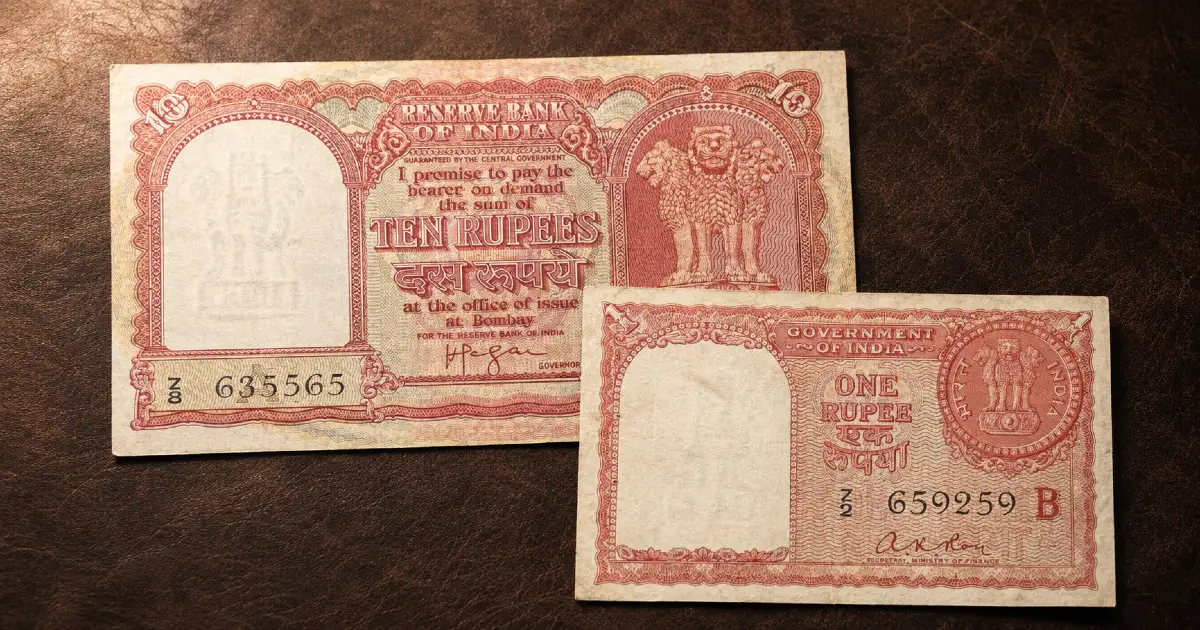
The series comprised four denominations: 1 Rupee, 5 Rupees, 10 Rupees and 100 Rupees. The Government of India issued the 1 Rupee note, while the Reserve Bank of India was responsible for the three higher denominations. Although initially equal in value to the Indian rupee, the special Gulf notes were not legal tender within India.
These banknotes circulated in Kuwait, Bahrain, Qatar, the Trucial States and Muscat and Oman. Indian currency had long played an important role in regional trade and banking, and the special Gulf issue allowed that monetary relationship to continue under separate exchange-control arrangements.
For collectors, Gulf Rupee banknotes offer a clearly defined four-denomination series with distinctive colours, signatures, watermarks and documented serial-number prefixes. Their association with the monetary development of the modern Gulf states adds historical significance beyond their Indian origins.
IndiaBanknotes specializes in historical Indian and related overseas paper money, including Persian Gulf Rupees and professionally certified examples. This page explores their history, principal denominations, identifying characteristics and collecting appeal.
OUR COLLECTION
Explore Persian Gulf Rupees for Sale
Discover collectible 1959 Gulf Rupee banknotes, including all four denominations, Z-prefix varieties and professionally certified examples.
Browse available Persian Gulf Rupees, including different denominations, serial number prefixes, collectible varieties and professionally graded examples. Our inventory changes as individual notes and collections are acquired or sold.
HISTORY & DEVELOPMENT
History of the Persian Gulf Rupee
How Indian currency became established in the Gulf, why a special issue was introduced and how it was gradually withdrawn.
Indian Currency in the Persian Gulf
Indian currency circulated in the Persian Gulf long before the introduction of the special Gulf Rupee notes. Centuries of maritime trade across the Arabian Sea connected Indian merchants, trading communities and financial institutions with ports in Kuwait, Bahrain, Muscat and other Gulf settlements.
During the British colonial period, commercial relationships were reinforced by political and administrative connections between British India and several Gulf territories. Indian rupees became widely accepted for commercial transactions, wages, remittances and banking operations.
The arrangement continued after Indian independence in 1947. By the 1950s, ordinary Indian rupee banknotes were circulating in Kuwait, Bahrain, Qatar, the Trucial States and Muscat and Oman, even though these territories had different political arrangements and developing monetary needs.
Why India Introduced a Separate Gulf Rupee
During the 1950s, India faced increasing pressure on its foreign exchange reserves. Rupees circulating in the Gulf could be presented through banking channels for redemption in foreign currency, creating concerns about overseas currency holdings and India’s exchange-control arrangements.
Differences in gold prices and foreign exchange restrictions also encouraged arbitrage involving Indian currency and Gulf markets. The authorities sought to limit the potential misuse of these arrangements without disrupting established trade and banking relationships.
The solution was to distinguish Indian rupees circulating overseas from those used domestically. The Reserve Bank of India’s historical overview of Persian Gulf issues explains the monetary circumstances behind this decision.
Introduction of the Persian Gulf Rupees in 1959
On 11 May 1959, India introduced a special external currency series comprising 1, 5, 10 and 100 Rupees banknotes. These retained the principal designs of contemporary Indian Ashoka Pillar notes but used distinctive colours and serial-number prefixes beginning with the letter Z.
The Gulf Rupee was initially maintained at parity with the Indian rupee, allowing regional transactions to continue using a familiar monetary unit. However, the special notes were intended exclusively for external circulation and were not legal tender in India.
The series involved two issuing authorities. The Government of India issued the 1 Rupee note signed by A. K. Roy, while the Reserve Bank of India issued the 5, 10 and 100 Rupees denominations bearing the signature of Governor H. V. R. Iyengar.
The notes were produced at the India Security Press in Nasik. Using established designs made the special issue practical to manufacture, while the different colours, Z-prefixes and modified promise clauses helped distinguish the Gulf notes from ordinary Indian currency.
How Persian Gulf Rupees Differed from Indian Notes
The special Z-prefix serial numbers are among the most recognizable features of Gulf Rupee banknotes. Each denomination was assigned its own documented prefix range, allowing collectors to identify the external issue and study differences in production.
Colour also provided an immediate distinction. The 1 Rupee Gulf note was red rather than grey-blue, the 5 Rupees was orange rather than green, the 10 Rupees was red-orange rather than violet, and the 100 Rupees was predominantly green rather than blue.
On the Reserve Bank of India denominations, the promise clause referred specifically to payment at the office of issue at Bombay. This wording differed from the ordinary domestic notes and reflected the special external currency arrangements.
Collectors should examine these features together with the signature, watermark, printing characteristics and underlying design. A Z-prefix alone should not be treated as sufficient evidence of authenticity.
Withdrawal of the Gulf Rupee
The Persian Gulf Rupee was gradually replaced as individual Gulf territories established their own monetary systems. Kuwait introduced the Kuwaiti Dinar in 1961, followed by Bahrain with the Bahraini Dinar in 1965.
India’s rupee devaluation in June 1966 accelerated monetary changes elsewhere in the Gulf. Qatar and Dubai adopted the Qatar-Dubai Riyal in September 1966, while other Trucial States used different currency arrangements during the transition.
Muscat and Oman continued with rupee-based currency arrangements until introducing a separate rial in 1970. The United Arab Emirates, formed in 1971, subsequently introduced the UAE Dirham in 1973, completing another important stage in the region’s monetary development.
The Gulf Rupee was therefore withdrawn progressively rather than on one uniform date. Its history reflects the emergence of separate Gulf monetary institutions and the declining role of Indian-issued currency in regional circulation.
The Historical Legacy of the Gulf Rupee
The Persian Gulf Rupee illustrates the historical importance of Indian currency beyond India’s borders. Issued by Indian authorities but intended for overseas circulation, the notes preserve evidence of the commercial and financial relationships that connected India with the Arabian Peninsula.
For collectors, the four-denomination series combines familiar Republic India designs with a distinct geographical purpose, limited circulation history and recognizable identification features. These characteristics make Gulf Rupees relevant to both Indian and Middle Eastern paper money collections.
DENOMINATIONS & VARIETIES
Persian Gulf Rupees by Denomination
Discover the four official 1959 issues and their principal identifying characteristics.
The Persian Gulf series comprises four principal catalogue types, each based on a contemporary Indian Ashoka Pillar design. The references below use The Banknote Book and the Standard Catalog of World Paper Money’s Pick numbering system.
1 Rupee Persian Gulf Banknote
The Persian Gulf 1 Rupee note is catalogued as BR101 / Pick R1. Issued by the Government of India, it retained the contemporary Indian One Rupee design but was printed in a distinctive red colour rather than the domestic grey-blue.
The front features the Lion Capital of Ashoka, denomination inscriptions and the signature of A. K. Roy. The reverse incorporates the Indian 1 Rupee coin design dated 1957 and a multilingual denomination panel.
The banknote measures approximately 101 × 64 millimetres and features an Ashoka Pillar watermark without a security thread. Its serial numbers are black, with an inset letter B and documented prefixes from Z/0 to Z/29.
This denomination is particularly significant because it was issued directly by the Government of India rather than the RBI. It provides an important foundation for a complete four-note Gulf Rupee collection.
5 Rupees Persian Gulf Banknote
The Persian Gulf 5 Rupees note is catalogued as BR201 / Pick R2. Based on the green domestic Indian 5 Rupees design, the special Gulf version features a distinctive orange and purple colour scheme.
The front displays the Lion Capital of Ashoka and the signature of RBI Governor H. V. R. Iyengar. The reverse features six antelopes in an open field, together with the RBI tiger-and-palm-tree seal and denomination inscriptions.
Measuring approximately 128 × 73 millimetres, the banknote includes a solid security thread and Ashoka Pillar watermark. Its serial numbers are black, with documented Z-prefixes extending from Z/0 to Z/16.
The colourful wildlife design makes this denomination popular among collectors of animal-themed banknotes and historical Republic India currency varieties.
10 Rupees Persian Gulf Banknote
The Persian Gulf 10 Rupees note is catalogued as BR202 / Pick R3. It retained the contemporary Indian Ashoka Pillar design but was issued in a red-orange colour scheme rather than the violet associated with the domestic note.
The front features the Lion Capital of Ashoka and the signature of H. V. R. Iyengar. Its reverse depicts a dhow sailing near a coastline, with palm trees, distant mountains and the RBI seal.
The banknote measures approximately 145 × 81 millimetres and includes a solid security thread and Ashoka Pillar watermark. Its black serial numbers use documented Z-prefixes ranging from Z/0 to Z/25.
The maritime illustration is especially appropriate to the Gulf issue, reflecting the longstanding commercial and seafaring connections between India and the Arabian Peninsula.
100 Rupees Persian Gulf Banknote
The Persian Gulf 100 Rupees note is the highest denomination of the series, catalogued as BR203 / Pick R4. It was based on the contemporary Indian 100 Rupees Ashoka Pillar design but issued in a predominantly green colour scheme instead of the domestic blue.
The front features the Lion Capital of Ashoka and the signature of Governor H. V. R. Iyengar. The reverse depicts two tusked elephants in a forest, together with the RBI seal and multilingual denomination panel.
Measuring approximately 170 × 107 millimetres, the note includes a solid security thread and Ashoka Pillar watermark. Its serial numbers are printed in red, with recorded Z-prefixes extending from Z/0 to Z/5.
The 100 Rupees denomination has the narrowest documented prefix range of the four Gulf issues. Its higher face value, distinctive elephant design and relative scarcity make authenticity, originality and condition particularly important when assessing examples.
THE COLLECTING APPEAL
Why Collect Persian Gulf Rupees?
Discover the historical, artistic and specialist appeal of India’s distinctive external currency issues.
Indian and Gulf Monetary History
Persian Gulf Rupees document an important period when Indian currency served overseas trade and banking. Their history connects India’s monetary administration with the emergence of separate currencies across the Gulf.
A Complete Four-Note Collection
The series offers a clearly defined collecting objective comprising 1, 5, 10 and 100 Rupees. Collectors can pursue a representative denomination set, well-preserved examples or specialist varieties.
Distinctive Z-Prefix Banknotes
The special Z-prefix identifies the external Gulf currency issue rather than replacement notes. Each denomination has documented ranges, making serial-number research an important part of collecting.
Special Colours and Designs
Gulf Rupees feature distinctive colour schemes based on Indian Ashoka Pillar banknotes. Their reverse illustrations include antelopes, a sailing dhow and elephants, appealing to wildlife and maritime collectors.
Government of India and RBI Signatures
The 1 Rupee note carries the signature of Government of India official A. K. Roy, while the three higher denominations bear the signature of RBI Governor H. V. R. Iyengar.
Authentication and Identification
Collectors should examine the correct denomination, colour, Z-prefix, signature and security features. The Bombay office wording on the RBI denominations provides an additional identification characteristic.
PMG Graded Gulf Rupees
Professional certification can provide independent authentication and standardized condition assessment. This is particularly useful when collecting scarce denominations or exceptionally well-preserved examples.
Rarity & Condition
Scarcity varies across the four denominations and individual prefix ranges. Original paper quality, folds, stains, repairs and preservation can significantly influence collector desirability.
EXPLORE RELATED PAPER MONEY
Related Banknote Collections & Guides
Explore Indian banknote collections and specialist resources connected with the Persian Gulf Rupee.
Republic India Banknotes
Explore the Ashoka Pillar series that provided the original designs for the Gulf Rupees, including historical denominations, signatures, watermarks and collectible varieties.
Explore Republic India Banknotes →British India Banknotes
Discover the earlier development of Indian paper money, including Government of India notes and royal portrait issues that preceded the Republic India currency designs.
Explore British India Banknotes →PMG Graded Banknotes
Explore professionally certified Indian and related paper money, including authentication, grading and the importance of original paper quality for historical banknotes.
Explore PMG Graded Banknotes →COMMON COLLECTOR QUESTIONS
Persian Gulf Rupees FAQs
Answers to common questions about the 1959 Gulf Rupee banknotes, their history and collecting characteristics.
What are Persian Gulf Rupees?
Persian Gulf Rupees were special Indian banknotes introduced on 11 May 1959 for circulation in certain Gulf territories. They were based on contemporary Indian designs but featured distinctive colours and Z-prefix serial numbers. They were not legal tender within India.
Why did India issue Gulf Rupee banknotes?
India introduced the special notes to distinguish external rupee circulation from domestic Indian currency. This supported foreign exchange controls while allowing trade and banking in the Gulf to continue using a familiar rupee-based system.
What denominations were issued as Persian Gulf Rupees?
The four denominations were 1, 5, 10 and 100 Rupees. Their catalogue references are Pick R1 through R4, corresponding to Banknote Book references BR101, BR201, BR202 and BR203.
Who issued the Persian Gulf Rupee notes?
The Government of India issued the 1 Rupee denomination, signed by A. K. Roy. The Reserve Bank of India issued the 5, 10 and 100 Rupees notes bearing the signature of Governor H. V. R. Iyengar.
What does the Z-prefix mean on Gulf Rupee notes?
The Z-prefix identifies the special currency intended for circulation in the Persian Gulf. It was not a replacement-note designation. Individual denominations had different authorized serial-prefix ranges.
How are Gulf Rupees different from ordinary Indian banknotes?
Gulf Rupees retained contemporary Indian designs but featured distinctive colours and Z-prefix serial numbers. The RBI denominations also carried special promise-clause wording referring to the Bombay office of issue.
Where did Persian Gulf Rupees circulate?
The special notes circulated in Kuwait, Bahrain, Qatar, the Trucial States and Muscat and Oman. These territories subsequently adopted separate national or regional currency arrangements.
When were Persian Gulf Rupees withdrawn?
Withdrawal occurred progressively. Kuwait introduced its dinar in 1961, Bahrain followed in 1965, Qatar and Dubai adopted a joint riyal in 1966, and Muscat and Oman introduced a separate rial in 1970.
Are Persian Gulf Rupees valuable?
Collector values depend on denomination, authenticity, serial-prefix variety, rarity and condition. The 100 Rupees issue is particularly challenging, while well-preserved examples of other denominations may also attract specialist interest.
Can Persian Gulf Rupees be PMG graded?
Yes. Persian Gulf Rupees can be submitted for professional authentication and grading. Certification may provide additional confidence when evaluating rare or valuable historical banknotes.
Does IndiaBanknotes buy Persian Gulf Rupees?
IndiaBanknotes considers collectible Persian Gulf Rupees, including all four denominations, scarce varieties and professionally graded examples. Contact us with clear photographs, serial numbers and available catalogue information.
Looking for a Specific Persian Gulf Rupee Note?
Share your want list with our specialists, including the denomination, Z-prefix, catalogue reference or preferred grade. We welcome enquiries about Persian Gulf Rupees and collectible 1959 external currency issues.
Submit Your Want List →Collect Persian Gulf Rupees?
Explore available Gulf Rupee banknotes, including the four official denominations, Z-prefix varieties and professionally certified examples.
Want to Sell Gulf Rupee Notes?
We consider collectible Persian Gulf Rupees, scarce denominations and specialist historical Indian paper money collections.