
1948 PAKISTAN PROVISIONAL ISSUES
Pakistan Overprint Banknotes
Explore Pakistan overprint banknotes issued in 1948, featuring King George VI portraits, Government of Pakistan inscriptions, five denominations and collectible varieties.
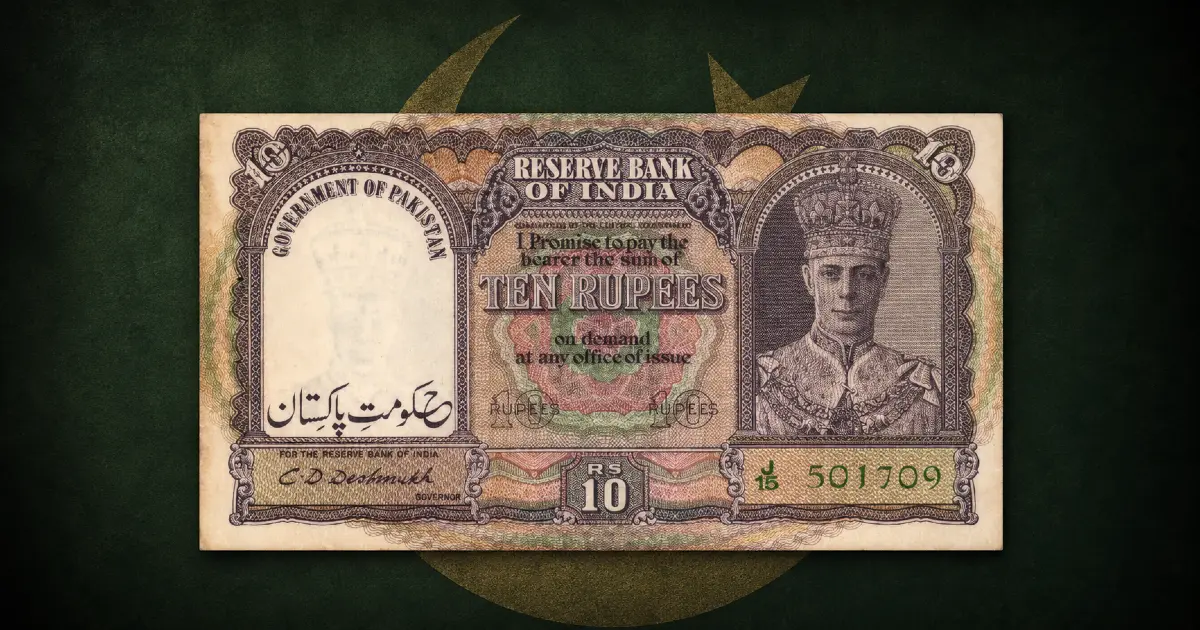
COLLECTING EARLY PAKISTAN CURRENCY
Discover Pakistan King George VI Banknotes
Pakistan overprint banknotes represent an important transitional issue in the monetary history of the Indian subcontinent. Introduced on 1 April 1948, these notes were prepared for the newly independent Dominion of Pakistan using existing British India designs featuring King George VI. They provided a temporary currency solution while Pakistan developed its own central banking and banknote-issuing arrangements.
Although commonly called Pakistan overprint banknotes, genuine examples are more accurately described as Pakistan inscribed banknotes. The English and Urdu Government of Pakistan inscriptions were incorporated into amended printing plates at the India Security Press, Nasik, rather than stamped onto completed Indian banknotes.
The provisional series comprised five denominations: 1, 2, 5, 10 and 100 Rupees. The 1 Rupee note was based on a Government of India issue, while the higher denominations used Reserve Bank of India designs. All retained Indian official signatures, providing a direct connection between the monetary histories of British India and Pakistan.
For collectors, these banknotes combine the historical significance of Partition with distinctive inscriptions, King George VI portraits and recognized catalogue varieties. Authentication is particularly important because genuine Indian banknotes have sometimes been altered with imitation Pakistan inscriptions.
IndiaBanknotes specializes in historical Indian and related colonial paper money, including Pakistan provisional issues, scarce denominations and professionally certified examples. This page introduces the five denominations, their identifying characteristics and their collecting significance.
OUR COLLECTION
Explore Pakistan Overprint Banknotes for Sale
Discover collectible 1948 King George VI provisional issues, including scarce denominations, genuine Government of Pakistan inscriptions and professionally certified examples.
Browse available Pakistan King George VI provisional banknotes, including all five denominations, recognized varieties and professionally graded examples. Our inventory changes as individual notes and collections are acquired or sold.
HISTORY & DEVELOPMENT
History of Pakistan Overprint Banknotes
How Partition and temporary monetary arrangements led to Pakistan’s first provisional banknotes.
Partition of British India in 1947
The Partition of British India in August 1947 created the independent dominions of Pakistan and India. Pakistan became independent on 14 August, followed by India on 15 August. The new Dominion of Pakistan comprised geographically separated territories in the northwest and east of the former British India.
Before independence, these regions shared a common monetary system. The Government of India issued the 1 Rupee note, while the Reserve Bank of India was responsible for higher denominations. Pakistan consequently inherited currency arrangements and financial institutions developed under British Indian administration.
Establishing an entirely new currency series required approved designs, security printing arrangements, banknote production and distribution. With limited preparation time, the continued use of Indian currency provided a practical solution to Pakistan’s immediate monetary requirements.
Temporary Currency Arrangements with India
The Pakistan (Monetary System and Reserve Bank) Order, 1947 established the legal framework for temporary monetary arrangements following Partition. Under this system, the Reserve Bank of India continued to perform central banking and currency-related functions for Pakistan during the transitional period.
Ordinary Indian banknotes initially remained in circulation in Pakistan. The authorities subsequently arranged for specially prepared Indian designs carrying Government of Pakistan inscriptions, distinguishing the provisional notes intended for Pakistan from ordinary Indian currency.
The Reserve Bank of India ceased acting as Pakistan’s central bank on 30 June 1948. The State Bank of Pakistan commenced operations on 1 July 1948, establishing Pakistan’s independent central banking institution.
Introduction of the 1948 Provisional Banknotes
On 1 April 1948, five denominations of specially inscribed banknotes were introduced for Pakistan: 1, 2, 5, 10 and 100 Rupees. They retained the established Indian designs, including King George VI portraits, original signatures and familiar security features.
The English inscription GOVERNMENT OF PAKISTAN appeared near the upper portion of the front watermark area, while the corresponding Urdu inscription appeared below. These inscriptions identified the banknotes as currency prepared for Pakistan.
The 1 Rupee retained the Government of India design signed by C. E. Jones. The 2, 5, 10 and 100 Rupees notes retained Reserve Bank of India designs bearing the signature of Governor C. D. Deshmukh. All five denominations are important examples of transitional currency following independence.
Pakistan Overprints and Amended Printing Plates
The expression Pakistan overprint banknotes is widely used by collectors and dealers, but the genuine provisional issues were produced using amended printing plates. Their Government of Pakistan inscriptions formed part of the printing process rather than being added to finished Indian notes as conventional overprints.
This manufacturing distinction matters because counterfeit Pakistan inscriptions have been applied to genuine Indian King George VI banknotes. An authentic underlying Indian note does not establish that the Pakistan inscription is genuine.
Collectors should therefore examine the original banknote type, authorized prefix range, inscription colour, typography, alignment and printing characteristics. Suspicious or particularly valuable examples may require independent authentication.
The State Bank of Pakistan and New Currency Issues
Following the establishment of the State Bank of Pakistan in July 1948, the country progressively introduced its own national currency designs. New emergency notes in denominations of 5, 10 and 100 Rupees appeared in October 1948, followed by additional national issues.
These developments reduced Pakistan’s reliance on the provisional Indian-derived series. The five King George VI provisional denominations were demonetised on 1 January 1952, bringing their brief monetary role to an end.
Historical Significance of the Provisional Series
Pakistan’s King George VI provisional banknotes are historically distinctive because they were issued for an independent country while retaining the designs and official signatures of the former British Indian monetary administration.
The series provides a direct connection between British India and Pakistan’s early currency history. For collectors, it illustrates how established banknote designs could be adapted through authorized production changes during a period of political and monetary transition.
DENOMINATIONS & VARIETIES
Pakistan King George VI Banknotes by Denomination
Discover the five official 1948 provisional issues and their principal identifying characteristics.
The provisional series comprised five denominations based on Government of India and Reserve Bank of India designs. The catalogue references below follow the Pick numbering system and The Banknote Book. Detailed serial-prefix ranges are intentionally reserved for specialist identification research.
1 Rupee Banknotes
The Pakistan King George VI 1 Rupee note is catalogued as B101 / Pick 1. It retained the Government of India design bearing the 1940 coin date and the signature of C. E. Jones, Secretary to the Finance Department.
The front features King George VI on a printed coin illustration, together with Government of Pakistan inscriptions in the watermark area. The reverse incorporates the 1940 coin design and a multilingual denomination panel.
Its compact format, blue-grey colour scheme, King George VI watermark and absence of a security thread distinguish it from the higher denominations. Collectors should also examine the serial prefix and inscription characteristics when assessing authenticity.
2 Rupees Banknotes
The Pakistan King George VI 2 Rupees note, catalogued as B102 / Pick 1A, retained the Reserve Bank of India’s profile portrait design and the signature of Governor C. D. Deshmukh.
The note has a lilac colour scheme and carries the Government of Pakistan inscriptions in the front watermark area. Its reverse features the Reserve Bank of India tiger-and-palm-tree seal, together with denomination inscriptions.
The banknote has a King George VI watermark but no security thread. Collectors should distinguish genuine Pakistan inscriptions from later additions to ordinary Indian 2 Rupees notes, particularly when examining scarce or well-preserved examples.
5 Rupees Banknotes
The Pakistan King George VI 5 Rupees note is catalogued as B103 / Pick 2. It retained the RBI’s frontal portrait design and the signature of C. D. Deshmukh.
The predominantly green banknote features Government of Pakistan inscriptions on the front and three antelopes on the reverse, alongside the RBI seal. Its design is one of the most recognizable wildlife illustrations of the King George VI period.
The note includes a solid security thread and King George VI watermark. Collectors consider its inscription characteristics, serial prefix, originality and condition when identifying and evaluating individual examples.
10 Rupees Banknotes
The Pakistan King George VI 10 Rupees note, catalogued as B104 / Pick 3, retained the frontal portrait of King George VI and the signature of RBI Governor C. D. Deshmukh.
The front incorporates the Government of Pakistan inscriptions within a multicoloured design. The reverse depicts a dhow sailing near a coastal landscape, accompanied by the Reserve Bank of India seal and denomination information.
Its security features include a solid security thread and King George VI watermark. The denomination is particularly interesting to collectors of maritime banknote designs and the monetary history of the Partition era.
Authorized serial-prefix ranges are important for authenticating the 10 Rupees issue. Collectors should examine the complete prefix and serial number alongside the original banknote type and inscription printing rather than relying on the appearance of the Pakistan wording alone.
100 Rupees Banknotes
The Pakistan King George VI 100 Rupees note, catalogued as B105 / Pick 3A, is the highest denomination of the provisional series. It retained the Reserve Bank of India’s profile portrait design and the signature of Governor C. D. Deshmukh.
The front features King George VI and elaborate security printing with Government of Pakistan inscriptions incorporated into the watermark area. The reverse depicts a roaring Bengal tiger, together with a multilingual denomination panel and the Reserve Bank of India seal.
The note includes a solid security thread and King George VI watermark. Its high denomination, historical significance and limited authorized serial-prefix ranges make careful authentication particularly important.
Collectors should examine the underlying Indian banknote variety, complete serial prefix, inscription characteristics and physical condition. Counterfeit Pakistan inscriptions applied to genuine Indian 100 Rupees notes present a significant authentication concern.
THE COLLECTING APPEAL
Why Collect Pakistan Overprint Banknotes?
Discover the historical and numismatic appeal of the 1948 King George VI provisional issues.
Partition and Monetary History
Pakistan overprint banknotes document the monetary consequences of Partition. They reflect the challenges faced by a newly independent country establishing its own currency system while temporarily relying on existing Indian monetary institutions.
King George VI Portrait Banknotes
All five provisional denominations retain King George VI imagery inherited from British India. The series includes both profile and frontal portraits, providing an interesting connection to British Commonwealth and royal portrait collecting.
Government of Pakistan Inscriptions
The English and Urdu Government of Pakistan inscriptions are the defining feature of the provisional series. Their incorporation into amended printing plates distinguishes genuine Pakistan issues from ordinary Indian currency.
Government of India and RBI Issues
The five denominations represent two original issuing authorities. The 1 Rupee retained the Government of India design, while the four higher denominations retained Reserve Bank of India designs and signatures.
Signatures and Serial Number Prefixes
The signatures of C. E. Jones and C. D. Deshmukh, together with authorized prefix ranges, help identify genuine provisional issues. These characteristics provide important evidence when assessing potentially altered banknotes.
Counterfeit Inscription Detection
Some counterfeit Pakistan notes begin with genuine Indian banknotes. Incorrect inscriptions, inappropriate printing characteristics and unauthorized prefixes are warning signs, making careful examination essential.
PMG Graded Banknotes
Professional certification can assist collectors in evaluating the authenticity and condition of Pakistan provisional issues. Independent grading is particularly useful for scarce denominations and important historical examples.
Rarity & Condition
Scarcity varies by denomination and preservation. Higher denominations and exceptionally well-preserved examples can be challenging to obtain, while originality, folds, stains, repairs and other condition factors influence collector interest.
EXPLORE RELATED PAPER MONEY
Related Banknote Collections & Guides
Explore the original Indian currency designs, related colonial issues and specialist collecting categories connected with Pakistan’s early paper money.
British India Banknotes
Explore the Government of India and Reserve Bank of India currency series, including historical denominations, signatures, issuing circles and varieties that formed the basis of Pakistan’s provisional notes.
Explore British India Banknotes →King George VI Banknotes
Discover the original King George VI portrait designs, including profile and frontal issues, watermarks, signatures and denominations used in British India, Burma and Pakistan.
Explore King George VI Banknotes →British Burma Banknotes
Compare Pakistan’s plate-inscribed provisional currency with the official Burma overprints, alongside the separate Peacock Series and other transitional banknotes.
Explore British Burma Banknotes →PMG Graded Banknotes
Explore professionally certified historical paper money and learn how independent authentication, grading and original paper quality assessments assist collectors of valuable issues.
Explore PMG Graded Banknotes →COMMON COLLECTOR QUESTIONS
Pakistan Overprint Banknotes FAQs
Answers to common questions about the 1948 provisional issues, Government of Pakistan inscriptions and collectible varieties.
What are Pakistan overprint banknotes?
Pakistan overprint banknotes is a common collecting term for the 1948 King George VI provisional issues prepared using Indian banknote designs. Genuine examples are more accurately described as Pakistan inscribed banknotes because their inscriptions were incorporated into amended printing plates.
When were Pakistan King George VI banknotes issued?
The five provisional denominations were introduced on 1 April 1948, following the Partition of British India in August 1947. They provided a temporary currency solution while Pakistan established its own monetary institutions.
What denominations were issued in the 1948 Pakistan provisional series?
The official series comprised five denominations: 1, 2, 5, 10 and 100 Rupees. The 1 Rupee was based on Government of India currency, while the other four denominations retained Reserve Bank of India designs.
Are Pakistan overprint banknotes genuine overprints?
Not in the conventional printing sense. Their Government of Pakistan inscriptions were incorporated into amended printing plates during production, rather than being applied to completed Indian notes through a separate overprinting operation.
Who signed the 1948 Pakistan banknotes?
The 1 Rupee retained the signature of C. E. Jones, while the 2, 5, 10 and 100 Rupees notes retained the signature of RBI Governor C. D. Deshmukh. These Indian signatures are original features of the genuine provisional series.
Why do Pakistan provisional notes feature King George VI?
Pakistan used existing British India designs because new national banknotes could not be prepared immediately after independence. The provisional notes retained the King’s portrait while carrying Government of Pakistan inscriptions identifying their intended circulation.
How can collectors identify genuine Pakistan inscriptions?
Important checks include the original banknote type, authorized prefix range, inscription colour, placement, typography and printing quality. Because counterfeit inscriptions can appear on genuine Indian notes, professional authentication may be appropriate for valuable examples.
When were Pakistan King George VI provisional notes demonetised?
The five provisional denominations were demonetised on 1 January 1952, after Pakistan had established its own central bank and introduced separate national currency designs.
Are Pakistan overprint banknotes valuable?
Collector values depend on denomination, authenticity, catalogue variety, recognized serial-prefix range, rarity and physical condition. Scarce denominations and well-preserved examples may attract considerable specialist interest.
Can Pakistan King George VI banknotes be PMG graded?
Yes. Genuine Pakistan provisional banknotes may be submitted for professional authentication and grading. Certification can provide additional confidence when evaluating scarce or difficult-to-authenticate examples.
Does IndiaBanknotes buy Pakistan overprint banknotes?
IndiaBanknotes considers collectible Pakistan King George VI provisional banknotes, including all five denominations and professionally certified examples. Contact us with clear photographs, complete serial numbers and available catalogue information.
Looking for a Specific Pakistan Overprint Banknote?
Share your want list with our specialists, including the denomination, catalogue reference, serial number prefix or preferred grade. We welcome enquiries about genuine 1948 Pakistan provisional issues and collectible King George VI varieties.
Submit Your Want List →Collect Pakistan Overprint Banknotes?
Explore available King George VI provisional issues, historical denominations and professionally certified Pakistan banknotes.
Want to Sell Pakistan Banknotes?
We consider genuine 1948 Pakistan provisional notes, scarce varieties and specialist Partition-era paper money collections.