
PAPER MONEY GRADING REFERENCE
Banknote Grading Scale
Understand the 1–70 Banknote Grading Scale used by professional grading services. Explore PMG and PCGS grades, Uncirculated notes and grading considerations for collectors of Indian paper money.
UNDERSTANDING BANKNOTE CONDITION
Understanding the 1–70 Banknote Grading Scale
The Banknote Grading Scale is a standardized numerical framework used to describe the physical condition of collectible paper money. It allows collectors, dealers and auction houses to compare banknotes according to their preservation, circulation wear, folds, centering, margins, paper originality and overall appearance.
Modern third-party grading companies, including Paper Money Guaranty (PMG) and PCGS Banknote, use a numerical framework derived from the 70-point grading system originally developed for coins. Professional graders assess the actual note rather than relying solely on photographs or seller descriptions.
The highest numerical grade is 70, representing exceptional preservation. As the numbers decrease, the grading scale generally reflects progressively more handling, folds, circulation wear and condition problems. Not every whole number between 1 and 70 is used as a standard numerical grade.
For Indian banknotes, grading involves additional considerations. Early Government of India uniface notes, King George V and King George VI portrait issues, British Burma currency and Republic India banknotes may exhibit different printing methods and historical issuance practices. These characteristics should be distinguished from later damage or deliberate alterations.
Understanding the Banknote Grading Scale is particularly useful when examining auction descriptions, comparing certified examples or considering whether a valuable Indian banknote should be professionally graded. A difference of only a few numerical points may influence collector preference, especially among scarce uncirculated issues.
Important: A numerical grade describes physical condition. It does not independently establish rarity or market value. Authentication, original paper quality, historical importance, surviving population and collector demand remain separate factors.
For a practical introduction, read How to Grade Banknotes and PMG Banknote Grading Explained. These articles complement the numerical reference presented below.
Browse the Banknote Grading Scale
PREMIUM CONDITION
Banknote Grading Scale: Uncirculated 60–70
Uncirculated grades describe banknotes without circulation folds through the design. Higher grades require increasingly superior centering, registration, paper quality and visual appeal.
- 70 — Gem Uncirculated
- The highest numerical grade assigned by PMG. No evidence of handling may be visible under five-times magnification, and margins and registration must appear centered to the unaided eye. A PMG 70 note must qualify for both Exceptional Paper Quality and the Star designation. Examples meeting these standards are exceptionally difficult to obtain for many historical Indian banknote issues.
- 69 — Superb Gem Uncirculated
- An exceptionally well-preserved banknote approaching the highest possible grade. Margins and registration may show slight imperfections, but handling is not visible to the unaided eye. PMG requires the EPQ designation at this grade. The distinction between 69 and 70 can be extremely subtle.
- 68 — Superb Gem Uncirculated
- A superb banknote with excellent overall presentation. Very slight handling or minor registration and centering imperfections may distinguish it from higher grades. The paper must qualify for EPQ. Strong original printing and attractive margins contribute to the overall assessment.
- 67 — Superb Gem Uncirculated
- A highly attractive uncirculated note with above-average centering, strong registration and impressive eye appeal. Minor handling may be permissible within the grading company’s standards. PMG requires EPQ at this level. Such grades are especially desirable for scarcer historical issues.
- 66 — Gem Uncirculated
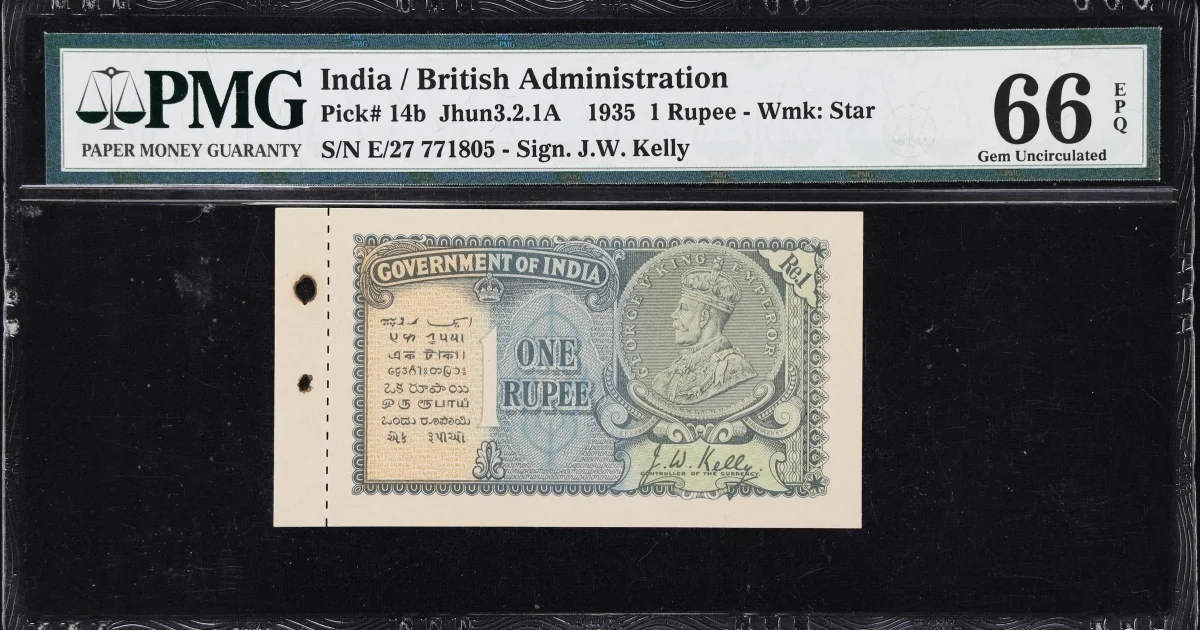
- A premium uncirculated banknote displaying strong centering and generally excellent preservation. Slightly more handling may be visible than on a 67, but the note still meets Gem standards. PMG requires EPQ for this grade. A British India One Rupee note graded 66 EPQ is illustrated later in this guide.
- 65 — Gem Uncirculated
- The entry level of the Gem Uncirculated category. A note should possess above-average centering and attractive overall appearance, although one or two minor handling distractions may be present. PMG requires EPQ. This grade often represents a significant quality distinction from Choice Uncirculated examples.
- 64 — Choice Uncirculated
- A banknote without circulation folds through the design, but displaying less desirable centering, handling or other minor imperfections than Gem examples. It may receive EPQ if its paper satisfies PMG’s originality standards. Choice Uncirculated notes can still be extremely appealing and collectible.
- 63 — Choice Uncirculated
- An uncirculated note showing noticeable centering limitations or several minor distractions. Handling marks, counting bends or less attractive registration may affect the appearance. The note remains free of circulation folds through the printed design.
- 62 — Uncirculated
- A banknote that remains uncirculated but may show imperfect centering, moderate handling or diminished eye appeal. Minor corner-tip issues may be present. Despite these limitations, the note has not acquired the circulation folds characteristic of About Uncirculated grades.
- 61 — Uncirculated
- An uncirculated example with considerable visual distractions. Poor centering, counting marks, smudges or substantial handling can reduce its attractiveness. The grade illustrates why an unused note is not automatically a Gem note.
- 60 — Uncirculated
- The lowest standard Uncirculated classification. The banknote remains without circulation folds through the design, but handling, toning, fading, poor registration or other problems may seriously detract from its appearance. An Uncirculated designation alone therefore does not guarantee exceptional quality.
Under PMG standards, notes graded 65 and above must qualify for EPQ. Certain lower numerical grades may also receive EPQ when the company’s originality criteria are met.
MODERATE CIRCULATION
Banknote Grading Scale: Grades 12–35
These classifications represent notes with progressively greater folding, handling, soiling and circulation wear. Many rare historical Indian banknotes survive primarily in circulated condition.
- 35 — Choice Very Fine
- An attractive circulated note that may initially resemble an Extremely Fine example. Additional folds, commonly several light creases, prevent a higher grade. Some firmness and appealing printing detail may remain. This can be a desirable condition for scarce older issues.
- 30 — Very Fine
- A moderately circulated banknote with multiple noticeable folds and possible light soiling. While it has lost some original firmness, the design generally remains clear and the paper relatively sound.
- 25 — Very Fine
- Shows obvious circulation, including several folds, creases and minor surface wear. The note remains substantially intact and recognizable. A historically important note in this grade can still form a valuable collection centerpiece.
- 20 — Very Fine
- A well-circulated note exhibiting numerous folds, handling and mild soiling. Wear is clearly visible, although the banknote remains reasonably sound. At this grade, individual characteristics such as tears or repairs can have a meaningful effect on desirability.
- 15 — Choice Fine
- A note with substantial circulation wear and numerous folds. It may initially appear to meet Very Fine standards but shows additional weaknesses under closer inspection. The printed design remains sufficiently clear for identification and research.
- 12 — Fine
- A heavily circulated banknote with numerous folds, softened paper, rounded corners and possible minor splits. Despite the wear, the note remains substantially whole. Fine examples of particularly rare historical issues may still be sought by serious collectors.
HEAVILY CIRCULATED BANKNOTES
Banknote Grading Scale: Grades 1–10
Lower grades describe banknotes with extensive wear, weakened paper, tears or missing pieces. Although PMG uses a 1–70 grading framework, its published grading descriptions extend down to Good 4. PCGS Banknote also provides descriptions for grades 1, 2 and 3.
- 10 — Very Good
- A heavily circulated banknote with numerous folds, rounded corners, limp paper and other minor impairments. The overall design remains recognizable and the note is substantially whole.
- 8 — Very Good
- A significantly worn note with weakened paper, staining, splits or potentially small missing pieces. The design is still recognizable, although the visual appearance has deteriorated considerably.
- 6 — Good
- A very worn banknote with considerable circulation damage. Extensive folding, frayed margins, holes or small missing sections may be present. Such notes are generally collected because of their issue’s historical significance or scarcity.
- 4 — Good
- An extremely heavily circulated note displaying weak paper, significant tears, stains or missing portions. The design remains identifiable, but overall appearance and structural strength are seriously impaired.
- 3 — About Good
- A severely worn note with extensive damage and possibly substantial missing sections. Major tears, folds and paper weakness are common. This lower-end grade is included in PCGS Banknote’s published scale.
- 2 — Fair
- A banknote with severe damage, possibly including significant paper loss, extensive staining and structural weakness. Careful handling may be necessary to avoid further deterioration.
- 1 — Poor
- The lowest numerical classification, describing an extensively damaged or incomplete banknote that remains identifiable. Examples may have major paper loss, heavy repairs or substantial deterioration.
Low numerical grades do not automatically mean a note lacks collector value. Extremely rare British India, Presidency Bank or early Government of India notes may remain desirable even in poor condition.
BEYOND THE NUMERICAL GRADE
EPQ, PPQ, Star, NET & Details
The Banknote Grading Scale provides a numerical condition assessment, while special designations offer additional information about originality, exceptional appearance and significant impairments.
- Exceptional Paper Quality (EPQ)
- PMG’s designation for banknotes judged to retain original paper quality without artificial processing intended to improve apparent condition. Normal circulation wear consistent with the grade may still be present. EPQ is mandatory for PMG grades 65 and higher and may also accompany eligible lower grades.
- Premium Paper Quality (PPQ)
- PCGS Banknote’s designation for qualifying notes with premium original paper quality. Grades 65 through 70 require PPQ under its published standards. Although EPQ and PPQ both concern originality, collectors should consult each company’s particular requirements.
- PMG Star (★)
- An additional designation recognizing exceptional eye appeal for the assigned numerical grade. Factors can include printing quality, centering, color and overall visual presentation. A PMG 70 must also qualify for the Star designation. Not every high-grade note automatically receives a Star.
- PMG NET
- Indicates that a banknote has significant impairments beyond those adequately represented by its numerical grade. Problems may include serious repairs or substantial damage. PMG identifies relevant issues on the holder, and its grade guarantee does not apply to NET-designated notes.
- PCGS Details
- A designation used when the banknote has noteworthy problems requiring separate disclosure. The holder identifies the relevant impairment, potentially including restoration, trimming, tears or significant environmental damage. Details grades should be evaluated carefully when comparing market prices.
Consult the official PMG Grading Scale and PCGS Banknote Grading Standards for the complete grading criteria.
READING A THIRD-PARTY HOLDER
Understanding a British India PMG 66 EPQ Note
The illustrated banknote is a British India One Rupee issue, identified as Pick 14b and certified PMG 66 EPQ Gem Uncirculated.
It provides a useful example of how the Banknote Grading Scale applies to historical Indian paper money. The numerical grade describes the assessed condition, while the accompanying designations provide additional information.
The number 66 places the note within the Gem Uncirculated category. It indicates a high level of preservation, with above-average centering and minimal distracting handling characteristics.
The designation EPQ means that PMG considers the paper to meet its Exceptional Paper Quality standards. This is important because original paper characteristics are especially valued among collectors of early Indian banknotes.
The Pick 14b catalogue reference helps identify the particular banknote variety in the Standard Catalog of World Paper Money numbering system.
Collectors should examine the entire grading holder, including its certification number, identifying details and any condition remarks. Certification information can generally be checked through the issuing grading company’s database.
Learn About PMG Grading →INDIAN PAPER MONEY
Special Considerations for Indian Banknotes
The Banknote Grading Scale must be interpreted alongside the characteristics of the particular issue being assessed. Historical Indian banknotes can exhibit production and issuance features that require specialist knowledge.
- Staple Holes at Issue
- Some Indian banknotes were historically distributed in stapled bundles. Consequently, collectors may encounter otherwise well-preserved examples with original staple holes associated with issuance.
Grading companies may distinguish documented issuance characteristics from damage occurring after a note entered circulation. However, staple holes do not automatically establish original issuance or guarantee a particular grade or EPQ designation.
Their location, surrounding paper condition and historical context should be examined carefully.
- Original Paper Quality
- Paper originality is central to evaluating historical Indian currency. Early banknotes may have distinctive paper texture, intaglio impressions, watermarks and manufacturing features that differ from modern currency.
Washing, pressing, chemical treatments or repairs can alter these original qualities, sometimes making a note appear cleaner or flatter without genuinely improving its preservation.
Collectors should distinguish natural aging from artificial processing and avoid assuming that a bright or apparently flawless note is necessarily original.
- Rarity Versus Condition
- Condition and rarity are related but separate aspects of banknote collecting. A scarce Government of India uniface note, King George V issue or important British Burma variety may be highly collectible even in circulated condition.
Conversely, a common modern Indian banknote can receive a very high numerical grade without becoming particularly rare.
Collectors should evaluate the original issue, surviving population, collector demand, historical importance and physical condition together rather than judging solely by the numerical grade.
For detailed terminology, visit the Indian Banknote Glossary or read our practical banknote grading guide.
COLLECTING WITH KNOWLEDGE
Why the Banknote Grading Scale Matters to Collectors
Understanding condition is an essential part of informed collecting. Two banknotes may share the same catalogue reference, signature, watermark and serial prefix but attract very different levels of collector interest because of their preservation.
The Banknote Grading Scale provides a common numerical language for describing these differences. It can make comparisons between auction listings, dealer inventories and certified examples more consistent. However, numerical grades should always be considered together with actual photographs, holder comments and the particular grading service.
For scarce historical Indian notes, the availability of high-quality examples may be extremely limited. A choice circulated specimen can therefore be a more realistic collecting target than an Uncirculated example. This is particularly relevant to early Government of India issues and certain rare varieties of British India currency.
Professional certification also offers an opportunity to obtain an independent assessment of authenticity and paper condition. Nevertheless, grading is not a substitute for understanding the historical issue, studying catalogue references or monitoring actual market transactions.
A well-informed collector should use the numerical scale as one research tool among several, rather than treating it as a guarantee of value or future price appreciation.
A PRACTICAL COLLECTING DECISION
Should You Submit an Indian Banknote for Grading?
Understanding the Banknote Grading Scale can help collectors decide whether professional certification is worthwhile. Authentication, originality assessment and standardized condition descriptions may be valuable when dealing with particularly rare or expensive notes.
Potential candidates include rare British India uniface notes, King George V and King George VI issues, scarce British Burma varieties, important early Republic India banknotes, unusual overprints, specimen notes and valuable high-grade examples.
Certification may also help where the difference between an original uncirculated note and an altered example is commercially significant. The condition of rare material should be assessed carefully before submission, especially when preservation or fragility presents practical concerns.
However, grading involves submission fees, shipping, insurance and other expenses. Common circulated banknotes may not justify these costs. The decision should consider the note’s potential value, rarity, condition, authenticity concerns and your collecting goals.
Read Our Grading Decision Guide →COLLECTOR QUESTIONS
Banknote Grading Scale FAQs
Answers to common questions about professional grading, paper originality, numerical grades and certified Indian banknotes.
What is the Banknote Grading Scale?
The Banknote Grading Scale is a numerical framework based on a maximum grade of 70. Professional services use selected grades within the range to describe preservation, folds, wear, centering and paper condition.
What is the difference between PMG 64 and 65?
PMG 64 is Choice Uncirculated, whereas PMG 65 is Gem Uncirculated. Grade 65 requires higher overall quality and must qualify for Exceptional Paper Quality. Centering, handling and eye appeal contribute to the distinction.
What does PMG 66 EPQ mean?
PMG 66 EPQ identifies a Gem Uncirculated banknote graded 66 out of 70, with paper considered to meet Exceptional Paper Quality requirements. The British India One Rupee illustrated on this page provides an example.
Do staple holes always reduce an Indian banknote’s grade?
Not necessarily. Grading companies may distinguish recognized issuance characteristics from later damage. The effect depends on the exact issue, location of the holes, surrounding condition and applicable standards.
Does a higher grade guarantee a more valuable banknote?
No. A higher numerical grade generally indicates better physical preservation, but rarity, authenticity, collector demand, historical importance and surviving populations also influence market value. Rare circulated notes can be worth much more than common high-grade examples.
Are PMG and PCGS Banknote grades identical?
Both grading companies use a 70-point numerical framework, but their grading judgments, paper quality designations and label terminology are not necessarily identical. Collectors should examine the published standards of each company.
Can an old Indian banknote receive an Uncirculated grade?
Yes. Age alone does not determine condition. A historical banknote may have survived without circulation folds and can qualify for an Uncirculated grade if its physical characteristics meet the grading criteria. Originality and handling remain important factors.
CONTINUE LEARNING
More Indian Banknote Grading Resources
Explore our practical guides to evaluating banknote condition, preserving historical paper money and understanding essential numismatic terminology.
How to Grade Banknotes
Learn to examine folds, paper originality, tears, repairs and other characteristics that determine a banknote’s condition.
Read Guide → BANKNOTE PRESERVATIONHow to Preserve Banknotes
Discover safe storage methods, suitable holders and handling practices that protect banknotes from damage and deterioration.
Read Guide → COLLECTOR REFERENCEIndian Banknote Glossary
Understand essential numismatic terms covering grading, printing characteristics and historical Indian currency varieties.
Explore Glossary →COLLECT WITH KNOWLEDGE
Explore Certified Indian Banknotes
Understanding the Banknote Grading Scale helps collectors make informed decisions about condition, originality and certified paper money. Explore rare Indian banknotes or contact us about a historically important note or collection.