
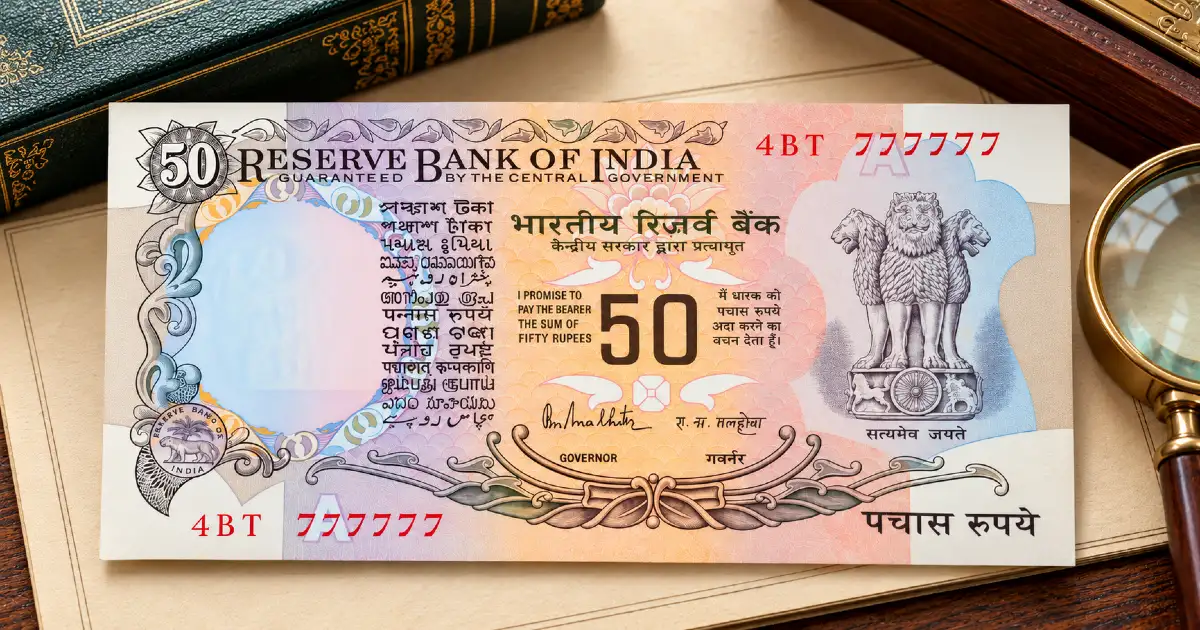
Fancy serial numbers on Indian banknotes are among the most interesting specialties in paper money collecting. A banknote bearing a solid number such as 777777, a ladder such as 123456, or a radar such as 123321 may attract collectors who appreciate unusual numerical patterns. Even when the underlying note is relatively common, a distinctive serial number can give it an additional dimension of collectibility.
The fascination lies in a combination of mathematics, rarity, visual appeal and personal preference. Some numbers are desirable because they repeat or form symmetrical patterns. Others mark important numerical positions, such as 000001, 100000 or 1000000. Still others are associated with cultural traditions, including the number 786.
Fancy serial number collecting is not limited to modern currency. Interesting numerical sequences can be found on British India notes, early Republic India issues and later Reserve Bank of India banknotes. However, the value of a particular example depends on more than its serial number. Historical rarity, denomination, signature, prefix, condition and authenticity also matter.
This guide explains the principal types of fancy serial numbers, concentrating on the familiar Indian six-digit format. It also examines how many examples of each pattern can occur within a complete prefix of one million notes, why some patterns overlap and what determines their value.
For information about buying and selling collectible notes, visit our Fancy Serial Number Banknotes collection. This article focuses primarily on identification, classification and numerical rarity.
Table of Contents
What Are Fancy Serial Numbers on Indian Banknotes?
A fancy serial number is an unusually arranged numerical sequence that attracts collector attention. Although every serial number identifies an individual note within a particular numbering arrangement, some sequences stand out because of their repetition, symmetry, progression or numerical position.
For example, 777777 consists of six identical digits and is known as a solid number. The sequence 123456 forms an ascending ladder, while 123321 is a radar because it reads identically in both directions. A number such as 123123 is a repeater because its first three digits appear again in the same order.
Some types have precise mathematical definitions, making it possible to calculate their frequency. Other descriptions, including lucky numbers, special dates and semi-fancy numbers, depend more heavily on collector preferences.
It is important to distinguish a genuinely scarce numerical pattern from a number that merely looks attractive. A familiar arrangement does not automatically command a substantial premium, particularly when many similar numbers can occur within a large printing.
International grading services recognize several categories of fancy serial numbers. PMG’s guide to fancy serial numbers describes solids, ladders, radars, repeaters, low numbers, binary numbers, rotators and combinations. Not every informal collector-market term qualifies for a professional grading designation.
Understanding Indian Banknote Serial Number Formats
Before calculating the rarity of any numerical pattern, collectors must understand the numbering system being examined. Indian banknotes have used different serial-number formats across their history. The calculations in this article concentrate on a standard complete prefix containing 1,000,000 numerical positions.
One Million Banknotes per Complete Prefix
In the numbering arrangement discussed here, a complete prefix begins with 000001 and continues through 999999. The final note carries the seven-digit number 1000000.
This produces 999,999 six-digit serial numbers and one seven-digit terminal number, giving exactly 1,000,000 numbers in a complete prefix.
The sequence 000000 is not issued as part of this numbering arrangement. It is therefore excluded from every numerical count in this guide.
For example, a complete prefix contains nine six-digit solid numbers. Their frequency across the full one-million-note prefix is therefore nine in one million, even though the final serial number has seven digits.
These calculations describe possible numerical positions within a complete prefix. They do not establish that every number was actually printed, released into circulation or preserved for every denomination, signature or historical variety.
Prefixes, Inset Letters and Other Identifiers
Indian banknotes commonly have prefix characters accompanying the main numerical serial. These may include letters, numbers or combinations of both, depending on the denomination and issue. Some Republic India notes also carry inset letters that help distinguish printing arrangements.
For most fancy-number classifications, the numerical serial is assessed separately from its prefix. Thus, a note bearing 888888 is a solid even when its prefix contains different characters.
Nevertheless, prefixes and inset letters remain important when identifying the banknote itself. Two notes with the same numerical serial can be different collectibles because of their prefixes, signatures, issue years or other characteristics.
Historical Five-Digit Serial Numbers
Not all Indian banknotes use six-digit serial numbers. Early uniface issues employed five-digit numbering, and other historical arrangements also require separate treatment.
A five-digit radar, for instance, has a different number of possible arrangements from a six-digit radar. The rarity of a fancy number on an early British India note must therefore be considered in the context of the actual numbering system.
The remainder of this guide uses six-digit patterns within the complete one-million-note prefix, while treating the serial number 1000000 separately where appropriate.
Solid and Super Solid Serial Numbers
Solid numbers are among the most striking fancy serial numbers on Indian banknotes. Every digit is identical, making the pattern recognizable even without close examination.
There are exactly nine six-digit solid numbers:
111111, 222222, 333333, 444444, 555555, 666666, 777777, 888888 and 999999.
Each occurs once within a complete prefix. Accordingly, there are nine solid numbers among one million numerical positions, or approximately one solid in every 111,111 notes.
Every six-digit solid is equally rare in mathematical terms. However, collector demand may favour certain digits. Some enthusiasts prefer repeated sevens or eights, while others seek a complete set containing all nine solids.
The number 777777 is particularly suitable for illustrating this collecting category. Its six identical digits immediately demonstrate the defining characteristic of a solid. It is also the number shown in the featured banknote selected for this article.
What Is a Super Solid Serial Number?
A super solid is a more specialized designation involving the relationship between a solid serial number and the prefix. Where the numbering format permits it, matching characters or digits in the prefix can extend the visual pattern beyond the main serial. For example 4A 444444, 77B 777777, and E/66 666666.
Low Serial Numbers
Low serial numbers are collected because they occur near the beginning of a numbering sequence. Their appeal comes from their position rather than from repetition or symmetry.
The first serial number, 000001, is especially desirable because it marks the beginning of the prefix. Other very low numbers include 000002, 000003 and 000008.
The first ten numbers, 000001 through 000010, account for ten positions within a complete prefix of one million notes. As a group, their mathematical frequency is one in 100,000.
PMG recognizes the first ten serial-number positions as a collectible category. However, individual collector preferences can differ, and the lowest numbers may attract greater interest than those nearer the end of this group.
Why Are Low Serial Numbers Desirable?
Collectors often associate low numbers with the beginning of a prefix or issue. A note numbered 000001 has an obvious numerical significance that makes it easy to understand and display.
Are High Serial Numbers Collectible?
High serial numbers occur near the end of a numbering range. Examples include 999997, 999998 and 999999. Although they can appeal to collectors, high numbers generally receive less attention in the Indian market than very low numbers.
The number 999999 is an important exception because it is also a six-digit solid. Its attractiveness therefore comes from more than its position near the end of the sequence.
Lakh and Million Serial Numbers
The Indian numbering system gives particular significance to the lakh, equal to 100,000. This makes exact lakh numbers an especially relevant category for Indian banknote collectors.
Lakh Serial Numbers
The nine exact lakh numbers within the six-digit sequence are:
100000, 200000, 300000, 400000, 500000, 600000, 700000, 800000 and 900000.
Each consists of one nonzero digit followed by five zeros. These are recognizable numerical milestones and are sometimes described as round numbers.
There are nine exact lakh numbers in a complete prefix of one million notes. Their mathematical frequency is therefore the same as that of six-digit solids: nine in one million. However, equal mathematical rarity does not imply equal collector demand or market value.
The Million Serial Number: 1000000
The serial number 1000000 represents ten lakh, or one million. In the standard numbering arrangement examined here, it occupies the final position of a complete prefix.
Unlike the preceding 999,999 notes, this terminal number contains seven digits. Its unusual length and numerical significance make it particularly interesting to collectors.
There is only one serial number 1000000 within each complete prefix, giving it a frequency of one in 1,000,000.
For collectors pursuing numerical milestones, the nine exact lakh numbers and the single million number form a complete set of ten 100,000-note milestones.
The million number should not be confused with an ordinary six-digit solid, ladder or repeater. It is best understood as a special terminal number associated with the numbering arrangement of the issue.
Ladder Serial Numbers
Ladder numbers feature digits arranged in a consecutive ascending or descending sequence. Their appeal lies in the immediately recognizable progression from one digit to the next.
Ascending Ladder Serial Numbers
The five complete six-digit ascending ladders, without wrapping from 9 back to 0, are:
012345, 123456, 234567, 345678 and 456789.
Each consecutive digit increases by one. The leading zero in 012345 is part of the printed six-digit sequence and must be retained when classifying the number.
Descending Ladder Serial Numbers
The five corresponding descending ladders are:
987654, 876543, 765432, 654321 and 543210.
Each digit decreases by one. A number that breaks the progression, even at one position, is not a complete ladder under this strict definition.
There are ten complete six-digit ladders in a full prefix, making their combined mathematical frequency one in 100,000.
Some collectors also appreciate partial ladders or sequences that wrap around between 9 and 0. These should be distinguished from the ten complete, non-wrapping ladders counted here, since broader definitions produce different rarity calculations.
Radar Serial Numbers
Radar serial numbers are palindromes: they read the same from left to right and from right to left. Their symmetry makes them one of the most recognizable fancy-number categories.
Examples of valid six-digit radars include 123321, 459954, 583385 and 900009.
A six-digit radar follows the general structure ABCCBA. The first three digits determine the final three, because the number must mirror itself around the centre.
How Many Six-Digit Radar Numbers Exist?
Each of the first three positions can contain any digit from 0 to 9. This produces 10 × 10 × 10 = 1,000 possible symmetrical arrangements.
One would be the unused 000000 sequence, which is excluded. Therefore, there are 999 valid six-digit radar numbers within a complete prefix. Across one million numerical positions, the frequency is approximately one radar in every 1,001 notes.
Some radar numbers also satisfy other definitions. For example, 777777 is both a solid and a radar. More elaborate combinations involving repeaters and rotators are discussed later in this guide.
Repeater Serial Numbers
Repeater serial numbers contain a numerical group that repeats to form the complete sequence. The repeating block must account for every digit, rather than merely appearing somewhere within an otherwise unrelated number.
Three-Digit Repeaters
A six-digit three-digit repeater follows the structure ABCABC. Examples include 123123, 259259, 456456 and 786786.
The first three digits determine the final three. There are 1,000 possible three-digit blocks, but the all-zero result is excluded. This leaves 999 valid three-digit repeater serial numbers.
Two-Digit Repeaters
A two-digit repeater follows the structure ABABAB. Examples include 121212, 343434, 565656 and 787878.
There are 100 possible two-digit blocks, with the unused all-zero arrangement excluded. Consequently, 99 valid two-digit repeaters exist in the six-digit range.
Binary, Rotator and Other Special Patterns
Beyond the major categories, collectors recognize a variety of other numerical patterns. Some have strict mathematical definitions, while others are informal descriptions of attractive arrangements.
Binary Serial Numbers
A strict binary serial number contains only the digits 0 and 1. Examples include 010101, 101010, 100011 and 111000.
Each of the six positions has two possibilities, giving 2 × 2 × 2 × 2 × 2 × 2 = 64 arrangements. Excluding the unused 000000 sequence leaves 63 mathematically valid six-digit binary numbers.
These 63 sequences represent the mathematical category, not necessarily the number eligible for a professional grading designation. For example, PMG excludes certain round or milestone numbers from its binary classification even though their digits consist entirely of zeros and ones.
Rotator Serial Numbers
A rotator serial number retains the same numerical appearance when turned upside down through 180 degrees. The digits normally used for this purpose are 0, 1, 6, 8 and 9, with 6 and 9 exchanging their appearances under rotation.
Examples include 108801 and 619619, assuming the printed numeral shapes support the rotation.
For a six-digit rotator, the first three positions each have five possible choices, while the final three are determined by the required rotational symmetry. This produces 5 × 5 × 5 = 125 arrangements.
After excluding 000000, there are 124 mathematically valid six-digit rotators under this convention.
Unlike most numerical categories, rotators depend partly on the appearance of the printed digits. The actual typeface on the banknote therefore matters, and a pattern that works in one font may not be equally convincing in another.
Bookends, Pairs and Semi-Fancy Numbers
Bookend numbers have matching digits or groups at the beginning and end of the serial. Other semi-fancy arrangements include repeated pairs, clusters of identical digits and visually memorable sequences.
These numbers may interest individual collectors, but many lack universally accepted definitions. Their rarity depends on precisely how the pattern is described.
A loose definition can encompass thousands of possible numbers. Collectors should therefore be cautious when an ordinary repeated pair is advertised as exceptionally rare without a clear mathematical explanation.
786 and Culturally Significant Serial Numbers
Not every collectible number is valued because of mathematical symmetry. Some serial numbers attract attention because of religious, cultural or personal associations.
The number 786 is particularly well known in South Asia. It is commonly associated with the numerical representation of the Islamic phrase Bismillah and has acquired cultural significance among some collectors.
Indian banknotes containing 786 may therefore attract interest beyond their ordinary denomination or issue type. Examples include 000786, 786000 and 786786.
However, these examples are not mathematically equivalent. The number 786786 is a complete three-digit repeater, while 000786 contains the culturally meaningful sequence without qualifying as a full repeater.
The position of 786, surrounding digits and overall pattern may affect desirability. Collectors should also consider the denomination, condition, authenticity and whether there is genuine demand for a particular arrangement.
Many common modern banknotes contain 786 somewhere in their serial numbers. Such occurrences do not automatically make them rare or valuable. A realistic assessment must distinguish cultural meaning from numerical scarcity and market evidence.
For a more detailed discussion, see our 786 Note Price in India guide.
Other Lucky and Personally Significant Numbers
Some collectors favour repeated eights, repeated nines, birthdays, anniversaries or dates associated with important events. These preferences can create personal or regional demand for particular arrangements.
However, personal significance does not necessarily translate into broad collector demand. A number meaningful to one buyer may carry little premium for another.
Combination and Multi-Pattern Fancy Serial Numbers
Some of the most interesting fancy serial numbers satisfy more than one recognized definition. These combinations can be particularly attractive because several unusual characteristics occur in a single numerical sequence.
For example, 777777 is both a solid and a radar. It also satisfies repeating-block structures, although its solid pattern remains the most immediately recognizable characteristic.
The number 808808 is an especially interesting combination. It is a three-digit repeater, a radar and a rotator when the printed numeral forms permit rotation. This type of multi-pattern sequence is recognized in PMG’s discussion of fancy serial numbers.
Similarly, 101101 is a three-digit repeater and a radar. It also qualifies mathematically as a binary number because it contains only zeros and ones.
Does a Combination Make a Note More Valuable?
A multi-pattern serial may attract greater attention than a number qualifying for only one category. However, overlapping patterns do not automatically guarantee a higher price. Collector recognition, visual appeal and the rarity of the underlying banknote remain important.
The most useful approach is to describe each valid characteristic clearly rather than invent a complex name. A note numbered 808808, for example, can accurately be called a radar-repeater-rotator when the printed digits support all three classifications.
Prefix-Enhanced Combinations
Additional interest may arise when the prefix complements the principal serial number. A matching numerical prefix can sometimes extend a pattern, creating a more unusual complete identifier.
However, Indian prefix arrangements vary by denomination and period. A prefix-enhanced pattern must be assessed using the actual numbering format, and its rarity cannot be determined solely from the frequency of the six-digit serial.
How Rare Are Fancy Serial Numbers?
The rarity of a fancy serial number can often be calculated when its definition is precise. The calculation must use the correct numbering range and distinguish numbers that satisfy multiple categories.
For the standard Indian numbering arrangement examined here, a complete prefix contains 1,000,000 numerical positions: 000001 through 999999, followed by 1000000.
There is no 000000 note in this sequence. The table below counts six-digit patterns within the first 999,999 positions and calculates their average frequency across the complete one-million-note prefix. The seven-digit million number is counted separately.
Mathematical Rarity of Major Fancy Serial Numbers
| Fancy number type | Count per complete prefix | Approximate frequency |
|---|---|---|
| Solid numbers | 9 | 1 in 111,111 |
| Low numbers 000001–000010 | 10 | 1 in 100,000 |
| Exact lakh numbers | 9 | 1 in 111,111 |
| Million number 1000000 | 1 | 1 in 1,000,000 |
| Complete ladders | 10 | 1 in 100,000 |
| Radars | 999 | 1 in 1,001 |
| Three-digit repeaters | 999 | 1 in 1,001 |
| Two-digit repeaters | 99 | 1 in 10,101 |
These figures refer to mathematical possibilities in a complete prefix, not the number of surviving banknotes. Actual populations depend on printing quantities, distribution, redemption, destruction, collector retention and the survival of individual issues.
Mathematical Rarity Versus Actual Availability
A pattern occurring once in 100,000 numerical positions is mathematically scarce. However, that does not mean collectors can expect to find one example for every 100,000 surviving notes of a particular historical issue.
Some prefixes may have been only partly printed or issued, while others may have experienced substantial losses through circulation, redemption or destruction. In addition, a fancy number may survive in poor condition or remain unavailable to collectors.
Mathematical rarity is therefore one factor in desirability, not an independent measure of market value.
What Determines the Value of Fancy Serial Number Banknotes?
The value of a fancy serial number banknote depends on the pattern itself and the underlying currency issue. A distinctive number may create additional demand, but it does not eliminate the importance of authenticity, condition, denomination or historical scarcity.
Type and Visual Appeal of the Pattern
Complete solids, ladders, very low numbers and attractive combination patterns are generally easier for collectors to recognize than loosely defined semi-fancy numbers.
Some patterns may attract premiums because of their mathematical scarcity, while others benefit from cultural associations or their visual arrangement. Demand can differ significantly even when two categories have the same theoretical frequency.
Denomination, Historical Period and Variety
A fancy number on a scarce British India note may appeal to collectors of both historical paper money and unusual serial numbers. The same pattern on a common modern denomination may derive most of its premium from the number alone.
Signatures, watermarks, prefixes, inset letters and recognized catalogue varieties can all influence collector demand. A rare banknote type bearing a fancy serial number combines two distinct collecting characteristics.
Condition and Originality
Condition is important because attractive, well-preserved examples generally display their serial numbers more clearly and appeal to condition-conscious collectors.
Original paper quality, the absence of significant folds and freedom from repairs or alterations may contribute to desirability. A badly damaged fancy-number note should not automatically be valued as highly as an otherwise identical note in excellent condition.
Professional Grading and Authentication
Professional grading can provide independent assessment of authenticity and condition. Recognized fancy serial numbers may also qualify for a special designation, depending on the grading service’s criteria.
Certification may be particularly useful when dealing with valuable historical issues or numbers that could have been altered. However, grading involves costs and does not guarantee an increased selling price.
Collectors can explore examples of professionally certified currency through our PMG Graded Banknotes collection.
Actual Market Demand
An advertised price is not proof of market value. Online listings sometimes attach extraordinary prices to common modern banknotes containing repeated digits or culturally meaningful numbers.
Reliable comparisons should use completed transactions involving genuinely similar notes, with comparable numerical patterns, grades and historical characteristics.
For further collecting and purchasing advice, see our How to Start Collecting Indian Banknotes guide.
Collecting and Authenticating Fancy Serial Numbers
Fancy serial number collecting can provide a rewarding specialist focus, but buyers should approach unusual notes carefully. Attractive numerical patterns can be misdescribed, and valuable examples may be subject to alteration or forgery.
Choose a Collecting Theme
Some enthusiasts aim to acquire one example of every major category: a solid, low number, lakh number, ladder, radar, repeater and rotator. Others specialize in one denomination, historical period or favourite numerical combination.
Collectors interested in British India may search for unusual numbers on King George V or King George VI issues, while Republic India collectors may concentrate on signatures, denominations or particular printing periods.
A focused collecting plan helps prevent unnecessary purchases and makes it easier to compare genuinely suitable notes.
Examine the Complete Number
Check every digit carefully rather than relying entirely on the seller’s classification. A radar must read identically in both directions, a repeater must reproduce its block across the full number, and a ladder must maintain an uninterrupted progression.
Also verify the prefix, inset letter, signature and other identifiers. These may be essential for attributing the banknote and confirming that its serial-number format is consistent with the issue.
Beware of Altered Serial Numbers
A genuine banknote can have its serial number altered to imitate a rare pattern. Such alterations may involve changing individual digits, adding ink or manipulating printed characters.
Potential warning signs include inconsistent ink, unusual character shapes, misalignment, irregular spacing and disturbance of the surrounding paper. However, sophisticated alterations may require expert examination.
Authentication must establish not only that the underlying banknote is genuine, but also that the fancy serial number is original and unaltered.
Preserve and Document Your Collection
Store collectible banknotes in suitable archival-quality holders away from excessive moisture, heat and direct sunlight. Avoid unnecessary handling, cleaning, pressing or chemical treatment.
Maintain a record of each note’s denomination, issuing authority, prefix, complete serial number, signature, condition and acquisition details. Photographs of both sides are especially useful for valuable or unusual examples.
For available examples and further collecting information, visit our Fancy Serial Number Banknotes collection.
Conclusion: Fancy Serial Numbers on Indian Banknotes
Fancy serial numbers on Indian banknotes bring together mathematical curiosity, visual appeal and the history of Indian paper money. Solids, low numbers, lakh numbers, ladders, radars, repeaters, rotators and combination patterns each offer distinctive collecting possibilities.
For the standard numbering arrangement examined in this guide, a complete prefix contains one million notes. The sequence begins at 000001, continues through 999999 and ends with the seven-digit terminal number 1000000. This distinction is essential when calculating the rarity of six-digit patterns and the exceptional million number.
Mathematical frequency is only part of the story. Authenticity, historical significance, denomination, signature, condition and genuine collector demand all influence the desirability of an individual note.
Whether you collect the simplicity of 777777, the symmetry of a radar or the numerical significance of 1000000, careful research will help you distinguish genuinely interesting notes from exaggerated rarity claims.
Explore our Fancy Serial Number Banknotes collection, or read Why Collect Indian Banknotes? and How to Start Collecting Indian Banknotes for broader guidance.
Frequently Asked Questions About Fancy Serial Numbers
What are fancy serial numbers on Indian banknotes?
Fancy serial numbers are unusual numerical sequences valued for features such as repetition, symmetry, progression, low numerical position or cultural significance. Common examples include solids, ladders, radars, repeaters and low numbers.
How many banknotes are numbered under one Indian prefix?
In the standard complete-prefix numbering arrangement discussed here, there are 1,000,000 positions. They run from 000001 through 999999 and conclude with 1000000. Earlier historical formats and other numbering arrangements may differ.
How many six-digit solid serial numbers are there?
There are nine six-digit solids, from 111111 through 999999. Each consists of one digit repeated six times. Their combined frequency is nine per complete one-million-note prefix.
What is the rarest fancy serial number?
There is no single universally rarest fancy-number category. Every individual serial occupies one position within its prefix. The terminal million number occurs once, while categories such as solids, lakh numbers and ladders contain only a small number of possibilities. Collector demand does not necessarily follow mathematical rarity.
How many radar serial numbers exist in six digits?
There are 999 valid six-digit radar numbers between 000001 and 999999. A radar follows the pattern ABCCBA and reads identically from either direction.
What is the difference between a radar and a repeater?
A radar reads the same forwards and backwards, such as 123321. A repeater consists of a block repeated across the complete number, such as 123123 or 121212. Some numbers, such as 212212 and 383383 qualify as both.
What is a lakh serial number?
An exact lakh serial number is a multiple of 100,000, such as 100000, 200000 or 900000. There are nine such six-digit numbers within a complete prefix.
Why is the serial number 1000000 special?
The seven-digit number 1000000 is the millionth and terminal number in the complete-prefix arrangement discussed here. It occurs once within the one-million-note sequence and marks an important numerical milestone.
Are 786 serial number banknotes valuable?
Some 786 notes attract collector interest because of the number’s cultural associations. However, value depends on the complete numerical pattern, banknote type, condition and demand. The appearance of 786 alone does not guarantee a substantial premium.
Can fancy serial numbers be forged or altered?
Yes. Individual serial-number digits can be manipulated to imitate desirable patterns. Collectors should examine the printing carefully and consider independent authentication for expensive or questionable examples.
Does PMG recognize fancy serial numbers?
PMG recognizes several fancy-number categories and may provide special designations for qualifying notes. Its criteria are more specific than some informal collector-market descriptions.
Where can I buy fancy serial number Indian banknotes?
Fancy serial number notes can be found through specialist banknote dealers, numismatic auctions and established collector networks. IndiaBanknotes maintains a dedicated Fancy Serial Number Banknotes collection for available notes and related enquiries.

