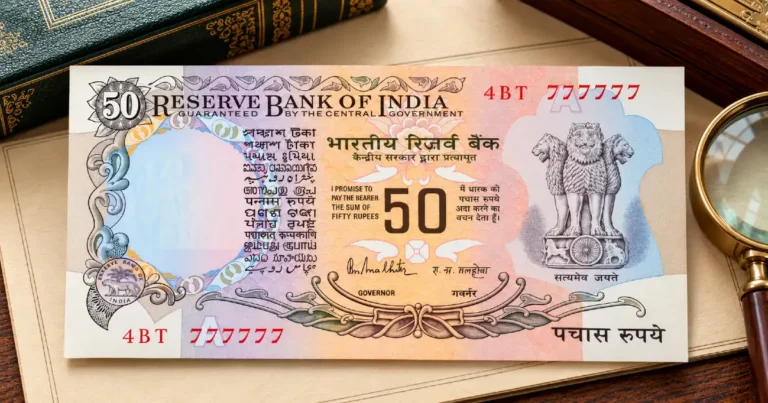
786 note price is a popular search among Indian banknote collectors and people who discover the number 786 in the serial number of a currency note. The number has cultural and religious significance for many people in South Asia, creating interest in banknotes carrying this particular sequence.
However, not every 786 number note is rare or valuable. Its collector value depends on the banknote’s age, issuing authority, denomination, variety, condition, serial-number pattern and market demand.
On modern Indian banknotes, ordinary six-digit serial numbers containing 786 are relatively common. Special combinations such as 000786, 786000 and 786786 are mathematically much less frequent and may attract greater collector interest.
The situation can be quite different for historical banknotes. On older British India and British Burma notes, even an ordinary serial number containing 786 may command a premium because surviving examples of the underlying banknote can be scarce. More unusual combinations may be exceptionally difficult to find.
This guide explains the meaning of 786, how frequently it appears in banknote serial numbers, which patterns collectors seek, and the factors that influence 786 note prices in India. It also examines why historical banknotes require a different approach from modern currency.
Table of Contents
- What Is a 786 Number Note?
- What Is the Meaning of 786?
- How Rare Are 786 Serial Numbers?
- Types of 786 Serial Numbers Collectors Look For
- 786 Serial Numbers on British India and British Burma Banknotes
- What Determines 786 Note Price in India?
- Does Denomination Matter for 786 Note Value?
- Common Myths About 786 Note Prices
- Buying and Selling 786 Number Notes
- Conclusion
- Frequently Asked Questions About 786 Notes
What Is a 786 Number Note?
A 786 number note is a banknote whose serial number contains the consecutive digits 786. The sequence may appear at the beginning, middle or end of the serial number, or form part of a distinctive numerical pattern.
For example, the following six-digit serial numbers all contain 786:
- 123786: The serial number ends with 786.
- 786123: The serial number begins with 786.
- 178623: The sequence appears within the number.
- 000786: Three leading zeros precede 786.
- 786000: Three trailing zeros follow 786.
- 786786: The sequence 786 appears twice consecutively.
These examples are not equally scarce or desirable. Ordinary placements occur regularly in sufficiently large numbering sequences, while certain combinations have a much lower mathematical frequency.
In Indian banknote collecting, 786 is often treated as a culturally significant or auspicious serial number. It differs from conventional fancy serial-number categories, such as solid numbers, radar numbers and ladders, because much of its appeal comes from the meaning associated with the digits rather than their numerical arrangement alone.
For a broader explanation of collectible numerical patterns, see our guide to Types of Fancy Serial Number Banknotes.
What Is the Meaning of 786?
The number 786 is widely associated in South Asian Muslim traditions with the Arabic phrase Bismillah ir-Rahman ir-Rahim, commonly translated as “In the name of God, the Most Gracious, the Most Merciful.”
This association comes from the Abjad numeral system, in which Arabic letters are assigned numerical values. Under a traditional calculation, the letters of the phrase correspond to a total of 786.
Over time, the number became a recognised shorthand for the phrase in parts of South Asia. It has appeared in correspondence, business records, decorative inscriptions and other cultural contexts.
Is 786 a Holy or Lucky Number in Islam?
Although many people regard 786 as auspicious because of its association with the Bismillah, the number itself is not prescribed in the Quran as a sacred number or a required substitute for the phrase.
Attitudes toward using 786 differ among Muslim communities and religious scholars. Its significance is particularly associated with regional custom rather than a universally observed Islamic practice.
For banknote collectors, this cultural association helps explain why 786 attracts attention. However, symbolic importance and numismatic rarity are separate considerations.
Why Is 786 Popular on Indian Banknotes?
Many collectors and members of the public seek banknotes bearing 786 because they associate the number with blessings, good fortune or personal significance.
Some people collect these notes as keepsakes, while others assemble collections based on denomination, issuing period or serial-number arrangement.
This demand can create a premium for certain banknotes, but popularity alone does not establish rarity. The number of surviving examples and the willingness of collectors to purchase them are equally important.
How Rare Are 786 Serial Numbers?
To understand 786 note rarity, it is necessary to distinguish the mathematical frequency of a serial-number pattern from the number of surviving banknotes available to collectors.
Early Government of India uniface notes generally used five-digit serial numbers, while later lower-denomination uniface notes adopted six-digit numbering. British India and British Burma portrait notes, as well as Republic India banknotes, use six-digit serial numbers, accompanied by alphanumeric prefixes.
Indian banknote serial numbers generally run from 000001 to 1000000 within each prefix, representing one million consecutive numbers per complete numbering cycle.
Where Can 786 Appear in a Six-Digit Serial Number?
The consecutive digits 786 can begin in four different positions within a six-digit serial number.
| Position | Pattern | Example |
|---|---|---|
| Beginning | 786xxx | 786129 |
| Second digit | x786xx | 178629 |
| Third digit | xx786x | 127869 |
| End | xxx786 | 129786 |
For each specified position, 786 appears in one out of every 1,000 possible six-digit combinations. However, because the sequence can occupy four positions, the probability of finding 786 anywhere in a serial number is higher than one in 1,000.
In a complete theoretical set of one million six-digit combinations, 3,999 distinct numbers contain the consecutive sequence 786. This count includes 786786, which contains the sequence twice but represents only one serial number.
These calculations explain why ordinary 786 combinations are relatively easy to encounter in modern, extensively printed banknote issues.
Why Mathematical Rarity Is Not the Same as Collector Rarity
Mathematical frequency describes how often a particular number could appear in a complete numerical sequence. It does not establish how many banknotes bearing that number were actually printed, issued or preserved.
A serial number may fall outside the issued range of a particular banknote variety. Even where it was issued, the corresponding note may have been lost, damaged, redeemed or destroyed.
This distinction is especially important when examining historical British India and British Burma banknotes, for which surviving populations can be very small.
Types of 786 Serial Numbers Collectors Look For
Collectors generally distinguish ordinary 786 placements from more visually distinctive combinations. The following examples illustrate the main patterns found on six-digit serial numbers.
Ordinary 786 Serial Numbers
An ordinary 786 serial contains the consecutive digits once, without an additional distinctive pattern. Examples include 152786, 157862, 178652, and 786152.
On modern Indian banknotes, such combinations occur regularly and generally attract limited or no interest from specialist fancy-serial collectors.
On older banknotes, ordinary 786 placements can be considerably more interesting. A scarce historical issue with an ordinary 786 serial may be more desirable than a modern banknote with a mathematically unusual pattern.
Double 786 Note (786786)
A double 786 note has the six-digit serial number 786786, in which the sequence 786 appears twice consecutively.
This is a repeating-block serial number, making it attractive both to collectors interested in 786 and to those who collect repeater patterns.
Within a complete set of one million six-digit combinations, 786786 occurs only once. Nevertheless, the same numerical combination can recur across different prefixes, denominations and banknote issues.
Consequently, a modern 786786 note is not necessarily exceptionally rare across the entire market. Its value depends on the underlying banknote, condition, collector demand and the number of comparable examples available.
000786 Serial Number
The serial number 000786 combines the culturally significant sequence with three leading zeros. Its appeal comes from the prominent placement of 786 and the visually distinctive arrangement of the preceding zeros.
Like 786786, this exact combination appears once in a complete theoretical six-digit numbering cycle. It may attract greater interest than an ordinary 786 placement, particularly on a well-preserved or otherwise collectible banknote.
786000 Serial Number
The serial number 786000 begins with 786 and ends with three zeros. It has the same theoretical numerical frequency as 000786 and 786786, but collector preferences may differ between these arrangements.
None of these three configurations should automatically be described as more valuable than the others. Actual demand, banknote type, condition and documented transactions determine their relative desirability.
| Serial Pattern | Mathematical Frequency | Collector Interest |
|---|---|---|
| xxx786 | One in one thousand | Generally common on modern notes |
| 786xxx | One in one thousand | Generally common on modern notes |
| 000786 | One in one million | Distinctive leading-zero pattern |
| 786000 | One in one million | Distinctive trailing-zero pattern |
| 786786 | One in one million | Double 786 and repeating-block pattern |
Important: These frequencies describe a complete theoretical numbering cycle. They do not establish the actual number of issued or surviving banknotes for any particular denomination, prefix, signature or variety.
786 Serial Numbers on British India and British Burma Banknotes
Unlike modern Indian currency, historical British India and British Burma banknotes often have limited surviving populations. Consequently, even an ordinary 786 serial number may attract a collector premium when it appears on a scarce historical issue.
786 Serial Numbers on British India Banknotes
British India banknotes include early Government of India uniface issues and later portrait notes featuring King George V and King George VI. Early uniface notes used five-digit or six-digit numbering, while portrait issues generally followed the six-digit format.
For collectors of historical 786 notes, even a common serial arrangement may be desirable because the underlying banknote is scarce. However, exceptional combinations such as 000786, 786000 and 786786 are extremely rare.
786 Serial Numbers on British Burma Banknotes
British Burma banknotes, including King George V and King George VI issues, are another important collecting field. Many varieties are scarce, making surviving examples with 786 serial numbers particularly interesting to collectors.
For both British India and British Burma, the 786 note price must be assessed alongside the banknote’s type, denomination, signature, variety, condition, and overall rarity. The presence of 786 enhances collector interest.
What Determines 786 Note Price in India?
There is no single standard 786 note price in India. Two banknotes with the same 786 serial-number arrangement may have very different collector values because of differences in issue, variety, rarity, condition, and demand.
The following factors are particularly important when evaluating a 786 number note.
1. The Rarity of the Banknote Itself
The underlying banknote is often more important than the serial-number pattern.
A scarce British India or British Burma issue may have substantial numismatic interest even without a special serial number. The presence of 786 can create additional demand among collectors who appreciate the number’s cultural significance.
Conversely, a common modern banknote may remain relatively easy to acquire despite carrying a desirable numerical combination.
2. Serial Number Placement and Pattern
The arrangement of 786 can influence collector interest.
Ordinary placements such as 152786 and 786152 occur frequently in large numbering sequences. More distinctive combinations such as 000786, 786000 and 786786 have a lower mathematical frequency.
However, collectors do not value serial numbers solely according to probability. Visual appeal, cultural meaning, personal preferences and the availability of comparable notes also influence demand.
3. Banknote Condition and Grade
Condition is one of the most important factors affecting the value of any collectible banknote.
An uncirculated note with original paper quality, sharp corners and no folds is generally more desirable than a heavily circulated example of the same type and serial number.
Professional grading may be useful for certain rare historical banknotes, particularly when authenticity and condition are important considerations.
Our How to Grade Banknotes guide explains the main grading principles used by collectors.
4. Issue, Signature, Prefix and Variety
Banknotes of the same denomination may exist in numerous varieties distinguished by design, signature, prefix, issuing authority, or production period.
Some varieties are much scarcer than others, making accurate identification essential before attempting to assess value.
For historical issues, the serial prefix can also help determine whether a particular numerical combination was possible within the relevant production range.
5. Collector Demand and Market Evidence
Collector demand determines whether the presence of 786 produces an additional premium.
Actual completed transactions, reputable auction results and specialist dealer assessments provide more meaningful evidence of market value than speculative online listings.
For a more detailed explanation, see Understanding Banknote Values: Rarity, Condition & Demand.
Does Denomination Matter for 786 Note Value?
Denomination is an important consideration when assessing 786 note price in India. Although collectors search for 786 notes in denominations such as ₹10, ₹20, ₹50, ₹100, ₹200 and ₹500, the collector premium can differ considerably between denominations, issues and varieties.
Modern ₹100 and ₹500 notes are among the most commonly enquired-about denominations for 786 serial numbers. Most enquiries concern Mahatma Gandhi Series banknotes with ordinary serial numbers beginning or ending with 786. These modern notes generally do not command a premium simply because they contain the sequence.
One reason is the scale of production. The Reserve Bank of India issues banknotes in large quantities across different denominations, signatures and prefix series. Consequently, ordinary 786 combinations occur repeatedly across modern Indian banknote issues.
Why Modern ₹500 Notes Attract Little or No Premium
Modern ₹500 banknotes with ordinary 786 serial numbers generally attract no meaningful collector premium. These notes are widely available, and their relatively high face value further limits demand. Collectors who find such 786 notes in circulation may choose to keep them as part of a personal collection, but should not expect significant resale value above face value.
Even the more desirable serial-number combinations 000786, 786000 and 786786 generally command only modest premiums on modern ₹500 notes. Although these patterns are more distinctive, their collector demand remains limited compared with similar combinations on lower-denomination or scarce historical banknotes.
Other Denominations and Collector Demand
Modern 786 notes in denominations such as ₹10, ₹20, ₹50 and ₹100 generally attract little or no premium when they have ordinary 786 serial numbers. However, their lower face values make them more affordable to collect.
Distinctive combinations such as 000786, 786000 and 786786 are more desirable, particularly on lower-denomination banknotes. A double 786 note bearing 786786 may attract greater interest, although premiums still depend on condition, issue and collector demand.
Modern ₹200 banknotes may also be slightly more desirable than ₹500 notes because of their lower face value and comparatively lower production quantities. Nevertheless, ordinary 786 serial numbers generally attract no premium, while special combinations offer better collecting potential.
Common Myths About 786 Note Prices
Online discussions about 786 notes often contain exaggerated claims or misunderstandings about rarity and value.
Myth 1: Every 786 Note Is Rare
Most ordinary 786 serial numbers on modern Indian banknotes are not mathematically rare. The sequence appears regularly in large numbering cycles.
Historical issues may be different because far fewer examples survive, but each banknote must be evaluated individually.
Myth 2: All Double 786 Notes Are Extremely Valuable
The serial number 786786 is mathematically uncommon within a single complete six-digit numbering cycle, but the same number can occur across many different prefixes and issues.
A modern double 786 note is therefore not automatically a major rarity. Its actual value depends on the banknote and market demand.
Myth 3: Online Asking Prices Reflect Actual Market Value
Social media posts and online advertisements sometimes claim exceptionally high prices for ordinary 786 notes.
However, an advertised asking price is not evidence that a banknote has sold for that amount.
Collectors should distinguish between unsold listings, completed transactions and independently supported valuations.
Myth 4: Dealers Will Buy Every 786 Note at a Premium
Not all banknote dealers specialise in fancy serial numbers or culturally significant numerical patterns.
Some focus on historical issues, rare varieties, specimen notes or professionally graded banknotes. Others specialise in modern fancy serial numbers.
Consequently, the willingness of a dealer to purchase a 786 note depends on the dealer’s collecting field and the particular banknote offered.
Buying and Selling 786 Number Notes
Anyone considering buying or selling a 786 note should first identify the banknote accurately and understand the difference between ordinary serial-number combinations and genuinely scarce issues.
Advice for Buyers
When purchasing a 786 banknote, examine the denomination, issuing period, signature, prefix, condition and serial-number pattern.
Collectors should be cautious about paying substantial premiums based solely on claims that 786 is a lucky or exceptionally rare number.
Where possible, compare similar banknotes through established numismatic dealers, reputable auction records and recognised catalogues.
Advice for Sellers
Before offering a 786 note for sale, identify its issuing authority, denomination, variety and condition.
Clear photographs of the front and back are essential, particularly for older banknotes. The serial number, prefix, signature and any condition problems should be visible.
Avoid assuming that an advertised online price represents the amount a buyer will actually pay.
Does IndiaBanknotes.com Buy 786 Notes?
Our collecting and purchasing interests focus primarily on older and genuinely scarce banknotes, particularly historical British India and British Burma issues.
We generally do not purchase modern post-1970 Indian banknotes solely because their serial numbers contain 786, including ordinary placements and double 786 combinations.
However, we may be interested in older banknotes with 786 serial numbers when the underlying issue is collectible and the note meets our purchasing criteria.
If you have an older British India or British Burma banknote bearing 786, please provide clear photographs of both sides, including the complete serial number and details of its condition.
Conclusion: Understanding 786 Note Price and Rarity
The number 786 has considerable cultural significance in South Asia, and banknotes bearing this sequence attract interest from collectors and members of the public.
However, 786 note price and rarity cannot be determined from the serial number alone.
On modern Indian banknotes, ordinary 786 placements are relatively common. Distinctive combinations such as 000786, 786000 and 786786 are mathematically less frequent, but their market value still depends on the issue, condition and collector demand.
For historical British India and British Burma banknotes, even an ordinary 786 serial may attract a premium because surviving examples of the underlying note can be scarce. Exceptional combinations may be extremely difficult to find.
Ultimately, collectors should evaluate each 786 banknote according to its historical importance, variety, authenticity, condition, serial-number pattern and genuine market demand rather than relying on exaggerated online claims.
Frequently Asked Questions About 786 Notes
What is the price of a 786 note in India?
There is no fixed price for a 786 note in India. Collector value depends on the banknote’s denomination, issue, variety, condition, serial-number arrangement, rarity and demand. Ordinary 786 placements on modern notes generally attract no premium, while scarce historical notes may be more desirable.
Is a 786 number note rare?
Not necessarily. Ordinary six-digit serial numbers containing 786 occur regularly in large numbering sequences. However, finding 786 on a scarce British India or British Burma banknote may be considerably more difficult because relatively few examples of the underlying issue survive.
What is the value of a double 786 note?
A double 786 note has the serial number 786786. This exact combination occurs once in a complete theoretical cycle of one million six-digit numbers. Its collector value nevertheless depends on the banknote’s issue, condition, prefix and market demand.
Are 000786 and 786000 valuable serial numbers?
These are distinctive six-digit combinations that may attract collector interest because of their prominent 786 placement and groups of zeros. Their actual value depends on the banknote type, rarity, condition and demand rather than the numerical pattern alone.
Can an ordinary 786 serial be valuable on a British India banknote?
Yes. An ordinary 786 serial may attract a premium on a scarce British India banknote, particularly a collectible King George V or King George VI issue. The underlying banknote’s rarity, variety and condition remain important factors in determining value.
Are 786 serial numbers collectible on British Burma banknotes?
Yes. Collectors may seek British Burma banknotes containing 786, including ordinary placements, because surviving examples of certain historical issues are scarce. The premium depends on the individual banknote and collector demand.
What is the 786 ₹100 note price?
The value of a ₹100 note containing 786 depends on its issue, serial-number arrangement, condition, and collector demand. An ordinary 786 placement on a common modern ₹100 note does not automatically create a premium.
What is the 786 ₹500 note price?
There is no standard price for a ₹500 note containing 786. Different ₹500 banknote issues and varieties have different levels of collectibility. The serial pattern, condition and demand must be considered alongside the underlying banknote.
Why is 786 considered lucky?
The number 786 is traditionally associated with the Arabic phrase Bismillah ir-Rahman ir-Rahim through the Abjad numeral system. Its association with blessings and good fortune developed through South Asian cultural traditions, although the number itself is not prescribed as sacred in Islamic scripture.
Does IndiaBanknotes.com buy modern 786 notes?
We do not purchase modern post-1970 Indian banknotes solely because they contain 786, including double 786 notes. Our purchasing interests focus primarily on older, scarce and historically collectible banknotes, particularly British India and British Burma issues.
How can I find out whether my 786 note is valuable?
Start by identifying the issuing authority, denomination, year or period, signature, prefix, serial number and condition. Compare the note with documented examples and reliable market evidence. For scarce historical banknotes, a specialist numismatic assessment may be appropriate.