Languages on Indian notes represent one of the most extensive multilingual designs in modern currency. Today’s Indian banknotes display 17 languages in total: English and Hindi on the obverse, together with a reverse language panel containing 15 additional Indian languages.
The history of languages on Indian notes stretches back to the British India era, when government-issued paper money initially relied heavily on English. Over time, regional inscriptions developed into standardised multilingual panels, eventually producing the 17-language system used on Republic India banknotes today.
The Indian banknote language panel evolved through distinct stages of colonial administration, Independence and constitutional reform. From regional four-language panels on uniface notes to the modern arrangement, each stage reflects changing circulation requirements, administrative geography and linguistic representation.
This article explores the evolution of languages on Indian notes, explaining why certain languages were added or removed, how the panels changed across major banknote series, and why these inscriptions are important to collectors.
Table of Contents
- Why Indian Currency Notes Have Multiple Languages
- Origins of Languages on Indian Notes
- King George V Banknotes: Evolution of the Language Panel
- King George VI Banknotes: Changes in the Language Panel
- Ashoka Pillar Notes: The Early Republic Language Panel
- The Mahatma Gandhi Series and the Modern 17-Language System
- Why Language Panels Matter to Collectors
- India’s Language Panels in Global Context
- Conclusion
- Frequently Asked Questions
Why Indian Currency Notes Have Multiple Languages
The presence of multiple languages on Indian notes reflects the country’s extraordinary linguistic diversity. Unlike countries that operate primarily through a single official language, India has numerous major languages spoken across different states and regions. The language panel provides a standardised way to present the denomination in several scripts while maintaining a consistent national currency design.
Importantly, India does not have a national language. Hindi in Devanagari script is the official language of the Union, while English continues to be used for official purposes under the applicable legal framework. Other languages receive constitutional recognition through the Eighth Schedule of the Constitution of India.
The use of multiple languages on Indian notes also serves a practical purpose. Banknotes circulate across regions with different scripts, literacy patterns and linguistic traditions. A multilingual panel allows denominations to be recognised in familiar scripts without requiring every language to appear prominently within the main design.
To prevent overcrowding, modern Indian banknotes place English and Hindi on the obverse and group 15 additional languages within a dedicated panel on the reverse. This arrangement balances readability, design consistency and linguistic representation.
The development of languages on Indian notes was gradual. Early government issues used different regional combinations, while later designs adopted common panels suitable for circulation throughout the country.
Origins of Languages on Indian Notes
The history of languages on Indian notes extends back to the nineteenth century, when the Government of India began developing a more centralised paper currency system. The earliest government-issued Queen Victoria notes relied predominantly on English inscriptions, reflecting the administrative conventions of colonial banking and government.
As paper currency developed, multilingual denomination inscriptions became increasingly important. Government of India uniface notes introduced regional language panels, followed by standardised six-language and eight-language arrangements that influenced later British India banknotes.
Queen Victoria Government of India Notes
Following the Paper Currency Act of 1861, the Government of India introduced banknotes bearing the portrait of Queen Victoria. These early notes used formal English inscriptions and did not incorporate the structured multilingual panels that became characteristic of later issues.
The limited use of languages on Indian notes during this initial period reflected the administrative and commercial environment in which high-value paper currency circulated. As the use of banknotes expanded, subsequent issues began incorporating denomination translations for different linguistic regions.
Introduction of the First Language Panels
A significant development occurred with the introduction of Government of India uniface notes from 1867. These notes incorporated regional language panels alongside English text, allowing the denomination to be expressed in scripts familiar to users in different issuing circles.
The earliest arrangements were not nationally standardised. The combinations of languages on Indian notes varied according to the issuing circle, reflecting the administrative geography and linguistic needs of the regions served.
| Issuing Circle | Languages Represented |
|---|---|
| Bombay | Urdu, Marathi, Gujarati, Kannada |
| Calcutta | Urdu, Hindi, Kaithi, Bangla (Bengali) |
| Madras | Telugu, Kannada, Malayalam, Tamil |
| Rangoon | Burmese, Tamil, Urdu, Chinese |
These regional combinations reveal the geographical reach of British India paper currency.
Several languages on Indian notes from this early period, including Urdu, Bengali, Gujarati, Tamil, Telugu and Kannada, remain represented on Indian currency today. Their continued presence illustrates the historical continuity of multilingual banknote design.
The First Standardised Six-Language Panel
In 1901, the green underprint 5 Rupee uniface note introduced a standardised six-language arrangement. This development accompanied the movement toward broader circulation and encashment beyond individual issuing circles.
The six languages represented were Urdu, Kaithi, Bengali, Kannada, Telugu and Tamil. Unlike the earlier regional panels, this arrangement brought together scripts associated with different parts of British India within a common design.
The standardisation of languages on Indian notes was an important step toward the nationally consistent panels that later became characteristic of Indian banknotes. Higher denominations, however, continued using regional four-language arrangements.
For more information about these issues, see our article on the Green Underprint 5 Rupees Note of India.
The Eight-Language System on Red Underprint Notes
The red underprint uniface series further expanded the multilingual system. Early 5 Rupee red underprint notes retained the six-language arrangement, while later 5, 10 and 50 Rupee issues adopted an eight-language panel from approximately 1907.
The expanded panel was arranged in two columns and included languages or scripts previously represented across different regional issues. This was another important development in the history of languages on Indian notes.
| Left Panel | Right Panel |
|---|---|
| Urdu | Telugu |
| Kaithi | Tamil |
| Bengali | Kannada |
| Burmese | Gujarati |
Kaithi is an important historical feature of these notes. It is a North Indian script formerly used for administrative and commercial writing.
The eight-language arrangement became an important foundation for subsequent portrait banknotes. For additional background, see our guide to the Red Underprint 5 Rupees Note of India.
King George V Banknotes: Evolution of the Indian Banknote Language Panel
The King George V period continued and refined the multilingual structure established during the uniface era. A major design development was the relocation of language panels from the obverse to the reverse on most portrait banknotes.
The standard eight-language panel was widely used across the King George V series.
Language Panels Move to the Reverse
King George V portrait banknotes generally placed the royal portrait, denomination and principal English inscriptions on the obverse, while the multilingual denomination panel appeared on the reverse. This created a clearer separation between the main design and the regional language inscriptions.
This arrangement of languages on Indian notes established an important convention that continued through later British India and Republic India issues. However, it was not universal: the 1935 King George V 1 Rupee note is a notable exception, with its language panel appearing on the obverse.
The Eight Languages on King George V Notes
The standard eight-language panel on King George V banknotes retained the arrangement inherited from the later uniface series: Urdu, Kaithi, Bengali, Burmese, Telugu, Tamil, Kannada and Gujarati.
Hindi in Devanagari script had not yet replaced the Kaithi entry. Burmese also remained part of the panel because Burma was administered as part of British India during most of the King George V issue period.
The languages on Indian notes during this period therefore reflected both the earlier colonial administrative system and the growing effort to standardise currency designs across different regions.
The Gujarati Inscription Error on the 1917 One Rupee Note
One of the best-known language-related varieties of the King George V period occurs on the 1917 British India 1 Rupee note.
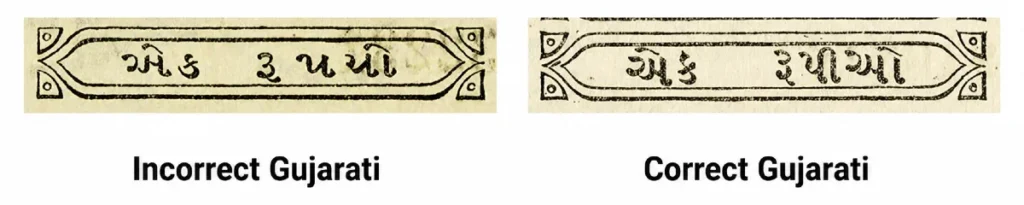
The original printing contained an incorrect Gujarati denomination inscription, which was corrected in subsequent printings. Collectors distinguish the original and corrected varieties by examining the Gujarati text in the language panel.
This is an inscription variety arising from the banknote design rather than an accidental misprint affecting an individual note. It illustrates how the increasing complexity of languages on Indian notes created distinctive and collectible varieties.
King George VI Banknotes: Changes in the Language Panel
The King George VI period, beginning in the late 1930s, marked an important transitional stage in the history of languages on Indian notes. Two developments were particularly significant: the replacement of Kaithi with Hindi in Devanagari script and the eventual removal of Burmese.
Replacing Kaithi with Hindi
One of the most important changes during the King George VI period was the replacement of the Kaithi-script entry with Hindi written in Devanagari. This reflected the growing use of Devanagari in official, educational and public contexts in northern India.
The early King George VI side-face portrait issues introduced in 1938 generally retained an eight-entry panel comprising Urdu, Hindi, Bengali, Burmese, Telugu, Tamil, Kannada and Gujarati.
Although the panel still contained eight entries, the replacement of Kaithi marked a significant change in the scripts represented on Indian currency. The development of languages on Indian notes was therefore not simply a matter of adding more entries, but also of changing the scripts used for existing denominations.
Removing Burmese from Indian Banknotes
Burma formally separated from British India on 1 April 1937. Nevertheless, Burmese continued to appear on certain early King George VI Indian banknotes, reflecting continuity with earlier currency designs.
Later King George VI issues introduced from 1944, including the 1 Rupee note and the front-face 5 and 10 Rupee notes, adopted a seven-language panel without Burmese.
The revised panel contained Urdu, Hindi, Bengali, Telugu, Tamil, Kannada and Gujarati.
The King George VI period therefore formed a bridge between colonial multilingual banknote designs and the expanded language panels introduced after Independence.
Ashoka Pillar Notes: The Early Republic India Banknote Language Panel
The introduction of the Ashoka Pillar series after Independence marked a major transformation in the history of languages on Indian notes. Colonial portraits were replaced by national symbols, while the language structure gradually evolved to reflect the administrative and constitutional framework of independent India.
During this period, Hindi moved to the obverse, Odia was introduced into the panel, denomination inscriptions were corrected, and the reverse panel eventually expanded to thirteen languages.
Early Republic Currency: Eight Languages
The earliest Republic India banknotes retained several structural features of late British India currency. English remained prominent on the obverse, while the reverse language panel initially contained eight languages: Urdu, Hindi, Bengali, Telugu, Tamil, Kannada, Gujarati and Odia.
Odia, historically referred to as Oriya, was a significant addition. Its inclusion expanded the linguistic representation of Indian banknotes beyond the preceding seven-language King George VI arrangement.
At this stage, the arrangement of languages on Indian notes was not completely standardised. Language positions and design details could differ between denominations, making the exact panel an important feature for collectors.
Hindi Moves to the Obverse
One of the most important developments of the early Republic period was the movement of Hindi from the reverse language panel to the obverse alongside English.
This transition occurred during the early 1950s, with the timing varying between denominations and printings. Once Hindi appeared on the obverse, it no longer needed to occupy a position within the reverse panel.
The revised reverse panel consequently contained seven languages: Bengali, Gujarati, Kannada, Odia, Tamil, Telugu and Urdu.
This change in the placement of languages on Indian notes established the basic arrangement still used on modern Indian banknotes: English and Hindi on the obverse, with additional languages grouped together on the reverse.
The Hindi Denomination Correction: Rupaya and Rupaye
Early Republic India banknotes contained an important Hindi inscription variety. Certain denominations above one rupee initially used the singular form रुपया (Rupaya), even though the plural form रुपये (Rupaye) was grammatically appropriate.
The wording was subsequently corrected, with changes appearing across different denominations and printings rather than through a single simultaneous redesign.
These Rupaya and Rupaye inscriptions are recognised catalogue varieties, not conventional printing errors affecting individual banknotes. They demonstrate how relatively small changes to languages on Indian notes can help distinguish different issues within the same series.
A notable example occurs on the Republic India 1000 Rupee note, where the earliest Ashoka Pillar type carries the incorrect Rupaya inscription and subsequent types use the corrected Rupaye wording.
Alphabetical Ordering of Languages
Another development during the Ashoka Pillar period was the adoption of a more systematic arrangement within the language panel.
Earlier British India and transitional Republic issues sometimes displayed languages in arrangements inherited from previous designs. Later panels increasingly followed a standard order, improving consistency across denominations.
The seven-language panel appeared in the following order: Bengali, Gujarati, Kannada, Odia, Tamil, Telugu and Urdu.
As the number of languages on Indian notes increased, this standardised ordering became increasingly important for maintaining a consistent and recognisable panel design.
Expansion to the Thirteen-Language Panel
The most significant linguistic expansion of the Ashoka Pillar period occurred during the 1960s with the introduction of a thirteen-language reverse panel.
This development closely reflected the original Eighth Schedule of the Constitution of India, which recognised fourteen languages. With Hindi already appearing on the obverse, the remaining thirteen scheduled languages were represented in the reverse panel.
The expansion of languages on Indian notes was especially significant because it extended representation to several languages that had not appeared in the earlier seven-language arrangement.
| Order | Language |
|---|---|
| 1 | Assamese |
| 2 | Bengali |
| 3 | Gujarati |
| 4 | Kannada |
| 5 | Kashmiri |
| 6 | Malayalam |
| 7 | Marathi |
| 8 | Odia |
| 9 | Punjabi |
| 10 | Sanskrit |
| 11 | Tamil |
| 12 | Telugu |
| 13 | Urdu |
This expansion brought the Indian banknote language panel into much closer alignment with the constitutional language framework. Assamese, Kashmiri, Marathi, Punjabi and Sanskrit were among the additions to the earlier seven-language arrangement.
Minor inscription corrections continued. A notable example is the Kashmiri inscription on early 20 Rupee notes introduced in 1972, which was subsequently corrected. Such changes are important to collectors because they distinguish different states of the printed design.
The thirteen-language arrangement remained a major feature of languages on Indian notes until the introduction of the Mahatma Gandhi series in 1996. Depending on the denomination and design, the panel could appear on either side of the note.
The Mahatma Gandhi Series and the Modern 17-Language System
The introduction of the Mahatma Gandhi Portrait Series in 1996 marked another major expansion of languages on Indian notes. Building on the thirteen-language system established during the Ashoka Pillar period, the new series introduced the familiar 17-language arrangement still used on modern Indian banknotes.
Under this arrangement, English and Hindi appear on the obverse, while fifteen additional languages appear in the reverse language panel.
Why the Language Panel Expanded in 1996
The expansion followed important constitutional developments, particularly the Constitution (Seventy-first Amendment) Act, 1992, which added Konkani, Manipuri and Nepali to the Eighth Schedule.
When the Mahatma Gandhi series was introduced, Konkani and Nepali were added to the banknote language panel. The reverse panel therefore increased from thirteen to fifteen languages, bringing the total displayed across each note to seventeen.
This expansion of languages on Indian notes reflected the continuing development of India’s constitutional language framework, although the banknote panel did not reproduce every scheduled language.
Manipuri was not included, and subsequent additions to the Eighth Schedule have not resulted in equivalent changes to the banknote panel.
Why Manipuri Was Not Included
One frequently asked question concerns the absence of Manipuri, also known as Meitei or Meiteilon, from the modern language panel.
Manipuri received constitutional recognition through the same 1992 amendment that added Konkani and Nepali. Nevertheless, only Konkani and Nepali were added to the banknote panel introduced in 1996.
No definitive official explanation for this particular exclusion has been established in the sources reviewed for this article. Although space, design continuity and other practical considerations may be relevant, they should not be presented as confirmed reasons for the decision.
The selection of languages on Indian notes is therefore best understood as a standardised currency design rather than a complete representation of the Eighth Schedule.
The 17 Languages on Modern Indian Currency Notes
The following table lists all seventeen languages on Indian notes today, together with their location and a brief explanation of their historical or geographical significance.
| Language | Position | Notes |
|---|---|---|
| English | Obverse | Official use; not included in the Eighth Schedule |
| Hindi | Obverse | Official language of the Union; moved from the reverse panel during the early Republic period |
| Assamese | Reverse | Associated with Assam; added during the thirteen-language expansion |
| Bengali | Reverse | Used in West Bengal, Tripura and other regions; represented since early multilingual issues |
| Gujarati | Reverse | Associated with Gujarat; represented since British India issues |
| Kannada | Reverse | Associated with Karnataka; represented since early language panels |
| Kashmiri | Reverse | Added during the thirteen-language expansion |
| Konkani | Reverse | Associated with Goa; added in 1996 |
| Malayalam | Reverse | Associated with Kerala; represented on early regional panels |
| Marathi | Reverse | Associated with Maharashtra; included in the thirteen-language panel |
| Nepali | Reverse | Associated with Sikkim and other Nepali-speaking communities; added in 1996 |
| Odia | Reverse | Associated with Odisha; introduced during the early Republic period |
| Punjabi | Reverse | Associated with Punjab; added during the thirteen-language expansion |
| Sanskrit | Reverse | Classical language; added during the thirteen-language expansion |
| Tamil | Reverse | Associated with Tamil Nadu; represented since early multilingual issues |
| Telugu | Reverse | Associated with Andhra Pradesh and Telangana; represented since early multilingual issues |
| Urdu | Reverse | Represented continuously across major historical panel systems |
The fifteen languages in the reverse panel are arranged in a fixed sequence. This standardisation makes the panel immediately recognisable across modern Indian denominations.
The Eighth Schedule now recognises twenty-two languages, following the addition of Bodo, Dogri, Maithili and Santhali through the Constitution (Ninety-second Amendment) Act, 2003. These later additions did not change the established fifteen-language banknote panel.
Consequently, the seventeen languages on Indian notes have remained consistent across the Mahatma Gandhi series and the later Mahatma Gandhi New Series, despite changes in denominations, security features and overall banknote design.
Why Languages on Indian Notes Matter to Paper Money Collectors
For collectors, languages on Indian notes are more than decorative design elements. They provide useful evidence of a note’s historical period, design type and sometimes its exact catalogue variety.
Changes in scripts, denomination inscriptions, panel size and placement can distinguish banknotes that otherwise appear almost identical.
Identifying Banknote Periods Through Language Panels
The evolution of languages on Indian notes provides a convenient way to identify major stages in Indian banknote history. The following table summarises the principal changes from British India uniface notes to the modern Mahatma Gandhi series.
| Banknote Type or Period | Language Panel | Principal Feature |
|---|---|---|
| Green underprint uniface | Regional four-language panels | Language combinations vary by issuing circle |
| Later green underprint 5 Rupees | Six languages | Early standardised arrangement |
| Early red underprint 5 Rupees | Six languages | Continuation of the standardised panel |
| Later red underprint uniface | Eight languages | Includes Kaithi and Burmese |
| King George V | Eight languages | Generally on reverse; 1935 ₹1 exception |
| Early King George VI | Eight languages | Hindi replaces Kaithi; Burmese retained |
| Later King George VI | Seven languages | Burmese removed |
| Early Ashoka Pillar | Eight languages | Odia added; Hindi initially on reverse |
| Ashoka Pillar transition | Seven languages | Hindi moves to obverse; Rupaya/Rupaye varieties |
| Later Ashoka Pillar | Thirteen languages | Expanded constitutional representation |
| Mahatma Gandhi series | Fifteen languages | Seventeen languages in total, including English and Hindi |
This table provides a general guide rather than an exact dating method. Language changes were introduced at different times across denominations, and some earlier designs continued alongside newer arrangements.
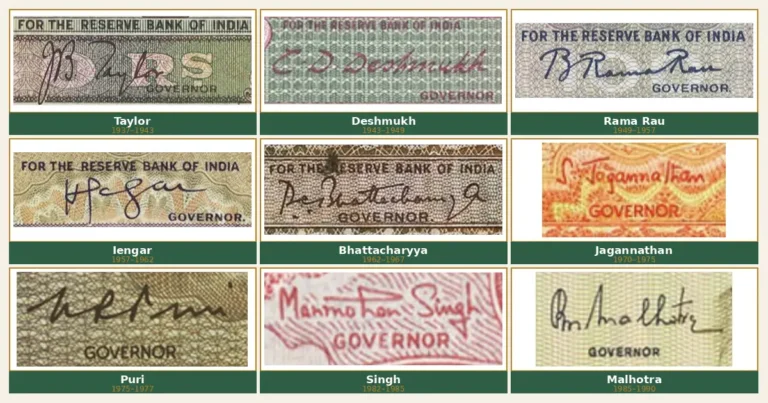
Collectors should therefore examine the languages on Indian notes together with the portrait, denomination, watermark, signature and serial prefix. For information on signatories, see our RBI Governor List.
Language Errors and Inscription Varieties
Some of the most interesting Indian banknote varieties involve changes to denomination inscriptions rather than conventional printing defects.
Examples include the corrected Gujarati inscription on the 1917 King George V 1 Rupee note, the Rupaya/Rupaye Hindi correction on early Republic India notes, and the corrected Kashmiri inscription on certain 1972 20 Rupee issues.
These examples show how variations in languages on Indian notes can identify distinct catalogue types, even when the portrait, colour and general design remain unchanged.
Such varieties generally result from changes to the prepared design or printing plates. They should be distinguished from accidental production errors such as missing ink, misalignment or printing folds.
For a broader explanation of genuine production defects, see our guide to Indian Banknote Errors.
India’s Language Panels in Global Context
Indian currency notes are remarkable for the number of languages displayed simultaneously and for the continuity of their multilingual design. Many countries use one or two languages on banknotes, while some multilingual states include several official or regional languages.
The seventeen languages on Indian notes are especially notable because this arrangement developed through successive historical stages rather than being introduced as a single comprehensive design. Its evolution reflects changes in administrative geography, national identity and constitutional recognition.
Although comparisons with other countries depend on how languages and scripts are counted, India’s modern banknotes are among the most linguistically diverse examples of circulating paper currency.
For collectors, the history of languages on Indian notes offers a distinctive way to trace more than a century of Indian monetary history through a relatively small but historically revealing part of the banknote design.
Conclusion
The history of languages on Indian notes reveals how banknote design evolved alongside the country’s political, administrative and constitutional development. Government of India uniface notes introduced regional multilingual panels, while later British India issues established more standardised arrangements.
After Independence, the Ashoka Pillar series transformed these inherited systems through the introduction of Odia, the movement of Hindi to the obverse, the correction of denomination inscriptions and the expansion to thirteen panel languages.
The Mahatma Gandhi series completed the transition to the modern seventeen-language format, with English and Hindi on the obverse and fifteen languages on the reverse. For collectors, the changing languages on Indian notes remain valuable tools for identifying historical types, inscription varieties and important stages in the development of Indian paper currency.
Frequently Asked Questions
How many languages are written on Indian currency notes today?
Modern Indian banknotes display seventeen languages in total. English and Hindi appear on the obverse, while fifteen additional languages appear in the reverse language panel.
Why are there so many languages on Indian notes?
The multiple languages on Indian notes reflect the country’s linguistic diversity and help make denominations recognisable across different regions. The panel also reflects the historical development of Indian currency and the broader representation of regional languages.
What is the language panel on Indian banknotes?
A language panel is a designated section of a banknote containing the denomination in several languages. On modern Indian banknotes, the panel appears on the reverse and contains fifteen languages.
Why is Hindi not included in the reverse language panel?
Hindi already appears on the obverse alongside English. During the early Republic period, Hindi moved from the reverse language panel to the front of the note, allowing the panel to accommodate additional languages.
When were language panels first introduced on Indian currency?
Structured regional language panels appeared on Government of India uniface banknotes from 1867. The earliest arrangements varied according to the issuing circle before later becoming more standardised.
Which languages appeared on the earliest language panels?
Early regional panels included combinations of Urdu, Marathi, Gujarati, Kannada, Hindi, Kaithi, Bengali, Telugu, Tamil, Malayalam, Burmese and Chinese, depending on the issuing circle. Kaithi is more accurately described as a script rather than a separate modern language.
Why did Burmese appear on Indian banknotes?
Burmese appeared because Burma was administered as part of British India until 1937. It remained on certain early King George VI notes before being removed from later designs.
Why does the modern language panel contain fifteen languages instead of all scheduled languages?
The modern panel is a standardised banknote design rather than a complete reproduction of the Eighth Schedule. Although the Constitution currently recognises twenty-two scheduled languages, the reverse banknote panel continues to display fifteen.
Why was Manipuri not included on Indian currency notes?
Manipuri was added to the Eighth Schedule in 1992 alongside Konkani and Nepali, but it was not included in the fifteen-language panel introduced with the Mahatma Gandhi series. A definitive official explanation for its exclusion has not been established.
Which country has the most languages on its currency?
India is widely recognised for having one of the most multilingual modern banknote systems, displaying seventeen languages across its currency notes. Exact international rankings depend on whether separate languages, scripts and repeated inscriptions are counted in the same way.