
INDIAN PAPER MONEY REFERENCE
Indian Banknote Glossary
Explore our Indian Banknote Glossary and understand the language of Indian paper money. Discover essential terms covering British India, Republic India, printing techniques, signatures, watermarks, grading, serial numbers, rare varieties and banknote values.
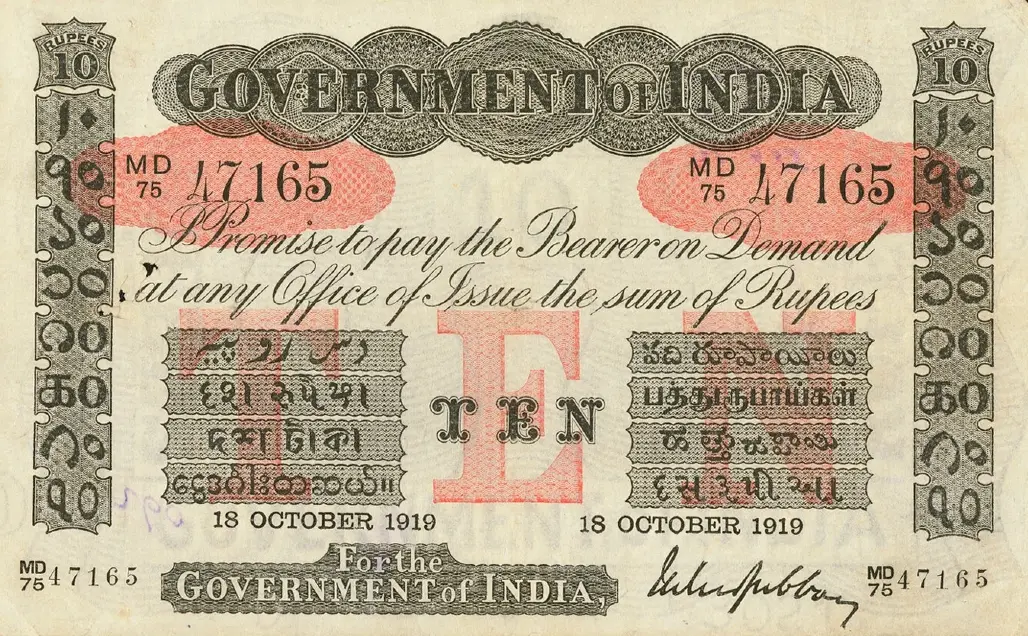
A REFERENCE FOR INDIAN BANKNOTE COLLECTORS
Understanding Indian Paper Money Terms
Banknote collecting, also known as notaphily, involves much more than identifying denominations and dates. Collectors regularly encounter specialist terminology relating to issuing authorities, serial prefixes, signatures, watermarks, printing techniques, condition, authenticity and rarity.
This comprehensive Indian Banknote Glossary explains important numismatic terms in clear language, with examples relevant to British India, British Burma, Republic India, Hyderabad, Pakistan overprints, Persian Gulf Rupees and other historically connected currency issues.
Understanding these terms is especially important when identifying older Indian banknotes. Two notes of the same denomination may differ in their signatures, watermarks, serial number prefixes, printing characteristics or issuing authorities. Such differences can determine whether a banknote is a common variety or a considerably scarcer collectible.
The glossary is arranged into eight collecting categories, with terms listed alphabetically within each category. You can browse individual subjects using the navigation below or follow direct links to particular definitions from our collecting articles.
Use this reference alongside our banknote grading guide and other Indian banknote collecting articles. Terminology and catalogue conventions may vary between publishers, dealers, auction houses and grading services.
Browse Glossary Topics
THE FUNDAMENTALS
Banknote Types & Formats
Essential Indian paper money terms describing banknote types, denominations, issuing authorities and physical formats.
- Banknote
- Paper or polymer currency issued under the authority of a government, central bank or other authorized institution and intended for use as money. Banknotes typically display a denomination and distinctive designs that identify the issuing authority.
- Bundle
- A group of banknotes held together, commonly comprising 100 notes in banking and collecting terminology. Bundles may contain consecutive serial numbers, although the exact quantity and packaging should always be confirmed.
- Cancelled Note
- A banknote marked or physically altered to indicate cancellation, sometimes through perforation, stamping, cutting or writing. Officially cancelled notes may have specialist historical interest. Cancellation is not necessarily the same as demonetisation.
- Counterfeit
- An unauthorized imitation of a genuine banknote made to deceive. Collectors distinguish contemporary counterfeits created during a note’s circulation period from later forgeries intended to deceive collectors. Some historical counterfeits are themselves studied as numismatic material.
- Demonetised Note
- A banknote whose legal tender status has been withdrawn by the relevant authority. Demonetisation does not necessarily eliminate historical or numismatic value. Certain demonetised Indian notes remain collectible, although their ownership and trade may be subject to applicable law.
- High-Denomination Note
- A banknote with a relatively large face value. Historic Indian examples include 1,000, 5,000 and 10,000 Rupee notes. Collectibility depends on the exact issue, surviving population, condition and collector demand.
- Legal Tender
- Currency legally recognized for discharging monetary obligations, subject to applicable laws and denomination-specific limitations. The legal tender status of historical notes must be distinguished from their value to collectors.
- Private Banknote
- Paper money issued by a private or commercial bank rather than a central bank or treasury. Early private banking issues form an important part of Indian paper money history, preceding the later centralized system of government currency issuance.
- Treasury Note
- Currency issued on behalf of a government rather than as a central bank liability. India’s One Rupee notes are issued by the Government of India and are distinguished from other Indian banknote denominations issued by the Reserve Bank of India.
- Uniface Note
- A banknote printed on one side only, leaving the opposite side blank. Early Government of India issues include notable uniface banknotes, particularly from the nineteenth and early twentieth centuries. These notes are an important specialty within British India paper money collecting.
- Unissued Note
- An authentic banknote prepared for possible issue but never officially released for general circulation. Unissued notes should be distinguished from specimens, proofs and ordinary notes withdrawn before circulation.
BANKNOTE PRODUCTION
Printing & Security Features
Technical terminology used to describe Indian banknote production, engraving, security features and design characteristics.
- Guilloche
- Intricate interlacing geometric lines used in banknote designs. Guilloche patterns are difficult to reproduce accurately and contribute to the visual complexity of security printing.
- Intaglio Printing
- A printing process using recessed engraved surfaces. Ink transferred under pressure can create the raised tactile effect associated with many security banknotes. Intaglio engraving is especially important when examining fine portrait and ornamental details.
- Language Panel
- A group of inscriptions displaying a banknote’s denomination in different languages. The language panel is a distinctive characteristic of many Republic India banknotes and can help collectors identify designs and historical series.
- Latent Image
- A concealed design or numeral that becomes visible from certain viewing angles. Latent images are commonly created through specialized printing techniques and are used as security features.
- Lithography
- A planographic printing process in which images are transferred from a prepared printing surface. Lithographic techniques have been used to produce banknote backgrounds, colored underprints and intricate design elements.
- Microprinting
- Extremely small printed letters, numerals or patterns that may require magnification to examine. Microprinting can help distinguish genuine security printing from lower-quality reproductions.
- Obverse
- The front or principal face of a banknote. On portrait issues of British India, the obverse normally contains the monarch’s portrait and principal identifying information.
- Optically Variable Ink (OVI)
- Specialized security ink that changes its apparent color when a banknote is tilted. The effect depends on the viewing angle and helps authenticate certain modern issues.
- Printer’s Imprint
- Printed identification of the company or institution responsible for manufacturing a banknote, where such information appears. Printer identification can assist historical research and the study of printing varieties.
- Reverse
- The back of a banknote, which may display additional illustrations, denomination text, security features or inscriptions. Some early Indian uniface notes have no printed reverse design.
- Security Thread
- A protective strip incorporated into banknote paper or substrate. Depending on its construction, it may appear as a continuous line when held against light or as visible sections on the surface.
- See-Through Register
- Complementary parts of a design printed on opposite sides of a banknote. When viewed against light, the two parts align to form a complete image or symbol.
- Underprint
- Background printing applied beneath the principal banknote design. Variations in underprint colors and patterns can distinguish collectible Indian banknote types. Green and red underprint varieties are particularly familiar subjects to collectors of historical Indian Five Rupees notes.
- Watermark
- A design created through variations in paper thickness during manufacture. It becomes more visible when examined against transmitted light. Watermarks are important for authentication and for distinguishing certain Indian banknote varieties.
CONDITION & PRESERVATION
Banknote Grading & Condition
Understand grading terminology used by collectors, professional grading services, dealers and numismatic auction houses.
- About Uncirculated (AU)
- A banknote showing relatively limited handling or folding compared with a fully uncirculated example. PMG uses AU grades 50–58. Original paper quality and the nature of any folds remain important considerations.
- Choice Uncirculated
- A higher-quality uncirculated banknote, typically corresponding to PMG numerical grades 63 and 64. Notes in this category generally exhibit strong eye appeal without circulation folds.
- Exceptional Paper Quality (EPQ)
- A designation used by PMG for banknotes whose paper quality is considered original and has not been artificially processed to improve their apparent grade. Normal wear consistent with the assigned numerical grade may still be present.
- Extremely Fine (EF/XF)
- A banknote with moderate signs of handling and relatively limited folding. PMG assigns numerical grades 40 and 45 to Extremely Fine notes.
- Foxing
- Yellowish or brown spotting that develops on paper. Foxing may be associated with moisture, oxidation and long-term storage conditions. It can affect appearance, grading and market desirability.
- Gem Uncirculated
- A premium uncirculated classification beginning at numerical grade 65. Higher Gem grades reflect increasingly demanding standards of centering, appearance and overall quality.
- NET Grade
- A designation used by PMG when significant problems cannot be adequately conveyed by the numerical grade alone. The holder may identify relevant impairments or other condition concerns.
- Original Embossing
- Raised printing impressions and paper deformation resulting from the original production process. Embossing may provide useful evidence of originality when evaluating a banknote.
- Spindle Hole
- A hole produced when notes are placed on a pointed accounting or storage spindle. Such holes are a form of physical damage but may also reflect historical banking practices.
- Staple Holes
- Small holes caused by staples, historically associated with the bundling and distribution of certain Indian banknotes. Their effect on the grade depends on their origin, condition and surrounding damage.
- Third-Party Grading
- Independent authentication, condition assessment and encapsulation performed by a specialized company such as PMG or PCGS. Professional grading provides useful information but does not establish a fixed market value.
- Uncirculated (UNC)
- A banknote without circulation folds, although minor handling, centering imperfections or other limitations may be present. PMG numerical grades 60–62 are classified as Uncirculated, with higher grades receiving Choice or Gem designations.
- Very Fine (VF)
- A circulated banknote exhibiting noticeable folds and wear while retaining generally recognizable details and sound paper. Very Fine is a widely encountered condition category for older collectible banknotes.
- Washed or Pressed Note
- A banknote subjected to cleaning, flattening or other treatments that may alter its original paper characteristics. Processing can reduce collector desirability, especially where originality is highly valued.
For a deeper explanation of grading, read our How to Grade Banknotes guide and explore the Banknote Grading Scale for numerical grades, paper quality designations and professional grading terminology. Our banknote preservation guide explains safe storage and handling.
NUMBERS & VARIETIES
Serial Numbers & Prefixes
Learn about numbering systems, special serial patterns and production identification codes found on Indian banknotes.
- Binary Number
- In collector terminology, a serial number consisting of only two distinct digits. Strictly speaking, a binary numeral contains only zeros and ones, but collecting usage is often broader.
- Fancy Serial Number
- A banknote serial number displaying a distinctive or desirable numerical pattern, such as a radar, repeater, solid or ladder sequence. Collector demand varies significantly between patterns. For examples, see our Fancy Serial Number Banknotes guide.
- Inset Letter
- A letter incorporated into the numbering area of certain Indian banknotes. It functions as part of the production identification system and may help distinguish printing varieties.
- Ladder Number
- A serial number containing consecutive ascending or descending digits, such as 123456 or 654321. Complete ladder sequences are generally more distinctive than partial sequences.
- Low Serial Number
- A serial number close to the beginning of a particular production sequence, often containing several leading zeros. Its desirability depends on the issue and the exact number.
- Prefix
- One or more letters or numerals appearing before a banknote’s serial number. Prefix configurations help identify production blocks, issue varieties and certain scarce Indian banknotes.
- Radar Number
- A palindromic serial number that reads identically forward and backward, such as 123321. Radar notes are a popular fancy serial number category.
- Repeater Number
- A serial number in which a sequence of digits repeats, such as 456456 or 343434. The pattern and length determine the particular repeater classification.
- Replacement Note / Star Note
- A note produced to replace an unsuitable banknote during the production process. Certain modern Indian replacement notes display a star symbol within the serial numbering sequence.
- Serial Number
- A sequence of numerals, sometimes accompanied by letters, identifying a banknote within a particular production series. Serial number formats differ between historical Indian currency issues.
- Solid Number
- A serial number consisting entirely of the same digit, such as 888888 or 111111. Complete solid numbers are among the more recognizable fancy serial number patterns.
- 786 Serial Number
- A banknote serial number featuring the digits 786, which have cultural and religious significance for some collectors. The presence of these digits alone does not establish scarcity or high market value.
Discover more in our Fancy Serial Number Banknotes guide and 786 Number Note Price article.
SPECIAL PRODUCTION MATERIAL
Specimens, Proofs & Unissued Notes
Terminology relating to banknote design development, sample production, printer records and non-circulating issues.
- Color Trial
- A test impression produced to examine alternative ink colors or combinations during banknote design development. Color trials may differ substantially from the final issued notes.
- Die Proof
- An impression taken directly from an engraved die to assess the quality of the engraving. Die proofs may show individual design components rather than a complete banknote.
- Essay
- A proposed banknote design or design element not adopted in its submitted form. Essays provide insight into the development of currency artwork and unissued design proposals.
- Printer’s Model
- A proposed banknote design assembled using artwork, printed elements, photographs or other production material. Models may be used to demonstrate possible designs before final approval.
- Proof Note
- A test impression produced to examine a proposed design, engraving or printing stage before full production. Proofs can differ from ordinary issued currency in paper, printing or completion details.
- Remainder
- An authentic unused note remaining from the issuing process, sometimes lacking signatures, dates or serial numbers required for issuance. Remainders should not be confused with counterfeit or reproduced notes.
- Specimen Note
- A banknote prepared for reference, training, official distribution or other non-circulation purposes. Specimens may feature special numbering, overprints, perforations or other distinctive markings.
- Specimen Overprint
- A word or marking such as SPECIMEN printed onto a banknote to identify it as a sample rather than an ordinary circulating note. The appearance and placement of markings vary by issue.
- Uniface Proof
- A proof printed on only one side of a sheet or note. Unlike an officially issued uniface banknote, its purpose relates to testing or approving a design.
PRODUCTION VARIETIES
Printing Errors & Overprints
Learn to distinguish production errors from official overprints, surcharges and deliberate changes to banknote designs.
- Double Printing
- A duplicated printed impression caused by an unintended repeated or misregistered printing operation. Genuine double printing errors must be distinguished from ordinary ink doubling, shadows and artificial alterations.
- Inverted Overprint
- An overprint accidentally applied upside down relative to the underlying banknote. Authentication is especially important because overprints can sometimes be altered or reproduced after issuance.
- Inverted Watermark
- A watermark appearing in an unexpected orientation relative to the printed design. Whether it represents a recognized error depends on the particular issue and its normal production characteristics.
- Miscut
- A banknote cut incorrectly from its printed sheet, resulting in irregular margins, misplaced designs or portions of adjacent notes appearing on the same piece.
- Mismatched Serial Numbers
- A numbering error in which different serial numbers appear in positions that should ordinarily match on the same banknote.
- Missing Print
- An error where one or more printing stages have been omitted, causing portions of the intended design to be absent. Missing serial numbers or background colors are possible examples.
- Overprint
- Additional text, symbols or markings printed onto an existing banknote. Overprints may identify a new issuing authority, circulation region or special purpose, as seen on certain Indian-related historical currency issues.
- Printing Error
- An unintended mistake occurring during banknote manufacture, printing, numbering or cutting. Genuine printing errors may be collected as distinctive varieties, although rarity and desirability vary considerably. Learn more in our Indian banknote errors guide.
- Provisional Overprint
- A temporary official marking used when existing banknotes are adapted for a new purpose or monetary arrangement. Provisional issues often reflect transitional historical or administrative circumstances.
- Surcharge
- An overprint that changes the stated denomination or face value of a banknote. A surcharge differs from an overprint that merely identifies a new authority or circulation territory.
INDIAN CURRENCY HISTORY
Historical Indian Banknote Terminology
Important issuing authorities, monetary periods, regional issues and historical terms relevant to Indian currency collectors.
- British Burma
- The colonial Burmese monetary collecting area, encompassing Indian currency used in Burma and subsequent Burma-specific banknote issues. British Burma is an important field for collectors of Indian-related colonial paper money.
- Circle of Issue
- A regional system historically used in British India to regulate the issue and redemption of government currency notes. Certain early notes bear identifying features connected to their circle of issue.
- Dominion of India
- The period between Indian independence in August 1947 and the establishment of the Republic in January 1950. Banknotes associated with this transitional period are a significant historical collecting subject.
- Finance Secretary Signature
- The signature of an authorized government official appearing on Government of India One Rupee notes. This differs from RBI banknotes bearing the Reserve Bank Governor’s signature.
- French India
- Former French-administered territories in India associated with distinctive colonial monetary arrangements. Their paper money forms part of the broader historical study of currency issued or circulated in the subcontinent.
- Government of India Notes
- Paper currency issued under Government of India authority. These include important early uniface notes and the later One Rupee denomination. Government-issued notes must be distinguished from the Reserve Bank’s own liabilities.
- Haj Notes
- Special Indian banknotes issued for pilgrims travelling to Saudi Arabia. These notes were intended for specific overseas use and are a distinctive category of Indian currency used abroad.
- Hundi
- A traditional Indian financial instrument used in commerce, credit and remittance. Hundis predate the widespread adoption of modern banknotes and provide important context for the history of Indian financial transactions.
- King George V Issue
- Indian or related colonial banknotes featuring King George V, whose reign lasted from 1910 to 1936. Portraits, signatures, denominations and watermarks distinguish collectible examples of these issues.
- King George VI Issue
- Colonial Indian banknotes featuring King George VI. Some remained in use or were adapted during the transition to independence. The series includes important wartime and postwar varieties.
- Osmania Sicca
- The monetary system associated with Hyderabad State under the Nizams. Hyderabad issued distinctive paper currency denominated in its own Rupees, making it an important princely state collecting field.
- Pakistan Overprint
- Pakistan’s provisional banknotes of 1948 were based on King George VI Indian designs, with Government of Pakistan inscriptions in English and Urdu incorporated into modified printing plates. Although commonly called Pakistan overprints, the inscriptions were not subsequently applied to completed Indian banknotes. These issues document the monetary transition following Partition in 1947.
- Persian Gulf Rupees
- Special Indian currency notes introduced in 1959 for circulation in designated Persian Gulf territories. The One Rupee note was issued by the Government of India, while the 5, 10 and 100 Rupees denominations were issued by the Reserve Bank of India. These distinctive Z-prefix notes are an important collecting category within the history of Indian currency used overseas.
- Portuguese India
- Former Portuguese territories in India, including Goa, associated with distinctive monetary units and banknotes issued by Banco Nacional Ultramarino. These notes form a separate colonial currency collecting area.
- Presidency Banknotes
- Notes associated with the Presidency Banks of Bengal, Bombay and Madras before the establishment of centralized government paper currency issuance. Surviving examples are important artifacts of India’s early banking history.
- Republic India Banknotes
- Banknotes associated with the Republic of India, established on 26 January 1950. Republic India notes encompass numerous denominations, signatures, designs and collectible varieties.
- Reserve Bank of India (RBI)
- India’s central bank, which commenced operations in 1935. Its banknote issues and Governors’ signatures form major areas of Indian paper money collecting.
- RBI Governor Signature
- The printed signature of the Reserve Bank Governor appearing on RBI banknotes. Different Governors’ signatures distinguish otherwise similar notes and are frequently used in cataloguing Indian banknote varieties.
For further historical information, explore the Reserve Bank of India Monetary Museum.
RESEARCH & MARKET VALUES
Banknote Catalogues, Rarity & Values
Understand the terminology used in numismatic catalogues, population reports, auctions, pricing and market research.
- Catalogue Number
- An identifier assigned to a particular banknote issue or variety in a published numismatic reference. Catalogue numbers help collectors distinguish notes with similar designs.
- Catalogue Value
- An estimated value listed in a printed or digital numismatic reference. Catalogue values may differ substantially from current auction realizations, dealer prices and private transaction values.
- Hammer Price
- The successful bid at an auction before the addition of buyer’s premium, taxes and other applicable charges. Auction results should be compared on a consistent basis.
- J&R Number
- A catalogue reference associated with the work of Jhunjhunwalla and Razack, widely consulted by collectors for identifying Indian paper money types and varieties.
- Market Value
- The price a banknote might realistically achieve under prevailing market conditions. Market value reflects the specific issue, condition, originality, scarcity and level of collector demand.
- Pick Number
- A reference identifier from the Standard Catalog of World Paper Money. Pick numbers are commonly used in international banknote descriptions, auctions and dealer listings.
- Population Report
- Data published by a grading company showing how many examples of a particular banknote have been certified at different grades. These figures reflect certification submissions rather than the total surviving population.
- Provenance
- The documented ownership history of a banknote. Provenance may include previous collectors, important collections, auction appearances and historical records.
- Rarity Index
- A system describing relative scarcity, sometimes using terms such as Common, Uncommon, Scarce, Rare and Very Rare. Rarity classifications are not completely standardized between catalogues or dealers.
- Top Population (Top Pop)
- A certified banknote holding or sharing the highest recorded grade for its defined issue within a grading company’s published population data. The reported position can change as additional examples are certified.
- Want List
- A collector’s list of desired banknotes, usually specifying denomination, issue, signature, variety, condition and approximate purchasing budget.
Read our Understanding Banknote Values guide or consult the PMG Population Report.
PRACTICAL COLLECTING ADVICE
How to Use This Indian Banknote Glossary
The Indian Banknote Glossary is intended as a starting point for accurately identifying and describing collectible currency. When examining an unfamiliar note, begin by establishing its issuing authority, denomination and general historical period.
Next, examine its signatures, watermark, prefix format, serial number and printing characteristics. Compare these details with reliable numismatic catalogues and reference photographs. Even relatively minor differences may indicate a separate catalogue variety or a scarcer issue.
Condition is equally important. Examine folds, paper quality, stains, tears, repairs and signs of washing or pressing. A genuine banknote may still command a lower market price if its condition has been significantly affected.
Finally, remember that identification, rarity and market value are separate considerations. An old note is not automatically rare, and a scarce variety does not always command a substantial price unless collectors actively seek it.
Use the terminology in this guide alongside specialist catalogues, recognized grading references, auction records and relevant historical research.
CONTINUE YOUR RESEARCH
Indian Banknote Collector Resources
Explore our related collecting guides to develop a deeper understanding of Indian currency, grading, identification and rare varieties.
How to Grade Banknotes
Understand condition, folds, paper originality, alterations and grading terminology.
Read Guide → SERIAL NUMBERSFancy Serial Number Notes
Discover radar numbers, repeaters, ladders, solids and other desirable serial patterns.
Read Guide → HISTORICAL RESEARCHIndian Banknote Guides
Explore British India, British Burma, Republic India, printing varieties and monetary history.
Explore Guides →QUESTIONS ABOUT INDIAN BANKNOTES?
Explore, Collect & Learn
Our Indian Banknote Glossary is designed to support your collecting journey. Whether researching an unfamiliar term, identifying a rare historical issue or considering selling a collection, explore our resources or contact our specialists.