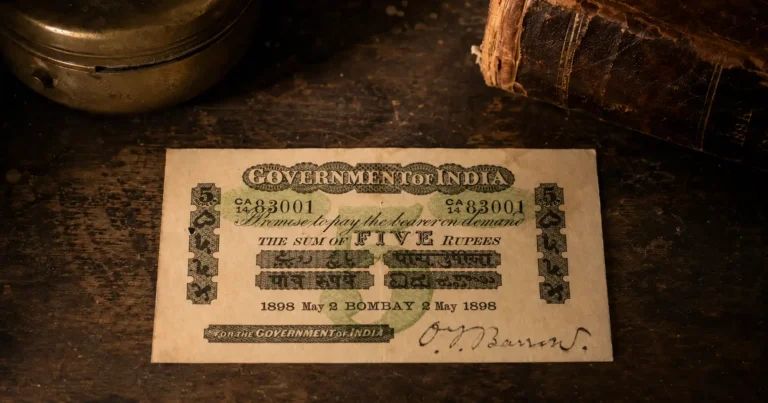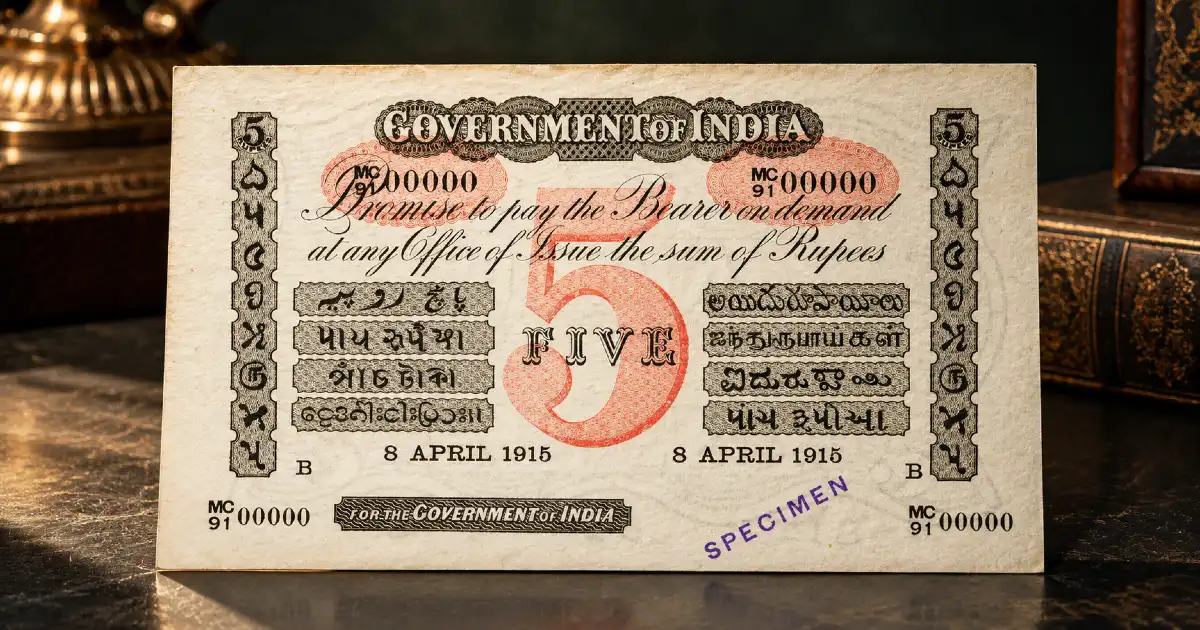
The India Red Underprint 5 Rupee uniface note represents an important chapter in the development of British India paper currency. Introduced during the early twentieth century, these Government of India banknotes reflect the transition from geographically restricted redemption to a more unified system of paper currency circulation across British India and Burma.
Distinguished by their red security underprint, intricate engraving and multilingual denomination panels, these notes were produced in several varieties. Differences in their language panels, serial-number arrangements, issuing-circle initials and official signatures provide collectors with an extensive field of study.
The Red Underprint series followed the earlier Green Underprint 5 Rupee uniface notes, which reflected the regional currency arrangements of the nineteenth century. The introduction of red-underprint notes was associated with significant changes in redemption rights and currency administration.
Collectors can distinguish four principal identification groups: the 6 Language Panels variety, the 8 Language Panels variety with four serial numbers, the 8 Language Panels variety with three serial numbers and circle initials, and the corresponding three-serial-number variety without circle initials.
In The Banknote Book, these are classified under three main catalogue types: BNB B130, B131 and B132. Each has additional sub-varieties based on issuing circles, signatures and other distinguishing features.
This guide examines the history, design characteristics, language panels, issuing circles, signatures, serial-number formats and catalogue varieties of the Red Underprint 5 Rupee note. Detailed tables are included to help collectors identify individual varieties.
Table of Contents
Historical Background of the Red Underprint 5 Rupee Note
The establishment of the Government of India paper currency system marked an important change in British Indian monetary administration. Following the Paper Currency Act of 1861, the Government assumed the monopoly over paper currency issuance previously exercised by the presidency banks.
The early government notes were issued through designated currency circles, with redemption arrangements linked to particular offices. These restrictions reflected the administrative and logistical requirements of a monetary system operating across a vast territory.
The introduction of the 5 Rupee denomination during the nineteenth century brought government paper currency to a lower face value than the original higher-denomination notes. Nevertheless, the system of geographically defined issuing circles continued to influence how these notes circulated and where they could be redeemed.
During the early twentieth century, legislative reforms gradually expanded the legal tender and redemption arrangements for Government of India currency. These changes were particularly significant for the 5 Rupee denomination.
From Green Underprint to Red Underprint
The earlier Green Underprint 5 Rupee notes were associated with specific currency circles and were produced with different regional language-panel arrangements.
Under reforms beginning in 1903, the geographical restrictions applicable to certain 5 Rupee notes were relaxed. Notes issued outside Burma became payable at other eligible offices of issue, although Burma initially remained subject to separate arrangements.
The red underprint distinguished these more widely redeemable notes from their green-underprint predecessors. The earliest Red Underprint variety retained six language panels and the established system of identifying issuing circles.
The change therefore represented more than a modification of the note’s appearance. It reflected an important stage in the development of a more integrated paper currency system.
The Move Toward Universal Currency
Subsequent reforms expanded the geographical scope of the currency system. The relevant notes eventually became payable at any office of issue, including offices in British Burma.
This development is commonly described as the universalization of Indian paper currency. Instead of having redemption rights restricted to particular offices or regions, notes could be presented for payment throughout the wider currency system.
The Reserve Bank of India’s historical account explains that the universalization of several denominations, including 5 Rupees, occurred progressively between 1903 and 1911.
For the official historical background, see the Reserve Bank of India’s history of British India paper money.
The Significance of British Burma
Burma was administered as part of British India during the period in which the Red Underprint 5 Rupee notes were issued. Rangoon was an important currency centre and was represented by its own issuing-circle designation.
This administrative relationship explains why Rangoon varieties appear in the India chapter of The Banknote Book, while related references are found in the Burma section of the Standard Catalog of World Paper Money.
Collectors should therefore understand that an Indian BNB number and a Burma Pick reference may identify the same historical banknote rather than separate issues.
Printing, Paper and Design Characteristics
The Red Underprint 5 Rupee banknotes share several important production characteristics. Understanding these common features provides a foundation for identifying the individual varieties.
Printing and Dimensions
The notes were printed by the Bank of England in London. They feature black printing combined with a red security underprint and measure approximately 176 × 108 mm.
These dimensions are common to the three principal catalogue types, B130, B131 and B132. Consequently, size alone is not sufficient to distinguish them.
The designs incorporate elaborate ornamental engraving, multilingual denomination panels and printed information associated with Government of India currency.
Uniface Printing
The term uniface means that the banknote is printed on only one side. The reverse of the Red Underprint 5 Rupee note is blank.
The principal design, denomination, serial-number impressions and signature therefore appear on the front. This differs from later King George V and King George VI banknotes, which generally have printed designs on both sides.
Watermark and Security Features
All three catalogue types have a watermark consisting of wavy lines and the inscription INDIA / 5 RUPEES 5.
The notes do not contain a security thread. Their principal security characteristics include specialized paper, the watermark, intricate engraving and the coloured underprint.
The watermark is particularly important when examining authenticity because it forms part of the paper rather than an ordinary printed element.
Signatures and Serial Numbers
Different currency officials signed the Red Underprint notes. Their signatures are important identifying characteristics and form the basis of many catalogue sub-varieties.
The serial-number arrangements also changed during the series. B130 and B131 have four serial-number impressions, while B132 has three.
Issuing-circle initials and prefixes provide additional identification clues. However, a prefix alone should not be used to attribute a note without considering its design, signature and numbering arrangement.
Red Underprint 5 Rupee Notes: Main Varieties
Although The Banknote Book classifies the series under three principal BNB types, collectors can distinguish four practical identification groups based on language panels, serial numbers and issuing-circle initials.
| Variety | Language Panels | Serial Numbers | Circle Initials | BNB | Pick |
|---|---|---|---|---|---|
| Early Red Underprint | 6 | 4 | Yes | B130 | India PA4 |
| Universal Issue | 8 | 4 | Yes | B131 | India PA5 / Burma PA4 |
| Revised Three-Number Issue | 8 | 3 | Yes | B132 | India PA6 / Burma PA4 |
| Three-Number Issue Without Circle Initials | 8 | 3 | No | B132 | India PA6 |
Catalogue note: BNB refers to The Banknote Book by Owen W. Linzmayer. Pick references follow the Standard Catalog of World Paper Money. The B132 varieties with and without circle initials share the same principal BNB number but are distinguished at the sub-variety level.
6 Language Panels Variety
Catalog: Banknote Book B130; Pick PA4
The 6 Language Panels variety is the earliest principal Red Underprint 5 Rupee design. It retains important features of the preceding Green Underprint series while introducing the red security underprint and revised redemption wording.
Promissory Text and Redemption Rights
The promissory wording specifies payment at an office of issue not situated in Burma. This restriction reflects the intermediate stage between the earlier geographically limited currency system and the fully universal arrangements introduced subsequently.
Accordingly, B130 should not be described as fully universal currency covering every issuing office in British India and Burma. Its redemption wording expressly preserves an exclusion relating to Burma.
Six Language Panels
Six language panels are arranged in two rows of three, using a standardized combination across the relevant issuing circles.
- Top row: Urdu, Bengali and Telugu.
- Bottom row: Kaithi, Kannada and Tamil.
The use of six standardized panels continued a design development already visible in the later Green Underprint 5 Rupee issues.
For the broader evolution of language panels, see our Languages on Indian Notes guide.
Serial Numbers and Circle Initials
The B130 design carries four serial-number impressions, positioned symmetrically on the front.
Issuing-circle initials identify the administrative office associated with the note. The referenced catalogue edition records combinations from Bombay, Calcutta and Lahore.
The circle initial should be distinguished from the serial prefix, as these serve different identification functions.
Signatures and Catalogue Varieties
The known signatories are Arthur Frederick Cox and Oscar Theodore Barrow.
The following table lists the four numbered BNB sub-varieties.
| BNB | Circle | Signature |
|---|---|---|
| B130b1 | B — Bombay | A. F. Cox |
| B130b2 | B — Bombay | O. T. Barrow |
| B130c | C — Calcutta | A. F. Cox |
| B130l | L — Lahore | A. F. Cox |
| – | M – Madras | A. F. Cox |
8 Language Panels with 4 Serial Numbers
Catalog: Banknote Book B131; India Pick PA4 and Burma Pick PA4
This variety represents a major design and administrative development in the Red Underprint 5 Rupee series. It introduces eight language panels and reflects the transition to universal redemption throughout the British Indian currency system.
Universal Redemption
The revised promissory wording provides for payment at any office of issue, without retaining the earlier exclusion relating to Burma.
This change was significant because it separated the identification of the issuing office from the geographical limits of redemption. Circle initials continued to identify the relevant issuing administration, but they no longer restricted payment to that particular circle.
Eight Language Panels
The B131 design increased the number of language panels from six to eight. They are arranged in two columns of four and reflect the linguistic diversity of the wider territory served by the currency system.
- Left column: Urdu, Kaithi, Bengali and Burmese.
- Right column: Telugu, Tamil, Kannada and Gujarati.
The inclusion of Burmese is particularly notable because Rangoon formed part of the wider network of issuing offices covered by the revised redemption arrangements.
The accompanying numeral denomination panels also reflect the multilingual character of the note.
Four Serial Numbers and Issuing Circles
B131 retains four serial-number impressions, positioned symmetrically across the front.
Seven issuing-circle initials appear among the known varieties:
- A: Cawnpore
- B: Bombay
- C: Calcutta
- K: Karachi
- L: Lahore
- M: Madras
- R: Rangoon
Known Signatures
Four principal signatories are recorded among the signed B131 varieties:
- Oscar Theodore Barrow (O. T. Barrow)
- Robert Woodburn Gillan (R. W. Gillan)
- Henry Fraser Howard (H. F. Howard)
- Moses Mordecai Simeon Gubbay (M. M. S. Gubbay)
Note: Robert Woodburn Gillan (R. W. Gillan) is also referred to as R. W. Gillen in some numismatic literature. Both spellings refer to the same official.
The signatures are distributed differently among the issuing circles. Not every signatory is recorded for every circle, making the combination of circle, signature and prefix important for accurate attribution.
Signed and Unsigned Varieties
This group includes 20 known signed circle-and-signature combinations and 2 known unsigned varieties associated with the sinking of the SS Shirala. An em dash in the BNB column means that no specific BNB sub-variety number is assigned to that combination in the referenced catalogue edition.
| BNB | Circle | Signature / Status |
|---|---|---|
| B131a1 | A — Cawnpore | H. F. Howard |
| B131a2 | A — Cawnpore | M. M. S. Gubbay |
| B131a3 | A — Cawnpore | Unsigned — SS Shirala |
| B131b1 | B — Bombay | O. T. Barrow |
| B131b2 | B — Bombay | R. W. Gillan |
| B131b3 | B — Bombay | H. F. Howard |
| B131b4 | B — Bombay | M. M. S. Gubbay |
| B131b5 | B — Bombay | Unsigned — SS Shirala |
| B131c1 | C — Calcutta | R. W. Gillan |
| B131c2 | C — Calcutta | H. F. Howard |
| B131c3 | C — Calcutta | M. M. S. Gubbay |
| B131k | K — Karachi | H. F. Howard |
| — | K — Karachi | M. M. S. Gubbay |
| B131l1 | L — Lahore | O. T. Barrow |
| B131l2 | L — Lahore | R. W. Gillan |
| B131l3 | L — Lahore | M. M. S. Gubbay |
| B131l4 | L — Lahore | H. F. Howard |
| B131m1 | M — Madras | R. W. Gillan |
| B131m2 | M — Madras | M. M. S. Gubbay |
| B131r1 | R — Rangoon | R. W. Gillan |
| — | R — Rangoon | H. F. Howard |
| B131r2 | R — Rangoon | M. M. S. Gubbay |
Catalogue note: A dash (—) indicates that the corresponding BNB sub-variety number or prefix has not been specified in the referenced catalogue table.
8 Language Panels with 3 Serial Numbers and Circle Initials
Catalog: Banknote Book B132; India Pick PA6 and Burma Pick PA4
The next major design development in the Red Underprint 5 Rupee series reduced the number of serial-number impressions from four to three while retaining the eight language panels.
Unlike B130 and B131, which carry four serial numbers, B132 has three. This provides one of the simplest methods of distinguishing the later design from its predecessors.
Revised Serial-Number Arrangement
The B132 layout places two serial-number impressions in the upper portion of the note and a third toward the lower left. The corresponding lower-right serial-number impression found on earlier types is absent.
The revised arrangement also includes the abbreviation “No.” associated with the numbering.
Collectors should distinguish the number of serial-number impressions from the number of digits in each serial. The B132 classification refers to the three separate printed appearances of the serial number.
Signature Placement and Design Changes
In the B132 layout, the signature appears toward the lower-right area of the note, while the wording “For the Government of India” is positioned near the lower centre.
The eight language panels and red security underprint remain characteristic features of the series. The changes primarily concern the arrangement of identifying and administrative information.
Issuing Circles and Signature
The first seven B132 sub-varieties retain the issuing-circle initials associated with the main currency centres.
All seven are catalogued with the signature of Moses Mordecai Simeon Gubbay (M.M.S. Gubbay).
| BNB | Circle | Signature |
|---|---|---|
| B132a | A — Cawnpore | M. M. S. Gubbay |
| B132b | B — Bombay | M. M. S. Gubbay |
| B132c | C — Calcutta | M. M. S. Gubbay |
| B132k | K — Karachi | M. M. S. Gubbay |
| B132l | L — Lahore | M. M. S. Gubbay |
| B132m | M — Madras | M. M. S. Gubbay |
| B132r | R — Rangoon | M. M. S. Gubbay |
These seven combinations demonstrate that the revised three-serial-number design was used across the seven principal issuing circles represented in the series.
8 Language Panels with 3 Serial Numbers but No Circle Initials — BNB B132
Catalog: Banknote Book B132; India Pick PA6
The final principal identification group retains the B132 design and its three serial-number impressions but omits the issuing-circle initials.
These notes remain classified within BNB B132 and Pick A6. Their absence of circle initials distinguishes them from the preceding seven circle-designated varieties.
Removal of Issuing-Circle Initials
The circle initials originally identified the issuing administration associated with a note. As the currency system developed and notes became more widely redeemable, these identifiers became less important for determining where payment could be obtained.
The omission of circle initials provides a convenient visual distinction without changing the denomination, language-panel arrangement or general uniface design.
Collectors can first identify B132 by counting its three serial-number impressions and then determine whether the note belongs to the circle-designated or non-circle-designated group.
Three Signature Varieties
The catalogue records three signature-based sub-varieties without circle initials:
| BNB | Circle Initials | Signature |
|---|---|---|
| B132s1 | None | M. M. S. Gubbay |
| B132s2 | None | A. C. McWatters |
| B132s3 | None | H. Denning |
How to Identify and Distinguish Red Underprint 5 Rupee Varieties
Collectors can identify a Red Underprint 5 Rupee note systematically by examining a small number of key features before consulting the detailed catalogue tables.
Check the Underprint Colour
First confirm that the note belongs to the red-underprint series rather than the earlier green-underprint issues.
The underprint colour provides the most obvious distinction between these historical groups. However, fading or discolouration may complicate identification on damaged examples, so colour should be considered together with other design characteristics.
Count the Language Panels
A note with six language panels belongs to B130. A note with eight language panels belongs to B131 or B132.
This is the quickest method of separating the earliest Red Underprint design from the later varieties.
Count the Serial-Number Impressions
For a note with eight language panels, count the serial-number impressions.
Four impressions indicate B131, while three indicate B132. B130 also carries four serial numbers but is distinguished by having only six language panels.
Do not confuse the number of serial-number impressions with the number of digits within each serial number.
Examine the Circle Initials
On B132 notes, check whether an issuing-circle initial is present. The seven circle-designated varieties carry A, B, C, K, L, M or R.
The later signature-based group does not have circle initials.
Circle initials should not be confused with the serial prefix, which serves a different identification function.
Identify the Signature and Prefix
After determining the main catalogue type, examine the signature and complete serial prefix.
Compare these details with the relevant table. A signature-and-circle combination may identify a particular sub-variety, while the prefix provides another useful means of checking the attribution.
Examine the Watermark and Physical Characteristics
Confirm that the note corresponds to the expected approximate dimensions of 176 × 108 mm and examine its watermark.
The expected watermark includes wavy lines and the inscription INDIA / 5 RUPEES 5. The note should be uniface, with a blank reverse and no security thread.
Where these characteristics do not agree, investigate further rather than assigning a catalogue number from the design alone.
Forgeries and Authentication of Red Underprint 5 Rupee Notes
Early Government of India uniface notes are important historical collectibles. Forgeries, reproductions and altered examples therefore deserve careful attention.
Authentication should consider the complete banknote rather than relying on one feature such as the signature, watermark or serial number.
Paper and Watermark Examination
The security paper and watermark are important authentication characteristics. The watermark should be consistent with the expected design and incorporated into the paper rather than simply imitated through printing.
Paper characteristics can be difficult to evaluate from photographs, and accurate examination may require suitable lighting and specialist experience.
Printing and Design Details
Compare the lettering, ornamental engraving, language panels, serial-number positioning and other design details with authenticated examples of the same type.
Remember that B130, B131 and B132 have genuine layout differences. A feature that looks unusual on one type may be entirely normal on another.
Signatures and Altered Notes
Signatures are especially important because many sub-varieties differ by the issuing official and accompanying circle or prefix.
Collectors should be cautious about added signatures, removed signatures and altered serial numbers. These modifications can change the apparent classification of an otherwise genuine note.
Unsigned SS Shirala examples require particularly careful authentication because their lack of signatures is central to their historical identification.
Professional Authentication
For valuable or uncertain examples, independent professional authentication may be worthwhile. Specialist grading services may assist with establishing authenticity, identifying the issue and assessing condition.
Our Should You Submit Indian Banknotes to PMG? guide discusses when professional certification may be appropriate for historical Indian paper money.
Rarity and Collectibility of Red Underprint 5 Rupee Notes
The Red Underprint 5 Rupee series offers several collecting approaches, from assembling representative design types to studying signatures, issuing circles, prefixes and unusual historical varieties.
Rarity can vary significantly among notes sharing the same main catalogue number. Certain circle-and-signature combinations may be encountered much less frequently than others.
Collecting the Principal Design Types
A straightforward collecting objective is to obtain one representative example of each main BNB type: B130, B131 and B132.
A more detailed type collection may distinguish four groups by including separate B132 examples with and without circle initials.
This approach illustrates the main design changes without requiring every known signature-and-circle combination.
Collecting by Signature and Issuing Circle
Specialist collectors may concentrate on a particular issuing circle or attempt to acquire different signatures across the full series.
The B131 group is particularly interesting because it includes 20 known signed circle-and-signature combinations. Some are assigned individual BNB numbers, while two additional combinations are included from IndiaBanknotes research.
Collecting by signature requires careful identification because similar prefixes may occur across different issues and administrative arrangements.
Condition and Preservation
Condition is important because these notes are more than a century old. Folds, tears, staining, annotations, repairs and other handling characteristics may affect their desirability.
However, condition should always be considered alongside historical significance and the relative scarcity of the variety.
Collectors should preserve these notes carefully and avoid attempts to improve their appearance through washing, pressing or other treatments.
For practical guidance, read How to Preserve and Store Banknotes and How to Grade Banknotes.
Red Underprint 5 Rupee Summary Table
The following table provides a concise reference to the principal Red Underprint 5 Rupee types and their distinguishing characteristics.
| Main Type | BNB | Pick | Language Panels | Serial Numbers | Circle Initials | Known Signatories |
|---|---|---|---|---|---|---|
| Early Red Underprint | B130 | India PA4 | 6 | 4 | B, C, L | Cox, Barrow |
| Universal Red Underprint | B131 | India PA5 / Burma PA4 | 8 | 4 | A, B, C, K, L, M, R | Barrow, Gillan, Howard, Gubbay |
| Revised Three-Number Issue | B132 | India PA6 / Burma PA4 | 8 | 3 | A, B, C, K, L, M, R | Gubbay |
| Three-Number Issue Without Circle Initials | B132 | India PA6 / Burma PA4 | 8 | 3 | None | Gubbay, McWatters, Denning |
Conclusion: The Importance of Red Underprint 5 Rupee Notes
The India Red Underprint 5 Rupee uniface notes represent an important stage in the development of British India paper currency. Its progression from six-language-panel notes with geographical redemption restrictions to eight-language-panel universal currency reflects significant monetary and administrative reforms during the early twentieth century.
The three principal catalogue types, B130, B131 and B132, provide a framework for studying these changes. Differences in language panels, serial-number impressions, issuing-circle initials and signatures allow collectors to identify the individual varieties within the broader series.
B131 is particularly interesting because of its extensive range of signed circle-and-signature combinations and the two unsigned varieties associated with the sinking of the SS Shirala in 1918.
For collectors of British India paper money, Red Underprint 5 Rupee notes are significant not only as historical banknotes but also as evidence of the transformation from a regional currency system into a more unified system of paper money circulation.
Read our companion guide, India Green Underprint 5 Rupee Uniface Note: Varieties, to understand the earlier designs and currency arrangements that preceded the Red Underprint series.
Frequently Asked Questions About Red Underprint 5 Rupee Notes
What is a Red Underprint 5 Rupee uniface note?
It is a Government of India banknote issued during British rule, distinguished by its red security underprint and printing on only one side. The series comprises three principal BNB catalogue types, B130, B131 and B132, with differences in language panels, serial numbers, issuing circles and signatures.
How many main types of Red Underprint 5 Rupee notes exist?
There are three principal catalogue types: B130, B131 and B132. For practical identification, collectors can distinguish four design groups because B132 occurs both with and without issuing-circle initials.
What is the difference between B130, B131 and B132?
B130 has six language panels and four serial numbers. B131 has eight language panels and four serial numbers. B132 retains eight language panels but has three serial-number impressions. B132 also includes varieties without issuing-circle initials.
What does universal currency mean for Red Underprint notes?
Universal currency refers to the expansion of redemption rights so that notes could be presented for payment at any eligible office of issue rather than being restricted to a particular issuing circle. The reforms eventually included British Burma within the wider currency system.
Why were eight language panels introduced?
The earlier Red Underprint design had six language panels, while the later universal issues adopted eight. The expanded arrangement reflected broader linguistic representation, including Burmese, within the currency system serving British India and Burma.
What were the issuing-circle initials on these notes?
The principal initials were A for Cawnpore, B for Bombay, C for Calcutta, K for Karachi, L for Lahore, M for Madras and R for Rangoon. Not all initials appear in every catalogue type, and later B132 varieties were issued without circle initials.
Are Gillan and Gillen different signatories?
No. R. W. Gillan and R. W. Gillen refer to the same official, Robert Woodburn Gillan. The alternative spelling Gillen appears in some numismatic literature.
What is the watermark on a Red Underprint 5 Rupee note?
The watermark consists of wavy lines and the inscription INDIA / 5 RUPEES 5. The notes do not contain a security thread and were printed in black and red on specialized security paper.
What are the SS Shirala 5 Rupee notes?
They are unsigned notes associated with the sinking of the SS Shirala on 2 July 1918, when newly printed Indian currency was being transported from Britain.
Are Red Underprint 5 Rupee notes rare?
Many examples are scarce or rare, but the degree of rarity varies by catalogue type, issuing circle, signature, prefix and condition. Collectors should identify the precise variety rather than assume that all Red Underprint 5 Rupee notes are equally scarce.
How can I identify the variety of my Red Underprint 5 Rupee note?
First count the language panels, then the serial-number impressions. Next examine whether circle initials are present, followed by the signature and serial prefix. Compare these features with the B130, B131 and B132 identification tables to establish the specific variety.
How can I authenticate a Red Underprint 5 Rupee banknote?
Examine the watermark, security paper, printing details, language-panel arrangement, serial-number format, signature and prefix against authenticated examples. Valuable or unusual varieties may warrant independent professional authentication because reproductions and alterations can complicate identification.