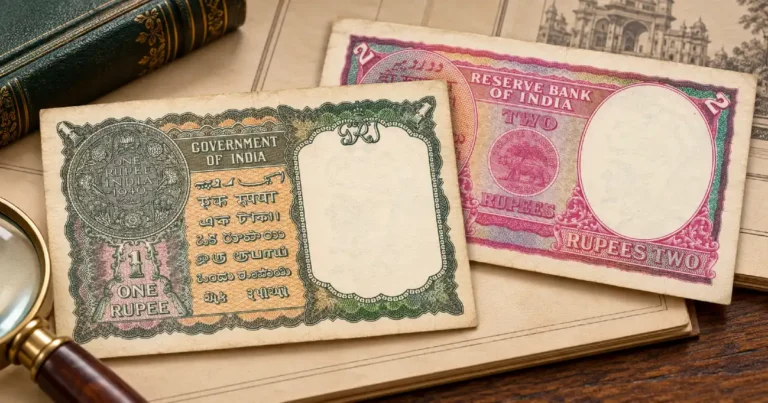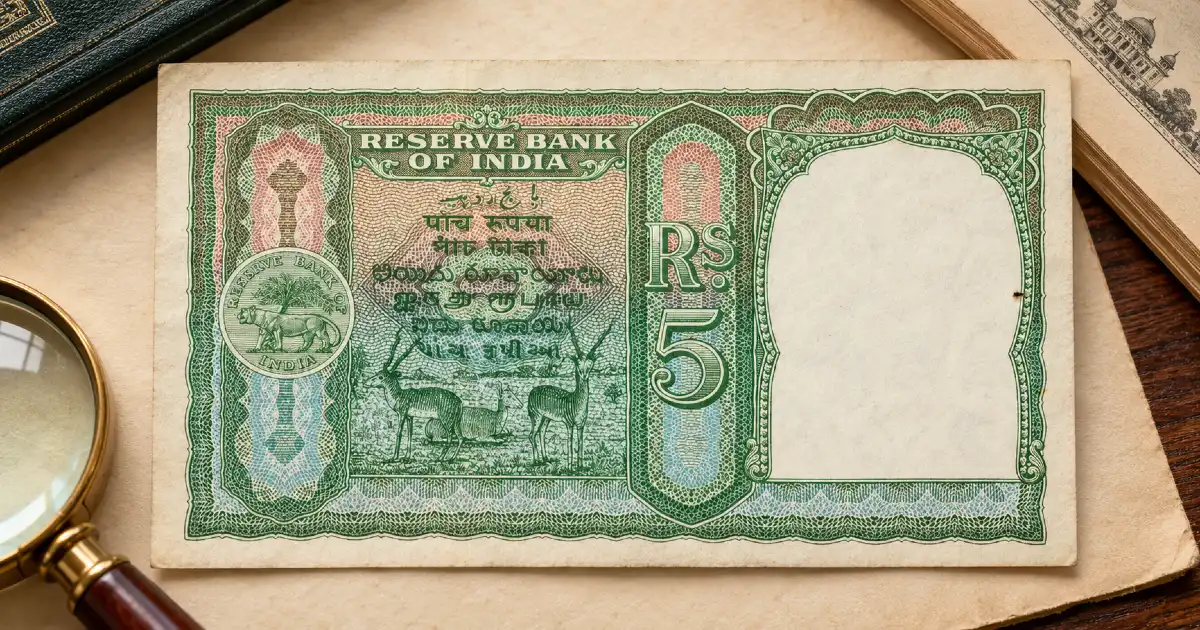
Why collect Indian banknotes? For many enthusiasts, the attraction goes far beyond owning old or unusual pieces of currency. Indian paper money offers a remarkable connection to history, art, culture, economics and the changing identity of a nation. Each banknote represents a particular period, issuing authority and monetary system, transforming an everyday financial instrument into a historical document worth studying and preserving.
Indian banknote collecting, a branch of numismatics known as notaphily, encompasses everything from early private bank issues and British India portrait notes to Republic India currency, princely state notes and unusual serial number varieties. Some collectors are attracted by the beauty of intricate designs, while others enjoy identifying rare signatures, tracing historical events or discovering banknotes that circulated in places that no longer exist as separate monetary jurisdictions.
There is also a personal dimension. A banknote may remind someone of childhood, a family member, a former country or an important historical event. For others, the satisfaction comes from researching a previously unfamiliar issue or finding a long-sought variety. The hobby can be approached casually or developed into a demanding field of specialist research.
Although certain Indian banknotes have significant market value, their appeal should not be measured by price alone. Historical knowledge, appreciation of design, the pleasure of discovery and the preservation of material heritage can be equally rewarding. Understanding these different motivations helps explain why Indian banknote collecting continues to attract enthusiasts with widely varied interests.
Table of Contents
1. Indian Banknotes Are Tangible Pieces of History
One of the strongest reasons to collect Indian banknotes is their historical significance. Paper money survives as physical evidence of the institutions, political systems and economic circumstances under which it was issued. Unlike many historical documents intended for archives, banknotes were created for everyday commercial use. They passed between individuals, businesses, banks and government offices, connecting major historical events with ordinary economic life.
From Private Banks to Government Paper Currency
The history of paper currency in India extends back to the late eighteenth century. Early issuing institutions included the Bank of Hindostan and other private banks, followed by the better-known Presidency Banks of Bengal, Bombay and Madras. Their notes served commercial needs in different parts of the subcontinent and reflected a monetary system that had not yet been brought under unified government control.
The Paper Currency Act of 1861 transformed this arrangement by giving the Government of India a monopoly over note issuance. The resulting Queen Victoria portrait notes represented an important step toward a centralized paper currency system. These early notes were followed by the uniface Underprint Series, distinguished by their green and red underprints, language panels and elaborate security designs.
Collectors interested in these developments can examine how note design changed in response to administration, printing technology and the need to prevent counterfeiting. The transition from privately issued notes to centralized government currency illustrates how money became increasingly connected to the machinery of the colonial state.
The Reserve Bank of India’s history of British India paper money provides a valuable introduction to these early developments, including the Queen Victoria portrait issues and subsequent green and red underprint uniface series.
The British India Portrait Series
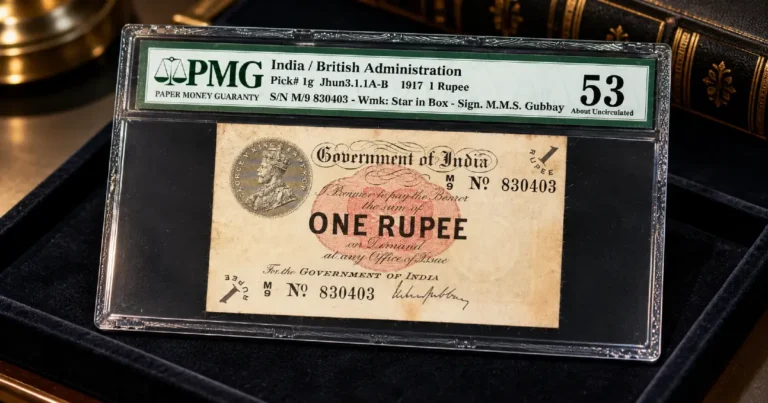
British India banknotes also document the reigns of successive British monarchs. Notes bearing King George V and King George VI provide recognizable chronological markers, although designs were introduced and withdrawn according to administrative requirements rather than simply coinciding with changes in the monarchy.
King George V banknotes are particularly important because they marked the introduction of more elaborate portrait notes with fully printed reverses. King George VI issues brought further developments following the establishment of the Reserve Bank of India in 1935. The RBI’s first banknotes appeared in 1938 and later underwent significant changes during the Second World War.
These banknotes offer much more than royal portraiture. Collectors can study the signatures of issuing officials, watermarks, currency circles, denominations and distinctive illustrations. Each feature provides information about the period in which the note was produced and the monetary arrangements that governed its circulation.
Our British India Banknotes collection introduces the different periods and types, while the dedicated King George V Banknotes and King George VI Banknotes collections explore these royal portrait series in greater detail.
Independence and a New National Identity
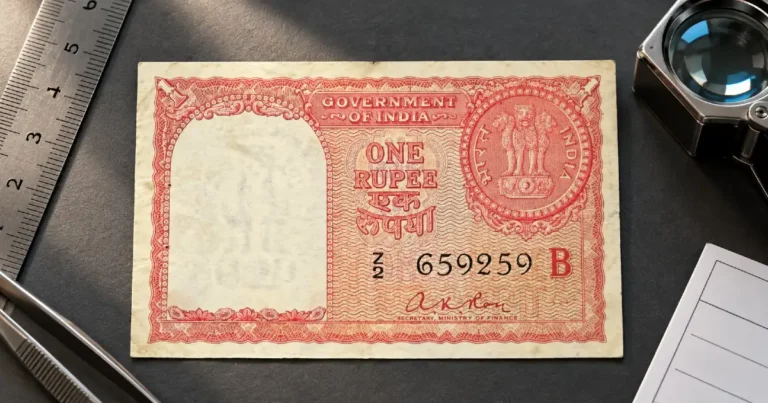
The independence of India in August 1947 brought a fundamental transformation in the symbolism of Indian currency. Existing King George VI designs initially continued in use while new national banknotes were prepared. In 1949, the Government of India introduced a redesigned 1 Rupee note featuring the Lion Capital of Ashoka in place of the British monarch.
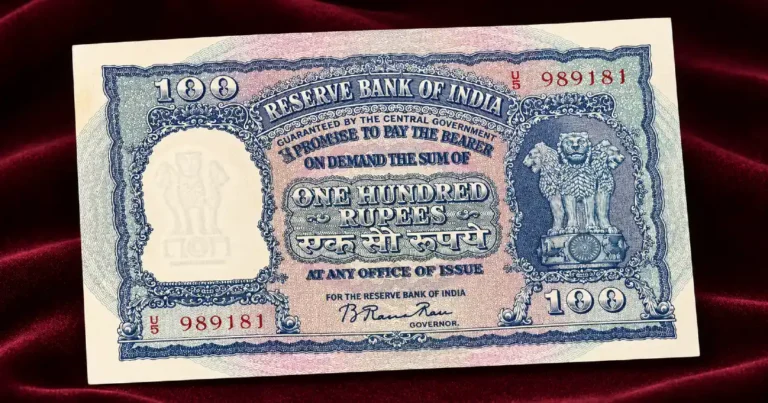
The choice was significant. Banknote design had previously reflected imperial authority; the new issues increasingly represented the sovereignty, history and aspirations of independent India. Later notes incorporated images associated with agriculture, industry, scientific achievement, national monuments and other aspects of the country’s development.
The introduction of the Mahatma Gandhi Series in 1996 marked another major transition. Gandhi’s portrait became a defining feature of Indian banknotes, while subsequent changes in size, security features and reverse designs reflected the continuing evolution of the currency.
A collector assembling representative British India and Republic India notes can therefore trace a remarkable political transformation through actual currency. The same objects that once carried royal portraits eventually came to display national emblems and the image of Mahatma Gandhi.
This transition is documented in the RBI’s historical overview of Republic India banknotes. Our Republic India Banknotes collection also explores the principal post-independence designs and denominations.
2. Indian Paper Money Reveals Regional and Political Diversity
Indian monetary history is not limited to banknotes issued by the Government of India or the Reserve Bank of India. The subcontinent’s complex political geography produced several other issuing authorities, each with distinctive designs and monetary arrangements. These notes offer collectors an opportunity to explore the histories of individual territories and the relationships between them.
Princely States and Hyderabad Currency
Hyderabad provides one of the most interesting examples of a separate Indian currency tradition. Its Osmania Sicca paper money, issued under the Nizam’s government, featured distinctive inscriptions and denominations reflecting Hyderabad’s monetary system.
These notes are significant because they demonstrate that the monetary landscape of the subcontinent was not entirely uniform during British rule. A collector who studies Hyderabad paper money encounters different political institutions, languages and administrative traditions from those associated with ordinary British India currency.
Hyderabad issues also encourage a broader understanding of Indian history. They illustrate the relationship between princely states and British paramountcy, as well as the complexities involved in incorporating different territories into independent India.
French India and Portuguese India
Other European colonial powers also left distinctive monetary records in India. French India notes were associated with the Banque de l’Indochine, while Portuguese India used banknotes issued through Banco Nacional Ultramarino and related colonial monetary arrangements.
These notes often display languages, portraits, symbols and denomination systems unlike those of British India. Their designs reflect different European administrative traditions while also revealing the economic connections between Indian territories and wider colonial networks.
For collectors, French and Portuguese India banknotes offer an opportunity to study territories whose political circumstances changed considerably during the twentieth century. They demonstrate how different currencies could coexist within the geographical region now associated with modern India.
British Burma and Pakistan Transitional Issues
British Burma provides another important dimension. Burma was separated administratively from British India in 1937, creating a need for currency arrangements appropriate to the new colony. Officially overprinted King George V notes and the later King George VI Peacock Series are especially interesting evidence of this transition.
The Second World War and its aftermath produced further monetary changes, including banknotes bearing Military Administration of Burma and Burma Currency Board overprints. These issues document periods when the authority responsible for currency changed while existing Indian note designs were adapted for continued use.
The Partition of British India in 1947 created a related but distinct collecting subject. Pakistan’s provisional notes of 1948 retained Indian King George VI designs while incorporating Government of Pakistan inscriptions. These banknotes illustrate the practical difficulties of establishing a new monetary system immediately after political independence.
Collectors interested in such transitional currency can explore our British Burma Banknotes and Pakistan Overprint Banknotes collections.
These regional issues are among the clearest examples of why collecting Indian banknotes can lead to a deeper appreciation of South Asian history. They reveal how currency moved across political boundaries and how monetary institutions responded when those boundaries changed.
3. Indian Banknotes Are Miniature Works of Art
Artistic appeal is another compelling reason to collect Indian banknotes. Although created primarily as financial instruments, many notes contain intricate illustrations, elaborate engraving, attractive colour combinations and carefully balanced typography. Their designs combine practical security requirements with artistic decisions about what should represent an issuing authority or country.
Engraving, Ornamentation and Security Printing
Early British India banknotes demonstrate the close connection between decorative printing and security. Fine line engraving, guilloche patterns, elaborate borders and multicoloured underprints were used not merely to improve appearance but also to make unauthorized reproduction more difficult.
Uniface notes are particularly interesting because their principal artwork appears on one side, leaving the reverse largely blank. Later portrait issues introduced more elaborate two-sided compositions, giving designers additional space for illustrations and denomination information.
Collectors who appreciate printing technology can examine how fine engraved lines, background patterns and watermark designs work together. Small differences between issues may reveal changes in production methods or attempts to address new counterfeiting techniques.
Even a relatively common note can reward close visual study. Details that are difficult to appreciate in photographs often become apparent when examining the printing quality, symmetry and engraved illustrations of an original banknote.
Wildlife and the Natural World
Animals have appeared repeatedly on Indian and related banknotes. The Reserve Bank of India seal, with its tiger and palm tree, became a familiar feature of early RBI issues. Other banknotes depicted elephants, antelopes, rhinoceroses, peacocks and various birds.
These illustrations provide insight into the imagery chosen by currency designers. Some were decorative, while others reflected regional landscapes, wildlife or cultural associations. The elephant and tiger motifs on British India notes, for example, create a distinctly different impression from the architectural scenes used on many later issues.
Wildlife themes can also connect different issuing territories. A collector interested in peacocks may encounter them on British Burma currency, while those interested in rhinoceroses may turn to Republic India notes featuring wildlife scenes.
For some enthusiasts, the appeal is purely aesthetic. Others use such notes to explore changing attitudes toward the environment and the ways governments have represented natural heritage in currency design.
Architecture, Monuments and Cultural Heritage
Indian banknotes also showcase architecture and historic monuments. The Lion Capital of Ashoka, the Konark Sun Temple, the Sanchi Stupa and other important landmarks have appeared in different designs and denominations.
Modern Indian banknotes feature additional architectural themes, including the Red Fort, Hampi’s Stone Chariot and Rani ki Vav. These illustrations introduce millions of currency users to important cultural sites and provide collectors with an opportunity to connect numismatics with architectural history.
Currency artwork is particularly interesting because it reflects decisions about national representation. Designers must select a limited number of images to convey a country’s identity, achievements and heritage. The chosen subjects reveal which historical and cultural associations were emphasized at particular times.
Science, Technology and Economic Progress
Republic India banknotes have also depicted dams, agricultural activity, industrial equipment and scientific achievements. These motifs reflect periods when economic development and technological progress were central themes in the country’s public imagery.
Examples include the Aryabhata satellite and the Sagar Samrat offshore drilling platform on earlier banknote designs. The 2,000 Rupees note introduced in 2016 featured Mangalyaan, India’s Mars Orbiter Mission, as part of its reverse design.
Such imagery broadens the artistic appeal of paper money beyond traditional portraits and heraldic symbols. A collection assembled around these motifs can illustrate how official representations of India’s economy and national achievements developed over time.
4. Indian Banknotes Reflect the Country’s Linguistic Diversity
India’s linguistic diversity is one of the most distinctive features of its paper money. Banknotes often contain inscriptions in several languages, reflecting the practical need for currency to be understood across different communities and regions.
During the British period, language panels evolved in response to changing circulation arrangements. Early notes had relatively limited language provisions, while later issues incorporated more extensive panels. The selection and placement of languages could differ according to the denomination and historical series.
Modern Reserve Bank of India notes generally feature Hindi and English in their principal inscriptions, together with a language panel showing the denomination in fifteen additional languages. These language panels are not merely decorative; they are a visible expression of India’s multilingual monetary system.
From a collecting perspective, inscriptions help identify individual banknote types and provide evidence of political, administrative and cultural change. The wording of a promise clause, the spelling of an issuing authority or the arrangement of language panels may distinguish one historical design from another.
For collectors interested in scripts and languages, banknotes offer an accessible way to study how official institutions communicated across diverse populations. They also demonstrate why accurately reading inscriptions is important when identifying historical currency.
To explore this subject in greater depth, read our Languages on Indian Notes: History of the 17-Language Panel guide, which traces the evolution of multilingual inscriptions from British India to modern Republic India banknotes.
5. Rarity and the Pleasure of Discovery
Rarity is an important part of the appeal of Indian banknote collecting, although the term should be used carefully. A note may be scarce because relatively few were originally produced, because most examples were redeemed and destroyed, or because very few survived in collectible condition.
These different forms of scarcity create distinct collecting challenges. Some notes are difficult to find in any grade, while others are readily available in circulated condition but uncommon when completely uncirculated. Particular signatures, prefixes, issuing circles or watermarks may also be scarcer than the general type.
Why Certain Historical Notes Are Scarce
Early Queen Victoria issues and some nineteenth-century uniface notes are important examples of historical currency with limited surviving populations. Their age, original circulation patterns and subsequent redemption have contributed to their scarcity.
High-denomination notes offer another illustration. British India 1,000 Rupees notes were used primarily for substantial transactions rather than ordinary retail payments. Their original purchasing power and limited practical circulation affected how many examples were preserved privately.
The demonetisation of high-denomination notes in January 1946 also had lasting consequences. Notes that were surrendered could be withdrawn and destroyed, leaving surviving examples of particular issues especially desirable to collectors today.
Recognizing Varieties Within a Banknote Series
Collecting becomes more interesting as enthusiasts discover that two apparently identical notes may represent different varieties. The signature of an official, an issuing-circle marking, a serial prefix, a watermark or a minor change in design can identify a separate catalogue entry.
These distinctions are especially significant in British India paper money. The same denomination may have circulated under different administrative arrangements or been issued with several signatures over a period of years.
Republic India notes also offer extensive variety. Signatures of RBI Governors, printing arrangements, design modifications and changes to security features provide numerous opportunities for specialist study.
The process of identifying these differences is itself part of the enjoyment. A collector may begin by acquiring a single representative note and later develop an interest in the historical or technical characteristics that distinguish it from similar examples.
Condition Rarity Versus Issue Rarity
A banknote may be relatively common in circulated condition but significantly harder to find with original uncirculated paper. Conversely, an intrinsically scarce issue may be desirable even when the surviving example shows substantial wear.
This distinction matters because rarity cannot be judged solely by appearance. An attractive modern note may be easy to replace, while a heavily circulated historical issue might be exceptionally difficult to acquire.
Professional grading services and population reports can assist collectors in understanding how many examples have been certified in particular grades. However, grading populations do not represent the complete number of surviving notes, and repeated submissions or ungraded holdings can affect interpretation.
Learning to distinguish issue rarity from condition rarity gives collectors a more realistic understanding of why particular banknotes attract attention.
6. The Financial Rewards and Investment Potential of Indian Banknotes
Beyond their historical, artistic and cultural appeal, Indian banknotes can also offer financial rewards. Scarce historical issues, rare signatures, exceptional grades and unusual varieties may command substantial premiums in the collector market. Some banknotes have appreciated considerably over time, making the possibility of long-term value growth another reason enthusiasts become interested in collecting.
The financial appeal of Indian paper money comes partly from its limited supply. Many historical notes have been redeemed, destroyed or lost, while surviving examples in excellent condition may be particularly difficult to obtain. As interest in Indian numismatics develops, competition among collectors can influence prices, especially for desirable and genuinely scarce issues.
For many enthusiasts, the greatest financial satisfaction comes from building a knowledgeable collection over time, acquiring desirable notes at reasonable prices and watching their collecting interests develop. Any eventual appreciation is an additional benefit rather than the sole purpose of collecting.
What Determines the Value of an Indian Banknote?
Several factors influence the market value of Indian banknotes. Historical significance and scarcity may establish the basic demand for an issue, while condition affects the price individual buyers are prepared to pay. Rare signatures, printing varieties and unusual serial numbers can also contribute to desirability.
For example, the market for a common circulated Republic India note is very different from that for a scarce British India uniface issue. Similarly, a rare signature or issuing-circle variety may attract specialist interest even when the general banknote type is relatively obtainable.
Authentication is another consideration. A genuinely rare banknote may be valuable, but a counterfeit or altered example has an entirely different market position. Collectors must therefore evaluate the banknote itself rather than relying exclusively on a seller’s description.
When evaluating potential purchases, collectors should compare examples of the same type, signature and grade. Published catalogue values can offer general guidance, but recent completed transactions often provide a more realistic indication of current market demand than advertised asking prices.
Professional Grading and Market Confidence
Independent certification can provide useful information about authenticity and condition. Services such as Paper Money Guaranty (PMG) examine notes and assign standardized grades, allowing collectors to compare preservation levels more consistently.
Certification is especially relevant for rare issues, high denominations and notes whose authenticity or condition may be difficult to assess through photographs alone. It can also improve confidence when buying from unfamiliar sellers or comparing notes offered in different markets.
Professionally graded notes may attract buyers who prefer independently assessed examples, particularly when substantial sums are involved. However, grading carries costs, and certification does not automatically increase a banknote’s resale value by more than those expenses.
A numerical grade also does not determine the complete market value of a banknote. The importance of the issue, the accuracy of its attribution, collector demand, originality and the presence of unusual characteristics remain relevant.
Explore our PMG Graded Banknotes collection for examples of professionally certified Indian and related paper money.
7. Indian Banknotes Offer Intellectual and Educational Rewards
Collecting Indian banknotes can encourage research across subjects that might initially appear unrelated. A single note may lead to questions about political history, economics, printing technology, geography, language or the biography of an issuing official.
For example, studying the signatures on Reserve Bank of India notes introduces collectors to the institution’s Governors and the periods during which they served. Examining historical watermarks reveals developments in security printing. Researching the currency of Burma or Pakistan leads naturally to the political events that shaped South Asia during the twentieth century.
This interconnected nature of the hobby is particularly rewarding because historical knowledge improves the collector’s ability to identify and appreciate individual banknotes. Understanding the circumstances surrounding an issue often makes its design and rarity more meaningful.
Research, Catalogues and Historical Evidence
Numismatic research requires careful examination of evidence. Collectors frequently consult specialized catalogues, official government publications, auction archives and contemporary historical records to establish a note’s issuing period or identify a particular variety.
Important reference works include specialized Indian paper money catalogues and the relevant country chapters of The Banknote Book. These resources provide structured information about designs, signatures, dates, varieties and recognized catalogue numbers.
However, catalogues are not infallible. New discoveries may change the understanding of a particular issue, and different authors may use different classification systems. Comparing sources and documenting uncertainty are important habits for anyone pursuing serious numismatic study.
Collecting therefore develops skills beyond memorizing catalogue entries. It encourages observation, critical evaluation and the ability to distinguish established facts from assumptions or unsupported claims.
Learning Through Design Details
The physical characteristics of banknotes can become a subject of study in their own right. Watermarks, paper composition, engraving techniques, printing methods and serial number systems all reveal aspects of production history.
A collector examining a note under suitable lighting may observe features that are difficult to appreciate in ordinary photographs. Comparing similar notes can reveal differences in typography, ink colour, watermark placement or security features.
These observations are valuable not only for identifying varieties but also for recognizing possible alterations. A detailed understanding of genuine printing characteristics helps collectors make better judgments when assessing unusual notes.
8. Banknote Collecting Preserves Cultural Heritage
Paper currency is inherently fragile. Unlike most coins, banknotes are vulnerable to tears, moisture, staining, light exposure and careless handling. Many historical issues disappeared because they were redeemed, destroyed or simply worn out through circulation.
Private collectors therefore play a role in preserving material that might otherwise be lost. A carefully maintained collection can safeguard examples of obsolete currency, unusual designs and historically important varieties for future study.
Preservation is not merely about maintaining financial value. It also protects information. A note’s original printing, serial number, signature, watermark and condition can provide evidence useful to researchers and later collectors.
Documentation strengthens this preservation role. Recording the provenance of a banknote, its catalogue attribution and relevant historical context helps maintain knowledge about the object. Where appropriate, photographs can also create a useful record of its appearance and condition.
The hobby becomes especially meaningful when a collector shares this information with others through articles, exhibitions, numismatic societies or educational projects.
Passing Knowledge Between Generations
Banknotes can also connect generations. Older family members may remember designs that younger collectors have never encountered in circulation. Stories about currency used before independence, during economic reforms or in different regions can provide a personal dimension to numismatic history.
A family collection may contain banknotes preserved after travel, political change or the withdrawal of a denomination. Even where the notes themselves are common, the circumstances in which they were saved can give them personal and historical importance.
Sharing a collection with children or new enthusiasts can introduce broader discussions about geography, national symbols, historical events and the development of money. Banknotes offer a practical starting point because the objects are compact, visually interesting and directly connected to everyday life.
For these reasons, a collection’s value may extend well beyond its potential resale price. The research, memories and historical understanding associated with it can become part of a family’s cultural inheritance.
9. The Satisfaction of Building a Personal Collection
Beyond history, art and monetary value, collecting Indian banknotes offers the simple enjoyment of assembling something meaningful over time. Each acquisition may fill a gap, introduce a new subject or mark the completion of a long-standing objective.
The hobby accommodates different personalities and interests. Some collectors enjoy systematic organization and seek clearly defined sets. Others prefer unusual designs or individual notes with particularly interesting historical stories.
There is no single correct way to appreciate Indian paper money. A modest collection assembled around one person’s interests may be more satisfying than a larger collection purchased without a clear purpose.
The Pleasure of Completing a Set
Completing a set can be one of the most rewarding experiences in numismatics. A collector may spend years searching for the final denomination, signature or variety needed to complete a particular series.
Some goals are relatively straightforward, such as obtaining representative notes from several familiar Republic India designs. Others are highly demanding, involving rare historical issues or varieties that appear only occasionally in the market.
The pursuit encourages patience and persistence. It also makes each new discovery meaningful, because the banknote contributes to a larger collecting objective rather than existing as an isolated purchase.
Different Collectors Find Different Rewards
Some enthusiasts are fascinated by fancy serial numbers because of their symmetry and mathematical properties. Others prefer printing errors, unusual watermarks or historically important overprints. A collector interested in wildlife may favour banknotes depicting elephants, tigers and birds, while another may concentrate on architecture or monetary history.
These different interests demonstrate the flexibility of Indian banknote collecting. A person does not need to pursue every denomination, era or variety to develop a worthwhile collection.
The important distinction is between choosing a subject that genuinely interests the collector and following a temporary market trend. Personal curiosity often provides the strongest motivation for sustained learning and long-term participation.
The Numismatic Community
Collecting is also a social activity. Numismatic societies, exhibitions, specialist dealers and online communities allow enthusiasts to exchange knowledge, compare discoveries and develop friendships based on shared interests.
Discussions with experienced collectors can be particularly helpful when studying unusual varieties or evaluating the authenticity of a difficult issue. They may also introduce historical references and collecting perspectives that are not immediately apparent from a catalogue.
At the same time, collectors should approach market claims critically. Community enthusiasm is valuable, but opinions about rarity and pricing should be supported by reliable evidence whenever possible.
A healthy collecting community combines enthusiasm with accurate information, fair dealing and a willingness to share knowledge.
10. Indian Banknote Collecting Can Be Enjoyed at Different Levels
One appealing aspect of the hobby is that it does not require every participant to seek exceptionally rare or expensive banknotes. A beginner can appreciate common Republic India designs, older circulated notes or small groups of notes representing different historical periods.
Over time, interests may become more specialized. A collector may discover a particular attraction to British India portrait issues, Republic India 1 Rupee notes, the banknotes of Hyderabad or the currency used in Burma during the Second World War.
Greater expertise often changes the way notes are evaluated. A beginner may initially be attracted by appearance, while an experienced collector may pay closer attention to signatures, watermarks, issue dates, printing varieties and provenance.
Neither approach is inherently superior. Visual appreciation can be a legitimate starting point, and specialist research can develop gradually as curiosity increases.
Those who wish to begin collecting systematically can consult our How to Start Collecting Indian Banknotes guide. It explains how to choose a collecting focus, assess condition, research varieties, establish a budget and preserve a collection.
That practical guide complements the present article: the purpose here is to explain why Indian banknotes are worth collecting, rather than provide a detailed manual for buying and organizing them.
Conclusion: Why Collect Indian Banknotes?
Indian banknotes bring together an extraordinary range of interests. They document the growth of monetary institutions, changes in political authority, the artistic representation of national identity and the economic development of the Indian subcontinent. Their designs reveal cultural traditions, languages, wildlife, architecture and scientific achievements.
For historically minded collectors, paper money provides direct evidence of the periods it represents. For those attracted to art and design, banknotes offer intricate illustrations and sophisticated printing techniques. Specialists may find satisfaction in identifying scarce varieties, while other enthusiasts enjoy assembling visually appealing collections or discovering meaningful serial numbers.
The possibility of financial appreciation adds another dimension to the hobby. Genuine rarity, exceptional condition and sustained collector demand can contribute to increasing values, but outcomes are uncertain and careful research remains essential. Collecting should be approached with realistic expectations rather than promises of easy profits.
Ultimately, the answer to the question why collect Indian banknotes is different for every enthusiast. Whether the attraction begins with an old family note, an unusual design, the possibility of acquiring something scarce or a desire to understand India’s monetary history, collecting offers opportunities for discovery that can continue throughout a lifetime.
Explore our British India Banknotes and Republic India Banknotes collections to discover the remarkable range of designs and historical issues that make Indian paper money such a rewarding field of numismatics.
Frequently Asked Questions About Collecting Indian Banknotes
Why do people collect Indian banknotes?
People collect Indian banknotes for their historical significance, artistic designs, cultural associations, rarity, potential financial rewards and personal enjoyment. Some pursue specialized varieties or unusual serial numbers, while others appreciate the opportunity to preserve and study objects connected with India’s monetary history.
Are Indian banknotes worth collecting?
Yes. Indian paper money offers a wide range of historical periods, designs and collecting interests. Both common and rare banknotes can be rewarding to study. Some issues also have substantial market value, although historical importance and personal enjoyment remain important reasons to collect.
Are old Indian banknotes valuable?
Some old Indian banknotes are valuable, particularly scarce historical issues, unusual varieties and exceptional high-grade examples. However, age alone does not establish rarity. Many older banknotes survive in substantial numbers, and values depend on the specific issue, authenticity, condition and collector demand.
Can collecting Indian banknotes be financially rewarding?
Yes, collecting Indian banknotes can be financially rewarding when desirable notes are acquired at reasonable prices and subsequently appreciate. Scarcity, condition, historical significance and sustained collector demand can contribute to higher values. However, appreciation is never guaranteed, and selling costs must be considered when assessing any financial gain.
Are Indian banknotes a good long-term investment?
Some scarce Indian banknotes have appreciated over time, but collectibles are not conventional financial investments. Their prices can rise or fall, buyers may be difficult to find, and transaction costs can reduce returns. Collectors should prioritize authenticity, rarity, condition and genuine personal interest rather than expecting guaranteed profits.
Which Indian banknotes have the greatest investment potential?
Collectors often show interest in genuinely scarce British India issues, early uniface notes, rare signatures, historical overprints and exceptional high-grade examples. Nevertheless, no category guarantees future appreciation. Purchase price, authenticity, surviving supply, collector demand and the ability to resell are all important considerations.
Does professional grading increase a banknote’s value?
Professional grading can improve buyer confidence by providing independent authentication and a standardized condition assessment. This may benefit certain rare or valuable notes, but certification does not automatically increase their market price. Grading fees and the desirability of the underlying issue should be considered before submission.
Which Indian banknotes are popular among collectors?
Popular subjects include British India portrait notes, Queen Victoria uniface issues, King George V and King George VI currency, early Republic India banknotes, fancy serial numbers, printing errors, historical overprints and professionally graded notes. Preferences differ according to collecting interests and budgets.
What makes Indian paper money historically interesting?
Indian banknotes reflect changes in government, banking institutions, national identity and printing technology. They also document regional monetary arrangements, including currency issued for Hyderabad, British Burma and Pakistan during periods of political transition.
Is Indian banknote collecting suitable for beginners?
Yes. The hobby can begin with relatively accessible banknotes and expand as knowledge develops. Beginners benefit from studying authentic examples, learning basic condition terminology, comparing market prices and consulting reliable references before making expensive purchases.
Where can I learn more about Indian banknote collecting?
Official Reserve Bank of India publications, specialized numismatic catalogues, established collecting societies and carefully researched educational articles are useful starting points. IndiaBanknotes also provides historical guides and collection pages covering British India, Republic India and related South Asian currency issues.