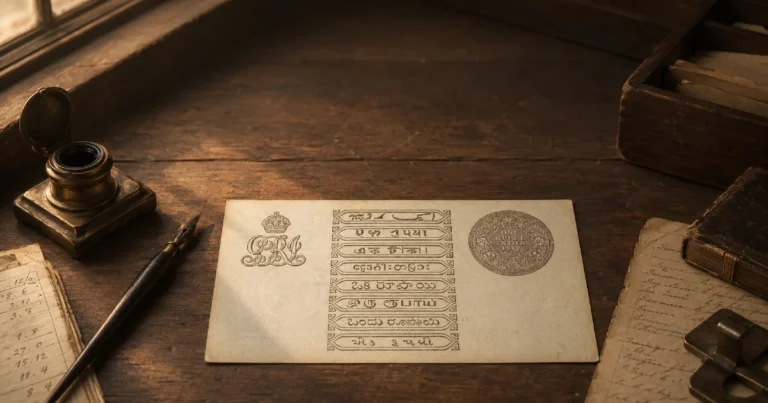
Demonetisation in India refers to the official withdrawal of banknotes from legal tender status. India has experienced three major demonetisation events—in 1946, 1978 and 2016—each involving different denominations, legal measures and economic circumstances.
The first demonetisation in 1946 targeted high-denomination British India notes during the final years of colonial rule. The second, in 1978, withdrew the ₹1,000, ₹5,000 and ₹10,000 Ashoka Pillar notes of Republic India. The third, announced on 8 November 2016, affected ₹500 and ₹1,000 notes of the Mahatma Gandhi Series and had a much broader impact on everyday transactions.
Although these events are commonly associated with attempts to address unaccounted wealth, their circumstances and outcomes differed considerably. The earlier demonetisations affected high-value notes used mainly for substantial financial transactions, while the 2016 withdrawal involved denominations widely used throughout the country.
For Indian banknote collectors, the history of demonetisation in India is particularly important because each event marked the end of legal tender status for specific historical issues. Some withdrawn notes are now exceptionally scarce, while others remain relatively obtainable despite having been demonetised.
This guide examines the causes, legal framework, exchange figures and outcomes of all three demonetisation events. It also identifies the principal withdrawn banknotes using The Banknote Book (BNB) and Pick catalogue references and explains the distinction between demonetisation and the withdrawal of the ₹2,000 note from circulation in 2023.
Table of Contents
What Is Demonetisation in India?
Demonetisation is the process by which a government removes the legal tender status of specified banknotes or currency issues.
Legal tender refers to money recognized by law for the discharge of monetary obligations. When particular notes are demonetised, they cease to have that status from the legally specified date, subject to any exceptions or transitional arrangements.
Demonetisation is usually accompanied by procedures allowing holders to surrender, deposit or exchange the affected notes within a specified period.
In India, the legal framework has differed across the three historical events. The 1946 demonetisation and 1978 demonetisation were implemented through special ordinances and legislation, while the 2016 demonetisation was initiated through notifications under Section 26(2) of the Reserve Bank of India Act, 1934, followed by further legislation.
Demonetisation vs Withdrawal from Circulation
Demonetisation should not be confused with the ordinary withdrawal of banknotes from circulation.
A banknote may be withdrawn as part of a currency-management policy while retaining its legal tender status. In that situation, the authorities seek to remove the notes from active circulation, but the notes do not automatically lose their legal validity.
This distinction became especially important in 2023, when the Reserve Bank of India announced the withdrawal of ₹2,000 banknotes from circulation without demonetising them.
Demonetisation is also different from currency devaluation. Devaluation concerns the value of a currency relative to other currencies, whereas demonetisation concerns the legal status of specific money.
How Many Times Has India Demonetised Its Currency?
India has carried out three major demonetisation exercises, in 1946, 1978 and 2016.
| Year | Effective Date | Denominations Withdrawn | Historical Period |
|---|---|---|---|
| 1946 | 12 January 1946 | ₹500, ₹1,000 and ₹10,000 | British India |
| 1978 | After 16 January 1978 | ₹1,000, ₹5,000 and ₹10,000 | Republic India — Ashoka Pillar Series |
| 2016 | From midnight following 8 November 2016 | ₹500 and ₹1,000 | Republic India — Mahatma Gandhi Series |
The 1978 measures were announced on 16 January, with the affected denominations ceasing to be legal tender after that date. The 2016 demonetisation was made on the evening of 8 November, with withdrawal effective from the beginning of 9 November, subject to specified temporary exceptions.
Each event involved different monetary conditions, and the withdrawal of the affected notes had different consequences for the public and the surviving supply of historical banknotes.
Why Has India Demonetised Its Currency?
The three major demonetisation events were introduced under different governments and economic conditions, but concerns about unaccounted wealth were a recurring justification.
In 1946, the British Indian Government was concerned about profits accumulated through wartime black-market activities and undeclared financial transactions.
In 1978, the Janata Party Government argued that high-denomination notes facilitated illicit transfers of money and the concealment of wealth.
In 2016, the Government identified several objectives, including addressing black money, counterfeit currency and terror financing. The policy was also associated with encouraging electronic payments and greater formalization of financial transactions.
These were the stated objectives of the respective governments. Whether the measures achieved those objectives must be considered separately from the reasons officially given for introducing them.
1946: First Demonetisation of Indian Banknotes
The first major demonetisation in India occurred on 12 January 1946, during the final years of British rule.
The Second World War had created unusual financial conditions. Government expenditure, wartime supply contracts, commodity shortages and speculative trading contributed to concerns about profits accumulated outside normal tax and accounting arrangements.
High-denomination banknotes were particularly relevant because they allowed substantial sums to be held or transferred using relatively few notes.
The denominations affected were ₹500, ₹1,000 and ₹10,000. These notes were associated mainly with large commercial transactions, financial institutions, and wealthy holders rather than everyday retail purchases.
For the historical development of the ₹1,000 denomination, see our British India 1000 Rupee Note guide.
The 1946 Demonetisation Ordinances
The Government introduced two related ordinances to carry out the 1946 demonetisation.
The first, the Bank Notes (Declaration of Holdings) Ordinance, 1946, required specified institutions, including banks and government treasuries, to report their holdings of high-denomination notes as of 11 January 1946.
The second, the High Denomination Bank Notes (Demonetisation) Ordinance, 1946, withdrew the legal tender status of the affected denominations from 12 January 1946.
Holders were required to surrender their notes through the prescribed exchange procedures. The initial exchange arrangements were subsequently extended, allowing additional notes to be submitted after the earliest deadlines.
The objective was to bring high-value currency holdings into the banking system and require holders to account for their possession of substantial sums.
How Much Currency Was Returned in 1946?
The historical exchange figures show that a large proportion of the affected currency was returned.
According to figures reported by the Government of India, the total value of high-denomination notes in circulation on 11 January 1946 was ₹143.97 crore. Of this amount, ₹109.67 crore had been exchanged before 26 January 1946, rising to ₹128.02 crore by 30 June 1946.
Later historical accounts record a cumulative exchange total of ₹134.90 crore by the end of 1947, equivalent to approximately 93.7% of the original high-denomination value. This left approximately ₹9.07 crore not exchanged.
These figures should not be confused because they refer to different reporting dates. The 30 June 1946 figure represents an earlier stage of the process, while the larger amount reflects the later cumulative total.
The substantial proportion returned also illustrates an important limitation of demonetisation as a means of identifying illicit wealth: exchanging or declaring a high-value note does not, by itself, establish whether the money was lawfully acquired.
British India Banknotes Demonetised in 1946
The 1946 demonetisation affected several important high-denomination British India banknote types, including earlier Government of India uniface notes and the King George V and King George VI portrait issues.
The following table summarizes the principal catalogue types withdrawn in 1946.
| Denomination | Banknote Type | BNB | Pick |
|---|---|---|---|
| ₹500 | Uniface | B125 | PA18 |
| ₹500 | Uniface | B126 | PA18A |
| ₹1,000 | Uniface | B127 | PA19 |
| ₹1,000 | Uniface | B128 | PA19A |
| ₹10,000 | Uniface | B129 | PA20 |
| ₹1,000 | King George V | B146 | P12 |
| ₹10,000 | King George V | B147 | P13 |
| ₹1,000 | King George VI | B205 | P21 |
| ₹10,000 | King George VI | B206 | P22 |
Catalogue note: BNB references follow The Banknote Book, while Pick references follow the Standard Catalog of World Paper Money. The table covers the principal types identified in this guide rather than every individual signature, prefix or issuing-circle variety.
Many of these historical banknotes are now extremely scarce, particularly in collectible condition. Their rarity reflects their original monetary role, limited surviving availability and subsequent withdrawal—not merely their demonetisation date.
The 1946 demonetisation event marked the end of an important chapter in British India high-denomination paper currency. It also provided a historical precedent for the later demonetisations of 1978 and 2016.
1978: Second Demonetisation of Indian Banknotes
The second major demonetisation in India was announced on 16 January 1978, more than three decades after the first.
By this period, India had been independent for thirty years and its banknotes carried national imagery rather than portraits of British monarchs.
The affected denominations were ₹1,000, ₹5,000 and ₹10,000, all belonging to the Ashoka Pillar era of Republic India paper money.
These high-denomination notes were primarily associated with substantial financial transactions and were not widely used in everyday retail commerce.
The political context was also different. The Janata Party Government had come to power in 1977 after the end of the Emergency, and the new administration placed particular emphasis on addressing corruption and unaccounted wealth.
The Government maintained that high-denomination currency facilitated illicit transfers and the concealment of substantial sums outside the formal financial system.
The history and varieties of the ₹1,000 denomination are covered in our Republic India 1000 Rupee Note guide.
The High Denomination Bank Notes (Demonetisation) Act, 1978
The 1978 demonetisation was initially implemented through the High Denomination Bank Notes (Demonetisation) Ordinance, 1978. Under the measure, ₹1,000, ₹5,000 and ₹10,000 notes ceased to be legal tender after 16 January 1978.
The ordinance was subsequently replaced by the High Denomination Bank Notes (Demonetisation) Act, 1978, enacted on 30 March 1978.
The legislation prescribed procedures for holders to exchange the affected notes, including declarations and specified deadlines. It also contained restrictions and penalties concerning transactions involving the withdrawn currency, subject to the provisions and exceptions of the Act.
The legislation reflected the Government’s stated view that large-denomination notes could be used to facilitate financial dealings considered harmful to the national economy.
How Much Currency Was Exchanged in 1978?
The official figures show that most of the affected high-denomination currency was presented for exchange.
According to the Government of India’s record, the total value of the withdrawn high-denomination notes in circulation was ₹145.42 crore. By 30 June 1978, notes worth ₹124.45 crore had been tendered for conversion to the Reserve Bank of India.
This represented approximately 85.6% of the original value, leaving around ₹20.97 crore not included in the reported converted amount as of that date.
These figures provide a more reliable account than general statements suggesting either that nearly all notes were exchanged or that most of the affected currency remained outside the banking system.
The reported exchange percentage concerns the monetary value of notes submitted by a specific reporting date. It does not establish how many individual banknotes survive today in private collections or institutions.
Republic India Banknotes Demonetised in 1978
The 1978 demonetisation terminated the legal tender status of several important high-denomination Ashoka Pillar banknote types.
These included different designs and varieties of the ₹1,000, ₹5,000 and ₹10,000 denominations.
| Denomination | BNB | Pick |
|---|---|---|
| ₹1,000 | B227 | P46 |
| ₹1,000 | B228 | P47a–e |
| ₹1,000 | B229 | P47f |
| ₹1,000 | B230 | P65 |
| ₹5,000 | B231 | P48 |
| ₹5,000 | B232 | P49 |
| ₹10,000 | B233 | P50 |
| ₹10,000 | B234 | P50A |
These issues are now important historical examples of India’s high-denomination paper currency, although their relative rarity differs by denomination, signature, type and condition.
The constitutionality of the 1978 demonetisation legislation was challenged, but the Supreme Court upheld the measure in the case of Jayantilal Ratanchand Shah v. Reserve Bank of India.
Although the ₹1,000 denomination was withdrawn in 1978, it was reintroduced in 2000 as part of the Mahatma Gandhi Series. That later issue would itself be demonetised in 2016.
2016: Third Demonetisation of Indian Banknotes
The third major demonetisation in India was announced on the evening of 8 November 2016.
Unlike the earlier demonetisations, which affected high-value notes used mainly for large transactions, the 2016 measure involved currency denominations used throughout the Indian economy.
Prime Minister Narendra Modi announced that the existing ₹500 and ₹1,000 Mahatma Gandhi Series banknotes would cease to be legal tender from midnight, subject to limited transitional arrangements for specified services.
At that time, these two denominations accounted for approximately 86.9% of the total value of currency in circulation.
The scale of the withdrawal made the 2016 demonetisation very different from the 1946 and 1978 events. It affected ordinary purchases, cash payments, bank deposits and access to cash across the country.
The Government’s Stated Objectives
The Government identified several principal objectives for the 2016 demonetisation, including addressing unaccounted wealth, reducing counterfeit currency, restricting the financing of unlawful activities and encouraging greater use of formal banking and digital payment systems.
The initiative was carried out through notifications under Section 26(2) of the Reserve Bank of India Act, 1934.
Under this provision, the Central Government may, on the recommendation of the RBI Central Board, declare that specified series of banknotes shall cease to be legal tender from the date stated in the notification, subject to any specified exceptions.
The stated objectives provide the political and legal context for the measure, but they should be distinguished from its subsequently recorded economic results.
Exchange Procedures and the Introduction of New Banknotes
The withdrawal required holders to deposit or exchange their existing ₹500 and ₹1,000 notes through the prescribed banking arrangements.
Demand for replacement currency was substantial. Banks and automated teller machines experienced heavy demand, while withdrawal restrictions and the recalibration of ATMs affected access to cash during the transition.
The main deposit period continued until 30 December 2016, with separate provisions applicable to certain categories of holders and circumstances.
The Reserve Bank of India introduced the Mahatma Gandhi New Series, including a new ₹500 note and the newly introduced ₹2,000 denomination.
These notes featured revised dimensions, colours, designs, and security features, marking an important change in the appearance of Indian paper currency.
How Much Currency Was Returned After the 2016 Demonetisation?
Official figures showed that the overwhelming majority of the withdrawn ₹500 and ₹1,000 notes were eventually returned to the banking system.
According to figures reported by the Government of India in Parliament, the total value of the specified banknotes in circulation on 8 November 2016, after verification and reconciliation, was ₹15,417.93 billion.
The total value of specified banknotes returned from circulation was ₹15,310.73 billion, or approximately 99.3% of the original value.
The high return rate is an important part of the historical record. It indicates that most of the affected cash was deposited or exchanged rather than permanently withheld from the banking system.
However, the return rate alone does not measure every possible effect of demonetisation. Questions concerning taxation, financial formalization, counterfeit currency, digital payments and economic disruption require separate evaluation.
The Reserve Bank of India examined these developments in its Macroeconomic Impact of Demonetisation — A Preliminary Assessment, published in March 2017.
The Specified Bank Notes (Cessation of Liabilities) Act, 2017
Following the 2016 withdrawal, the Government introduced the Specified Bank Notes (Cessation of Liabilities) Ordinance, 2016, subsequently replaced by the Specified Bank Notes (Cessation of Liabilities) Act, 2017.
The Act addressed the cessation of obligations relating to the withdrawn notes and established legal provisions concerning their possession, transfer and exchange.
The legislation is particularly relevant to banknote collectors because it includes limited exceptions for retaining specified banknotes.
Under Section 5, a person may retain not more than ten specified banknotes in total, irrespective of denomination, or not more than twenty-five specified banknotes for study, research or numismatic purposes, subject to the statutory provisions.
Collectors should distinguish these legal limits from the position of earlier historical banknotes demonetised in 1946 or 1978, which were governed by different legal arrangements.
Supreme Court Review of the 2016 Demonetisation
The constitutional validity of the 2016 demonetisation was challenged before the Supreme Court of India.
The proceedings raised questions concerning the statutory powers used to implement the measure and the process through which the decision had been taken.
On 2 January 2023, a five-judge Constitution Bench upheld the demonetisation decision by a 4:1 majority.
The majority held that the decision-making process satisfied the applicable legal requirements, while the dissenting judge expressed a different view concerning the procedure adopted.
The judgment concerned the legality of the decision and should not be interpreted as an independent determination that every economic objective of demonetisation had been achieved.
Indian Banknotes Demonetised in 2016
The 2016 demonetisation withdrew the existing ₹500 and ₹1,000 banknotes of the original Mahatma Gandhi Series.
These included several design and security-feature variations catalogued under different BNB and Pick references.
| Denomination | BNB | Pick |
|---|---|---|
| ₹500 | B276 | P92 |
| ₹500 | B277 | P93 |
| ₹500 | B284 | P99 |
| ₹500 | B290 | P106 |
| ₹500 | B296 | P106 (later variety) |
| ₹1,000 | B278 | P94 |
| ₹1,000 | B285 | P100 |
| ₹1,000 | B291 | P107a–n |
| ₹1,000 | B297 | P107o–t |
The withdrawal of these banknotes marked the end of the existing ₹500 and ₹1,000 Mahatma Gandhi Series designs and their replacement by new issues.
Although the withdrawn notes no longer have their former legal tender status, they remain historically important examples of India’s currency before the 2016 reforms.
Was the ₹2,000 Note Demonetised in 2023?
No. The ₹2,000 banknote was withdrawn from circulation in 2023, but it was not demonetised.
The ₹2,000 denomination had been introduced in November 2016 to help meet the immediate currency requirements created by the withdrawal of the earlier ₹500 and ₹1,000 notes.
On 19 May 2023, the Reserve Bank of India announced the withdrawal of ₹2,000 banknotes from circulation under its Clean Note Policy.
Unlike the demonetisation measures of 1946, 1978 and 2016, this decision did not remove the denomination’s legal tender status.
Bank branch exchange and deposit arrangements continued through 7 October 2023. The RBI subsequently maintained facilities for eligible exchange and deposit through its designated Issue Offices.
In its consolidated instructions dated 9 June 2026, the RBI expressly confirmed that ₹2,000 banknotes continue to be legal tender.
This distinction is important when studying the history of demonetisation in India. A note withdrawn from active circulation is not necessarily a demonetised note.
Impact of Demonetisation on Indian Banknote Collecting
The history of demonetisation in India has had an important influence on the survival and collectibility of particular Indian banknote issues.
When banknotes are surrendered through official exchange procedures, large quantities may eventually be withdrawn and destroyed. This can reduce the supply of surviving examples available for collectors and researchers.
However, demonetisation does not automatically make every affected banknote rare.
Some high-denomination British India notes were scarce even before demonetisation because their original circulation was limited and they were used mainly for substantial financial transactions.
The 1978 Ashoka Pillar high denominations also differ considerably in surviving availability. Certain signatures, denominations and design varieties are much more difficult to acquire than others.
By contrast, the large original circulation of the ₹500 and ₹1,000 Mahatma Gandhi Series notes meant that many examples were retained by collectors and members of the public, despite the 2016 withdrawal.
The collectibility of a demonetised note therefore depends on several factors, including its original issue quantity, surviving population, condition, signature, variety and collector demand.
Our Understanding Banknote Values: Rarity, Condition & Demand guide explains how these factors interact.
Conclusion: The History of Demonetisation in India
The history of demonetisation in India spans three distinct periods of monetary and political development.
The 1946 demonetisation occurred during the final years of British rule and targeted high-denomination notes associated with large financial holdings and wartime economic concerns.
The 1978 demonetisation was implemented after independence and withdrew the ₹1,000, ₹5,000 and ₹10,000 Ashoka Pillar notes amid concerns about unaccounted wealth and illicit financial transactions.
The 2016 demonetisation differed significantly in scale, withdrawing widely used ₹500 and ₹1,000 notes and leading to the introduction of new designs under the Mahatma Gandhi New Series.
The official exchange figures provide valuable evidence of the different outcomes, but they also demonstrate the importance of distinguishing the date of withdrawal from the subsequent reporting of returned currency.
For collectors and historians, demonetisation marks important boundaries between banknote issues and monetary systems. Yet the rarity of a particular note ultimately depends on its individual characteristics and surviving availability, not simply the fact that it was withdrawn.
Together, the events of 1946, 1978 and 2016 form a significant chapter in the history of Indian paper money, illustrating how the legal status of currency can change in response to economic conditions, public policy and monetary reform.
Frequently Asked Questions About Demonetisation in India
How many times has India demonetised its currency?
India has carried out three major demonetisation events, in 1946, 1978 and 2016. Each involved withdrawing the legal tender status of specified banknotes under different historical and legal circumstances.
What is demonetisation?
Demonetisation is the legal process of withdrawing the legal tender status of specified currency notes. Affected notes cease to be recognized as valid money from the effective date, subject to applicable exceptions and exchange arrangements.
When was the first demonetisation in India?
The first major demonetisation took place on 12 January 1946, when the British Indian Government withdrew the ₹500, ₹1,000 and ₹10,000 denominations.
Which Indian banknotes were demonetised in 1946?
The 1946 demonetisation affected high-denomination British India banknotes of ₹500, ₹1,000 and ₹10,000, including Government of India uniface notes and King George V and King George VI issues.
What percentage of notes was returned after the 1946 demonetisation?
By 30 June 1946, approximately ₹128.02 crore had been exchanged out of ₹143.97 crore in affected notes. Later historical accounts record a cumulative exchange total of ₹134.90 crore by the end of 1947, representing approximately 93.7% of the original value.
When was the second demonetisation in India?
The second demonetisation was announced on 16 January 1978. The ₹1,000, ₹5,000 and ₹10,000 Ashoka Pillar banknotes ceased to be legal tender after that date.
Which Indian banknotes were demonetised in 1978?
The 1978 demonetisation affected Republic India Ashoka Pillar notes in denominations of ₹1,000, ₹5,000 and ₹10,000, including several catalogue varieties issued during the 1950s, 1960s and 1970s.
How much currency was exchanged after the 1978 demonetisation?
By 30 June 1978, high-denomination notes worth ₹124.45 crore had been tendered for conversion out of ₹145.42 crore originally in circulation. This represented approximately 85.6% of the withdrawn value.
When was the most recent demonetisation in India?
The most recent major demonetisation occurred on 8 November 2016, when the Government announced the withdrawal of legal tender status from the existing ₹500 and ₹1,000 Mahatma Gandhi Series notes, effective from midnight.
Which Indian banknotes were demonetised in 2016?
The existing ₹500 and ₹1,000 notes of the original Mahatma Gandhi Series were demonetised in 2016. They were replaced by new designs, including a redesigned ₹500 note and the newly introduced ₹2,000 denomination.
How much of the demonetised currency was returned in 2016?
Official reconciled figures show that approximately 99.3% of the affected value was returned. Out of ₹15,417.93 billion in specified banknotes, ₹15,310.73 billion was returned from circulation.
Can collectors legally keep demonetised ₹500 and ₹1,000 notes from 2016?
The Specified Bank Notes (Cessation of Liabilities) Act, 2017 provides limited exceptions for possession. These include up to ten specified banknotes in total or up to twenty-five for study, research or numismatic purposes, subject to the provisions of the Act.
Was the ₹2,000 note demonetised in 2023?
No. The Reserve Bank of India announced the withdrawal of ₹2,000 notes from circulation on 19 May 2023, but the notes retained their legal tender status. The RBI reaffirmed their continued legal tender status in June 2026.
Does demonetisation make Indian banknotes rare?
Demonetisation can reduce the number of surviving notes when surrendered currency is destroyed, but it does not automatically create rarity. The availability and desirability of an individual issue depend on its original printing quantity, surviving population, condition, and collector demand.