The British India 1 Rupee note was first issued in 1917 as a wartime measure to address a severe shortage of silver. It marked the introduction of the 1 Rupee denomination in Indian paper currency, replacing silver coins in everyday transactions when the supply of precious metal was under pressure.
Unlike higher-denomination currency notes, the 1 Rupee denomination developed a distinctive legal position. After the Reserve Bank of India (RBI) was established in 1935, the Government of India retained responsibility for issuing 1 Rupee notes. When the denomination was reintroduced in August 1940, the notes were legally given the status of rupee coins rather than ordinary RBI currency notes.
Over time, British India 1 Rupee banknotes evolved through three important designs: the 1917 King George V issue, the 1935 King George V issue, and the 1940 King George VI issue. These notes include numerous signatures, watermarks, printing variations, prefixes, and collectible varieties.
The denomination also played an important role beyond India. Government of India 1 Rupee notes circulated in British Burma under special legal arrangements, while King George VI notes were also adapted for the Military Administration of Burma, the Burma Currency Board and Pakistan.
This guide explores the history, designs, signatures, prefixes, catalogue references and collecting significance of the British India 1 Rupee note, including its important regional adaptations.
Table of Contents
Background of the British India 1 Rupee Note
Before 1917, the lowest denomination of Government of India paper currency was 5 Rupees, while the 1 Rupee denomination existed as a silver coin. Paper currency was generally associated with larger transactions, and silver coinage remained important in everyday commerce.
The Indian Paper Currency Act of 1871 did not provide for government paper currency below 5 Rupees. Consequently, introducing a 1 Rupee note required a change to the existing currency legislation.
The First World War created the circumstances for that change. Increased demand for silver placed considerable pressure on the availability and cost of metal needed for coin production.
World War I and the Silver Shortage
During World War I, global demand for silver increased sharply, while supplies available for minting coins became more difficult to obtain. The Government of India needed an alternative that could maintain the circulation of small-denomination money without requiring additional silver.
The Indian Paper Currency (Amendment) Act of 1917 permitted the issue of lower-denomination paper money, including the 1 Rupee note.
The first British India 1 Rupee note was issued on 30 November 1917, followed by the 2 Rupees 8 Annas note on 2 January 1918.
These issues represented a significant development in Indian monetary history. For the first time, a denomination previously associated with silver coinage was available in paper form.
Although the public initially showed some reluctance to accept the new notes, their practical importance increased as wartime conditions continued.
The Reserve Bank of India’s Currency Museum provides further information about the introduction of small-denomination Indian paper currency during the First World War.
1917 British India 1 Rupee Note
The 1917 1 Rupee note was the first issue of the denomination and featured King George V. It introduced a distinctive two-sided design combining illustrations of the contemporary 1 Rupee coin with multilingual denomination panels.
This issue is catalogued as India BNB B135 / Pick 1.
Design and Features
The front features the obverse of a King George V 1 Rupee coin within a circular frame on the left. The upper portion carries the inscription “GOVERNMENT OF INDIA”, while the denomination appears prominently in the centre.
The promissory text states: “I promise to pay the bearer the sum of One Rupee on demand at any Office of Issue.” The signature of the Controller of Currency appears beneath the main inscription.
A red security underprint forms part of the design, providing additional protection against counterfeiting.
The reverse features the reverse of the 1 Rupee coin dated 1917, a multilingual denomination panel and the crowned royal monogram “GRI”.
The note measures approximately 128 × 70 mm and has no security thread.
- Monarch: King George V
- Coin date: 1917
- Front: King George V coin portrait, Government of India inscription, promissory text and signature
- Reverse: Reverse of the 1917 coin, language panel and GRI monograms
- Underprint: Red
- Watermark: Rayed star in a square box or rayed star in a plain field
- Security thread: None
- Dimensions: 28 × 70 mm
- Catalogue: India BNB B135 / Pick 1
Issuing Circles and Universalized Issues
The earliest 1917 1 Rupee notes were issued through the existing currency-circle system, with certain prefixes identifying the issuing administration.
Seven issuing circles were represented:
- A: Cawnpore
- B: Bombay
- C: Calcutta
- K: Karachi
- L: Lahore
- M: Madras
- R: Rangoon
The issuing-circle system for the 1 Rupee note was abolished in November 1918. Subsequent universalized issues were no longer associated with the same geographical restrictions.
These later notes employed additional prefix letters, including D to S, subject to the relevant exclusions, together with X, Y and Z.
For collectors, the distinction between issuing-circle and universalized notes provides an important basis for classifying early British India 1 Rupee varieties.
Language Panel Varieties
The reverse of the 1917 King George V 1 Rupee note contains denomination inscriptions in eight languages: Urdu, Kaithi, Bengali, Burmese, Telugu, Tamil, Kannada and Gujarati.
An important collectible variation concerns the Gujarati inscription, which originally contained an error that was subsequently corrected.
Two principal language-panel varieties are recognized:
- Incorrect Gujarati: Found on the early issuing-circle prefixes A, B, C, K, L, M and R, and on certain universalized notes with prefixes D and E.
- Corrected Gujarati: Found on later universalized issues, including recorded prefixes D, E, F, G, H, J, N, O, P, S, X, Y, and Z.
For a broader explanation of multilingual inscriptions and their evolution, see our Languages on Indian Notes guide.
Signature Varieties
Three Controller of Currency signatures appear on the 1917 British India 1 Rupee note:
- M. M. S. Gubbay: Found on issuing-circle notes and early universalized varieties.
- A. C. McWatters: Found on universalized issues with both principal watermark types.
- H. Denning: Found on later universalized notes with the plain-field watermark.
The combination of signature, prefix, language-panel variety and watermark determines the more precise classification of an individual note.
Watermark Varieties
Two principal watermark types are known for the 1917 1 Rupee note:
- Rayed star in a square box: Associated with notes printed in the United Kingdom between 1917 and 1926.
- Rayed star in a plain field: Associated with later notes printed at the India Security Press in Nasik from 1928 onward.
The watermark is an important identification feature because certain signatures and prefixes occur with particular watermark types.
Summary of 1917 Signature, Watermark and Prefix Varieties
The following table summarizes the principal combinations found on the 1917 King George V 1 Rupee notes.
| Signature | Issue / Gujarati Text | Watermark | Recorded Prefixes |
|---|---|---|---|
| M. M. S. Gubbay | Issuing circles; incorrect Gujarati | Rayed star in square box | A, B, C, K, L, M, R |
| M. M. S. Gubbay | Universalized; incorrect Gujarati | Rayed star in square box | D, E |
| M. M. S. Gubbay | Universalized; corrected Gujarati | Rayed star in square box | D, E, F, G, H, J, X |
| A. C. McWatters | Universalized; corrected Gujarati | Rayed star in square box | N, O, P, X, Y, Z |
| A. C. McWatters | Universalized; corrected Gujarati | Rayed star in plain field | P, S |
| H. Denning | Universalized; corrected Gujarati | Rayed star in plain field | S |
These combinations make the 1917 issue particularly interesting to specialists studying signatures, language-panel errors and changes in British India security-paper production.
The notes are also known with straight-cut and perforated left edges, providing an additional physical characteristic for collectors to examine.
East Africa, SS Shirala and Booklet Issues
An interesting but lesser-known chapter in the history of the 1917 British India 1 Rupee note concerns additional printing undertaken for the East African Government. In February 1918, the Bank of England was requested to produce notes for this purpose, with a reported total of approximately 20 million 1 Rupee notes involving specific serial-number allocations. This arrangement illustrates the wider use of Indian paper currency within Britain’s colonial monetary system.
Another historical connection concerns the sinking of the SS Shirala in 1918. Certain 1917 1 Rupee notes, including examples associated with prefix M/9, were lost when the ship was torpedoed during the First World War.
Booklet issues were introduced in 1919, with each booklet containing 25 notes. The booklets had red covers bearing the crowned “GRI” monogram.
These special printing arrangements, wartime losses and booklet varieties add further historical interest to the first British India 1 Rupee note.
1935 British India 1 Rupee Note
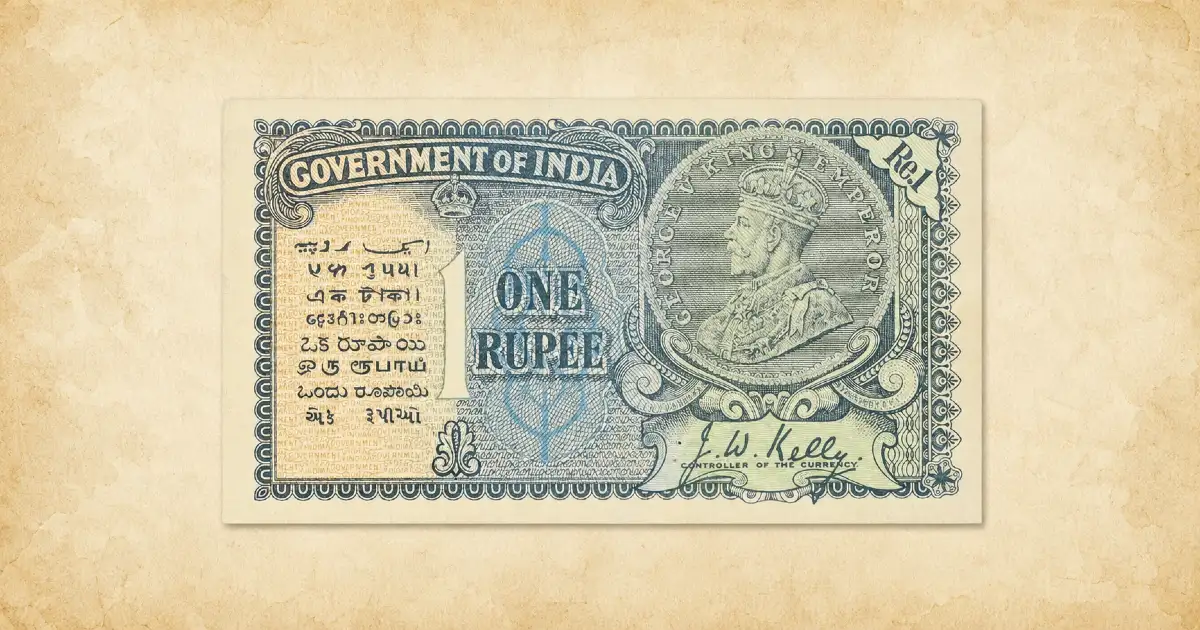
The 1935 1 Rupee note retained King George V but introduced a smaller and more refined design. Although the note bears the 1935 coin date, it was not released into circulation until August 1940, when the Government of India reintroduced the 1 Rupee denomination as a wartime measure.
This issue is catalogued as India BNB B148 / Pick 14.
Its history is particularly interesting because the notes were originally prepared in Britain in 1935, remained unissued for several years and were subsequently released during the Second World War in response to renewed pressure on silver coinage.
Design and Features
The 1935 King George V 1 Rupee note features the obverse of a 1 Rupee coin within a circular frame, surrounded by decorative engraving and ornamental borders.
A prominent language panel on the front displays the denomination in eight languages: Urdu, Kaithi, Bengali, Burmese, Telugu, Tamil, Kannada and Gujarati.
The front also contains the Government of India inscription, the denomination and the signature of J. W. Kelly, Controller of Currency.
One of the most distinctive characteristics of this note is the placement of its serial number. Unlike other British India issues of the period, the serial number appears on the reverse rather than the front.
The reverse also features the reverse of the 1 Rupee coin dated 1935.
The banknote measures approximately 92 × 55 mm, making it considerably smaller than the 1917 design.
- Monarch: King George V
- Coin date: 1935
- Circulation introduction: August 1940
- Front: King George V coin portrait, language panel and J. W. Kelly signature
- Reverse: Reverse of the 1935 coin and serial number
- Distinctive feature: Serial number printed on the reverse
- Watermarks: King George V portrait or two five-pointed stars
- Dimensions: 92 × 55 mm
- Catalogue: India BNB B148 / Pick 14
Historical Context: Printed in 1935, Issued in 1940
The printing and release history of the 1935 1 Rupee banknote provides an important link between the monetary circumstances of the 1930s and the renewed wartime demand for paper currency.
During 1935, rising international silver prices created concern that silver coins might be hoarded or withdrawn from circulation because of their bullion value.
In response, the Bank of England undertook emergency printing of 1 Rupee banknotes for the India Office. Approximately 250 million notes were prepared as part of this program.
The immediate silver crisis subsided, and the notes were not placed into circulation at that time. King George V died in January 1936, while the already prepared notes remained unissued.
The original issue eventually became useful during the Second World War. In 1940, the Government of India again faced the need to supplement available coinage, resulting in the reintroduction of paper 1 Rupee currency note.
The Bank of England archival record C40/896, titled “Emergency Printing of 1 Rupee Notes for India Office”, covers the period from 2 May 1935 to 25 July 1940. It documents the emergency printing program and the subsequent 1940 ordinance permitting the notes to be issued.
These archival dates should not be confused with the actual circulation date. The Reserve Bank of India records that the 1 Rupee denomination was reintroduced in August 1940.
The 1935-dated King George V note therefore represents an unusual example of a banknote prepared years before its eventual release into circulation.
Watermark Varieties
The 1935 King George V 1 Rupee note is known with two principal watermark types, associated with different printing arrangements.
- King George V portrait and “GOVT OF INDIA”: Used on notes printed in the United Kingdom.
- Two five-pointed stars and “GOVT OF INDIA”: Used on notes printed at the India Security Press in Nasik.
These watermark differences help collectors distinguish the British-printed notes from the later Indian-printed varieties.
Printing Varieties and Serial-Number Prefixes
The 1935 1 Rupee note is particularly interesting because it was produced by three printers in the United Kingdom and subsequently by the India Security Press in Nasik.
Each printer employed distinctive serial-number styles, prefix formats and associated security-paper characteristics.
| Prefixes | Printer | Watermark | Serial-Number Characteristics |
|---|---|---|---|
| A, B | Bank of England | King George V portrait | Alphanumeric prefix in one line without a space, such as 01A; monoweight serial font |
| C | Waterlow & Sons | King George V portrait | Alphanumeric prefix in one line with a space, such as 01 C; thin serif serial font |
| D | Bradbury Wilkinson | King George V portrait | Fractional prefix with number above letter D; serial numbers with commas |
| E, F | India Security Press, Nasik | Two five-pointed stars | Fractional prefix with letter above numeral; Indian-style serial font |
The notes with prefixes A through D were printed in the United Kingdom, while prefixes E and F were printed in India.
The Indian-printed notes were produced with perforated left edges for use in booklets containing 25 notes. Booklet covers from this period were greenish and carried the GRI monogram.
These differences in printing location, watermark, serial-number typography and booklet format make the 1935 British India 1 Rupee note an interesting series to collect by variety.
1940 British India 1 Rupee Note
The 1940 1 Rupee note featuring King George VI was introduced into circulation in 1944. Although the banknote displays the 1940 coin date, it represents a later design than the King George V note dated 1935 and released in August 1940.
This redesigned issue is catalogued as India BNB B151 / Pick 25.
The new design was more compact and modern in appearance, with revised inscriptions, a different arrangement of the serial number and a new King George VI coin portrait.

The colour essay illustrated above, associated with T. Archer, shows an experimental design featuring the King George VI coin portrait, denomination, elaborate ornamental borders and a proposed watermark area. This rare essay offers collectors a fascinating glimpse into the design process behind the 1940-dated banknote, which was eventually introduced into circulation in 1944.
Design and Features
The King George VI 1 Rupee note has a predominantly blue-grey appearance. The front features the obverse of a King George VI 1 Rupee coin within a circular frame, together with the words “GOVERNMENT OF INDIA” and “ONE RUPEE”.
Unlike the 1917 issue, the note does not contain the earlier promissory wording. This reflects the distinct legal position of the Government of India 1 Rupee denomination.
The serial number appears on the front, while the signature of C. E. Jones, Secretary of the Finance Department, is placed beneath the principal inscription.
The reverse features the reverse of the 1 Rupee coin dated 1940, bearing the inscription “ONE RUPEE INDIA 1940”, together with a multilingual denomination panel.
The language panel contains seven languages: Urdu, Hindi, Bengali, Telugu, Tamil, Kannada and Gujarati. Burmese, which appeared on the earlier King George V issues, is absent.
The note has a King George VI portrait watermark and was printed at the India Security Press in Nasik. It measures approximately 101 × 63 mm.
- Monarch: King George VI
- Coin date: 1940
- Circulation introduction: 1944
- Signature: C. E. Jones, Secretary, Finance Department
- Front: King George VI coin portrait, Government of India inscription and serial number
- Reverse: Reverse of the 1940 coin and seven-language panel
- Colour: Predominantly blue-grey
- Watermark: King George VI portrait
- Printer: India Security Press, Nasik
- Dimensions: 101 × 63 mm
- Catalogue: India BNB B151 / Pick 25
Historical Context and Legal Status
The King George VI 1 Rupee note continued the Government of India’s practice of issuing the denomination separately from ordinary Reserve Bank of India banknotes.
Section 24 of the Reserve Bank of India Act, 1934, provided for RBI banknotes of denominations beginning at 2 Rupees. The 1 Rupee denomination therefore remained a Government of India issue.
When the denomination was reintroduced in 1940, the Government of India 1 Rupee note received the legal status of a rupee coin rather than an ordinary RBI currency note. The King George VI design introduced in 1944 continued within this arrangement.
This distinctive status is one of the most important features separating the British India 1 Rupee note from higher-denomination notes issued by the Reserve Bank of India.
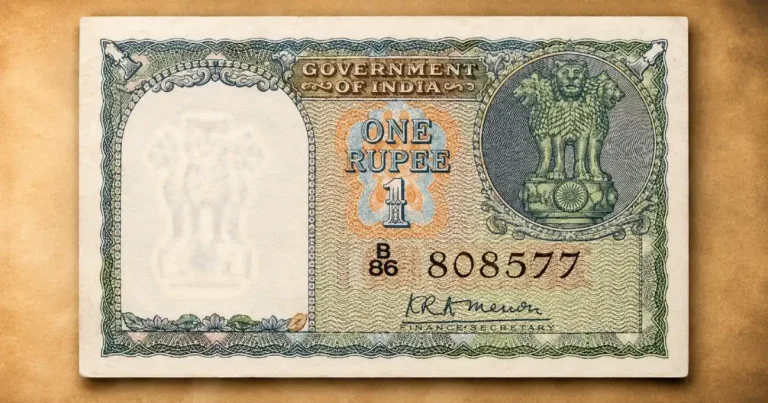
The King George VI design circulated during the final years of British rule and continued into the post-independence period. Notes from this design remained in circulation for some time after the establishment of the Republic of India.
The issue was ultimately withdrawn from circulation on 27 October 1957.
Serial-Number Colours and Inset Varieties
One of the most interesting collecting features of the 1940-dated King George VI 1 Rupee note is the variation in serial-number colour and inset letters.
Four principal varieties are recognized, distinguished by black, green, or red serial numbers and the presence or absence of inset A.
| Variety | Serial-Number Colour | Inset | Recorded Prefixes |
|---|---|---|---|
| 1 | Black | None | A/0–Z/99, excluding I and O |
| 2 | Black | A | W series |
| 3 | Green | A | A/0–W/99, excluding I and O |
| 4 | Red | None | D/90–D/99 and E/0–E/10 |
The introduction of inset letters was an important development in Indian banknote numbering.
The later red serial-number variety is associated with the post-independence Dominion of India period and is generally scarcer than the earlier black and green serial-number issues.
Collectors should check the complete prefix, serial-number colour and inset arrangement when identifying a particular 1940 King George VI 1 Rupee note.
British India 1 Rupee Banknote Used in Burma
British India 1 Rupee notes also played an important role in the currency history of Burma, where special legal arrangements permitted their circulation after Burma’s separation from British India.
Subsequent political and military developments led to distinctive Burma overprints on the King George VI 1 Rupee design.
The Currency Act, 1940
Under Section 2 of the Currency Act, 1940 (Burma Act No. XVI of 1940), enacted on 13 September 1940, Government of India 1 Rupee notes were declared legal tender in British Burma.
The Act was enacted under powers conferred by Section 43 of the Government of Burma Act, 1935, and related to the monetary arrangements established following Burma’s political separation from India in 1937.
The legislation gave Government of India 1 Rupee notes the same legal standing as the Indian rupee coin for relevant currency purposes.
Importantly, it also distinguished the 1 Rupee note from an ordinary currency note under the Reserve Bank of India Act, 1934. The denomination was treated as rupee coinage for the purposes of the applicable monetary arrangements.
This legal framework permitted Government of India 1 Rupee currency to circulate in Burma. The 1935-dated King George V issue was already available during this period, and the later King George VI design also entered circulation after its introduction.
Examples of the 1935 King George V 1 Rupee note are known bearing Japanese occupation seals, reflecting the complicated monetary conditions in Burma during the Second World War.
Military Administration of Burma Overprint
Following the Allied reconquest of Burma during the Second World War, the British Military Administration assumed responsibility for currency management.
The Reserve Bank of India resumed operations in Rangoon, and Government of India King George VI 1 Rupee notes were adapted for use under the new administration.
These notes received a red overprint reading “MILITARY ADMINISTRATION OF BURMA LEGAL TENDER IN BURMA ONLY”.
Currency Proclamation No. 6 of 1945 formalized the renewed monetary arrangements and the withdrawal of Japanese invasion currency.
The Military Administration 1 Rupee note is catalogued as Burma BNB B503 / Pick 25.
Two principal varieties are recorded:
| Serial Number | Inset | Recorded Prefixes |
|---|---|---|
| Black | None | T/99, U/0, U/1 |
| Green | A | C/86–C/99, D/0–D/71, E/42–E/99, F/0–F/61 |
The black serial-number variety is particularly scarce, with a reported printing quantity of approximately 3 million notes.
The documented prefixes and serial-number arrangements are important authentication characteristics. Notes bearing purported Military Administration overprints outside the established allocations should be treated as counterfeit overprints, even where the underlying Indian note is genuine.
Burma Currency Board Overprint
The Burma Currency and Coinage Act of 1946 provided for the establishment of the Burma Currency Board, which assumed responsibility for currency management after the Military Administration period.
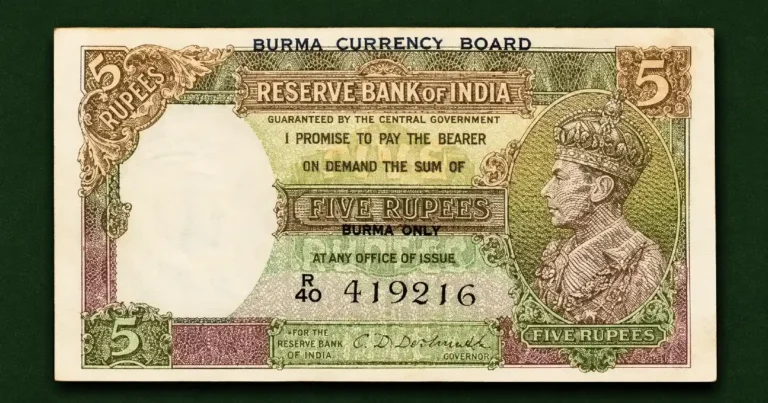
The Burma Currency Board was established in London on 31 March 1947. Existing stocks of Government of India 1 Rupee notes that had not received Military Administration overprints were subsequently adapted for use by the new authority.
The notes were overprinted in red with the inscription “BURMA CURRENCY BOARD LEGAL TENDER IN BURMA ONLY” and introduced in July 1947.
This issue is catalogued as Burma BNB B601 / Pick 30.
The recorded examples have green serial numbers with inset A and the following prefixes: K/27–K/66 and Q/17–Q/36.
These prefix allocations are essential when assessing authenticity. Examples bearing purported Burma Currency Board overprints outside the documented ranges should be regarded as counterfeit overprints.
The Military Administration and Burma Currency Board issues demonstrate how the same King George VI Indian 1 Rupee design was adapted for different monetary authorities during Burma’s transition from wartime occupation to postwar administration.
For the earlier 1937 provisional issues based on King George V notes, see our Indian KGV Burma Overprint Banknotes: 5, 10 & 100 Rupees guide.
British India 1 Rupee Banknote Used in Pakistan
The partition of British India in August 1947 created an immediate need for Pakistan to establish its own currency system.
As an interim arrangement, existing Indian banknote designs were adapted for use in Pakistan under the Pakistan (Monetary System and Reserve Bank) Order, 1947.
The modifications differed from ordinary Burma overprints. Rather than applying a simple overprint to finished banknotes, the inscription “GOVERNMENT OF PAKISTAN” and its Urdu equivalent, حکومت پاکستان, were incorporated through modifications to the printing process.
These inscriptions appeared in the watermark area on the front of the relevant King George VI note designs.
The provisional Pakistan banknotes entered circulation on 1 April 1948 and were intended for use within Pakistan rather than India.
The Reserve Bank of India continued to perform central banking functions in Pakistan until 30 June 1948. Ordinary Indian notes without Pakistan-specific inscriptions remained in circulation there until 30 September 1948.
King George VI Government of Pakistan 1 Rupee Note
The King George VI Government of India 1 Rupee design was adapted for Pakistan with additional inscriptions identifying the new issuing authority.
These notes have green serial numbers, inset A and inscriptions applied in a greenish-grey shade.
The known prefix allocations are Q/37–Q/99, R/0–R/6, R/76–R/99, and S/0–S/55.
This issue is catalogued as Pakistan BNB B101 / Pick 1.
Collectors should distinguish these officially adapted Pakistan notes from ordinary Government of India notes and from later unofficial alterations.
Catalogue References of British India 1 Rupee Notes
The following table summarizes the principal British India 1 Rupee note types and their associated Burma and Pakistan adaptations discussed in this guide.
| Country | Type | BNB Reference | Pick Reference |
|---|---|---|---|
| India | King George V — 1917 issue | India B135 | India P1 |
| India | King George V — 1935 issue | India B148 | India P14 |
| India | King George VI — 1940 issue | India B151 | India P25 |
| Burma | King George VI Military Administration overprint | Burma B503 | Burma P25 |
| Burma | King George VI Burma Currency Board overprint | Burma B601 | Burma P30 |
| Pakistan | King George VI Government of Pakistan issue | Pakistan B101 | Pakistan P1 |
Catalogue note: BNB references follow The Banknote Book, while Pick references follow the Standard Catalog of World Paper Money. The country designation identifies the catalogue chapter and should not be confused with the original design’s issuing authority.
Collecting British India 1 Rupee Note Varieties
The British India 1 Rupee note offers a broad range of collecting possibilities, from assembling the three principal historical designs to studying signatures, watermarks, language-panel inscriptions, printers, and serial-number varieties.
The 1917 King George V issue is especially interesting because of its issuing-circle system, incorrect and corrected Gujarati inscriptions, different signatures and watermark changes.
The 1935 King George V issue provides another distinctive field of study, with different British printers, Indian-printed varieties, unusual serial-number placement and two principal watermark types.
The 1940-dated King George VI issue adds black, green and red serial-number varieties, together with the introduction of inset letters.
Collectors interested in wider monetary history may also pursue the Military Administration of Burma, Burma Currency Board and Government of Pakistan adaptations.
Rarity and desirability vary considerably among these issues. Signature combinations, unusual prefixes, exceptional condition, and historical significance all influence their collectibility.
For further guidance on the factors affecting desirability, read our Understanding Banknote Values: Rarity, Condition & Demand article.
Conclusion
The British India 1 Rupee notes represent an important turning point in Indian monetary history. First introduced in 1917 to conserve silver during the First World War, it later reappeared as a wartime necessity during the Second World War and developed a distinctive legal status as a Government of India issue treated as rupee coinage.
The three principal designs — the 1917 King George V note, the 1935 King George V note released in August 1940, and the 1940 King George VI note introduced in 1944 — demonstrate the evolution of Indian paper currency across three decades of political and monetary change.
Differences in signatures, language panels, printers, watermarks, and serial-number styles create numerous collectible varieties. The subsequent adaptations for Burma and Pakistan further illustrate the important role played by Indian currency beyond the boundaries of present-day India.
Today, British India 1 Rupee notes remain an appealing collecting field, combining historical significance, distinctive designs and a wide range of varieties. Understanding their detailed characteristics is essential for identifying scarce issues and appreciating the development of Indian paper money.
Frequently Asked Questions About British India 1 Rupee Notes
When was the first British India 1 Rupee note issued?
The first British India 1 Rupee note was issued on 30 November 1917 during World War I. It featured King George V and was introduced as a wartime measure to address the shortage of silver needed for coinage.
Why was the 1 Rupee currency note introduced?
The 1 Rupee note was introduced in 1917 to conserve silver during World War I. The denomination was discontinued in 1926 and reintroduced in August 1940 because of renewed wartime metal shortages. The reintroduced notes initially featured the King George V design dated 1935.
What makes the British India 1 Rupee note unique?
The 1 Rupee note was issued by the Government of India rather than the Reserve Bank of India. When the denomination was reintroduced in 1940, it was legally treated as a rupee coin rather than an ordinary RBI currency note. This distinctive arrangement continued after Indian independence.
Are British India 1 Rupee notes rare?
Yes, certain British India 1 Rupee varieties are scarce or rare, particularly some 1917 issuing-circle notes, unusual prefixes, watermark varieties and high-grade examples. Rarity differs considerably among the 1917, 1935 and 1940 issues, making accurate identification important for collectors.
Under what law were British India 1 Rupee notes made legal tender in Burma?
The Currency Act, 1940 (Burma Act No. XVI of 1940), declared Government of India 1 Rupee notes legal tender in British Burma. These notes were treated as having the same legal standing as the Indian rupee coin.
When did the Reserve Bank of India stop operating in Pakistan?
The Reserve Bank of India ceased functioning in Pakistan on 30 June 1948. Indian 1 Rupee notes without Pakistan-specific inscriptions continued circulating there until 30 September 1948, after which they were withdrawn.