Republic India 1 Rupee notes occupy a distinctive place in Indian paper money history. Unlike higher-denomination banknotes issued by the Reserve Bank of India (RBI), the 1 Rupee currency note is issued by the Government of India and bears the signature of an authorised government official rather than the RBI Governor. Since independence, these small-denomination notes have undergone numerous changes in design, signatures, coin dates, language panels, watermarks and serial-number formats.
For collectors, Republic India 1 Rupee banknotes offer a combination of accessible issues, scarce varieties and historically significant designs. This guide examines 11 regular types comprising 64 varieties, one Mahatma Gandhi commemorative variety and one special Persian Gulf issue, covering banknote issues from 1949 to 2020. It explains how to identify each type and its varieties using signatures, coin dates, inset letters and serial-number prefixes.
Table of Contents
History of Republic India 1 Rupee Notes
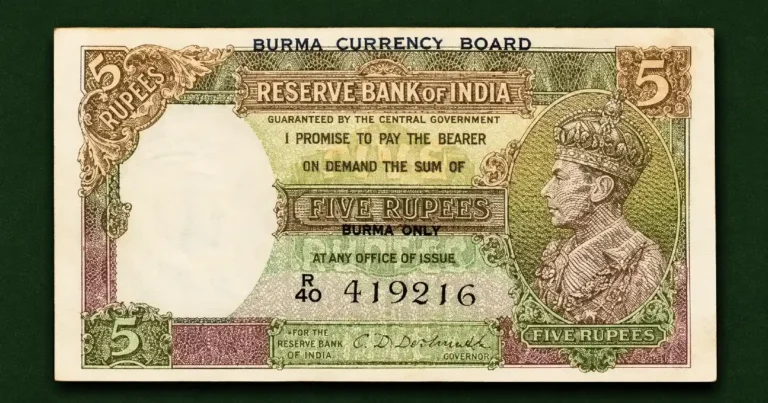
India became independent on 15 August 1947, but existing British India currency continued to circulate during the transition to a new monetary system. During the Dominion of India period, the Government of India continued issuing 1 Rupee notes bearing King George VI, including a post-independence variety distinguished by its red serial numbers.
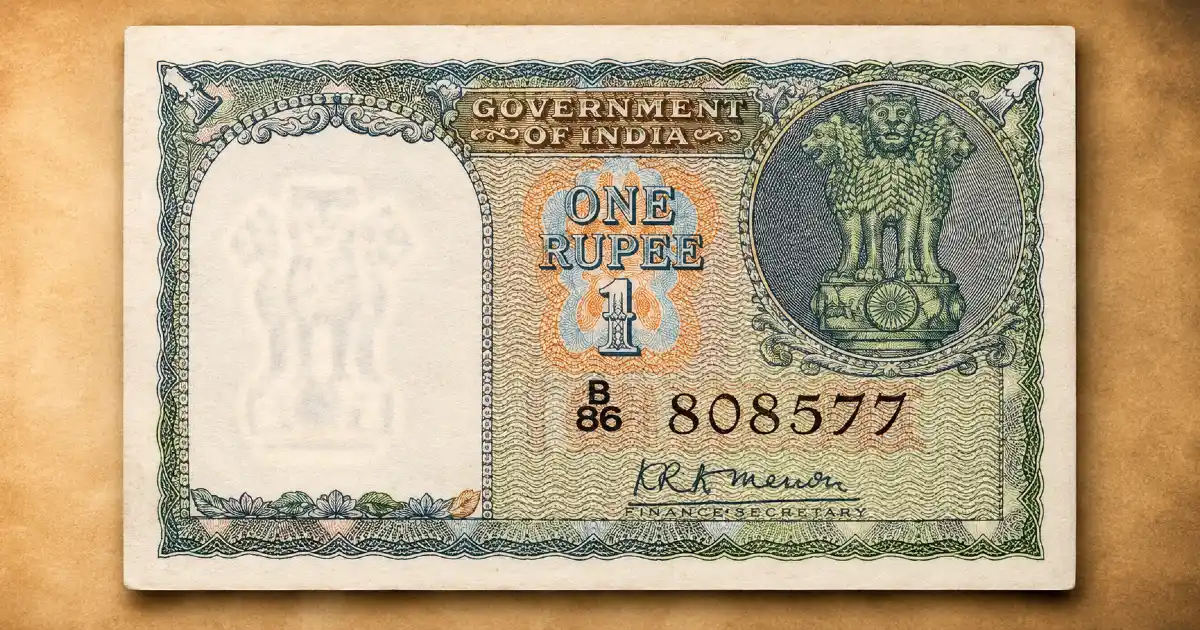
The first Republic India 1 Rupee note entered circulation on 12 August 1949, before India formally became a republic on 26 January 1950. It replaced the royal portrait with the Lion Capital of Ashoka, establishing a new visual identity for independent India’s paper currency.
For the preceding issues, including the King George VI notes with the 1940 coin date, see our companion article on British India 1 Rupee Notes.
Why Is the 1 Rupee Note Issued by the Government of India?
Although the RBI issues most Indian banknotes, the 1 Rupee banknote is an exception. It is issued by the Government of India under India’s currency legislation and carries the signature of an authorised official of the Ministry of Finance rather than the RBI Governor.
Under Indian law, the 1 Rupee currency note is treated as a rupee coin for relevant legal purposes. It is legal tender and does not carry the RBI’s usual promise-to-pay clause. This unusual legal status distinguishes it from other Indian paper money. Further information about India’s currency system is available from the Reserve Bank of India.
How to Identify Republic India 1 Rupee Notes
Collectors can identify Republic India 1 Rupee notes by examining their design, coin date, signature, reverse language panel, inset letter and serial-number prefix. Some features distinguish major types, while others identify individual varieties within the same type.
- Design: Changes to the Ashoka emblem, coin illustrations, colours, reverse imagery and dimensions help distinguish major types.
- Coin date: Many notes reproduce a 1 Rupee coin. The date shown on the coin is a design feature and does not necessarily indicate when the banknote entered circulation.
- Signature: Different government officials signed successive issues. Changes in signature or official designation can identify separate varieties.
- Language panel: Changes in the number, order and arrangement of languages on the reverse are particularly important for distinguishing certain early types.
- Inset letter: An uppercase letter printed near the serial-number panel may identify a particular variety or production sequence. It is independent of the serial-number prefix.
- Serial-number prefix: Prefix letters, numbers and their arrangement help distinguish individual issues and varieties.
Fractional and Horizontal Serial-Number Prefixes
Earlier Republic India 1 Rupee notes generally used fractional prefixes, in which a letter appeared above a number. For example, the letter A above the number 12 is represented as A/12. This prefix is followed by a six-digit serial number, giving a complete numbering format such as A/12 123456.
From December 1976, the numbering arrangement changed to a horizontal prefix, with the numbers and letter printed on the same line. For example, the prefix 12A is followed by a six-digit serial number, giving a complete numbering format such as 12A 123456.
This change distinguishes Type 6 (1966–1976), which uses fractional prefixes, from Type 7 (1976–1980), which introduced horizontal prefixes. The horizontal arrangement continued on subsequent issues.
Serial-Number Prefix Rules and Excluded Letters
Republic India 1 Rupee notes followed systematic serial-number prefix arrangements, with certain letters excluded depending on the issue. Understanding these rules helps collectors identify varieties and recognise unusual prefix combinations.
- Types 1–3: Prefix letters ranged from A to Z, excluding I and O.
- Type 4 (H. M. Patel): Prefix letters ranged from A to Z, excluding I and O.
- Type 4 (A. K. Roy onwards) to Type 6: Prefix letters ranged from A to Y, excluding I and O. The letter Z was not used for these regular domestic issues.
- Type 7 onwards: Prefix letters ranged from A to W, excluding I and O. The letters X, Y and Z were excluded.
An important exception is the special Persian Gulf 1 Rupee note signed by A. K. Roy, which uses Z-series prefixes. These distinguish it from the regular domestic A. K. Roy issue.
11 Regular Types of Republic India 1 Rupee Notes
The regular series consists of 11 principal types. Each type is distinguished by its design or another significant change, while varieties are identified through coin dates, signatures, official designations, inset letters and prefix allocations.
Type 1: 1949 Ashoka Pillar Issue
Catalog: BNB B152 · Pick 71
Introduced on 12 August 1949, this was the first Government of India 1 Rupee note with the Ashoka emblem replacing the portrait of King George VI. Its green, blue and orange design includes decorative patterns and a reverse language panel. Unlike subsequent coin-design types, it does not feature a dated 1 Rupee coin. The note measures 101 × 63 mm.
2 varieties:
- K. R. K. Menon, prefixes A–C
- K. G. Ambegaonkar, prefixes C–Q
The two varieties share the same basic design. Their signatures provide the principal means of identification.
Type 2: 1951 Green Coin Design
Catalog: BNB B153 · Pick 72
Introduced on 25 January 1952, this type incorporates the obverse and reverse of the Indian 1 Rupee coin dated 1951. The obverse depicts the coin bearing the Lion Capital of Ashoka, while the reverse shows the dated coin and language panel. The green, blue and orange colour scheme remains similar to the preceding issue. The note measures 101 × 63 mm.
1 variety:
- 1951 coin date, K. G. Ambegaonkar, prefixes A–M
The date on the coin illustration is 1951, although the banknote itself was introduced in 1952. This distinction between coin date and issue date is important when cataloguing Indian paper money.
Type 3: 1951 Purple Issue
Catalog: BNB B154–B155 · Pick 73–74
This type introduced a purple, blue and orange colour scheme while retaining the 1951 coin date. It includes notes signed by K. G. Ambegaonkar and H. M. Patel, with the principal differences between varieties involving signatures, inset letters and serial-number prefixes. The note measures 101 × 63 mm.
3 varieties:
- 1951 coin date, K. G. Ambegaonkar, no inset, prefixes A–P
- 1951 coin date, H. M. Patel, no inset, prefixes P–Z
- 1951 coin date, H. M. Patel, inset A, prefixes A–G
The H. M. Patel issues are particularly noteworthy because they introduced inset letters to Government of India 1 Rupee notes. The earlier H. M. Patel variety has no inset, while the subsequent variety carries inset A.
Type 4: 1957 Coin Date
Catalog: BNB B156 · Pick 75
Type 4 continues the purple, blue and orange design but replaces the 1951 coin date with 1957. This change coincides with India’s transition to decimal coinage. The note includes several signature and official-designation changes, making it an interesting type for collectors specialising in Government of India currency notes. The note measures 101 × 63 mm.
6 varieties:
- 1957 coin date, H. M. Patel as Secretary, inset A, prefixes G–L
- 1957 coin date, H. M. Patel as Principal Secretary, inset A, prefixes L–Z
- 1957 coin date, A. K. Roy, inset B, prefixes A–X
- 1957 coin date, L. K. Jha, inset B, prefix Y
- 1957 coin date, L. K. Jha, inset C, prefixes A–Y
- 1957 coin date, L. K. Jha, inset D, prefixes A–Y
The two H. M. Patel varieties are distinguished by the official designation accompanying the signature. The L. K. Jha varieties require closer examination of the inset letter and prefix allocation.
Type 5: 1963–1965 Coin Dates
Catalog: BNB B157 · Pick 76
This issue introduced coin dates of 1963, 1964 and 1965, together with changes to the watermark frames and reverse language panel. The revised language panel contains 13 languages. Although the general purple design continued, these changes distinguish Type 5 from the preceding issue. The note measures 101 × 63 mm.
3 varieties:
- 1963 coin date, L. K. Jha, inset A, prefixes A–Y
- 1964 coin date, S. Bhoothalingam, inset B, prefix A
- 1965 coin date, S. Bhoothalingam, inset B, prefixes A–K
The 1964 variety is particularly distinctive because its documented prefix allocation is much narrower than those of the adjacent coin dates.
Type 6: 1966–1976 Reduced-Size Issue with Fractional Prefixes
Catalog: BNB B158 · Pick 77
Introduced on 21 January 1966, this type adopted a reduced size of 96 × 64 mm while retaining the purple, blue and orange colour scheme. It includes coin dates from 1966 to 1976, with several changes in signatures and inset letters.
All 19 varieties use fractional serial-number prefixes, distinguishing them from the horizontal-prefix issues introduced in December 1976.
19 varieties:
- 1966 coin date, S. Bhoothalingam, no inset, prefixes A–Y
- 1967 coin date, S. Jagannathan, inset A, prefixes A–V
- 1968 coin date, S. Jagannathan, inset A, prefixes V–Y
- 1968 coin date, I. G. Patel, inset B, prefixes A–T
- 1969 coin date, I. G. Patel, inset B, prefixes T–Y
- 1969 coin date, I. G. Patel, inset C, prefixes A–G
- 1970 coin date, I. G. Patel, inset C, prefixes G–T
- 1971 coin date, I. G. Patel, inset C, prefixes T–Y
- 1971 coin date, I. G. Patel, inset D, prefixes A–K
- 1972 coin date, I. G. Patel, inset D, prefixes L–Y
- 1972 coin date, I. G. Patel, inset E, prefixes A–K
- 1973 coin date, M. G. Kaul, inset E, prefixes L–Y
- 1973 coin date, M. G. Kaul, inset F, prefixes A–J
- 1974 coin date, M. G. Kaul, inset F, prefixes J–Y
- 1974 coin date, M. G. Kaul, inset G, prefixes A–J
- 1975 coin date, M. G. Kaul, inset G, prefixes J–Y
- 1975 coin date, M. G. Kaul, inset H, prefixes A–F
- 1976 coin date, M. G. Kaul, inset H, prefixes F–Y
- 1976 coin date, M. G. Kaul, inset I, prefixes A–D
Collectors should pay particular attention to notes with the same coin date but different inset letters. These combinations represent distinct production allocations and are important when assembling a complete variety collection.
Type 7: 1976–1980 Reduced-Size Issue with Horizontal Prefixes
Catalog: BNB B158 · Pick 77
Beginning on 19 December 1976, the Government of India introduced a new serial-number prefix arrangement for its 1 Rupee notes. Instead of the earlier fractional format, the numbers and letter were printed horizontally, with the letter following the numbers.
For example, the horizontal prefix 12A is followed by a six-digit serial number, giving a complete numbering format such as 12A 123456. This easily identifiable change distinguishes Type 7 from the preceding fractional-prefix issue.
The notes retain the same principal design, purple, blue and orange colour scheme, dimensions of 96 × 64 mm. The seven varieties cover coin dates from 1976 to 1980.
7 varieties:
- 1976 coin date, Manmohan Singh, no inset, prefix letters A–N
- 1977 coin date, Manmohan Singh, no inset, prefix letters P–W
- 1978 coin date, Manmohan Singh, inset A, prefix letters A–L
- 1979 coin date, Manmohan Singh, inset A, prefix letters M–N
- 1980 coin date, Manmohan Singh, inset A, prefix letters P–T
- 1980 coin date, R. N. Malhotra, inset A, prefix letters U–W
- 1980 coin date, R. N. Malhotra, inset B, prefix letters A–D
Although Types 6 and 7 share the same basic design and catalogue reference, they are treated separately in this guide because of their distinctly different serial-number prefix formats. The horizontal-prefix arrangement continued on subsequent Republic India 1 Rupee notes.
Type 8: 1981 Sagar Samrat Oil Platform Design
Catalog: BNB B160 · Pick 78
The 1981 issue introduced a major change to the reverse design by featuring the Sagar Samrat offshore oil exploration platform. This replaced the earlier emphasis on decorative patterns and introduced an industrial development theme to the denomination.
The reverse also includes the 1981-dated coin illustration and language panel. The note measures 96 × 64 mm.
2 varieties:
- 1981 coin date, R. N. Malhotra, prefix letters A–H
- 1981 coin date, M. Narasimham, prefix letters K–L
The Sagar Samrat design continued on later Republic India 1 Rupee notes, making this type an important transition in the denomination’s visual history.
Type 9: 1983–1994 Satyameva Jayate Issues
Catalog: BNB B161 · Pick 78A
Type 9 retains the Sagar Samrat oil platform on the reverse but introduces the national motto सत्यमेव जयते (Satyameva Jayate) beneath the Ashoka Pillar on the obverse coin illustration. The revised design distinguishes it from the preceding 1981 issue.
The type includes coin dates from 1983 to 1994, with numerous signatures and inset letters. It measures 96 × 64 mm.
15 varieties:
- 1983 coin date, P. K. Kaul, no inset, prefix letters A–B
- 1984 coin date, P. K. Kaul, no inset, prefix letters C–F
- 1985 coin date, P. K. Kaul, no inset, prefix letters G–K
- 1985 coin date, S. Venkitaramanan, no inset, prefix letters L–W
- 1986 coin date, S. Venkitaramanan, inset A, prefix letters A–L
- 1987 coin date, S. Venkitaramanan, inset A, prefix letters M–Q
- 1988 coin date, S. Venkitaramanan, inset A, prefix letters R–V
- 1989 coin date, S. Venkitaramanan, inset A, prefix letters V–W
- 1989 coin date, Gopi Kishen Arora, inset B, prefix letters A–C
- 1990 coin date, Bimal Jalan, inset B, prefix letters D–G
- 1991 coin date, S. P. Shukla, inset B, prefix letter H
- 1991 coin date, Montek Singh Ahluwalia, inset B, prefix letters H–M
- 1992 coin date, Montek Singh Ahluwalia, inset B, prefix letters M–N
- 1993 coin date, Montek Singh Ahluwalia, inset B, prefix letter N
- 1994 coin date, Montek Singh Ahluwalia, inset B, prefix letter N
The extensive signature sequence makes Type 9 particularly suitable for a chronological collection. Collectors should also exercise caution with purported 1995- or 1996-dated examples, which are not recognised as genuine regular issues.
Type 10: 2015–2019 Reintroduced 1 Rupee Notes
Catalog: BNB B162 · Pick 117
The Government of India reintroduced the 1 Rupee paper note in 2015 after a long period in which the coin had largely replaced it in everyday circulation. The redesigned banknote uses a pink and green colour scheme and incorporates the Indian rupee symbol.
The obverse features the Ashoka Pillar emblem, while the reverse includes a modern coin illustration, the Sagar Samrat oil platform and a 15-language panel. The note measures 97 × 63 mm.
5 varieties:
- 2015 coin date, Rajiv Mehrishi, inset L, prefixes A–B
- 2016 coin date, Ratan P. Watal, inset L, prefixes A–B
- 2017 coin date, Shaktikanta Das, inset L, prefixes A–D
- 2018 coin date, Subhash Chandra Garg, inset L, prefixes A–B
- 2019 coin date, Subhash Chandra Garg, inset L, prefix B
The 2018 issue (BNB B162d) introduced a change in the placement of the coin date on the reverse. The date, previously printed horizontally near the lower centre, was moved to a vertical position at the upper left.
Modern issues may also be encountered with different serial-number characteristics, including replacement-note markings. These are additional collecting features rather than separate principal design types.
Type 11: 2020 Ascending-Size Serial Numbers
Catalog: BNB B163
The 2020-dated issue continues the pink and green design introduced in 2015 but features ascending-size serial numbers, in which the digits progressively increase in height from left to right. It also incorporates minor changes to the coin illustration on the reverse.
The Sagar Samrat oil platform, rupee symbol and 15-language panel remain part of the design. The note measures 97 × 63 mm.
1 variety:
- 2020 coin date, T. V. Somanathan, inset L, prefix A
The ascending-size serial numbers and revised coin illustration distinguish Type 11 from the earlier modern issues. The 2020 date is the latest coin date covered in this guide.
1969 Mahatma Gandhi Commemorative 1 Rupee Note
Catalog: BNB B159 · Pick 66
On 2 October 1969, the Government of India introduced a commemorative 1 Rupee note marking the 100th birth anniversary of Mahatma Gandhi. This special issue is distinguished by its illustration of a commemorative coin bearing Gandhi’s portrait.
The reverse depicts the other side of the commemorative coin, including the Lion Capital of Ashoka, together with the language panel. The note measures 96 × 64 mm and has an Ashoka Pillar watermark.
1 variety:
- No coin date, I. G. Patel, prefixes A–T
The Gandhi commemorative is counted separately from the 11 regular types but forms part of the 65 domestic varieties covered in this guide. Its historical significance and distinctive portrait make it a popular choice among collectors of Indian commemorative paper money.
1959 Persian Gulf 1 Rupee Note
Catalog: BNB BR101 · Pick R1
The Government of India issued a special 1 Rupee note for circulation in the Persian Gulf region, introduced on 11 May 1959. Although closely related to the domestic 1957 coin-date design, the Persian Gulf issue has a distinctive red colour and Z-series serial-number prefixes. The Persian Gulf note measures 101 × 64 mm.
The note was intended for circulation in territories where Indian currency had historically been used, including Bahrain, Kuwait, Qatar, Muscat and Oman, and territories that later became part of the United Arab Emirates. The arrangement was progressively discontinued as local currencies were introduced or adopted.
1 variety:
- 1957 coin date, A. K. Roy, inset B, prefix Z
The Persian Gulf issue is treated as a separate category and is not included in the total of 65 domestic varieties.
Republic India 1 Rupee Notes: Types and Varieties
The following table summarises the 11 regular types, the commemorative issue and the Persian Gulf issue. The classification groups the 1951 purple issues together while distinguishing the 1966–1976 fractional-prefix and 1976–1980 horizontal-prefix issues. These divisions are intended to make the banknotes easier to identify and collect.
| Type | Identifying Feature | Catalog | Varieties |
|---|---|---|---|
| 1 | 1949 Ashoka Pillar | BNB B152 · Pick 71 | 2 |
| 2 | 1951 Green | BNB B153 · Pick 72 | 1 |
| 3 | 1951 Purple | BNB B154–B155 · Pick 73–74 | 3 |
| 4 | 1957 coin date | BNB B156 · Pick 75 | 6 |
| 5 | 1963–1965 coin dates | BNB B157 · Pick 76 | 3 |
| 6 | 1966–1976 fractional prefixes | BNB B158 · Pick 77 | 19 |
| 7 | 1976–1980 horizontal prefixes | BNB B158 · Pick 77 | 7 |
| 8 | 1981 Sagar Samrat | BNB B160 · Pick 78 | 2 |
| 9 | 1983–1994 Satyameva Jayate | BNB B161 · Pick 78A | 15 |
| 10 | 2015–2019 reintroduced notes | BNB B162 · Pick 117 | 5 |
| 11 | 2020 ascending-size numbers | BNB B163 | 1 |
| Commemorative | 1969 Mahatma Gandhi | BNB B159 · Pick 66 | 1 |
| Persian Gulf | 1959 red issue | BNB BR101 · Pick R1 | 1 |
There are 64 regular domestic varieties and one Gandhi commemorative variety, giving a total of 65 domestic varieties. Including the separate Persian Gulf issue brings the total to 66 collectible varieties across 13 principal types.
Rarity and Collectibility of Republic India 1 Rupee Notes
The rarity of Republic India 1 Rupee banknotes varies considerably by type, signature, coin date, inset letter, prefix allocation and condition. While many later issues are readily obtainable, certain early notes and narrowly allocated varieties can be significantly more difficult to find.
Early Republic Issues
The 1949 K. R. K. Menon issue of Type 1 is an important early Republic banknote and is generally more difficult to obtain than many later 1 Rupee notes. Early K. G. Ambegaonkar issues and the H. M. Patel varieties of Types 3 and 4 are also of particular interest to collectors seeking the earliest post-independence designs.
Scarce Varieties
Among the more notable varieties is the 1957 coin-date note signed by L. K. Jha with inset B. Its limited prefix allocation distinguishes it from the much broader inset C and D allocations of the same type.
The 1964 coin-date note signed by S. Bhoothalingam with inset B is another variety worth particular attention. The 1968 S. Jagannathan issue with inset A and prefixes V–Y may also be less frequently encountered than neighbouring varieties.
These observations should be treated as collecting guidance rather than absolute rarity rankings. Availability can differ substantially between circulated notes, uncirculated examples and notes with unusual serial numbers.
Persian Gulf and Commemorative Issues
The red Persian Gulf 1 Rupee note is among the most distinctive and sought-after issues associated with the denomination. Its restricted regional circulation and separate Z-prefix allocation make it especially attractive to collectors of overseas Indian currency.
The 1969 Mahatma Gandhi commemorative note is popular for its historical subject and distinctive coin illustration. Its collectibility is driven by commemorative interest as well as the usual considerations of condition and originality.
Condition, Originality and Serial Numbers
Condition is an important consideration when collecting Indian paper money. Notes with original paper, strong colours, intact margins and minimal handling are generally preferred. Tears, repairs, stains, cleaning and other alterations can reduce desirability.
Some older Indian banknotes were routinely bundled with staples, so staple holes may be encountered even on otherwise well-preserved examples. Their significance depends on the particular issue and the overall condition of the note.
Fancy serial numbers, including solid numbers, low numbers, repeated digits and distinctive numerical patterns, may attract additional collector interest.
How to Build a Republic India 1 Rupee Note Collection
There are several ways to collect Republic India 1 Rupee notes, depending on budget, availability and personal interests. A basic type collection can begin with one example of each of the 11 regular types, followed by the Gandhi commemorative and Persian Gulf issues.
A more detailed collection may include all recognised varieties. Types 6 and 7 together offer 26 varieties covering the transition from fractional to horizontal prefixes. Type 9 provides another substantial collecting group, with 15 varieties covering coin dates from 1983 to 1994.
When building a collection, record each note’s type, catalogue number, signature, coin date, inset letter, prefix, serial number and condition. Accurate records help distinguish varieties and identify gaps.
Conclusion
Republic India 1 Rupee notes provide a detailed record of India’s monetary development from the first Ashoka Pillar issue of 1949 to the modern 2020-dated currency note. Their changing designs, coin dates, signatures, language panels and serial-number formats make them an especially rewarding field of Indian paper money collecting.
The series comprises 11 regular types with 64 varieties, one 1969 Gandhi commemorative variety and one separate Persian Gulf issue. Understanding the differences between types and individual varieties allows collectors to identify notes accurately and build collections that reflect both their numismatic and historical significance.
Frequently Asked Questions About Republic India 1 Rupee Notes
How many types and varieties of Republic India 1 Rupee notes are there?
Under the classification used in this guide, there are 11 regular types comprising 64 collectible varieties, plus one 1969 Mahatma Gandhi commemorative variety. This gives 65 domestic varieties. The separate Persian Gulf 1 Rupee issue brings the overall total to 66 varieties across 13 principal types.
Who issues the Indian 1 Rupee note?
The 1 Rupee note is issued by the Government of India rather than the Reserve Bank of India. It carries the signature of an authorised Ministry of Finance official instead of the RBI Governor.
What was the first Republic India 1 Rupee note?
The first post-independence Ashoka Pillar 1 Rupee note was introduced on 12 August 1949 and signed by K. R. K. Menon. It is identified as Type 1, BNB B152 and Pick 71.
What distinguishes the 1951 purple 1 Rupee note varieties?
The 1951 purple issue includes three varieties distinguished by their signatures, inset letters and fractional-prefix allocations. One variety bears the signature of K. G. Ambegaonkar, while two bear the signature of H. M. Patel. The H. M. Patel varieties can be distinguished by the absence or presence of inset A.
What is the difference between fractional and horizontal prefixes?
A fractional prefix places a letter above a number, represented as A/12, followed by a six-digit serial number such as A/12 123456. A horizontal prefix places the numbers and letter on the same line, such as 12A 123456. The fractional-prefix format is used on Type 6, while the horizontal-prefix format distinguishes Type 7.
Why are the 1966–1980 notes divided into two types?
Although the 1966–1980 notes share the same principal design, this guide divides them into two types based on their serial-number prefix formats. Type 6 covers 19 fractional-prefix varieties dated 1966–1976, while Type 7 covers seven horizontal-prefix varieties dated 1976–1980. The change occurred in December 1976.
Which Republic India 1 Rupee note varieties are rare?
Notable difficult-to-find varieties include the early 1949 K. R. K. Menon issue, the 1957 L. K. Jha note with inset B and prefix Y, and the 1964 S. Bhoothalingam issue with inset B and prefix A. The Persian Gulf 1 Rupee note is also highly sought after. Rarity depends on the exact variety and condition.
What is the value of an old Indian 1 Rupee note?
The value of an old Indian 1 Rupee note depends on its type, signature, coin date, inset letter, prefix, rarity, authenticity and condition. Notes with similar designs may have different levels of collector demand, so accurate identification is essential before assessing value.
What is special about the 1969 Gandhi 1 Rupee note?
The 1969 commemorative note was issued to mark the birth centenary of Mahatma Gandhi. It features a commemorative coin illustration bearing Gandhi’s portrait and is treated separately from the regular Republic India 1 Rupee types.
How can I identify a Persian Gulf 1 Rupee note?
The Persian Gulf issue is distinguished by its red colour, 1957 coin date, A. K. Roy signature, inset B and Z-series fractional prefixes. It was introduced in May 1959 for circulation in the Persian Gulf region.
What is the latest Republic India 1 Rupee note?
The latest coin date covered in this guide is 2020. This issue bears the signature of T. V. Somanathan and introduced ascending-size serial numbers, in which the digits progressively increase in height from left to right. It also features a revised coin illustration on the reverse, distinguishing it from the earlier 2015–2019 issues.