The private banknotes of British India represent the earliest period of modern paper currency in the Indian subcontinent. Long before the Government of India obtained the monopoly of banknote issuance in 1861, private banking institutions and European agency houses introduced paper money to meet the financial needs of merchants, trading companies and colonial administration.
Among the pioneering institutions was the Bank of Hindostan, established in Calcutta in 1770. Other early banking ventures included the General Bank of Bengal and Bahar, Bengal Bank, Commercial Bank, Calcutta Bank and Union Bank. During the nineteenth century, additional institutions emerged in Bombay, including the Bank of Western India, later associated with the Oriental Bank Corporation, and the Commercial Bank of India.
These institutions operated during a period when metallic currency remained fundamental to commerce. Paper money offered a convenient alternative for substantial transactions, but its acceptance depended on the financial standing of the issuing bank and the confidence of its customers.
The surviving notes are important historical documents. They reveal early banknote designs, monetary denominations such as the sicca rupee, multilingual inscriptions and the growing sophistication of security engraving.
The history of private banknotes in India must also be distinguished from that of the three Presidency Banks: the Bank of Bengal, Bank of Bombay and Bank of Madras. Although both groups issued paper currency before 1861, their institutional relationships with the colonial government differed.
This article explores the principal private banking institutions associated with early Indian paper money, their documented banknote issues, the commercial circumstances in which they operated and the legislation that brought independent banknote issuance to an end.
For the history of the three major semi-governmental banks, read our companion article, Presidency Banknotes of British India: Early Paper Money History.
Table of Contents
The Rise of Private Banking in British India
The development of private banking in India took place against the background of major political and commercial changes during the eighteenth century.
As the authority of the Mughal Empire declined and the East India Company expanded its political influence, European trading firms became increasingly involved in the financing of commerce, government expenditure and military operations.
India already possessed sophisticated financial traditions. Indigenous bankers, merchants, and money changers employed instruments such as hundis, which facilitated payments and the transfer of funds across considerable distances.
European agency houses developed banking activities alongside these established financial practices. Some accepted deposits, provided credit, arranged remittances and eventually established banks that issued their own paper currency.
These early notes were promises by the issuing institution to pay a specified monetary amount. Their acceptance depended upon the ability and reputation of the bank to honour that obligation.
Unlike modern Indian banknotes issued by a central bank, early private-bank notes represented the obligations of individual banking institutions. Their circulation was closely connected with the commercial networks in which those institutions operated.
The Reserve Bank of India’s Currency Museum identifies this period as the beginning of modern paper money in India and discusses the role of early private banks and agency houses.
Private Banks and Presidency Banks: An Important Distinction
Private banks and the Presidency Banks were both involved in issuing currency notes before 1861, but they should not be treated as identical institutions.
Private banks were generally established through commercial partnerships, agency houses or other private banking arrangements. Some enjoyed official patronage, while others operated with more limited institutional connections.
The Presidency Banks, by contrast, maintained particularly close relationships with the colonial administration through government charters, participation in their capital and official banking business.
The Bank of Bengal, Bank of Bombay and Bank of Madras developed into important regional institutions and survived long after their authority to issue banknotes ended.
Both groups contributed to the development of Indian paper currency, but their histories are best studied separately.
Early Private Banks in British India: Historical Overview
The following table summarizes important early banking institutions recorded in the history of British India. It distinguishes their operating periods and geographical associations without assuming that every bank’s surviving notes have been fully documented.
| Bank | Established | Principal Location | Historical Notes |
|---|---|---|---|
| Bank of Hindostan | 1770 | Calcutta | Established by Alexander and Company; failed in 1832 |
| General Bank of Bengal and Bahar | 1773 | Calcutta | Government-supported venture; wound up in 1775 |
| Bengal Bank | 1784 | Calcutta | Early banking institution; ceased in 1791 |
| General Bank of India | 1786 | Calcutta | Early private banking venture; ceased in 1791 |
| Commercial Bank | 1819 | Calcutta | Operated until 1828 |
| Calcutta Bank | 1824 | Calcutta | Operated until 1829 |
| Union Bank | 1829 | Calcutta | Operated until 1848 |
| Bank of Western India | 1842 | Bombay | Predecessor of the Oriental Bank Corporation |
| Commercial Bank of India | 1845 | Bombay | Exchange bank and banknote issuer; failed in 1866 |
The dates and principal locations above reflect historical banking records, including the Reserve Bank of India’s account of the development of modern banking in India. They should not be interpreted as verified first and last dates of banknote issuance for every institution.
The sections below concentrate on banks whose histories or paper currency issues can be discussed using identifiable historical evidence.
Bank of Hindostan: Pioneer of Private Banknotes in India
The Bank of Hindostan was among the earliest and most important private banks associated with the introduction of paper money in India.
Established in 1770 in Calcutta by the agency house Alexander and Company, the bank operated during a period when British commercial interests in Bengal were expanding rapidly.
Its establishment reflected the growing demand for financial institutions capable of supporting commercial transactions, accepting deposits and providing banking services within the developing colonial economy.
The Bank’s Establishment and Early Operations
The Bank of Hindostan emerged from the activities of Alexander and Company, one of the European agency houses involved in trade and finance in Bengal.
Agency houses combined commercial activities with financial services and often maintained close relationships with merchants, officials and other business interests.
The establishment of a bank allowed such activities to be organized through a more recognizable financial institution.
The Bank of Hindostan remained active for more than six decades, an unusually long period when many early banking ventures experienced short lives or financial difficulties.
According to the Reserve Bank of India’s historical account, the bank survived three banking panics before eventually failing in the commercial crisis of 1832. Its collapse followed the failure of its parent agency house, Alexander and Company.
This history illustrates an important characteristic of early private banking: the financial condition of the issuing institution was directly relevant to confidence in its paper currency.
Bank of Hindostan Banknote Designs
Surviving Bank of Hindostan banknotes provide valuable evidence of early nineteenth-century Indian security printing.
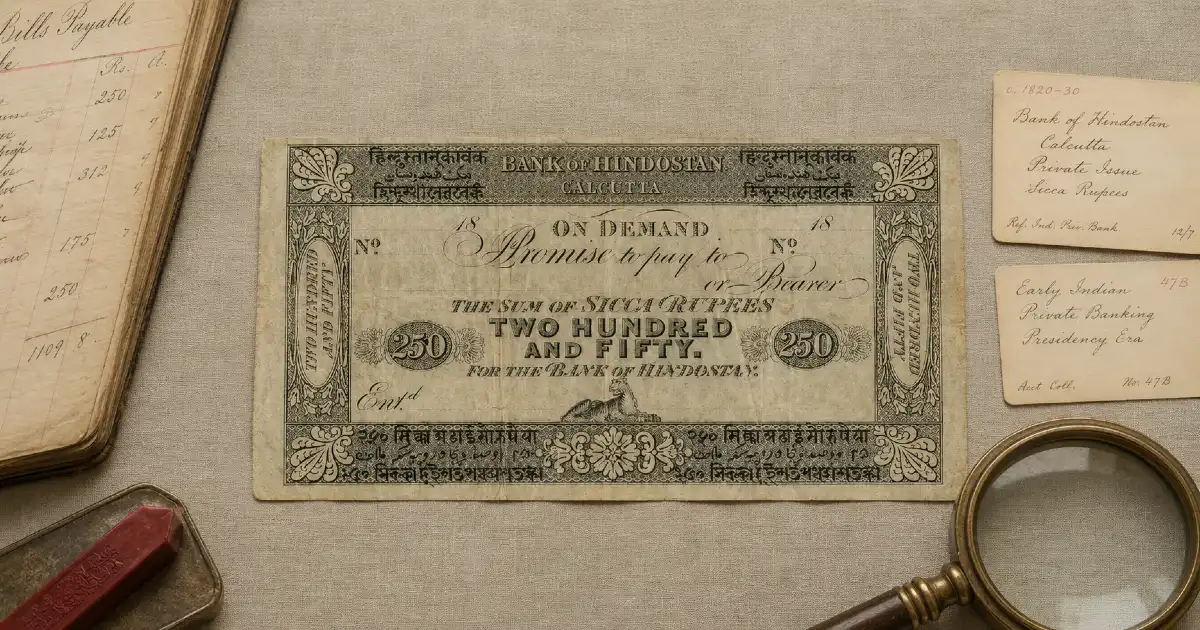
One particularly well-documented group consists of notes denominated in sicca rupees, including 50, 100, 250, 500 and 1,000 Sicca Rupees.
These designs featured the bank’s name, the denomination in words and numerals, an ornamental border, and a promissory inscription indicating payment to the bearer. A seated tiger appeared near the lower centre of the design, providing a distinctive pictorial element.
The notes also incorporated inscriptions in multiple scripts, including forms of Hindi or Nagri, Bengali and Persian, reflecting the multilingual commercial environment in which the bank operated.
The complex borders and engraved lettering demonstrate the importance of distinctive visual design in an era when private institutions were responsible for producing and maintaining confidence in their own currency notes.
The term sicca rupee refers to a historical monetary unit associated with the silver rupee system of Bengal.
The 250 Sicca Rupees Note of 1823–1827
One of the best-documented surviving examples is an unissued 250 Sicca Rupees Bank of Hindostan note attributed to the period around 1823–1827.
The design bears the inscription “BANK OF HINDOSTAN CALCUTTA”, the denomination “TWO HUNDRED AND FIFTY” and the bank’s promise to pay the bearer on demand.
Large numerals “250” appear on both sides of the principal inscription, while a small seated tiger occupies the lower centre. Ornamental borders and multilingual text complete the composition.
The engraving was produced by Perkins Bacon, a British firm associated with the development of secure banknote and stamp printing.
An example of this note was offered in Spink Auction 20009, Lot 188, on 4 November 2020.
The note was described as unissued, without signatures, and was graded PMG 20 Very Fine, with tears noted. It achieved a hammer price of £50,000.
The sale is noteworthy because it documents a surviving example of an early private Indian banknote, its design, printer, condition and specialist catalogue classification.
General Bank of Bengal and Bahar
The General Bank of Bengal and Bahar was established in 1773, only three years after the Bank of Hindostan.
It was a government-supported banking institution established with local financial participation during the administration of Warren Hastings.
The bank operated during a period when colonial authorities were exploring ways to strengthen commercial finance and facilitate payments in Bengal.
Although it had official patronage and was reportedly profitable, the institution was short-lived and was wound up in 1775.
Its brief existence illustrates the experimental character of early European-style banking institutions in India.
The General Bank of Bengal and Bahar is particularly significant because it demonstrates that government participation and private financial interests were already interconnected during the earliest stages of Indian paper currency development.
Its history also provides an important institutional comparison with the Presidency Banks, which later developed more durable relationships with the colonial administration.
Bengal Bank and the General Bank of India
Several additional banking institutions appeared in Calcutta during the closing decades of the eighteenth century.
Among them were the Bengal Bank, established in 1784, and the General Bank of India, established in 1786. Historical banking records identify both institutions as having ceased operations in 1791.
Their histories belong to the same period of early banking experimentation that followed the establishment of the Bank of Hindostan and General Bank of Bengal and Bahar.
These institutions should not be confused with the later Bank of Bengal, which originated as the Bank of Calcutta in 1806 and became the first of the three Presidency Banks.
For some short-lived banks, detailed descriptions of specific banknote designs and denominations are less securely documented than their establishment and closure dates.
Accordingly, their inclusion here is primarily to explain the broader development of private banking rather than to assign unsupported catalogue varieties or design features.
Commercial Bank of Calcutta
The Commercial Bank was established in Calcutta in 1819 and operated until 1828. It was one of several banking institutions active in the city during a period of expanding commerce and changing financial arrangements.
Calcutta’s commercial importance created demand for deposit banking, credit facilities, remittances and other financial services used by merchants and trading firms.
Although the Commercial Bank belongs to this broader historical setting, its precise institutional history should be distinguished from that of other banks with similar names.
In particular, the Commercial Bank established in Calcutta in 1819 was not the same institution as the Commercial Bank of India established in Bombay in 1845.
This distinction is important because the latter institution is specifically documented as a banknote issuer with identifiable artistic characteristics.
Calcutta Bank
The Calcutta Bank was established in 1824 and operated until 1829. It was part of a succession of banking ventures that appeared in Calcutta during the early nineteenth century, when the city served as one of the most important commercial and administrative centres in British India.
The bank’s relatively short operating period illustrates the difficulties encountered by financial institutions in an environment affected by fluctuations in trade, credit conditions and the fortunes of individual agency houses.
As with several other early institutions, historical banking records provide a clearer account of its existence than of the complete range of paper currency associated with the bank.
The Calcutta Bank should also be distinguished from the Bank of Calcutta established in 1806, which subsequently became the Bank of Bengal.
Union Bank of Calcutta
The Union Bank was established in Calcutta in 1829 and continued operating until 1848. It emerged during a period when banking institutions faced increasing demands for commercial credit, deposit services, and reliable payment arrangements.
Historical accounts of nineteenth-century banking identify the Union Bank as one of the private institutions associated with banknote issuance.
However, the bank operated within a financial environment that remained vulnerable to commercial downturns and the failure of connected firms.
Its closure in 1848 formed part of the wider pattern of instability experienced by several private banks during the first half of the nineteenth century.
Unlike the three Presidency Banks, the Union Bank did not survive into the later era of centralized banking in India.
Bank of Western India and Oriental Bank Corporation
The Bank of Western India represents an important development in the geographical expansion of private banking beyond Calcutta.
Established in Bombay in 1842, the institution emerged as the city’s international commercial importance was increasing.
Bombay was developing into a major centre for maritime trade and financial transactions linking western India with other parts of Asia and the wider British commercial system.
The Bank of Western India subsequently developed into the institution associated with the Oriental Bank and later Oriental Bank Corporation.
These names represent successive stages in a related institutional history and should not be treated as wholly unrelated banking ventures.
From Bombay to International Banking
The Bank of Western India initially operated within Bombay’s commercial environment before expanding its activities beyond the presidency.
Historical accounts describe the bank’s expansion into locations including Calcutta, Ceylon and Canton, reflecting the increasingly international character of nineteenth-century Asian banking.
Its subsequent development into the Oriental Bank marked a transition toward wider exchange banking and international commercial operations.
The Oriental Bank Corporation later became a major name in colonial banking, although the institution ultimately failed in 1884.
Banknotes of the Bank of Western India
The Reserve Bank of India specifically identifies the Bank of Western India and Oriental Bank Corporation among the early private banks associated with Indian paper currency.
Its banknotes are notable for a vignette depicting Bombay Town Hall, an important civic landmark in the city. The use of a recognizable architectural subject connected the banknote visually with the institution’s place of origin.
Bombay Town Hall also appeared on notes associated with the separate Bank of Bombay, illustrating how local landmarks could serve as important visual subjects for more than one institution.
For collectors and historians, the issuing bank’s name, inscriptions and institutional period are therefore essential for distinguishing notes that may share similar pictorial themes.
Commercial Bank of India
The Commercial Bank of India was established in Bombay in 1845, several years after the creation of the Bank of Western India. It operated as an exchange bank and was associated with the growing importance of commercial finance and international trade in western India.
Unlike the earlier Commercial Bank established in Calcutta in 1819, the Commercial Bank of India has a specifically documented place in the history of Indian banknote design.
Distinctive Western and Eastern Banknote Motifs
The Reserve Bank of India’s Currency Museum describes the Commercial Bank of India’s notes as combining Western and Eastern artistic motifs.
This combination is historically significant because it reflects the visual environment in which European banking techniques were adapted to Indian commercial and cultural circumstances.
European security engraving was increasingly sophisticated during the nineteenth century, incorporating intricate ornamental borders, pictorial subjects and carefully arranged inscriptions.
When applied to banknotes intended for circulation in India, these techniques could be combined with local symbolism and multilingual elements.
The resulting designs form part of the distinctive artistic history of early Indian paper money.
The Commercial Bank of India’s Failure in 1866
The Commercial Bank of India ceased operations during the financial crisis of 1866. The collapse followed a period of severe instability in commercial and financial markets, particularly after the speculative expansion associated with the cotton trade.
The bank’s failure occurred five years after private banking institutions had lost their authority to issue currency notes under the Paper Currency Act of 1861.
Its history therefore illustrates two separate developments: the withdrawal of independent note-issuing privileges and the financial difficulties that affected private commercial banks during the 1860s.
Other Early Banking Institutions in British India
The banks discussed above formed part of a much wider network of financial institutions established during the eighteenth and nineteenth centuries.
Historical banking records identify numerous additional institutions, including the Carnatic Bank, Bank of Mirzapore, Benares Bank, Cownpore Bank and several banks associated with Agra and northern India.
Not all of these institutions are equally well documented as banknote issuers. Some are known primarily through historical banking records rather than surviving paper currency.
Other bank names appearing in numismatic or historical discussions, including the Asiatic Bank and institutions described as Madras Government banks, require careful identification before their histories or banknote designs can be attributed with confidence.
It is important to distinguish an institution’s documented existence from evidence that it issued a particular denomination or surviving banknote design.
The broader history of private banking remains a valuable area of research precisely because the surviving records and banknotes are unevenly distributed among institutions.
Designs and Denominations of Early Private Indian Banknotes
Early private banknotes in India combined features of European banking documents with the monetary systems and commercial requirements of the Indian subcontinent.
Their designs varied according to the issuing institution, period and printer, but several recurring characteristics can be identified.
Sicca Rupees and Other Historical Monetary Units
The sicca rupee was an important monetary unit in Bengal during the period when some of the earliest private Indian banknotes were issued.
Banknotes denominated in sicca rupees reflected the currency arrangements prevailing within their regional commercial environment.
Some early paper money also used other monetary units, including the gold mohur and regional denominations associated with different parts of India.
Understanding these monetary units is important because a denomination appearing on an eighteenth- or nineteenth-century banknote cannot always be interpreted using the later standardized rupee system.
Multilingual Inscriptions
Multilingual inscriptions were a notable characteristic of some early Indian private-bank notes.
The Bank of Hindostan 250 Sicca Rupees design, for example, incorporated inscriptions in English and several Indian-language scripts.
This reflects the practical need for paper currency to communicate its denomination and issuing authority to users operating within a multilingual commercial environment.
Such designs demonstrate that multilingual banknote inscriptions existed well before the Government of India assumed responsibility for paper currency issuance in 1861.
For more information, see our Languages on Indian Notes: History and Panels guide.
Engraving, Promissory Text and Security Features
Private banknotes generally contained the name of the issuing institution, denomination and wording promising payment to the holder or bearer.
Ornamental engraving, decorative borders, pictorial vignettes and carefully arranged typography helped distinguish genuine notes from unauthorized reproductions.
British security printers, including Perkins Bacon, played an important role in producing elaborate engraved designs for Indian banking institutions. The increasing sophistication of these designs contributed to the technical development of banknote printing during the nineteenth century.
Readers unfamiliar with terms such as vignette, uniface, specimen or promissory text can consult the Indian Banknote Glossary.
The Paper Currency Act of 1861 and the End of Private Banknote Issuance
The most important turning point in the history of private banknotes of British India came with the Paper Currency Act of 1861.
Before this legislation, several private banking institutions and the three Presidency Banks had issued their own paper currency under the legal arrangements applicable to their institutions.
The Paper Currency Act transferred the monopoly of banknote issuance to the Government of India, ending the independent note-issuing privileges of private and Presidency Banks.
This reform followed the transfer of government in India from the East India Company to the British Crown in 1858.
It established a more centralized system in which paper money was issued under the authority of the Government rather than by individual commercial banking institutions.
Sir James Wilson and Samuel Laing
The development of the new Government paper currency system was closely associated with Sir James Wilson, the first Finance Member of the Viceroy’s Executive Council.
Wilson supported financial reforms intended to improve the organization of government revenue and public finance in British India.
Following his death in 1860, his successor Samuel Laing played an important role in implementing and modifying the proposals for Government-issued paper currency.
The reform created the foundation for the nineteenth-century Government of India banknote series that succeeded the private-bank and Presidency Bank issues.
From Private Banknotes to Government Currency Notes
The transition to Government-issued currency did not immediately produce the banknote designs familiar to modern collectors.
Early Government of India notes included the Queen Victoria Portrait Series, followed by uniface currency designs incorporating intricate engraving, denomination inscriptions and security features.
Over time, these notes developed through different issuing circles, signatures, language panels, watermarks and printing arrangements.
For an example of the later development of Government-issued uniface paper money, see our India Green Underprint 5 Rupee Uniface Note guide.
The transition also explains why the private-bank and Presidency Bank periods form distinct introductory chapters in the history of British India currency.
Historical Importance of Private Banknotes of British India
The private banknotes of British India provide evidence of an early stage in the development of organized banking and modern paper money.
They illustrate how financial institutions adapted European-style banking practices to the established commercial and monetary traditions of the Indian subcontinent.
The variety of issuing institutions also reveals the difficulties of maintaining public confidence in paper currency when the financial obligations represented by notes depended upon individual banks.
Some institutions survived for several decades, while others were closed after relatively short periods or failed during commercial crises.
The surviving banknotes preserve information about monetary denominations, languages, printing techniques and institutional identity that may not be fully recorded elsewhere.
Examples such as the Bank of Hindostan 250 Sicca Rupees note also demonstrate the historical importance of specimen and unissued notes as evidence of early banknote production.
Given their age and historical significance, surviving early Indian private bank notes may benefit from independent authentication and professional grading. For further information, see our Should You Submit Indian Banknotes to PMG? guide and Banknote Grading Scale.
Conclusion: The Legacy of Early Private Indian Paper Money
The private banknotes of British India represent the beginnings of modern paper currency in the Indian subcontinent.
Beginning with institutions such as the Bank of Hindostan in 1770, private banking developed alongside the expansion of trade and colonial administration during the late eighteenth and early nineteenth centuries.
The General Bank of Bengal and Bahar, Bengal Bank, Commercial Bank, Union Bank and other institutions formed part of this developing financial environment.
Later banks, including the Bank of Western India and Commercial Bank of India, reflected the increasing importance of Bombay and international commercial finance.
The surviving notes reveal the evolution of monetary denominations, multilingual inscriptions, engraved vignettes and security printing before centralized Government currency was introduced.
The Paper Currency Act of 1861 ultimately ended the independent note-issuing rights of private and Presidency Banks, establishing the Government of India’s monopoly over paper currency.
Together with the Presidency Banknotes of British India, these early private issues form an essential part of the history of Indian banking and paper money.
Frequently Asked Questions About Private Banknotes of British India
What were private banknotes of British India?
Private banknotes were paper currency issued by individual banking institutions and agency-house banks before the Government of India obtained the monopoly of note issuance in 1861. They represented obligations of the issuing banks and formed an important part of early Indian monetary history.
Which was the earliest private bank to issue paper money in India?
The Bank of Hindostan, established in Calcutta in 1770 by Alexander and Company, was among the earliest and best-known private banks associated with Indian paper money. It continued operating until 1832.
What were Bank of Hindostan banknotes?
Bank of Hindostan banknotes were issued or prepared by the private bank established in Calcutta in 1770. Surviving examples include notes denominated in sicca rupees, with engraved borders, promissory text, multilingual inscriptions and a distinctive seated tiger design.
What was a sicca rupee?
The sicca rupee was a historical monetary unit associated with the silver currency of Bengal. Some early private Indian banknotes, including Bank of Hindostan issues, were denominated in sicca rupees rather than the later standardized rupee system.
What is the difference between private banks and Presidency Banks?
Private banks were generally established through commercial partnerships or agency houses. The Presidency Banks—Bank of Bengal, Bank of Bombay and Bank of Madras—maintained especially close institutional relationships with the colonial government through charters and official banking arrangements. Both groups issued paper currency before 1861.
Was the Bank of Western India related to the Oriental Bank Corporation?
Yes. The Bank of Western India was established in Bombay in 1842 and subsequently developed into the institution associated with the Oriental Bank and Oriental Bank Corporation. Its banknotes included designs featuring Bombay Town Hall.
Were the Commercial Bank and Commercial Bank of India the same institution?
No. The Commercial Bank was established in Calcutta in 1819 and ceased operations in 1828. The Commercial Bank of India was a separate institution established in Bombay in 1845. The latter was an exchange bank and banknote issuer that failed during the financial crisis of 1866.
When did private banks stop issuing banknotes in British India?
The Paper Currency Act of 1861 transferred the monopoly of note issuance to the Government of India, ending the independent note-issuing privileges of private banks and the three Presidency Banks.
Are original private banknotes of British India rare?
Yes. Surviving original private-bank notes are generally rare, particularly examples from short-lived institutions and early issues. Unissued notes and specimens are also important historical records of designs prepared by these banking institutions.
Featured image: Bank of Hindostan 250 Sicca Rupees note, circa 1823–1827. Original banknote image courtesy of Spink Auctions; adapted for historical and educational illustration.