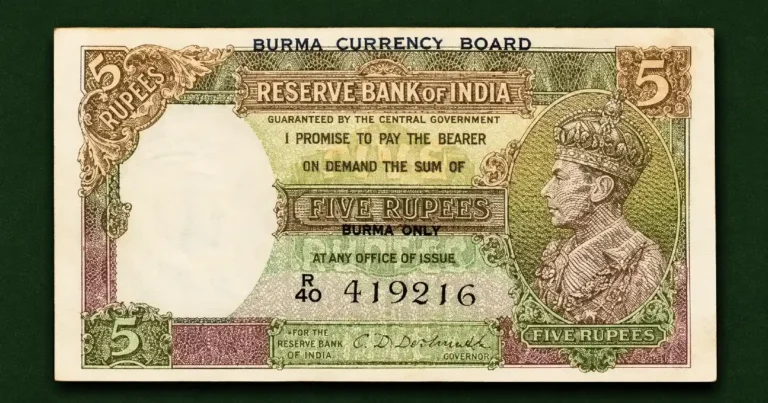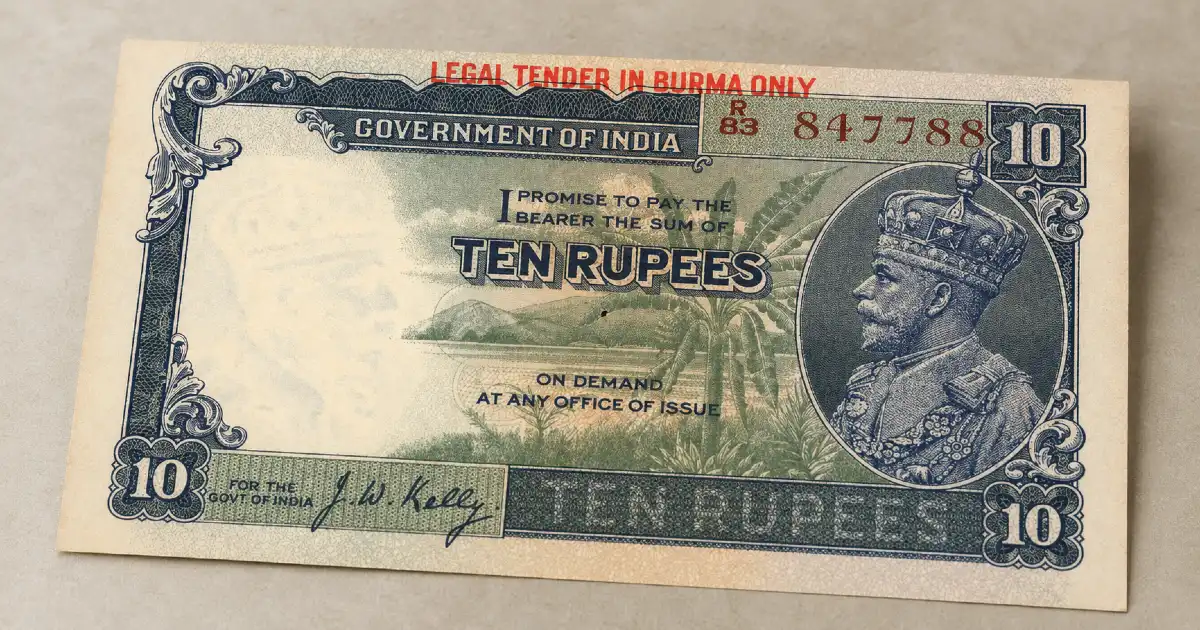
Indian KGV Burma overprint banknotes originated from a major administrative change: when Burma separated from British India on 1 April 1937, the authorities needed to establish a distinct paper currency system without immediately introducing unfamiliar banknote designs.
The Government of India therefore adapted existing, unissued stocks of King George V Indian banknotes by applying the inscription “LEGAL TENDER IN BURMA ONLY”. These provisional issues were produced in three denominations: 5 Rupees, 10 Rupees and 100 Rupees.
The solution allowed Burma to continue using familiar Indian currency designs while restricting the legal tender status of the overprinted notes to Burma. The provisional series remained an important transitional issue until purpose-designed Burma banknotes became available.
For Indian banknote collectors, the series is particularly interesting because every officially overprinted note originated from a specific British India banknote type. Identifying the original Indian issue is therefore just as important as examining the Burma overprint itself.
There are six principal varieties: black and red overprints for each of the three denominations. These can be distinguished by their overprint placement, catalogue numbers and precisely documented serial-number prefixes.
This guide examines the Indian base notes used for the 1937 Burma provisional notes, the six recognized varieties, their prefixes, relative rarity and important authentication considerations. It also discusses the disputed 1,000 Rupees overprint, which is not recognized here as an official issue.
Table of Contents
Why Burma’s Separation Required Overprinted Indian Notes
Burma had been administered as a province of British India since 1886, following the Third Anglo-Burmese War. During this period, it shared the wider Indian currency and banking system.
Rangoon had already become a recognized regional issuing circle under the nineteenth-century Indian paper currency administration. This arrangement explains why earlier high-denomination Indian notes could carry a Rangoon circle designation long before Burma became a separate British colony.
Burma’s political separation was implemented on 1 April 1937 under the constitutional arrangements established in 1935. The separation created a monetary challenge because Burma did not yet possess a complete, purpose-designed banknote series of its own.
Standard Government of India banknotes had circulated in both territories for many years. Continuing to use unrestricted Indian notes would have complicated the distinction between the monetary systems of India and Burma.
At the same time, preparing an entirely new series required the design, engraving, printing and distribution of secure banknotes. An immediate replacement would have been impractical.
The authorities adopted a transitional solution: existing King George V banknotes were overprinted with the words “LEGAL TENDER IN BURMA ONLY”, making them identifiable as currency intended for Burma.
The overprints allowed a separate provisional currency to be established using banknote designs already familiar to the public. This is the historical origin of the Indian KGV Burma overprint banknotes.
The 1937 Burma provisional notes are particularly important to collectors because they represent the transition from Indian currency administration to a separate Burmese monetary system. These Burma overprint banknotes preserve the original King George V designs while documenting a significant change in their legal tender status.
The Reserve Bank of India’s Currency Museum provides further historical background on Rangoon as a currency circle, the Bank’s responsibilities in Burma and the introduction of distinctive Burma banknotes in 1938.
The Indian KGV Banknotes Behind the Overprint
Every genuine denomination in the 1937 provisional series was based on an existing Government of India King George V banknote bearing the signature of J. W. Kelly, Controller of Currency.
The original banknotes were produced at the India Security Press in Nashik. The Burma overprint was an additional modification to these established Indian designs, rather than a completely new engraved Burma banknote.
The three base-note classifications are especially important for collectors identifying the Indian origins of the series.
| Denomination | Pick Base-Note | BNB Base-Note |
|---|---|---|
| 5 Rupees | India Pick 15b | B149b |
| 10 Rupees | India Pick 16b | B150b |
| 100 Rupees | Burma Pick A8f — Rangoon Circle | B144r3, India chapter |
The 100 Rupees reference requires clarification. The Standard Catalog of World Paper Money places the relevant Rangoon Circle note within its Burma listings, while The Banknote Book identifies the underlying note within the Indian series.
This difference reflects the organization of the two catalogue systems. It does not mean that the notes were produced from two different base designs.
Understanding the original Indian base notes is essential when identifying King George V Burma overprint varieties, particularly because a genuine Indian banknote can subsequently be altered by the addition of an unofficial overprint.
Black and Red King George V Burma Overprint Varieties
The Indian KGV Burma overprint banknotes were produced in two principal overprint styles. Black overprints appeared first, followed by more visible red overprints.
Black Overprints: The Earlier Variety
The initial overprints were printed in black ink. On the 5 Rupees and 10 Rupees notes, the inscription appeared within the principal design area, below the denomination. On the 100 Rupees note, it was positioned below the Rangoon issuing-circle designation.
The reverse placement differed according to denomination. Because the black lettering often overlapped intricate printed designs, the territorial restriction could be less immediately noticeable.
These earlier varieties are an important part of the 1937 Burma provisional notes and can be particularly challenging to acquire in desirable condition.
Red Overprints: The Later Variety
The later issues used red ink and moved the territorial restriction into the upper margins on both the front and reverse.
This made the words “LEGAL TENDER IN BURMA ONLY” easier to distinguish from the underlying banknote design. Red overprints are particularly recognizable because of their strong visual contrast.
For collectors, both colours are essential to assembling a complete set of the six officially recognized Burma overprint banknotes.
Pick and BNB Numbering Differences
An important catalogue distinction is that the Standard Catalog of World Paper Money lists the red varieties under the letter a and the black varieties under b. The Banknote Book follows the opposite arrangement, assigning a to black and b to red.
Collectors should therefore check which catalogue system is being used when examining a dealer description, auction listing or certification label.
1937 KGV Burma Overprint Banknotes: Complete Variety Table
The official 1937 Burma provisional notes comprise three denominations, each with black and red overprint varieties. The following table provides a quick cross-reference for all six recognized issues.
| Denomination | Overprint | BNB | Pick | Prefixes |
|---|---|---|---|---|
| 5 Rupees | Black | B101a | 1b | S/88 (200001–1000000); S/89–S/90 |
| 5 Rupees | Red | B101b | 1a | T/18–T/22 |
| 10 Rupees | Black | B102a | 2b | R/42–R/49 |
| 10 Rupees | Red | B102b | 2a | R/82–R/89 |
| 100 Rupees | Black | B103a | 3b | T/32 (700001–1000000); T/41 (000001–100000) |
| 100 Rupees | Red | B103b | 3a | T/41 (100001–1000000); T/47 (000001–606000) |
5 Rupees KGV Burma Overprint Banknote
The 5 Rupees denomination is the lowest value in the official King George V Burma overprint series. It was produced using the Indian home-market note catalogued as Pick 15b / BNB B149b.
The original note measures approximately 127 × 73 mm and was printed in brown, violet, orange, and green. Its front features King George V facing left, while the reverse displays the customary multilingual denomination panel.
The watermark incorporates the Star of India and the inscription “5 GOVERNMENT OF INDIA 5.” The note does not contain a security thread.
5 Rupees Black Overprint — BNB B101a / Pick 1b
The black overprint appears near the centre of the front, below the denomination, with a corresponding overprint at the lower centre of the reverse.
This variety is associated with a particularly narrow prefix allocation:
- S/88: Serial numbers 200001–1000000.
- S/89: Entire recorded prefix run.
- S/90: Entire recorded prefix run.
These allocations amount to the equivalent of approximately 2.8 complete prefix runs, making the 5 Rupees black overprint an especially interesting variety for collectors studying the limited original production of the provisional issues.
5 Rupees Red Overprint — BNB B101b / Pick 1a
The red overprint appears prominently in the upper margins on both sides of the banknote.
Prefixes extend from T/18 through T/22.
The red-overprint variety is generally more obtainable than its black counterpart. Nevertheless, well-preserved examples remain desirable because of the issue’s historical importance and distinctive provisional character.
For collectors assembling a complete set of Indian KGV Burma overprint banknotes, the two 5 Rupees varieties provide a useful comparison between the original black overprint and the revised red inscription.
10 Rupees KGV Burma Overprint Banknote
The 10 Rupees denomination was adapted from the Indian home-market note catalogued as Pick 16b / BNB B150b.
Printed in violet, olive green and blue, the note features a left-facing portrait of King George V and a palm-tree motif on the front. The reverse includes elephants with mahouts and a multilingual denomination panel.
The watermark incorporates King George V and the denomination inscription “TEN RUPEES GOVERNMENT OF INDIA TEN RUPEES.” No security thread is present.
Among the six principal Burma overprint varieties, the 10 Rupees black overprint is generally the most accessible starting point for collectors assembling a representative set.
10 Rupees Black Overprint — BNB B102a / Pick 2b
The black overprint appears near the centre of the front below the denomination. On the reverse, it is positioned below the “GOVERNMENT OF INDIA” heading.
Prefixes extend from R/42 through R/49.
This variety provides a useful introduction to the 1937 Burma provisional notes because it combines a recognizable King George V design with a historically significant territorial overprint.
10 Rupees Red Overprint — BNB B102b / Pick 2a
The red inscription is positioned in the upper margins of the front and reverse, rather than within the principal design.
Prefixes extend from R/82 through R/89.
Although both 10 Rupees varieties cover eight recorded prefixes, the red overprint is generally considered scarcer than the black overprint. This demonstrates why surviving rarity should not be estimated from the number of prefixes alone.
100 Rupees KGV Burma Overprint Banknote
The 100 Rupees is the highest denomination among the three officially recognized Indian KGV Burma overprint banknotes. It was adapted from the large-format Rangoon Circle note catalogued as Pick A8f in the Burma chapter and BNB B144r3 in the India chapter.
The note measures approximately 171 × 108 mm and was printed predominantly in violet and green. Its watermark includes King George V and the Government of India inscription, and it has no security thread.
The 100 Rupees overprints are particularly important to collectors because of their narrow prefix allocations, comparatively limited survival, and relationship to the history of high-denomination Indian paper money in Burma.
100 Rupees Black Overprint — BNB B103a / Pick 3b
The black overprint appears beneath the Rangoon issuing-circle designation on the front and at the lower centre of the reverse.
The genuine prefix allocations are:
- T/32: Serial numbers 700001–1000000.
- T/41: Serial numbers 000001–100000.
These narrow ranges are especially important when identifying the genuine 100 Rupees black overprint variety.
100 Rupees Red Overprint — BNB B103b / Pick 3a
The later red overprint is positioned in the upper margins on both the front and reverse.
The prefix allocations are:
- T/41: Serial numbers 100001–1000000.
- T/47: Serial numbers 000001–606000.
Important Clarification: The Disputed T/32 Prefix Range
Some references give the black 100 Rupees overprint a wider T/32 range beginning at serial number 400001 rather than 700001.
IndiaBanknotes research has identified the earlier starting point as arising from the inclusion of a forged overprint in the recorded population. Based on the examples examined and the verified range used in this guide, the genuine allocation begins at T/32 700001.
Collectors should therefore use T/32 700001–1000000 and T/41 000001–100000 as the established black-overprint ranges adopted by IndiaBanknotes.
Some King George V 100 Rupees notes associated with Burma also survive as quarter-cut fragments, retained during official cancellation and accounting procedures. These form a distinct collecting specialty. For their history, identification and significance, read our British Burma King George V 100 Rupee Quarter Cut Note guide.
The “1000 Rupees KGV Burma Overprint” — Not an Official Issue
Although a small number of King George V 1000 Rupees notes bearing purported Burma overprints have appeared in the collector market, no officially issued 1000 Rupees Burma overprint has been established through contemporary official records.
The documented provisional program comprised only the 5 Rupees, 10 Rupees and 100 Rupees denominations.
The disputed 1000 Rupees examples were not listed in the earlier standard references, including The Coins and Banknotes of Burma by Michael Robinson and L. A. Shaw or the original edition of The Standard Reference Guide to Indian Paper Money.
A small group of examples appeared in the market during the mid-2000s. A subsequent reference illustrated one of these notes, and The Banknote Book later included a listing under B104, describing a crude red overprint.
However, the known examples display significant differences from the authorized provisional series. Their overprint style and placement do not correspond to the official red-overprint arrangements found on the 5, 10 and 100 Rupees notes.
IndiaBanknotes directly examined examples from the group offered during that period and rejected them as forged overprints. Accordingly, this guide recognizes three official denominations and six principal overprint varieties. The purported 1000 Rupees overprint is discussed as a disputed and counterfeit issue, not as an additional authorized denomination.
How to Identify Genuine KGV Burma Overprint Banknotes
The 1937 provisional issues are vulnerable to counterfeit overprints because ordinary Indian King George V banknotes can resemble the genuine Burma notes very closely. A counterfeit may involve a genuine Indian base note to which an unofficial overprint has been added.
For this reason, authentication requires examination of the underlying Indian banknote as well as the overprint.
Confirm the J. W. Kelly Signature
All officially recognized Indian KGV Burma overprint denominations were produced using banknotes signed by J. W. Kelly.
Burma overprints on otherwise similar Indian notes bearing the signature of J. B. Taylor are not recognized as genuine examples of the official 1937 provisional program.
Checking the signature is therefore one of the simplest initial authentication steps.
Verify the Prefix and Complete Serial Number
The documented prefixes and serial-number ranges listed above represent the verified allocations for genuine Indian KGV Burma overprint banknotes. Notes bearing overprints outside these established ranges should be treated as counterfeit overprints, even if the underlying Indian banknotes are genuine.
This is particularly important for the 100 Rupees black overprint, where an incorrect expansion of the T/32 prefix range has resulted in forged examples being recorded as genuine in some references.
Examine Overprint Colour and Placement
The earlier black overprints were positioned within the main design, whereas the later red overprints appeared in the upper margins.
Check both sides of the banknote and compare the positioning, lettering and alignment against authenticated examples of the same denomination and variety.
Differences in ink density, typography and placement can be important warning signs, particularly when the underlying base note is otherwise genuine.
Distinguish Contemporary and Later Forgeries
Counterfeit Burma overprints are known from different periods. Some were created when the provisional notes circulated, while others were produced later to imitate scarce collector varieties.
Contemporary counterfeit material may itself have historical interest, but it must not be confused with an officially issued banknote.
Our Should You Submit Indian Banknotes to PMG? guide discusses the role of professional authentication for important historical notes.
Rarity of Indian KGV Burma Overprint Banknotes
Surviving Indian KGV Burma overprint banknotes are scarce across all three denominations, although their relative rarity differs considerably among the six varieties.
The 100 Rupees issues are particularly difficult to obtain, while the 10 Rupees black overprint is generally the most accessible of the principal varieties.
Based on the collecting experience and research reflected in this guide, the approximate rarity order from most difficult to least difficult to find is:
- 100 Rupees — Black Overprint
- 100 Rupees — Red Overprint
- 5 Rupees — Black Overprint
- 5 Rupees — Red Overprint
- 10 Rupees — Red Overprint
- 10 Rupees — Black Overprint
This is a general ranking of relative availability rather than a fixed numerical survival census. Differences in condition, provenance and individual collector requirements may also influence desirability.
Why the 100 Rupees Varieties Are Especially Scarce
The 100 Rupees issues had narrow documented prefix allocations and a high monetary denomination. Their large physical format also made the notes less convenient to preserve in pristine condition.
Later currency withdrawals, accounting procedures and the disruptions associated with the Second World War contributed to the limited survival of intact examples.
Both varieties are important targets for collectors assembling a complete set of King George V Burma overprint notes.
The 5 Rupees Black Overprint
Within the 5 Rupees denomination, the black variety is generally scarcer than the red variety. Its restricted S/88 allocation, followed by S/89 and S/90, is an important part of its numismatic significance.
Collectors seeking a complete six-variety set often find the black 5 Rupees more challenging to obtain than the corresponding red example.
The 10 Rupees Red Overprint
The 10 Rupees provides an interesting contrast. Despite both varieties covering eight prefixes, the red overprint is generally more difficult to find than the black overprint.
This demonstrates that prefix allocation alone does not determine the number of surviving collectible banknotes.
Condition Rarity
High-grade Indian KGV Burma overprint banknotes are especially challenging to obtain across all three denominations.
Many surviving examples show folds, staining, handling wear or other condition problems. Burma’s tropical environment and the wartime disruptions of the 1940s also form part of the broader historical context affecting preservation.
Collectors should therefore assess the exact variety and condition together rather than relying solely on the denomination or overprint colour.
For a broader discussion of scarcity, grade and collector demand, see our Understanding Banknote Values: Rarity, Condition & Demand guide.
Indian KGV Burma Overprint Banknotes: Historical Legacy
The Indian KGV Burma overprint banknotes occupy an unusual position in the history of British India paper money. They were printed as Indian banknotes, modified for use in a newly separated colony, and replaced relatively quickly by a dedicated Burmese series.
For collectors approaching these notes from the Indian side, the original British India catalogue classifications provide the starting point. The J. W. Kelly signature, precise prefixes and original designs link the provisional notes directly to the Indian currency system from which they emerged.
The red and black overprints distinguish the six officially recognized Burma provisional varieties. Together, these differences offer a compact but challenging collecting field.
The provisional solution was temporary. Beginning in 1938 and continuing into 1939, the Reserve Bank of India introduced Burma-specific King George VI notes, commonly known as the Peacock series.
Unlike the 1937 King George V overprints, the Peacock notes were designed specifically for Burma and incorporated distinctive Burmese imagery and language elements.
The two series therefore document consecutive stages of Burma’s monetary separation: the adaptation of existing Indian currency and the introduction of a dedicated Burmese banknote design.
As a short-lived transitional issue, the 1937 Burma provisional notes form an important link between the history of British India currency and the development of Burma’s separate paper money system.
Collectors interested in the wider historical context can explore our British Burma Banknotes collection and King George V Banknotes collection.
Frequently Asked Questions About Indian KGV Burma Overprint Banknotes
What are Indian KGV Burma overprint banknotes?
They are Government of India King George V banknotes overprinted with “LEGAL TENDER IN BURMA ONLY” for use in Burma following its separation from British India on 1 April 1937. The official provisional series consists of 5, 10 and 100 Rupees notes.
Why were King George V Indian banknotes overprinted for Burma?
Burma needed a distinct currency system after its separation from British India, but a new purpose-designed banknote series was not yet available. Overprinting existing Indian notes provided a practical transitional solution.
Which denominations were officially issued with Burma overprints?
Only the 5 Rupees, 10 Rupees and 100 Rupees denominations are recognized as official King George V Burma provisional overprint issues. Each denomination exists with both black and red overprints, creating six principal varieties.
Which Indian base notes were used for the Burma overprints?
The 5 Rupees was based on India Pick 15b / BNB B149b; the 10 Rupees on India Pick 16b / BNB B150b; and the 100 Rupees on the Rangoon Circle note catalogued as Burma Pick A8f / India BNB B144r3.
What is the difference between black and red Burma overprints?
The earlier black overprints appeared within the banknote’s main design. The later red overprints were positioned in the upper margins on both sides, making the territorial restriction easier to recognize.
What is the prefix range for the 5 Rupees Burma overprint?
The black variety uses S/88 serial numbers 200001–1000000, plus prefixes S/89 and S/90. The red variety uses prefixes T/18 through T/22.
What is the prefix range for the 10 Rupees Burma overprint?
The black variety uses prefixes R/42 through R/49. The red variety uses prefixes R/82 through R/89.
What is the prefix range for the 100 Rupees Burma overprint?
The black variety uses T/32 serial numbers 700001–1000000 and T/41 serial numbers 000001–100000. The red variety uses T/41 serial numbers 100001–1000000 and T/47 serial numbers 000001–606000.
Why do Pick and BNB use different suffix letters?
Pick designates the red overprints with suffix a and black overprints with suffix b, while The Banknote Book uses suffix a for black and suffix b for red. Collectors should check both the catalogue system and overprint colour when identifying a variety.
Were 1000 Rupees Burma overprint banknotes officially issued?
No officially authorized 1,000 Rupees King George V Burma overprint has been confirmed. Examples appearing in the collector market have been identified as forged overprints, and the denomination is not included among the three recognized official provisional issues.
How can collectors identify counterfeit Burma overprints?
Check the J. W. Kelly signature, the exact prefix and serial-number range, and the overprint’s colour, lettering and placement. Genuine Indian base notes can carry forged overprints, so the authenticity of the underlying note alone is not sufficient.
Which KGV Burma overprint banknote is the rarest?
The 100 Rupees black overprint is generally regarded as the most difficult of the six principal varieties to obtain, followed by the 100 Rupees red overprint. Rarity also depends on the condition and availability of individual examples.
Are KGV Burma overprint banknotes valuable?
Yes. Genuine KGV Burma overprint banknotes are scarce and highly collectible, with strong appeal among collectors of British India and British Burma paper money. The 100 Rupees varieties are particularly rare and desirable, while well-preserved examples across all three denominations can command significant collector premiums.
What replaced the 1937 Burma provisional overprint notes?
The King George VI Burma Peacock series was introduced beginning in 1938, with additional denominations following in 1939. These were purpose-designed Burma banknotes rather than ordinary Indian notes modified with a territorial overprint.