The British India 1000 Rupee note represents one of the most prestigious and historically significant denominations of colonial Indian paper money Issued from the reign of Queen Victoria through the reign of King George VI, these high-denomination banknotes were primarily intended for substantial commercial transactions, banking operations, and government treasury purposes rather than everyday circulation.
Over approximately eight decades, the denomination underwent major changes in design, printing technology, issuing authority and security features. The earliest Queen Victoria notes were followed by large-format uniface issues, then by the distinctive portrait banknotes of King George V and King George VI.
Today, surviving British India 1000 Rupees currency notes are prized by collectors for their historical importance, intricate designs and rarity. Some varieties are exceptionally difficult to obtain, particularly the early Government of India issues and notes from uncommon issuing circles.
This guide examines the five principal types of British India 1000 Rupee banknotes, including their historical backgrounds, designs, signatures, issuing circles, serial prefixes, security features and collectibility.
Table of Contents
- History of the British India 1000 Rupee Note
- Five Types of British India 1000 Rupee Notes
- Queen Victoria 1000 Rupee Note
- Government of India Uniface 1000 Rupee Notes
- King George V 1000 Rupee Note
- King George VI 1000 Rupee Note
- Understanding Issuing Circles and Prefixes
- Economic Role of High-Denomination Banknotes
- The 1946 Demonetisation
- Rarity and Collectibility
- How to Identify and Evaluate These Notes
- Conclusion
- Frequently Asked Questions
History of the British India 1000 Rupee Note
The history of the British India 1000 Rupee banknote is closely connected with the development of government-controlled paper currency in colonial India.
Before 1861, several Presidency Banks possessed the authority to issue their own banknotes within prescribed territories. The Paper Currency Act of 1861 established a government monopoly over paper currency issuance, bringing a major transformation to India’s monetary system.
The Government of India subsequently introduced a series of banknotes bearing the portrait of Queen Victoria. These included high denominations intended primarily for financial institutions, wealthy merchants, and large commercial transactions.
In 1867, the Queen Victoria portrait design was replaced by a new series of uniface banknotes. The 1000 Rupee denomination continued in this format into the early twentieth century, with changes to serial-number placement, issuing circles and administrative details.
A further transformation occurred in 1931, when the Government of India introduced a new King George V 1000 Rupee banknote. Unlike its predecessors, this currency note was printed on both sides and featured elaborate pictorial designs.
The establishment of the Reserve Bank of India in 1935 brought another important change. The RBI assumed responsibility for issuing paper money, and the King George VI 1000 Rupee note was introduced in 1938 under the new central banking authority.
All these historical issues were eventually affected by the demonetisation of high-denomination banknotes in January 1946, bringing an end to the circulation of the British India 1000 Rupee denomination.
Five Types of British India 1000 Rupee Notes
Five principal catalogue types are recognised in the Banknote Book (BNB) and the Standard Catalog of World Paper Money (Pick). They represent four major design periods, with the uniface series divided into two types according to serial-number placement.
| BNB | Pick | Type | Period |
|---|---|---|---|
| B107 | PA1E | Queen Victoria portrait | 1861–1867 |
| B127 | PA19 | Uniface, two serial numbers | 1867–1901 |
| B128 | PA19A | Uniface, four serial numbers | 1901–1927 |
| B146 | P12 | King George V portrait | 1931–1936 |
| B205 | P21 | King George VI portrait | 1938–1946 |
These catalogue classifications provide a useful starting point, but each type may include several collectible varieties distinguished by issuing circle, signature, prefix or other identifying features.
For collectors, identifying the correct variety is particularly important because surviving availability can differ substantially even within the same catalogue type.
Queen Victoria 1000 Rupee Note
Catalogue: BNB B107 / Pick PA1E
The Queen Victoria 1000 Rupee note belongs to the first Government of India paper currency series introduced following the Paper Currency Act of 1861. It represents the beginning of centrally administered banknote issuance in British India.
These notes were printed in London by the Bank of England. The obverse features an engraved portrait of Queen Victoria surrounded by elaborate ornamental elements, including olive and oak branches. The denomination and issuing authority appear prominently within the design.
The note is uniface, meaning that all printed design elements appear on one side, while the reverse remains blank. This format was characteristic of several early Government of India banknote issues.
Security features included fine engraving and a watermark incorporating the words GOVERNMENT OF INDIA, ONE THOUSAND and RUPEES. The notes also carried a printed date and a signature associated with the issuing circle.
Issuing Circles and Recorded Varieties
Government paper currency was initially administered through designated issuing circles. The circle identified where a banknote was issued and formed an important part of its administrative identity.
The following combinations are recorded for the Queen Victoria 1000 Rupee denomination.
| Issuing Circle | Recorded Signatory | Prefix |
|---|---|---|
| Calcutta | Hyde | A |
| Madras | Not established | B |
These early banknotes are exceptionally rare. Their scarcity reflects their age, high original denomination and the limited number of surviving examples available to collectors.
Government of India Uniface 1000 Rupee Notes
In 1867, the Government of India introduced a redesigned series of banknotes that replaced the earlier Queen Victoria portrait issues. The new notes used elaborate lettering and ornamental patterns rather than a royal portrait.
The uniface 1000 Rupee note was printed by the Bank of England in black ink over a green underprint. It measured approximately 208 × 133 mm and retained the blank reverse characteristic of earlier Government of India notes.
The obverse contained the issuing circle, denomination, serial numbers, printed date, signature and four regional language panels. Security features included watermarks, while no embedded security thread was used.
Two principal types are recognised: an earlier issue with two serial numbers and a later issue with four serial numbers. This distinction provides the simplest method of separating the two major uniface varieties.
Uniface Notes with Two Serial Numbers
Catalogue: BNB B127 / Pick PA19
The earlier uniface 1000 Rupee note displays two printed serial numbers near the top of the obverse. Its design combines decorative borders, prominent denomination inscriptions, and regional language panels.
These banknotes were issued through several currency circles, reflecting the geographical organisation of colonial India’s paper currency administration.
| Issuing Circle | Signatory | Prefix |
|---|---|---|
| Bombay | J. A. Ballard | C |
| Bombay | S. Jacob | C, CA |
| Bombay | A. F. Cox | C, CA |
| Calcutta | S. Jacob | L, LA |
| Calcutta | A. F. Cox | LA, OA |
| Allahabad or Calcutta | S. Jacob | D |
| Lahore or Calcutta | S. Jacob | E |
| Lahore | H. Denning | EE |
| Madras | Not established | — |
The table above lists currently documented combinations and should not be considered exhaustive, as additional varieties may exist or come to light through future discoveries.
Surviving uniface 1000 Rupee notes with two serial numbers are extremely scarce, with availability varying by issuing circle, signature and prefix.
Uniface Notes with Four Serial Numbers
Catalogue: BNB B128 / Pick PA19A
The later uniface type introduced four printed serial numbers, positioned near the upper and lower portions of the obverse. This arrangement improved the visibility of the serial number while retaining the established design style.
The notes continued to use black printing over a green underprint, regional language panels and a blank reverse. Their appearance remained sufficiently similar to the earlier type that collectors should pay close attention to the serial-number arrangement.
The four serial number series is notable for its broader range of recorded issuing circles, signatures and prefixes. These combinations provide numerous opportunities for specialist collecting.
| Issuing Circle | Signatory | Prefix |
|---|---|---|
| Bombay | A. M. Brigstocke | SB, WA, ZA |
| Bombay | E. M. Cook | ZB |
| Bombay | H. Denning | ME, WC, SD |
| Bombay | A. V. V. Aiyer | ME, WC |
| Bombay | A. C. McWatters | SD |
| Bombay | C. W. C. Carson | WC, ZB |
| Bombay | W. H. Michael | WA |
| Calcutta | A. F. Cox | PA, RD |
| Calcutta | M. M. S. Gubbay | PC |
| Calcutta | H. Denning | RD, RE |
| Calcutta | C. J. R. Carnac | PD |
| Calcutta | A. V. V. Aiyer | PD |
| Calcutta | C. Gwyther | RD |
| Allahabad or Calcutta | A. F. Cox | D |
| Kurrachee | H. Denning | GE |
| Lahore | H. Denning | EE |
| Lahore | J. B. Taylor | EE |
| Rangoon | H. Denning | QE |
The Rangoon issuing-circle variety is particularly interesting because Burma was then administered as part of British India. It therefore connects the history of Indian government paper currency with the later development of separate British Burma banknotes.
For collectors, the most meaningful distinction is not simply whether a note belongs to B127 or B128, but the complete combination of type, issuing circle, signature and prefix.
Regional Language Panels on Uniface Notes
One of the most distinctive features of Government of India uniface banknotes is their use of regional language panels. These reflected the linguistic diversity of the territories served by the various issuing circles.
The uniface 1000 Rupee notes generally contained four language panels, but the languages represented differed according to the issuing circle.
Bombay-circle notes included Urdu, Marathi, Gujarati and Kannada, while Calcutta notes included Urdu, Hindi, Kaithi and Bengali. Madras notes used Telugu, Kannada, Malayalam and Tamil, whereas Rangoon notes included Burmese, Tamil, Urdu and Chinese.
These differences are important identification features. They also illustrate how colonial paper currency was adapted to regional administrative and commercial requirements.
For a broader discussion, see our article on Languages on Indian Currency Notes.
King George V 1000 Rupee Note
Catalogue: BNB B146 / Pick P12
The King George V 1000 Rupee note was introduced in 1931, marking a major departure from the earlier uniface designs. Produced at the India Security Press, Nasik Road, the new banknote featured printing on both sides and incorporated elaborate pictorial imagery.
The obverse displays a portrait of King George V within an ornate frame. The surrounding design includes intricate geometric and ornamental patterns intended to enhance both appearance and security.
The reverse features an agricultural scene showing a farmer ploughing a field with a team of oxen. Trees, buildings, water and distant mountains complete the composition, while the denomination and language panel occupy other parts of the design.
This agricultural vignette is one of the most recognisable designs in British India paper currency. It reflects the importance of agriculture to the colonial economy and provides a striking contrast with the predominantly typographic designs of the earlier uniface notes.
The watermark incorporates a portrait of King George V and GOVERNMENT OF INDIA lettering. The note did not contain a security thread.
King George V Signatures and Issuing Circles
Two signatories are recorded for the King George V 1000 Rupee denomination: J. B. Taylor and J. W. Kelly.
Seven issuing circles are known, each associated with specific numerical prefix allocations. The serial prefixes consist of the letter X followed by a number identifying the issuing circle or allocation.
| Issuing Circle | J. B. Taylor | J. W. Kelly |
|---|---|---|
| Cawnpore | X/7 | X/7 |
| Bombay | X/3, X/9 | X/9 |
| Calcutta | X/1, X/8 | X/8, X/10 |
| Karachi | X/4 | X/4 |
| Lahore | X/2 | X/2 |
| Madras | X/5 | X/5 |
| Rangoon | X/6 | X/6 |
The issuing-circle name and serial prefix should be examined together when identifying a note.
King George VI 1000 Rupee Note
Catalogue: BNB B205 / Pick P21
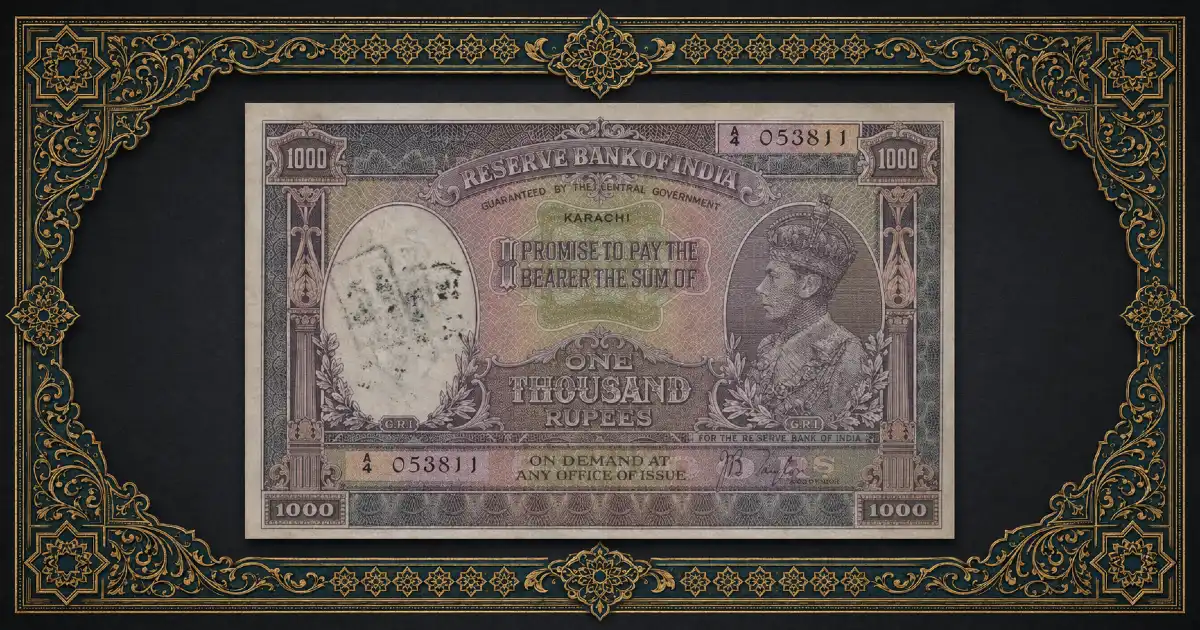
The King George VI 1000 Rupee note was introduced in June 1938 under the authority of the Reserve Bank of India. It was the final British India 1000 Rupee type and the only one issued by the RBI before independence.
The Reserve Bank of India had commenced operations in April 1935 and subsequently assumed responsibility for banknote issuance. Its establishment marked the transition from direct government-issued currency to a central banking system.
The obverse features King George VI wearing the Imperial Crown of India. The portrait is surrounded by elaborate ornamental engraving, with the denomination and issuing authority prominently displayed.
The reverse depicts a mountain landscape with fir trees and snow-covered peaks. It also includes the language panel and the RBI seal featuring a tiger and palm tree.
The mountain scenery distinguishes the King George VI note from the agricultural reverse of its King George V predecessor, while the RBI seal reflects the change in issuing authority.
Watermark and Security Features
The King George VI 1000 Rupee note incorporated a watermark featuring the monarch’s portrait, chain patterns and RESERVE BANK OF INDIA lettering. It also introduced a solid security thread, representing an important improvement over the earlier King George V denomination.
These features are useful when examining authenticity, although collectors should assess them alongside the paper, printing, dimensions and other characteristics of a genuine example.
Signature and Serial Prefixes
All recorded King George VI 1000 Rupee notes bear the signature of J. B. Taylor, the second Governor of the Reserve Bank of India.
Six issuing circles are recorded, with serial prefixes beginning with A followed by a numerical allocation.
| Issuing Circle | Recorded Prefixes |
|---|---|
| Bombay | A/3, A/7 |
| Calcutta | A/0, A/6 |
| Cawnpore | A/1 |
| Karachi | A/4 |
| Lahore | A/2 |
| Madras | A/5 |
Unlike the King George V series, there was no Rangoon issuing-circle variety. Burma had separated administratively from British India in 1937, before the introduction of the King George VI 1000 Rupee note.
For more information about the signatory and the development of the RBI, see our guide to RBI Governors.
Understanding Issuing Circles and Prefixes
Issuing circles are an important feature of historical British India banknotes. Unlike modern Indian banknotes, which are generally identified by denomination, signature, prefix and printing variety, many colonial issues also carried a specific issuing-circle designation.
The issuing circle identified the administrative centre responsible for the note’s issue. Major circles included Bombay, Calcutta, Cawnpore, Madras, Lahore, Karachi, and Rangoon, although the number of participating circles varied by type and period.
For collectors, the issuing circle may be as important as the portrait or catalogue number. Two otherwise similar banknotes can represent different varieties because they were issued through different administrative centres.
Serial prefixes provide another essential identification feature. On King George V notes, prefixes begin with X, while King George VI notes use A followed by numerical allocations. Earlier uniface issues employed different prefix arrangements.
When evaluating a British India 1000 Rupee note, collectors should therefore record the complete combination of catalogue type, issuing circle, signature and prefix. This information is essential for accurate identification and meaningful rarity comparisons.
Economic Role of High-Denomination Banknotes
During the colonial period, 1000 Rupees represented a substantial amount of money. The denomination was consequently unsuitable for most everyday purchases and was primarily associated with high-value financial transactions.
Government treasuries, commercial banks, merchants and businesses could use high-denomination banknotes to transfer substantial sums without handling large quantities of lower-value currency.
Although the 1000 Rupee note was legal tender, its practical circulation was concentrated in financial and commercial environments rather than ordinary retail transactions.
This limited everyday use helps explain why the denomination is relatively unfamiliar compared with smaller British India banknotes. It also contributes to the scarcity of surviving examples, as high-value notes were less likely to be retained casually as souvenirs.
Collectors should nevertheless avoid assuming that all high-denomination varieties are equally rare. Original issuance, historical usage, redemption and subsequent survival differed across types and issuing circles.
The 1946 Demonetisation of British India 1000 Rupee Notes
On 12 January 1946, the Government of British India demonetised 500 Rupee, 1000 Rupee and 10000 Rupee banknotes under the High Denomination Bank Notes (Demonetisation) Ordinance, 1946.
The measure was introduced against the background of concerns about unaccounted wealth and financial activity associated with the Second World War. Holders of affected banknotes were required to follow prescribed declaration and exchange procedures.
The withdrawal applied to the high-denomination notes then in circulation, including the King George VI 1000 Rupee issue. Earlier notes of the same denomination were also affected to the extent that they remained outstanding and legally exchangeable.
The demonetisation is an important event in the collecting history of British India 1000 Rupee notes. Many outstanding notes were surrendered through the banking system, reducing the number remaining outside official channels.
However, it would be inaccurate to attribute the rarity of every variety solely to demonetisation. The earliest Queen Victoria and uniface notes were already decades old by 1946, and their surviving availability had been affected by ordinary redemption, wear, loss and other historical circumstances.
Similarly, the proportion of notes exchanged or remaining outstanding does not directly establish the number of collectible examples surviving today.
For a detailed explanation of the legislation, exchange arrangements and historical context, see our article on the History of Demonetisation in India.
Rarity and Collectibility of British India 1000 Rupee Notes
The British India 1000 Rupee note is a specialist collecting field, with rarity varying considerably across its five principal types. Queen Victoria notes are exceptionally rare, followed by the extremely scarce Government of India uniface issues. King George V notes are also scarce, while King George VI notes are comparatively more accessible.
Rarity by Type and Variety
Rarity depends not only on the catalogue type but also on the issuing circle, signature and serial prefix. Some combinations may be considerably harder to find than others within the same type. Published catalogues, auction records and documented surviving examples help collectors assess relative scarcity, although the absence of recent sales does not necessarily indicate that a variety is unique.
Condition, Authenticity and Collector Demand
Condition significantly influences collector demand, with well-preserved examples generally commanding greater interest. However, even damaged or repaired notes may remain desirable when the underlying variety is exceptionally rare.
Collectors should carefully examine the design, watermark, security features, signature, and prefix to establish authenticity and identify the correct variety. Professional authentication and grading may be worthwhile for rare or expensive examples.
For further guidance, read How to Grade Banknotes and Should You Submit Indian Banknotes to PMG?.
Conclusion
From the earliest Queen Victoria issues to the final King George VI banknotes, the British India 1000 Rupee denomination illustrates the development of colonial Indian paper currency over more than eighty years.
Its five principal types offer collectors a wide range of historical designs, issuing circles, signatures and prefixes. Although surviving examples are scarce, careful identification and research can reveal important differences between individual varieties.
For the subsequent history of the denomination after independence, explore our companion article on the Republic India 1000 Rupee Note.
Frequently Asked Questions
When was the first British India 1000 Rupee note issued?
The first Government of India 1000 Rupee notes were introduced in 1861 under the Paper Currency Act. They featured Queen Victoria and were printed in London by the Bank of England.
How many types of British India 1000 Rupee notes exist?
Five principal Banknote Book catalogue types are recognised: B107, B127, B128, B146 and B205. These cover Queen Victoria, two Government of India uniface types, King George V and King George VI.
What is a uniface 1000 Rupee note?
A uniface banknote has its printed design on one side, with the reverse left blank. The Government of India issued two principal uniface 1000 Rupee types, distinguished by whether they display two or four serial numbers.
Which signatures appear on King George V 1000 Rupee notes?
Two signatories are recorded: J. B. Taylor and J. W. Kelly. Their notes were issued through seven circles, including Bombay, Calcutta, Cawnpore, Karachi, Lahore, Madras and Rangoon.
Who signed the King George VI 1000 Rupee note?
J. B. Taylor, the second Governor of the Reserve Bank of India, is the only recorded signatory for the King George VI 1000 Rupee type.
Why are British India 1000 Rupee notes rare?
Their high original denomination, limited everyday circulation, age, historical redemption and the 1946 demonetisation all contributed to their limited surviving availability. Rarity varies by type, issuing circle, signature, prefix and condition.
When were British India 1000 Rupee notes demonetised?
The denomination was demonetised on 12 January 1946, together with ₹500 and ₹10000 banknotes, under the High Denomination Bank Notes (Demonetisation) Ordinance, 1946.
Are King George VI 1000 Rupee notes more common than earlier types?
King George VI 1000 Rupee notes are generally more accessible than the earlier Queen Victoria, uniface and King George V issues. However, they remain scarce historical banknotes, and availability differs according to issuing circle and condition.
How should collectors evaluate a British India 1000 Rupee note?
Collectors should identify the catalogue type, issuing circle, signature, prefix, watermark and security features, then assess authenticity, condition, documented rarity and collector demand. The denomination alone does not establish the note’s value.