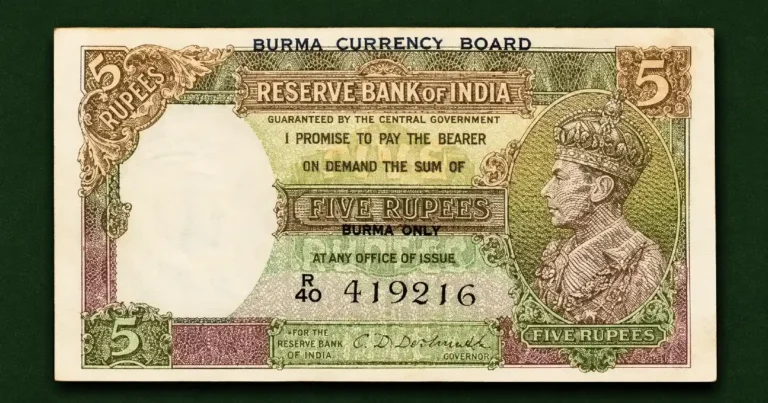
RBI Burma Peacock banknotes were issued by the Reserve Bank of India between May 1938 and July 1939 specifically for circulation in British Burma. Featuring the side-face portrait of King George VI, these distinctive currency notes combined the authority of the RBI with Burmese designs, including peacocks, elephants, a tiger and river landscapes.
The series comprised five denominations: 5 Rupees, 10 Rupees, 100 Rupees, 1000 Rupees and 10000 Rupees. All five were signed by Sir James Braid Taylor, the second Governor of the Reserve Bank of India, and were printed by the India Security Press.
The RBI Burma Peacock banknotes occupy an unusual position in Indian paper money history. Although issued by India’s central bank, they were designed exclusively for Burma following its administrative separation from British India in April 1937. Their engraved promise to pay specifically referred to payment at an office of issue in Burma, and the notes were not valid in India.
For collectors, the series is especially interesting because of its limited issue period, restricted serial number prefixes, distinctive watermarks and the disruption caused by the Second World War. The five denominations are catalogued as B201–B205 in The Banknote Book: Burma and Pick P4–P8 in the Standard Catalog of World Paper Money.
This guide examines the history, designs, denominations, catalogue references, prefixes, security features and rarity of the RBI Burma Peacock banknotes, with particular emphasis on their relationship to contemporary Indian currency.
Table of Contents
- Historical Background of the RBI Burma Peacock Banknotes
- Relationship with the King George VI India Side-Face Series
- Design and Security Features
- Five Denominations of the Burma Peacock Series
- Signatures, Serial Numbers and Prefix Ranges
- Rarity and Collectibility
- Wartime History and Survival
- Demonetisation of RBI Burma Peacock Banknotes
- Conclusion
- Frequently Asked Questions
Historical Background of the RBI Burma Peacock Banknotes
Burma was administered as part of British India until 1 April 1937, when it became a separate British colony. This political change required new arrangements for the administration of currency, banking and government finance.
Although Burma had become administratively separate, it did not immediately establish an independent central bank. Under the India and Burma (Burma Monetary Arrangements) Order, 1937, the Reserve Bank of India continued to manage Burma’s currency during the transitional period.
This arrangement allowed existing monetary institutions to continue functioning while a separate system was developed. It also explains why the first purpose-designed King George VI Burma banknotes were issued under the name of the Reserve Bank of India rather than a Burmese issuing authority.
From King George V Overprints to the Peacock Series
Before the introduction of the RBI Burma Peacock banknotes, the monetary authorities relied on existing Indian banknotes overprinted with the words LEGAL TENDER IN BURMA ONLY. These provisional notes bore the portrait of King George V and were issued in several denominations, including 5, 10 and 100 Rupees.
The overprints identified the notes as valid specifically within Burma, providing a temporary solution without requiring an entirely new banknote design immediately after administrative separation.
For a detailed examination of their types, overprints and prefixes, see our companion article on King George V Burma Overprint Banknotes.
The provisional arrangement was followed by the introduction of the RBI Burma Peacock banknotes in May 1938. Unlike the earlier overprints, the new series was designed specifically for Burma, with its own artwork, language inscriptions and legal tender wording.
Why the Reserve Bank of India Issued Burma Banknotes
The Reserve Bank of India had been established in April 1935, two years before Burma’s separation from British India. It therefore possessed the institutional infrastructure necessary to manage note issuance and currency distribution during the transitional period.
The RBI Burma Peacock banknotes were consequently an official RBI issue, even though they were intended exclusively for Burma. Their production at the India Security Press further illustrates the continued connection between the monetary systems of the two territories.
This institutional relationship makes the series relevant to both Indian banknote collectors and specialists in British Burma paper money. It represents an important chapter in the history of the Reserve Bank of India beyond the geographical boundaries of India itself.
Relationship with the King George VI India Side-Face Series
The RBI Burma Peacock banknotes were introduced during the same period as the King George VI Side-Face series issued for India. Both series featured the portrait of the new monarch, were issued under the authority of the Reserve Bank of India and initially bore the signature of Governor J. B. Taylor.
Both also shared the same original denomination structure, comprising 5, 10, 100, 1000 and 10000 Rupees. Neither included a 1 Rupee denomination within these initial RBI series. A 2 Rupees note was subsequently introduced for India in 1943, but no equivalent denomination appeared in the Burma Peacock series.
Despite these administrative similarities, the Burma notes were not merely modified versions of Indian banknotes. They were separate designs incorporating Burmese cultural symbols, local landscapes and inscriptions in English, Burmese and Shan.
The engraved promise to pay was also different. Whereas ordinary Indian banknotes were issued for circulation in India, the RBI Burma Peacock banknotes expressly referred to payment at an office of issue in Burma. They were therefore a distinct monetary issue rather than an interchangeable part of the Indian currency series.
The Indian King George VI series later developed additional signature varieties and wartime designs. The Burma Peacock series, by contrast, remained confined to its original five denominations and a single RBI Governor’s signature.
Design of RBI Burma Peacock Banknotes
One of the most appealing features of the RBI Burma Peacock banknotes is their combination of traditional Burmese imagery with the formal design conventions of British imperial paper currency.
All five denominations carry the side-face portrait of King George VI on the obverse, accompanied by English inscriptions and the Reserve Bank of India heading. The reverse designs incorporate Burmese, English and Shan text, together with elaborate illustrations of wildlife and landscapes.
The Peacock Motif
The peacock is the most recognisable decorative element of the series and gives these banknotes their familiar name. The bird has a long association with Burmese royal symbolism and appeared on the coinage of the Konbaung dynasty before British annexation.
On the RBI Burma Peacock banknotes, the peacock appears alongside other local motifs, creating a distinctive visual identity. Its presence helps collectors immediately distinguish the Burma designs from contemporary King George VI banknotes issued for India.
Other illustrations include elephants in forest settings, teak logging, agricultural scenes, boats, a tiger and a waterfall. Together, these designs provide a visual record of Burma’s natural environment and important economic activities during the late colonial period.
English, Burmese and Shan Inscriptions
Another distinctive feature is the use of three languages: English, Burmese and Shan. English appears on the obverse, while the reverse contains denomination inscriptions in Burmese, English and Shan.
This differs from the multilingual panels used on contemporary Indian banknotes. The Burmese and Shan inscriptions identify the series as a currency specifically intended for Burma and provide an additional feature for authentication and catalogue identification.
For a broader comparison with Indian currency, see our guide to Languages on Indian Notes.
Security Features
The RBI Burma Peacock banknotes were printed on watermarked paper, with different watermark inscriptions according to denomination. All five denominations were produced without a security thread.
The 5 Rupees note has a King George VI watermark accompanied by the denomination and Reserve Bank of India wording. The 10 Rupees note also has a King George VI watermark, but its denomination inscription reads TEN RUPEES.
The 100 Rupees and 1000 Rupees notes feature King George VI, linked chains and RESERVE BANK OF INDIA. The 10000 Rupees note uses a related watermark arrangement incorporating the denomination wording Rs 10.000 Rs.
These denomination-specific differences are important when examining RBI Burma Peacock banknotes for authenticity. Collectors should verify the watermark against the correct catalogue type rather than assuming that every denomination uses identical paper.
Five Denominations of the RBI Burma Peacock Banknotes
The complete RBI Burma Peacock banknotes series comprises five denominations, introduced between May 1938 and July 1939. Each denomination has its own design, colour combination, dimensions, watermark and serial number prefix range.
The following table summarises the five types using The Banknote Book: Burma and the corresponding Pick catalogue references.
| Denomination | BNB | Pick | Introduction | Prefix Range | Dimensions |
|---|---|---|---|---|---|
| 5 Rupees | B201 | P4 | May 1938 | A/0–A/36 | 127 × 73 mm |
| 10 Rupees | B202 | P5 | June 1938 | A/0–A/50 | 146 × 84 mm |
| 100 Rupees | B203 | P6 | May 1939 | A/0–A/2* | 171 × 108 mm |
| 1000 Rupees | B204 | P7 | July 1939 | A/0 | 202 × 126 mm |
| 10000 Rupees | B205 | P8 | May 1939 | A/0 | Not recorded |
*For the 100 Rupees denomination, the A/2 prefix extends only to serial number 500000.
5 Rupees Peacock Banknote
Catalogue: BNB B201; Pick P4; IPM 5.4.1
The 5 Rupees RBI Burma Peacock banknote was introduced in May 1938 and was the first denomination of the series to enter circulation. Its relatively small size made it suitable for ordinary commercial transactions, while its design established the distinctive Burmese style used throughout the series.
Printed predominantly in violet and green, the obverse features the portrait of King George VI, a chinthe and a peacock. The chinthe, a mythical lion-like guardian figure, is a familiar element of Burmese architecture and symbolism.
The reverse depicts an elephant in a forest setting, accompanied by Burmese, English and Shan inscriptions. The watermark consists of King George VI and the inscription 5 RESERVE BANK OF INDIA 5. There is no security thread.
The 5 Rupees note measures 127 × 73 mm and bears the signature of J. B. Taylor. Its prefix range extends from A/0 to A/36.
10 Rupees Peacock Banknote
Catalogue: BNB B202; Pick P5; IPM 5.4.2
The 10 Rupees RBI Burma Peacock banknote was introduced in June 1938. Its multicoloured design combines violet, green, blue and orange, making it one of the most visually elaborate denominations in the series.
The obverse features King George VI together with flowers, palm trees, a farmer ploughing with oxen and a bullock cart. These agricultural illustrations reflect the importance of farming and rural transport in Burma’s economy.
The reverse features a peacock and a river scene with boats, a fisherman and trees. Burmese, English and Shan inscriptions appear alongside the illustrations.
The watermark consists of King George VI and the wording TEN RUPEES RESERVE BANK OF INDIA TEN RUPEES. The note has no security thread and measures 146 × 84 mm.
Signed by J. B. Taylor, the 10 Rupees note was issued with prefixes A/0 through A/50.
100 Rupees Peacock Banknote
Catalogue: BNB B203; Pick P6; IPM 5.4.3
The 100 Rupees RBI Burma Peacock banknote was introduced in May 1939. Designed for higher-value commercial and banking transactions, it is considerably larger than the 5 and 10 Rupees denominations.

The note combines blue, green, orange and violet. Its obverse features the portrait of King George VI and a peacock, while the reverse depicts elephants and mahouts engaged in logging teak trees in a forest.
Teak was one of Burma’s most important natural resources and export commodities during the colonial period. The logging scene therefore reflects a significant part of the territory’s commercial economy.
The watermark comprises King George VI, linked chains and RESERVE BANK OF INDIA. The note measures 171 × 108 mm and has no security thread.
The 100 Rupees note bears J. B. Taylor’s signature and is known with prefixes A/0, A/1 and A/2. Importantly, the A/2 prefix is limited to serial numbers up to 500000.
1000 Rupees Peacock Banknote
Catalogue: BNB B204; Pick P7; IPM 5.4.4
The 1000 Rupees RBI Burma Peacock banknote was introduced in July 1939. As one of the two highest denominations in the series, it was intended principally for substantial commercial, treasury and banking transactions rather than everyday circulation.
Printed in brown, blue, violet and green, the obverse features King George VI within an ornamental temple-style frame flanked by chinthe figures. The elaborate border and large format distinguish the note from the lower denominations.
The reverse depicts a tiger in tall grass, accompanied by peacock motifs and inscriptions in Burmese, English and Shan. The tiger vignette makes this denomination especially attractive to collectors interested in wildlife on banknotes.
The watermark consists of King George VI, linked chains and RESERVE BANK OF INDIA. The note has no security thread and measures 202 × 126 mm.
Only the A/0 prefix was issued, and all regular notes bear J. B. Taylor’s signature. The 1000 Rupees denomination was demonetised in May 1945.
10000 Rupees Peacock Banknote
Catalogue: BNB B205; Pick P8; IPM 5.4.5
The 10000 Rupees RBI Burma Peacock banknote was the highest denomination of the series and was introduced in May 1939. Its exceptionally high face value indicates a role in major institutional and banking transactions rather than ordinary retail circulation.
The design combines violet, brown, yellow and orange. The obverse features the portrait of King George VI flanked by chinthe figures, while the reverse depicts a waterfall framed by peacock motifs.
The note carries Burmese, English and Shan inscriptions and has a watermark comprising King George VI, linked chains and the wording RESERVE BANK OF INDIA Rs 10.000 Rs. No security thread was incorporated.
Like the 1000 Rupees denomination, the 10000 Rupees note was issued only with the A/0 prefix and bears J. B. Taylor’s signature. The 10000 Rupees denomination was demonetised in May 1945.
Signatures, Serial Numbers and Prefix Ranges
The RBI Burma Peacock banknotes have an unusually straightforward signature structure. All five denominations bear the signature of Sir James Braid Taylor (J. B. Taylor), the second Governor of the Reserve Bank of India, who served from July 1937 until February 1943.
Unlike the contemporary King George VI Indian series, the Burma Peacock notes did not develop additional regular signature varieties under later RBI Governors. No regular issues bearing the signatures of C. D. Deshmukh or subsequent Governors belong to this series.
For more information about RBI Governors and their terms in office, see our RBI Governor List.
Understanding the Serial Number Format
All regular RBI Burma Peacock banknotes use a six-digit serial number accompanied by a fractional alphanumeric prefix, such as A/0 or A/1. The prefix identifies the series, while the six-digit number identifies the individual banknote within that series.
The prefix system is especially important because the five denominations have markedly different ranges. The lower denominations were issued across more prefixes, while the two highest denominations were confined to A/0.
| Denomination | Known Prefix Range | Important Detail |
|---|---|---|
| 5 Rupees | A/0–A/36 | 37 prefixes |
| 10 Rupees | A/0–A/50 | 51 prefixes |
| 100 Rupees | A/0–A/2 | A/2 ends at serial 500000 |
| 1000 Rupees | A/0 | Single prefix |
| 10000 Rupees | A/0 | Single prefix |
A prefix or serial number outside the authorised range is a serious indication that a note is not a genuine regular issue.
Rarity and Collectibility of RBI Burma Peacock Banknotes
The RBI Burma Peacock banknotes are highly collectible because of their limited issue period, distinctive Burmese designs and close connection with the Reserve Bank of India. They appeal to collectors of British India, British Burma, Commonwealth and Southeast Asian paper money.
Unlike many Indian banknote series, which offer numerous signature and design varieties, the Burma Peacock series is comparatively simple. Collectors generally concentrate on obtaining the different denominations, identifying the correct prefixes and assessing condition and authenticity.
Relative Scarcity of the Five Denominations
The 5 Rupees and 10 Rupees denominations are generally the most accessible RBI Burma Peacock banknotes. Their wider prefix ranges and lower original face values contributed to their greater availability compared with the higher denominations.
The 100 Rupees note is considerably more difficult to obtain, particularly in higher grades. Its three-prefix structure, with the A/2 serial-number limit of 500000, makes it an important denomination for collectors examining the relationship between issue size and surviving examples.
The 1000 Rupees and 10000 Rupees denominations are especially rare. Both were confined to the A/0 prefix, carried exceptionally high face values and were demonetised in May 1945.
As with other historical banknotes, rarity should be assessed alongside condition, authenticity and the availability of comparable examples. The absence of multiple signature varieties does not make the series easy to complete.
Comparison with King George VI Indian Banknotes
One way to understand the scarcity of RBI Burma Peacock banknotes is to compare their prefix ranges with contemporary King George VI Indian notes.
The Indian 5 Rupees Side-Face note signed by J. B. Taylor is known across approximately 900 prefixes, compared with just 37 prefixes (A/0–A/36) for the Burma 5 Rupees Peacock note. Similarly, the Indian 10 Rupees Side-Face issue signed by J. B. Taylor extends across approximately 712 prefixes, while the Burma 10 Rupees Peacock note was issued with only 51 prefixes (A/0–A/50).
These differences reflect the substantially different monetary requirements of India and Burma. The Indian notes served a much larger population and economy, while the Burma Peacock series was produced for a smaller and geographically separate currency area.
These significantly narrower prefix ranges highlight the much more restricted issuance of the Burma Peacock banknotes compared with their Indian counterparts. Combined with their limited circulation period and wartime losses, the Burma issues are generally considerably rarer and more difficult to obtain, particularly in higher grades.
Condition and Collector Demand
Condition plays a major role in the collectibility of RBI Burma Peacock banknotes. Notes with strong original colours, intact margins, clear watermarks and minimal folds are particularly desirable.
However, circulated examples remain important because many surviving notes experienced difficult storage and circulation conditions during the Second World War. Tears, repairs, stains, annotations and other impairments should be evaluated carefully rather than automatically dismissed.
Collectors considering expensive examples may benefit from independent authentication and grading. For guidance, see our articles on How to Grade Banknotes and Should You Submit Indian Banknotes to PMG?.
Wartime History and Survival of Burma Peacock Banknotes
The RBI Burma Peacock banknotes were introduced during a relatively peaceful period immediately before the Second World War transformed Burma’s political and monetary environment.
Japan’s invasion of Burma began in late 1941, followed by a rapid military advance during 1942. The collapse of British administration, evacuation of personnel and disruption of commercial activity created severe problems for banking and currency circulation.
Banknotes held in government treasuries, commercial banks and private hands were exposed to wartime destruction, loss and displacement. These events affected the survival of the RBI Burma Peacock banknotes and help explain their scarcity today.
However, the wartime interruption of normal circulation should not be confused with the formal withdrawal or demonetisation dates of the notes. The five denominations did not all lose their legal tender status at the same time.
Wartime Counterfeits and Authentication
Collectors should also be aware of wartime counterfeits associated with King George VI currency. Counterfeit examples of Burma Peacock notes, particularly the 10 Rupees denomination, form an interesting but challenging area of specialist study.
Authentication requires comparison with genuine notes of the same denomination, including the portrait, fine engraving, agricultural or wildlife vignettes, watermark, paper and serial-number characteristics.
On the 10 Rupees note, the bullock cart and agricultural scene provide useful areas for examining the quality and precision of the printed details. Differences in line work should be evaluated alongside other security features rather than used as the sole basis for authentication.
Demonetisation of RBI Burma Peacock Banknotes
The RBI Burma Peacock banknotes were demonetised at different times according to denomination. The two highest denominations, 1,000 and 10,000 Rupees, were demonetised in May 1945, while the 5, 10 and 100 Rupees notes retained their legal tender status until June 1950.
| Denomination | Final Status | Month and Year |
|---|---|---|
| 5 Rupees | Demonetised | June 1950 |
| 10 Rupees | Demonetised | June 1950 |
| 100 Rupees | Demonetised | June 1950 |
| 1,000 Rupees | Demonetised | May 1945 |
| 10,000 Rupees | Demonetised | May 1945 |
Following the defeat of Japanese forces and the restoration of British administration, Burma faced the task of rebuilding its monetary system. Indian banknotes overprinted for the Military Administration of Burma were introduced in 1945, followed by further transitional issues under the Burma Currency Board in 1947.
The three lower denominations of the RBI Burma Peacock series remained legal tender during this transition until their demonetisation in June 1950. Their continued legal status should be distinguished from the disruption to actual circulation during the Japanese occupation.
Conclusion
The RBI Burma Peacock banknotes of 1938–1939 represent one of the most distinctive currency issues administered by the Reserve Bank of India. Issued specifically for Burma following its separation from British India, the series combined the portrait of King George VI with Burmese wildlife, cultural motifs and multilingual inscriptions.
Among the five denominations, the 5 Rupees and 10 Rupees banknotes are particularly appealing to collectors. Their colourful designs, featuring peacocks, elephants and traditional Burmese scenes, make them excellent examples of British Burma’s numismatic heritage.
The 100 Rupees note is considerably scarcer, while the 1000 and 10000 Rupees denominations are exceptionally difficult to acquire. Across all five denominations, the restricted prefix ranges, wartime history and limited survival contribute to the enduring interest in these banknotes.
Today, RBI Burma Peacock banknotes remain an important collecting field connecting Indian, Burmese and Commonwealth paper money. For collectors beginning with the series, the 5 Rupees and 10 Rupees notes offer an appealing combination of historical significance, distinctive artwork and relative availability.
Frequently Asked Questions About RBI Burma Peacock Banknotes
What are RBI Burma Peacock banknotes?
RBI Burma Peacock banknotes are five denominations of King George VI paper currency issued by the Reserve Bank of India between May 1938 and July 1939 specifically for circulation in British Burma. They feature Burmese designs including peacocks, elephants, a tiger and landscapes.
Why did the Reserve Bank of India issue banknotes for Burma?
Following Burma’s separation from British India in April 1937, the Reserve Bank of India continued to administer Burma’s currency under transitional monetary arrangements. The Peacock series was issued specifically for Burma while the RBI retained responsibility for its currency system.
What denominations were issued in the Burma Peacock series?
The RBI Burma Peacock banknotes comprised five denominations: 5 Rupees, 10 Rupees, 100 Rupees, 1000 Rupees and 10000 Rupees. No 1 Rupee or 2 Rupees denomination was issued as part of this series.
Who signed the King George VI Burma Peacock banknotes?
All five denominations were signed by Sir James Braid Taylor, commonly identified as J. B. Taylor, the second Governor of the Reserve Bank of India. There are no recognised regular signature varieties bearing later RBI Governors.
What are the prefix ranges for RBI Burma Peacock banknotes?
The 5 Rupees note has prefixes A/0–A/36, the 10 Rupees note A/0–A/50, and the 100 Rupees note A/0–A/2, with the A/2 prefix ending at serial number 500000. Both the 1000 Rupees and 10000 Rupees denominations were issued only with the A/0 prefix.
Did Burma Peacock banknotes have security threads?
No. All five denominations were printed without security threads. Their security features included intricate designs and watermarks featuring King George VI with denomination-specific inscriptions.
Are RBI Burma Peacock banknotes rare?
RBI Burma Peacock banknotes are collectible because of their restricted prefix ranges, short issue period and wartime history. The 5 Rupees and 10 Rupees notes are generally more accessible, while the 100, 1000 and 10000 Rupees denominations are considerably more difficult to obtain, especially in higher grades.
When were Burma Peacock banknotes demonetised?
The 1000 Rupees and 10000 Rupees denominations were demonetised in May 1945. The 5 Rupees, 10 Rupees and 100 Rupees denominations were demonetised in June 1950.
What are the BNB and Pick catalogue numbers for Burma Peacock banknotes?
The series is catalogued as B201–B205 in The Banknote Book: Burma and P4–P8 in the Standard Catalog of World Paper Money. The numbers correspond consecutively to the 5, 10, 100, 1000 and 10000 Rupees denominations.