The Burma Currency Board banknotes were introduced on 1 July 1947, marking an important transition from wartime military administration to civilian monetary authority in Burma. Rather than immediately introducing an entirely new series, the Burma Currency Board overprinted existing King George VI Indian banknotes with wording restricting their legal tender status to Burma.
Four denominations were issued: 1 Rupee, 5 Rupees, 10 Rupees and 100 Rupees. Although these currency notes retained their original Indian designs, watermarks, signatures and serial numbers, the additional BURMA CURRENCY BOARD overprint identified them as a separate series authorised for circulation in Burma.
For collectors, the Burma Currency Board series offers an interesting combination of historical significance, King George VI banknote designs and precisely defined prefix ranges. Particular attention must be paid to the authorised serial-number blocks, especially for the 100 Rupees denomination, where genuine Indian base notes may also be encountered with forged Burma overprints.
This guide examines the history, legal authority, denominations, catalogue references, signatures, prefixes, authentication and collectibility of Burma Currency Board banknotes. It also explains their relationship to the earlier Military Administration of Burma issues and the development of independent Burmese currency.
Table of Contents
Historical Background of the Burma Currency Board
The origins of the Burma Currency Board lie in the monetary disruption caused by the Second World War and the subsequent restoration of British administration. Although Burma had separated from British India in April 1937, Indian currency and the Reserve Bank of India continued to play important roles in its monetary system.
Before the Japanese occupation, Burma had used Indian banknotes bearing special legal tender overprints, followed by the purpose-designed RBI Burma Peacock banknotes introduced in 1938 and 1939. These issues formed part of the monetary system disrupted by the Japanese invasion.
From Japanese Occupation to Military Administration
Japanese forces occupied most of Burma during 1942, disrupting the existing British monetary system. Japanese military currency and later issues of the Japanese-sponsored Burma State Bank circulated during the occupation.
As Allied forces regained control during 1944 and 1945, restoring a functioning monetary system became an urgent priority. Existing Indian banknotes were overprinted for use under the Military Administration of Burma, with the first provisional issues introduced in May 1945.
These military overprints provided a practical solution during the immediate post-war period. However, as civilian administration resumed, Burma required a more permanent legal and institutional framework for managing its currency.
Establishment of the Burma Currency Board
The Currency and Coinage Act, 1946 (Burma Act XLV of 1946), provided the statutory foundation for Burma’s post-war currency arrangements. The legislation established a framework for currency issuance and legal tender under civilian authority.
The Burma Currency Board was established in London at the end of March 1947 and commenced its currency operations on 1 April 1947. Its responsibilities included administering currency issuance and maintaining the reserves supporting Burma’s monetary system.
The Board represented an important institutional change. Currency administration was no longer dependent on the temporary arrangements established during military rule, although existing Indian banknotes continued to provide a practical foundation for the new civilian issues.
Introduction of the 1947 Overprints
The first Burma Currency Board overprinted banknotes were introduced on 1 July 1947, several months before Burma achieved independence on 4 January 1948.
The authorities adopted an approach already familiar from earlier Burmese currency issues: applying special overprints to existing Indian banknotes. This practice had been used following Burma’s separation from British India in 1937 and again for the Military Administration of Burma issues in 1945.
The resulting Burma Currency Board banknotes provided continuity during the transition to civilian monetary administration. They also became the final major series of Indian banknotes officially overprinted for circulation in Burma.
Why Indian Banknotes Were Overprinted for Burma
Overprinting existing Indian banknotes offered a practical way to introduce currency under the new civilian authority without immediately producing an entirely new Burmese series. The notes retained their original designs, signatures, serial numbers and security features.
The 1 Rupee denomination was a Government of India issue, while the 5, 10 and 100 Rupees notes originated from the Reserve Bank of India. Only selected prefixes and serial-number ranges were authorised for Burma Currency Board overprinting, making these details essential for identifying genuine examples.
Overprint Design and Security Features
The defining characteristic of Burma Currency Board banknotes is the inscription identifying the civilian issuing authority and restricting their legal tender status to Burma.
The principal wording reads BURMA CURRENCY BOARD and LEGAL TENDER IN BURMA ONLY. Its arrangement varies according to the denomination and the available space on the original Indian banknote.
Red and Black Overprints
The Burma Currency Board retained the overprint colour scheme used for the preceding Military Administration issues. The 1 Rupee, 10 Rupees and 100 Rupees notes carry red overprints, while the 5 Rupees denomination uses black.
Although the wording identifying the issuing authority changed, the overall appearance remained closely related to the earlier military overprints. Collectors should nevertheless distinguish the two series by their inscriptions and authorised numbering ranges.
Original Indian Security Features
Because the Burma Currency Board notes were produced from existing Indian banknotes, they retained the security features of their respective base issues.
- 1 Rupee: King George VI watermark
- 5 Rupees: King George VI watermark with denomination and Reserve Bank of India wording
- 10 Rupees: King George VI watermark incorporating TEN RUPEES and RESERVE BANK OF INDIA
- 100 Rupees: King George VI watermark with linked chains and RESERVE BANK OF INDIA lettering
None of the four regular denominations incorporated a security thread. Authentication therefore depends on examining the correct Indian base note, watermark, signature, serial number and overprint.
Burma Currency Board Banknote Denominations
The Burma Currency Board issued four denominations of overprinted King George VI Indian banknotes. The principal catalogue references are B601–B604 in The Banknote Book: Burma and Pick P30–P33.
| Denomination | Burma BNB | Burma Pick | Indian Base Note | Overprint |
|---|---|---|---|---|
| 1 Rupee | B601 | P30 | India B151d | Red |
| 5 Rupees | B602 | P31 | India B202b | Black |
| 10 Rupees | B603 | P32 | India B208 | Red |
| 100 Rupees | B604 | P33 | India B204b2 | Red |
Each denomination has its own authorised prefix allocation. The following sections examine their designs, signatures and numbering ranges in greater detail.
1 Rupee Burma Currency Board Banknote
Catalogue: BNB B601; Pick P30; Indian base note B151d
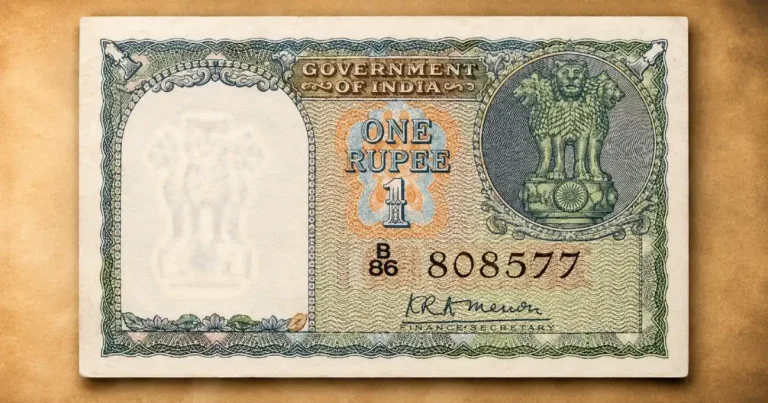
The 1 Rupee Burma Currency Board banknote was produced by overprinting the Government of India King George VI 1 Rupee note dated 1940. Its blue-grey design features the obverse of an Indian 1 Rupee silver coin bearing the King’s portrait, while the reverse reproduces the corresponding coin design.
The note bears the signature of C. E. Jones, Secretary of the Finance Department, rather than an RBI Governor. It measures approximately 101 × 63 mm and carries a red Burma Currency Board overprint.
Unlike the Military Administration of Burma 1 Rupee, which exists with both black serial numbers with no inset and green serial numbers with inset A, the Burma Currency Board variety has green serial numbers with an inset A.
Its authorised prefix ranges are K/27–K/66 and Q/17–Q/36.
5 Rupees Burma Currency Board Banknote
Catalogue: BNB B602; Pick P31; Indian base note B202b
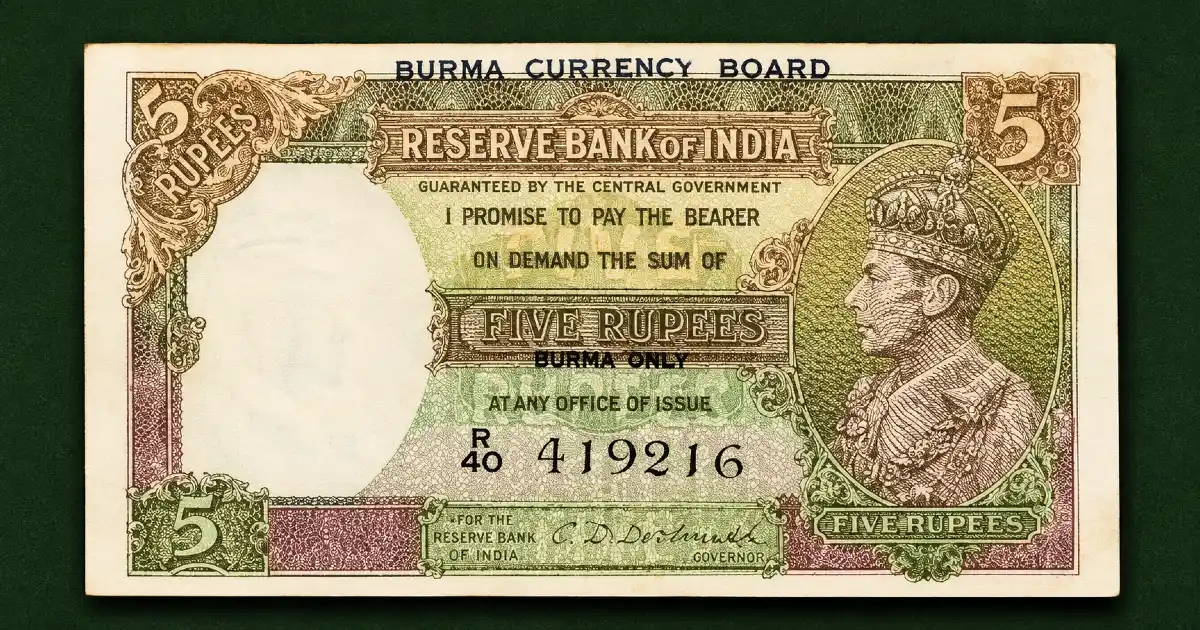
The 5 Rupees Burma Currency Board banknote was overprinted on the Reserve Bank of India King George VI Side-Face 5 Rupees note. Its design features the King’s portrait on the obverse and a language panel with the RBI seal on the reverse.
The Burma Currency Board inscription appears in black, distinguishing this denomination from the red-overprinted 1, 10 and 100 Rupees notes. The banknote measures approximately 127 × 73 mm and has a watermark incorporating King George VI and the wording 5 RESERVE BANK OF INDIA 5.
All Burma Currency Board 5 Rupees notes bear the signature of C. D. Deshmukh, the third Governor of the Reserve Bank of India. This differs from the earlier Military Administration issue, which includes both J. B. Taylor and C. D. Deshmukh signature varieties.
The authorised prefix range is R/24–R/41.
10 Rupees Burma Currency Board Banknote
Catalogue: BNB B603; Pick P32; Indian base note B208
The 10 Rupees Burma Currency Board banknote was produced using the Reserve Bank of India King George VI Front-Face 10 Rupees note. Its design features the King’s portrait, a multilingual language panel, sailing boat, palm trees and the RBI seal.
The note bears the signature of C. D. Deshmukh and carries a red Burma Currency Board overprint. Its watermark incorporates King George VI and the wording TEN RUPEES RESERVE BANK OF INDIA TEN RUPEES. The banknote measures approximately 146 × 82 mm.
In addition to the English-language Burma Currency Board overprint, Burmese text was added to the obverse of the 10 Rupees note. This is particularly noteworthy because Burmese was not included among the languages in the original Indian banknote’s reverse language panel. For further background, see our guide to Languages on Indian Currency Notes.
The authorised prefix ranges are G/31–G/42, H/73–H/82 and J/43–J/50.
100 Rupees Burma Currency Board Banknote
Catalogue: BNB B604; Pick P33; Indian base note B204b2
The 100 Rupees Burma Currency Board banknote was the highest denomination of the overprint series. It was produced using the Reserve Bank of India King George VI Side-Face 100 Rupees note, with Calcutta as the office of issue.
The original Indian banknote features King George VI on the obverse and a tiger alongside the RBI seal and language panel on the reverse. Its watermark incorporates King George VI, linked chains and RESERVE BANK OF INDIA lettering.
The Burma Currency Board overprint appears in red, and the note measures approximately 171 × 107 mm. All regular issues bear the signature of C. D. Deshmukh.
Unlike the lower denominations, the 100 Rupees issue is particularly important for its restricted serial-number blocks. The authorised prefixes and ranges are:
| Prefix | Authorised Serial Number Range |
|---|---|
| B/47 | 600001–1000000 |
| B/52 | 000001–1000000 |
| B/53 | 000001–800000 |
Collectors must examine the complete serial number rather than relying on the prefix alone when identifying genuine Burmese overprints.
Signatures, Prefixes and Serial Number Ranges
Burma Currency Board banknotes feature two signatories inherited from their original Indian base notes: C. E. Jones and C. D. Deshmukh. Unlike the preceding Military Administration of Burma series, which included J. B. Taylor-signed notes, the Burma Currency Board issues have only one recognised signature variety for each denomination.
| Signatory | Position | Denominations |
|---|---|---|
| C. E. Jones | Secretary, Finance Department | 1 Rupee |
| C. D. Deshmukh | RBI Governor | 5, 10 and 100 Rupees |
These signatures were already present on the Indian banknotes and were not added during the Burma Currency Board overprinting process. C. D. Deshmukh served as Governor of the Reserve Bank of India from August 1943 to June 1949. For further background, see our guide to the RBI Governor List (1935–1990).
Each denomination was issued using specific authorised prefixes and serial-number ranges, as detailed in the preceding sections. These allocations are particularly important for the 100 Rupees denomination, where only certain serial-number blocks within selected prefixes were authorised. Collectors should verify the complete numbering against the appropriate base-note variety rather than relying on the signature or prefix alone.
Counterfeits and Authentication of Burma Currency Board Banknotes
Counterfeit Burma Currency Board overprints are known on genuine Indian base notes. An authentic watermark, correct engraving and original King George VI portrait therefore do not necessarily establish that the Burma overprint is genuine.
Verify the Prefix and Serial Number
The first authentication step is to confirm that the complete serial number falls within the authorised range for the denomination. This is particularly important for the 100 Rupees notes, where only specific serial-number blocks within selected prefixes were authorised.
Examine the Overprint
Collectors should compare the overprint against a verified genuine example of the same denomination. Differences in lettering, spacing, alignment, ink application and the position of the overprint relative to the underlying design may indicate a forgery.
Check the Indian Base Note
The underlying Indian note must also match the authorised design, signature, watermark and serial-number format. For example, the Burma Currency Board 1 Rupee requires green serial numbers with an inset A, while all three RBI denominations must bear the signature of C. D. Deshmukh.
Independent Authentication and Grading
For scarce or high-value examples, professional authentication and grading may be worthwhile, particularly when purchasing notes without reliable provenance. See our guides to How to Grade Banknotes and Should You Submit Indian Banknotes to PMG? for further advice.
Rarity and Collectibility of Burma Currency Board Banknotes
Burma Currency Board banknotes attract collectors of British India, British Burma, King George VI currency, Southeast Asian banknotes and post-war paper money. Their rarity varies according to denomination, prefix allocation, condition and surviving availability.
The lower denominations are generally more accessible, while the 100 Rupees is particularly challenging because of its high original face value and restricted serial-number allocations. Although the series has only one signature variety per denomination, its different prefix groups offer considerable scope for specialised collecting.
Collecting by Prefix Blocks
Beyond completing a four-denomination set, advanced collectors may seek examples from each authorised prefix-letter group. This could include K and Q for the 1 Rupee, G, H and J for the 10 Rupees, or all three numbered prefixes of the 100 Rupees denomination.
More ambitious collectors may pursue the first and last numbered prefixes of each authorised range. For example, the 5 Rupees offers R/24 and R/41, while the 10 Rupees offers G/31 and G/42, H/73 and H/82, and J/43 and J/50. Completing entire numbered prefix runs presents an even greater challenge.
Collectors of the 100 Rupees may also focus on the boundaries of its authorised serial-number blocks. Availability can vary significantly between individual prefixes, while well-preserved examples with strong original colour, sound paper and clear overprints are particularly desirable.
Burma Currency Board and the Transition to Independence
The Burma Currency Board overprints were introduced during the final months of British colonial administration. Burma became independent on 4 January 1948, but the transition to a fully independent monetary system continued over several years.
Introduction of Independent Burmese Banknotes
Following independence, Burma progressively introduced banknotes bearing its own issuing authority rather than overprints applied to Indian currency. Government of Burma banknotes appeared from 1948, beginning with the lower denominations, followed by additional issues in subsequent years.
The Burma Currency Board overprints continued to serve as part of the monetary system during this transition, alongside newly issued Burmese banknotes.
The Union Bank of Burma
The Union Bank of Burma was established in February 1948, but the Burma Currency Board continued to administer the currency system during the early years of independence.
On 1 July 1952, the Union Bank of Burma assumed full central banking responsibilities under the new legislative framework. This transfer marked an important step toward a nationally administered monetary system and preceded the final demonetisation of the Burma Currency Board overprints.
Demonetisation of Burma Currency Board Banknotes
All four circulating denominations of the Burma Currency Board overprint series were demonetised on 28 December 1952, bringing their legal tender status in Burma to an end.
The Burma Currency Board ceased operations on 31 December 1952, shortly after the demonetisation of its overprinted banknotes. The transition marked the conclusion of the Board’s role in administering Burma’s currency and the end of this distinctive series of Indian banknotes overprinted for Burmese circulation.
Although the Burma Currency Board currency notes were no longer legal tender, they remain historically significant as the final major overprint series linking Indian paper money with Burma’s post-war monetary development.
Conclusion
The Burma Currency Board banknotes of 1947 represent an important stage in Burma’s transition from British military administration to an independent monetary system. Produced by overprinting existing King George VI Indian banknotes, the four denominations reflect the continuing connection between Indian and Burmese currency during the post-war period.
For collectors, their distinctive overprints, authorised prefix ranges and restricted serial-number blocks provide opportunities for both denomination-based and specialised collections. Together with the earlier Military Administration issues, they form an important chapter in the history of Indian and Burmese paper money.
Frequently Asked Questions
What was the Burma Currency Board?
The Burma Currency Board was a civilian monetary authority established in 1947 to administer Burma’s currency system. It issued banknotes, managed currency reserves and continued operating during the early years of Burmese independence.
When were Burma Currency Board banknotes issued?
Burma Currency Board overprinted banknotes were first introduced on 1 July 1947, before Burma gained independence on 4 January 1948.
What denominations were issued?
The four denominations were 1 Rupee, 5 Rupees, 10 Rupees and 100 Rupees.
Why were Indian banknotes overprinted for Burma?
Existing Indian banknotes provided a practical way to maintain currency circulation during Burma’s post-war monetary transition. The Burma Currency Board overprint identified their separate legal tender status in Burma without requiring an entirely new banknote design.
Who signed Burma Currency Board banknotes?
The 1 Rupee note bears the signature of C. E. Jones, while the 5, 10 and 100 Rupees notes bear the signature of C. D. Deshmukh. These signatures originated on the Indian base notes.
How can I identify a genuine Burma Currency Board overprint?
Check the correct Indian base-note design, signature, watermark, overprint colour and typography. Most importantly, verify that the complete prefix and serial number fall within the authorised Burma Currency Board ranges. A genuine Indian banknote does not automatically have an authentic Burma overprint.
Are Burma Currency Board banknotes rare?
Rarity varies according to denomination, prefix, condition and availability. Lower denominations are generally more accessible, while the 100 Rupees and well-preserved examples of other denominations can be considerably more challenging to obtain.
What is the difference between Burma Currency Board and Military Administration banknotes?
Military Administration of Burma banknotes were introduced in 1945 under wartime military authority. Burma Currency Board notes followed in 1947 under civilian administration. The two series carry different overprint inscriptions and have separate authorised prefix and serial-number allocations.
When were Burma Currency Board banknotes demonetised?
All four denominations were demonetised on 28 December 1952, shortly before the Burma Currency Board ceased operations on 31 December 1952.