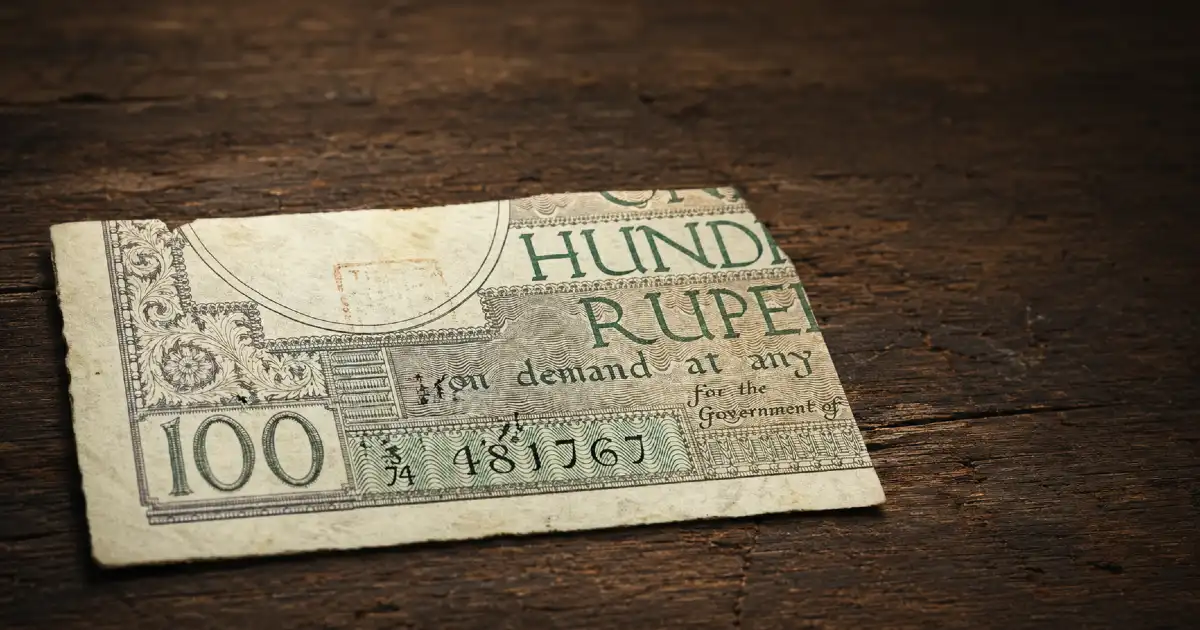
The 100 Rupee quarter cut note is one of the most unusual surviving forms of British India and British Burma paper money. These fragments, generally consisting of the lower-left quarter of a King George V 100 Rupees banknote, were not emergency currency or fractional notes intended for circulation. Instead, they were retained as accounting records after the original high-denomination banknotes had been cancelled, redeemed or destroyed.
For many years, collectors debated the purpose of these quarter-cut fragments. Their unusual appearance led to suggestions that they had circulated as emergency money during the Japanese occupation of Burma. Subsequent research into colonial currency administration and treasury procedures established a different explanation: the surviving fragments served an accounting and verification function rather than a monetary one.
Most importantly, a British Burma King George V 100 Rupee quarter cut note can originate from different parent banknote varieties. Some fragments came from ordinary Rangoon Circle issues used before Burma’s separation from British India in 1937. Others originated from the provisional King George V Burma overprint notes bearing the inscription “LEGAL TENDER IN BURMA ONLY”.
Surviving examples may retain serial numbers, portions of official overprints, treasury stamps, and unusual markings associated with Burma’s wartime history. Some are also known with markings described as Japanese chop marks, adding another dimension to their historical and numismatic interest.
Today, 100 Rupee quarter cut notes are highly collectible among specialists in British India, British Burma and wartime paper money. Their rarity, distinctive appearance and connections with colonial treasury procedures make them an important collecting field.
This guide explains the original purpose of these fragments, their connection with Rangoon Circle and 1937 Burma overprint banknotes, their known prefixes, physical characteristics, Japanese chop marks and identification considerations.
Table of Contents
What Is a 100 Rupee Quarter Cut Note?
A 100 Rupee cut note is the surviving lower-left portion of an original King George V 100 Rupees banknote. The remaining three-quarters of the note were removed during official cancellation and accounting procedures.
These fragments were not issued as 25 Rupee currency, nor did they represent an officially recognized fractional denomination. Their function was administrative rather than monetary.
When high-denomination banknotes were redeemed, withdrawn or otherwise cancelled, treasury officials needed to maintain records showing which notes had been accounted for. Retaining the portion containing the serial number provided a physical record that could be matched against accounting documentation.
This practice explains why the surviving quarter-cut fragments generally preserve the same section of the parent note rather than random portions of the original design.
Why Were These Notes Cut into Quarters?
The purpose was to preserve identifying evidence while ensuring that the original banknote could no longer circulate as currency.
For high-denomination notes, recording the serial number was particularly important because each note represented a substantial monetary obligation.
The lower-left quarter of the King George V 100 Rupees design retained identifying information useful for verification. Keeping this fragment while destroying the remaining portions provided a practical way to document the cancellation of the original note.
Similar administrative practices were associated with the withdrawal and destruction of other high-denomination currency. However, the surviving British Burma 100 Rupee fragments form a particularly distinctive and recognizable category.
Why Were They Once Mistaken for Emergency Currency?
For many years, the unusual appearance of quarter-cut notes encouraged speculation that they had circulated as emergency currency during the Second World War.
Some collectors proposed that a quarter of a 100 Rupees banknote might have been used as a substitute for 25 Rupees during monetary disruption following the Japanese invasion of Burma in 1942.
However, these fragments lack evidence of an authorized fractional issue. Their consistent retained portion and association with treasury processing support their identification as accounting remnants.
They should therefore be collected and described as cancelled banknote fragments, not as circulating 25 Rupee notes.
British India, Rangoon and Burma Before 1937
Before 1 April 1937, Burma formed part of British India and shared its paper currency system. Government of India banknotes circulated in Burma, while Rangoon served as an important regional currency centre.
Rangoon was one of the established issuing circles within British India’s currency administration. Its importance is reflected in the King George V 100 Rupees notes that carried the Rangoon issuing-circle designation.
These high-denomination notes were used for significant financial transactions and formed part of the broader Government of India paper currency system.
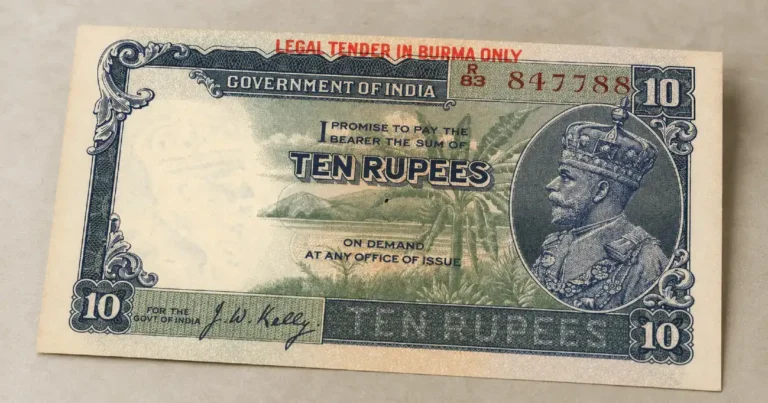
When Burma became a separate British colony in 1937, the authorities needed to distinguish currency intended for Burma from ordinary Indian banknotes. As an interim arrangement, certain unissued King George V notes were overprinted with the words “LEGAL TENDER IN BURMA ONLY”.
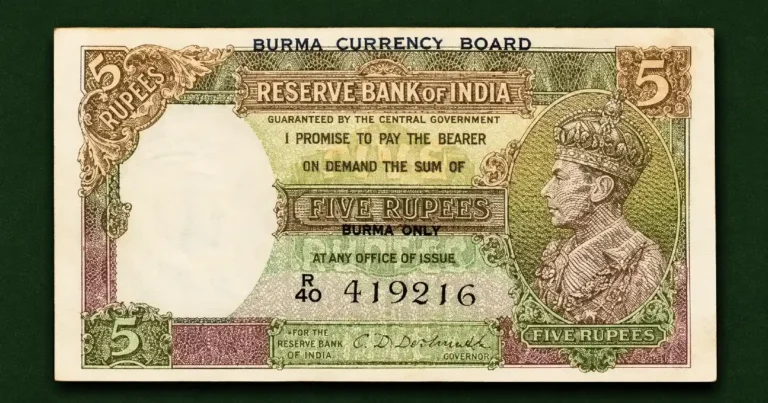
The 1937 provisional series comprised 5, 10 and 100 Rupees denominations, each with black and red overprint varieties.
Consequently, surviving British Burma 100 Rupee quarter cut notes may belong to either the earlier Rangoon Circle series or the later Burma provisional overprint series.
The Reserve Bank of India’s Currency Museum provides historical background on Rangoon as a currency circle, the RBI’s responsibilities in Burma and the subsequent introduction of Burma-specific banknotes.
For a detailed account of the provisional notes, see our Indian KGV Burma Overprint Banknotes: 5, 10 & 100 Rupees guide.
Two Main Types of British Burma 100 Rupee Quarter Cut Notes
Although quarter-cut fragments share a similar physical appearance, they do not represent a single original banknote variety.
The surviving pieces can be studied according to the parent notes from which they originated. This distinction is essential when identifying a fragment’s catalogue classification, prefix and historical period.
Rangoon Circle King George V 100 Rupees Notes
The first group consists of fragments originating from ordinary Government of India King George V 100 Rupees notes associated with the Rangoon issuing circle.
These banknotes belong to the period before Burma’s political separation from British India and were not originally issued with the 1937 territorial overprint.
Recorded prefixes associated with this group include S/60, S/65, S/74, T/1, T/16, T/25 and T/32.
Relevant catalogue classifications include BNB B144r1, B144r2 and B144r3 in the India chapter of The Banknote Book, with corresponding references in the Burma chapter of the Standard Catalog of World Paper Money, including Pick A8a through A8e.
Because these fragments were retained from original currency notes, they do not have a separate serial-number series of their own. Their identification depends on the underlying note and its recorded prefix.
Ordinary Rangoon Circle quarter-cut fragments are particularly interesting because they preserve evidence of British India’s regional high-denomination paper currency system before the 1937 separation.
1937 King George V Burma Overprint Notes
The second group originates from King George V 100 Rupees banknotes officially overprinted for use in Burma following its separation from British India.
The original provisional notes bore the inscription “LEGAL TENDER IN BURMA ONLY” and were produced in two varieties: an earlier black overprint and a later red overprint.
These two varieties are important when identifying a quarter-cut fragment because their overprints appeared in different positions on the parent note.
The black-overprint variety is catalogued as Burma BNB B103a / Pick 3b, while the red-overprint variety is catalogued as Burma BNB B103b / Pick 3a.
Black and Red Overprint Quarter Cut Notes
Identifying whether a fragment originated from the black or red Burma overprint variety requires attention to its prefix, serial number and any surviving portions of the overprint.
Black Overprint Quarter Cut Notes
On the original black-overprint 100 Rupees note, the territorial restriction appeared below the Rangoon issuing-circle inscription on the front and toward the lower portion of the reverse.
Because the lower-left section was retained, portions of the black overprint may remain visible on the reverse of quarter-cut fragments.
Authentic black-overprint parent notes are associated with the following documented allocations:
- T/32: Serial numbers 700001–1000000.
- T/41: Serial numbers 000001–100000.
These precise ranges are important because some later references expanded the T/32 allocation through the inclusion of a forged overprint. IndiaBanknotes research retains the verified starting point of T/32 700001.
Red Overprint Quarter Cut Notes
The later red overprint was positioned in the upper margins of the original banknote, making the inscription more visible on an intact note.
However, the upper-margin lettering is missing from the surviving lower-left quarter. As a result, red-overprint quarter-cut notes can be more difficult to identify from their appearance alone.
The documented allocations are:
- T/41: Serial numbers 100001–1000000.
- T/47: Serial numbers 000001–606000.
Known Prefixes of 100 Rupee Quarter Cut Notes
The following table summarizes the principal parent-note categories relevant to British Burma King George V 100 Rupee quarter-cut fragments.
Important: These are the prefix allocations of the original banknotes, not a separate numbering system created for the quarter-cut fragments.
| Original Banknote | BNB | Pick | Recorded Prefixes / Serial Ranges |
|---|---|---|---|
| Rangoon Circle, without 1937 overprint | B144r2–B144r3 | Burma A8d–A8f | Known examples include S/60, S/65, S/74, T/1, T/16, T/25, T/32 |
| 1937 Burma black overprint | B103a | Burma 3b | T/32: 700001–1000000; T/41: 000001–100000 |
| 1937 Burma red overprint | B103b | Burma 3a | T/41: 100001–1000000; T/47: 000001–606000 |
The Rangoon Circle prefixes shown above are examples recorded for the earlier notes and should not be interpreted as an exhaustive list of their allocations. The black and red overprint ranges are the documented limits used in IndiaBanknotes research.
Where the surviving overprint is absent, collectors must rely on the complete prefix and serial-number range, together with the physical characteristics of the fragment, to identify its likely parent issue.
The full 5, 10 and 100 Rupees overprint allocations are discussed in our King George V Burma Overprint Banknotes guide.
Physical Characteristics of a Genuine 100 Rupee Quarter Cut Note
Surviving quarter-cut notes share several recognizable physical characteristics. These features help collectors distinguish genuine treasury fragments from ordinary damaged banknotes or later imitations.
The Lower-Left Quarter
The most distinctive characteristic is the retention of the lower-left quadrant of the original King George V 100 Rupees banknote.
The horizontal and vertical cuts were generally made deliberately, producing a relatively regular fragment rather than an irregularly torn piece.
The preserved portion includes the serial-number area and parts of the original design that can assist with identifying the parent note.
Although minor differences in cutting and subsequent handling may occur, a fragment that does not correspond to the expected retained section requires careful examination.
Serial Numbers and Printed Details
The retained serial number is among the most valuable identification features of a 100 Rupee quarter cut note.
It can help establish whether the fragment came from an earlier Rangoon Circle note or a 1937 provisional Burma overprint issue.
For the provisional notes, the serial number may also distinguish the black and red overprint varieties even when the overprint lettering itself is missing.
Banknote Paper and Printing
A genuine quarter-cut fragment should have paper and printing characteristics consistent with the original Government of India 100 Rupees banknote.
The parent notes did not contain a security thread.
Collectors should compare the fragment’s paper texture, printed details and natural ageing characteristics with authenticated examples of the relevant parent issue.
Paper alone cannot establish authenticity, especially when a fragment has been affected by long-term storage, moisture, or handling. It remains an important part of the overall examination.
Treasury Stamps and Date Markings
Some British Burma 100 Rupee quarter cut notes carry additional stamped markings associated with treasury handling and cancellation procedures.
Examples are known with markings containing figures such as “31”, “34” and “37”. These are generally interpreted as administrative or date-related markings rather than serial numbers belonging to the original banknote.
The exact significance of an individual stamp depends on its form, placement and historical context. Collectors should avoid assuming that every numerical stamp records the date of the original issue or cancellation.
An original British Burma 100 Rupees quarter-cut fragment from the IndiaBanknotes collection illustrates the unusual combination of surviving note details, treasury handling marks and historical features discussed in this guide.
Japanese Chop Marks and the Wartime History of Burma
Some 100 Rupee quarter cut notes carry additional markings described in numismatic literature as Japanese chop marks.
These markings have been associated with the Japanese occupation of Burma during the Second World War, which began in 1942 and continued until the Allied reconquest in 1945.
Burma’s occupation brought major changes to the region’s monetary system. British-administered currency arrangements were disrupted, Japanese-issued currency circulated, and existing monetary records and banknote stocks were affected by wartime conditions.
Against this historical background, chop-marked 100 Rupee fragments are particularly intriguing to collectors of British Burma and wartime paper money.
What Were the Japanese Chop Marks Used For?
The precise purpose of these markings has not been conclusively established. They have been associated with wartime administrative or treasury handling, but the surviving evidence does not always allow a particular mark to be attributed to a specific office or procedure.
Consequently, the presence of a chop mark should be distinguished from proof of its exact origin or function.
Genuine wartime-associated markings can add historical and collecting interest, particularly when their form and provenance are consistent with documented examples.
Collecting Significance of Chop-Marked Fragments
Chop-marked examples are especially desirable to some collectors because they combine an unusual British India banknote fragment with a possible connection to the Japanese occupation of Burma.
Such markings may distinguish an individual fragment from otherwise similar examples without chop marks.
However, authentication remains important. A later addition intended to imitate a historical chop mark should not be treated as equivalent to a genuinely contemporary marking.
Historical Importance of the British Burma 100 Rupee Quarter Cut Note
The historical significance of the British Burma 100 Rupee quarter cut note extends well beyond the appearance of the surviving paper fragment.
These pieces document an administrative practice in which part of a redeemed or cancelled high-denomination banknote was retained for financial verification.
They also preserve evidence of the original King George V 100 Rupees designs used in Burma, including notes associated with Rangoon’s role as an Indian currency circle.
Fragments from the 1937 provisional overprint issues provide a further connection to the moment when Burma established a distinct monetary identity after its separation from British India.
The later Japanese occupation, the collapse of the prewar currency arrangements and the subsequent restoration of British administration add further historical context to surviving marked examples.
In this respect, quarter-cut notes are not simply damaged examples of an earlier banknote. They are recognizable historical artefacts that reveal how valuable currency was handled, accounted for and withdrawn from use.
From the Provisional Overprints to Burma’s Peacock Notes
The 1937 King George V Burma overprints were intended as a temporary solution. Beginning in 1938, the Reserve Bank of India introduced purpose-designed King George VI banknotes for Burma, commonly known as the Peacock series.
These notes incorporated distinctive Burmese imagery and represented a new stage in the territory’s paper currency development.
The quarter-cut fragments, therefore, belong to a broader monetary history that includes Rangoon Circle issues, the 1937 provisional overprints, the Peacock series and the disruptions of the Second World War.
For further historical background, see our RBI Burma Peacock Banknotes: King George VI Series guide and browse the British Burma Banknotes collection.
Rarity and Collectibility of 100 Rupee Quarter Cut Notes
British Burma 100 Rupee quarter cut notes are scarce historical collectibles. Their unusual form, limited surviving availability and connection with important monetary developments make them attractive to specialist collectors.
However, not every fragment has identical collecting characteristics. Differences in the original parent note, prefix, overprint variety, treasury markings, chop marks and physical condition can influence desirability.
Collecting by Parent Banknote Variety
Collectors may concentrate on the early Rangoon Circle issues or seek examples originating from the later black and red Burma overprints.
Within the overprint group, the distinction between black and red varieties is especially interesting because the original inscription placement differed, and red-overprint fragments often cannot be recognized from visible lettering alone.
Collecting by Prefix and Historical Markings
Specialist collectors may also study surviving prefixes, administrative stamps and Japanese-associated chop marks.
These characteristics can make individual examples especially distinctive, particularly when a fragment retains a clear serial number and historically interesting markings.
Condition and Preservation
Condition is important, but quarter-cut notes should be assessed differently from ordinary intact currency. The deliberate removal of three-quarters of the original banknote is an inherent characteristic of the collectible, not an accidental defect requiring ordinary banknote grading treatment.
Instead, collectors should examine the preserved fragment for additional tears, stains, repairs, losses, mounting damage or alterations.
For broader guidance on scarcity and collector demand, read Understanding Banknote Values: Rarity, Condition & Demand. For suitable archival storage, see How to Preserve and Store Banknotes.
Conclusion: The Significance of the 100 Rupee Quarter Cut Note
The British Burma King George V 100 Rupee quarter cut note occupies a distinctive place in the history of Indian and Burmese paper money. Unlike ordinary circulating notes, these fragments survived because a portion of the original banknote was retained for official accounting purposes.
Their significance extends across several historical periods, from the Rangoon Circle currency system of British India to Burma’s separation in 1937 and the wartime upheavals of the 1940s.
Individual fragments can often be studied through their serial prefixes, surviving design elements, original overprint classifications and additional administrative markings. Some examples carry Japanese-associated chop marks, providing further collecting interest.
For collectors of British Burma, British India and wartime currency, 100 Rupee quarter cut notes are far more than incomplete banknotes. They are historical records of how high-denomination currency was managed, cancelled and preserved in an unusual physical form.
Readers interested in the intact parent notes should continue with our Indian KGV Burma Overprint Banknotes guide, which details the 5, 10 and 100 Rupees provisional issues and their authenticated prefix allocations.
Frequently Asked Questions About 100 Rupee Quarter Cut Notes
What is a 100 Rupee quarter cut note?
A 100 Rupee quarter cut note is a surviving lower-left fragment of a King George V 100 Rupees banknote originally issued for British India or Burma. These fragments were retained during official cancellation and accounting procedures after the remaining portions of the banknote were removed.
Were 100 Rupee quarter cut notes used as currency?
No. These fragments were retained as accounting records rather than issued as fractional currency. They were not official 25 Rupee notes, despite earlier speculation about their possible use as emergency wartime money.
Why was only the lower-left quarter preserved?
The lower-left section retained the serial number and useful identifying details of the original King George V 100 Rupees banknote. Keeping this portion allowed treasury officials to verify the cancellation or withdrawal of the original note.
Do all 100 Rupee quarter cut notes have Burma overprints?
No. Some originated from ordinary Rangoon Circle King George V 100 Rupees notes, while others came from the 1937 provisional Burma issues bearing the inscription “LEGAL TENDER IN BURMA ONLY”.
What are Japanese chop marks on 100 Rupee quarter cut notes?
Japanese chop marks are stamped markings associated in numismatic research with the Japanese occupation of Burma during World War II. Their exact administrative purpose is uncertain, but genuine wartime-associated examples can be especially interesting to collectors.
Are British Burma 100 Rupee quarter cut notes rare and valuable?
Yes. Genuine British Burma 100 Rupee quarter cut notes are scarce and highly collectible, particularly among specialists in British India, Burma and wartime currency. Desirable prefixes, visible overprint remnants, historically significant markings and good preservation can increase their collector appeal.