
1000 Rupee Note Republic India: History, Varieties & Value
Explore Republic India 1000 Rupee notes: from 1954 Lion Capital series to Mahatma Gandhi issues. Learn rare varieties, 1978 and 2016 demonetisations & values.
IndiaBanknotes.com Editorial Team
8 min read
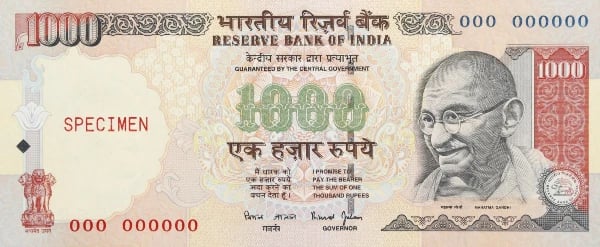
The 1000 Rupee note in Republic India was first reintroduced in 1954 following the demonetisation of high-denomination British India notes in 1946. Issued by the Reserve Bank of India, it served initially as a high-value denomination for institutional and large-scale financial transactions before later becoming widely used in the modern economy.
Republic India 1000 Rupee notes evolved through two major phases: the Ashoka Pillar series (1954–1978) and the Mahatma Gandhi portrait series (2000–2016). These issues reflect India’s transition from post-Independence monetary consolidation to a modern, high-volume cash economy. Today, they are studied for their varieties, design evolution, and differing levels of rarity following demonetisation in 1978 and 2016.
Overview of Republic India 1000 Rupee Notes
The 1000 Rupee denomination occupies a unique position in Republic India currency history. Unlike British India issues, which were primarily used for institutional transactions, Republic India notes evolved from limited-use high-value currency into widely circulating banknotes in the modern economy.
Two major phases define this denomination:
Ashoka Pillar series (1954–1978)
Early one-column legal tender panel type (introduced 1954)
Later two-column legal tender panel type (introduced 1975)
Mahatma Gandhi portrait series (2000–2016)
These phases reflect major shifts in India’s monetary system, including post-Independence identity, economic expansion, and changes in currency usage patterns.
Purpose and Usage of 1000 Rupee Notes in Republic India
The 1000 Rupee note was originally introduced as a high-value denomination intended for large financial transactions, including government payments, interbank settlements, and commercial trade. During the early Republic period, these notes were not widely used by the general public due to their high purchasing power.
By contrast, the Mahatma Gandhi series marked a shift toward broader circulation. Improvements in banking access and economic growth led to increased use of high-denomination notes in everyday transactions, particularly in urban areas.
This change in usage patterns helps explain the differences in survival rates between Ashoka Pillar notes and later Gandhi series notes, with earlier issues being significantly rarer today.
Comparison with British India 1000 Rupee Notes
Republic India 1000 Rupee notes differ significantly from their British India predecessors in both purpose and circulation, as discussed in our guide on 1000 Rupee British India Note.
British India 1000 Rupee notes were primarily used for institutional transactions and rarely circulated among the general public. In contrast, Republic India notes—particularly the Mahatma Gandhi series—became widely used in everyday transactions as the economy expanded.
Design evolution also reflects this transition. Earlier British India notes featured uniface and portrait styles with relatively limited security features, while Republic India notes introduced national symbolism, expanded language panels, and progressively more advanced security elements.
This comparison highlights the transformation of Indian currency from colonial administrative instruments to widely used national banknotes.
Early Republic India 1000 Rupee Notes (Ashoka Pillar Series)
The reintroduction of the 1000 Rupee note in 1954 marked a new phase in Indian paper money. These notes replaced colonial-era designs with national symbolism while maintaining the large format associated with high-denomination currency.
All Ashoka Pillar 1000 Rupee notes share a consistent framework, including the Lion Capital of Ashoka on the front and the Brihadeeswarar Temple on the reverse. These notes were printed at the India Security Press and produced in a large format measuring approximately 203 × 127 mm, reflecting their role as high-denomination currency.
The "Tanjore Temple" Reverse: Brihadeeswarar Temple Design
The Ashoka Pillar 1000 Rupee series is widely known among collectors as the “Tanjore Temple note”, named after the depiction of the Brihadeeswarar Temple on the reverse. Located in Thanjavur (historically known as Tanjore), this temple is a UNESCO World Heritage Site and one of India’s most significant architectural landmarks.
In the numismatic market, the term “Tanjore Temple 1000 Rupee” is commonly used to identify these large-format notes issued between 1954 and 1978, distinguishing them from the later Mahatma Gandhi series.
Issuing Circles and Identification
Republic India 1000 Rupee notes from the Ashoka Pillar series can be identified by their issuing circles, which are indicated by the prefix letter of the serial number as well as the printed city name on the note.
The issuing circles are:
A — Bombay
H — Calcutta
Q — Madras
U — Kanpur
X — Delhi
These identifiers are important for collectors, as certain issuing circles are scarcer than others. Understanding these prefixes helps distinguish varieties and assess relative rarity within the same series.
Incorrect Hindi Text “Rupaya” (First Issue)
Catalogue References: Banknote Book B227 / Pick 46
The earliest issue contains a notable linguistic error, using the singular “रुपया” (RUPAYA) instead of the correct plural “रुपये” (RUPAYE). The reverse panel features seven languages: Bangla (Bengali), Gujarati, Kannada, Oriya, Tamil, Telugu, and Urdu.
In addition to the Hindi error, several inscriptions in Gujarati, Kannada, Tamil, Telugu, and Urdu also contain spelling or typographical inaccuracies, making this variety particularly significant for collectors.
These notes exist across five issuing circles, identifiable by their prefix letters: A (Bombay), H (Calcutta), Q (Madras), U (Kanpur), and X (Delhi). The full issuing city name is printed at the bottom centre of the note above the denomination. All notes are signed by B. Rama Rau.
Correct Hindi Text “Rupaye” (Seven-Language Panel)
Catalogue References: Banknote Book B228 / Pick 47
This subtype corrected the linguistic errors of the earlier issue while retaining the same overall design and structure.
Only three varieties are known, defined by issuing circle and signature. Bombay (prefix A) exists with signatures of B. Rama Rau and H. V. R. Iengar, while Calcutta (prefix H) is known only with the Rama Rau signature.
This issue represents an important transitional stage in early Republic India currency standardisation.
Correct Hindi Text “Rupaye” (Thirteen-Language Panel)
Catalogue References: Banknote Book B229 / Pick 47f
The final subtype expanded the language panel to thirteen languages, reflecting a broader national linguistic representation.
This issue is limited to the Bombay circle and bears the signature of P. C. Bhattacharyya. It represents a key step in the evolution of Indian banknote language policy.
Two-Column Legal Tender Panel Type (Ashoka Pillar Series)
Catalogue References: Banknote Book B230 / Pick 65
This later Ashoka Pillar type introduced a redesigned obverse with a structured bilingual legal tender panel, with English on the left and Hindi on the right.
Although more available than earlier Ashoka Pillar issues, it remains an important collectible and represents the final large-format 1000 Rupee note before the denomination was withdrawn.
This type is known only for the Bombay issuing circle and includes signatures of N. C. Sen Gupta and K. R. Puri. For collectors studying signatories, this type connects with developments discussed in RBI Governors from 1970 to 1990.
Mahatma Gandhi Series 1000 Rupee Notes
Introduced in 2000, the Mahatma Gandhi series represents a fundamentally different phase in Indian currency history. Unlike earlier high-denomination notes, these were widely used in everyday transactions.
The design features Mahatma Gandhi’s portrait, advanced security elements, and a thematic reverse reflecting India’s economic development.
Over time, the series evolved with:
introduction of the rupee symbol
enhanced security threads
dated varieties and multiple signatures
Signature varieties correspond to successive RBI Governors, including Bimal Jalan, Y. V. Reddy, D. Subbarao, and Raghuram Rajan.
Unlike earlier issues, Gandhi series notes were printed in multiple facilities, including the Security Printing and Minting Corporation of India, reflecting the increased scale of currency production.
Design Evolution and Security Features
The evolution of Republic India 1000 Rupee notes reflects broader advancements in banknote design and security.
Ashoka Pillar notes retained large-format layouts with relatively simple security features, including watermark patterns and basic security threads. Their design emphasised clarity and authority rather than advanced anti-counterfeiting measures.
In contrast, the Mahatma Gandhi series introduced more sophisticated security features, including windowed security threads, micro-lettering, latent images, and improved printing techniques. These changes were necessary to support a high-volume currency system and reduce the risk of counterfeiting.
This transition highlights the modernization of Indian currency as economic activity expanded and reliance on paper money increased.
Demonetisation of Republic India 1000 Rupee Notes
Republic India 1000 Rupee notes were demonetised twice, in 1978 and 2016.
The 1978 demonetisation targeted Ashoka Pillar issues, significantly reducing their survival rates and contributing to their rarity today.
In contrast, the 2016 demonetisation affected the Gandhi series differently. Due to widespread banking access and modern collecting practices, many examples were preserved, and their availability remains relatively high.
For a broader historical overview, see our article on History of Demonetisation of Indian Banknotes.
Collectibility and Value of Republic India 1000 Rupee Notes
Republic India 1000 Rupee notes vary significantly in collectibility depending on the series, rarity, and survival rates. The Ashoka Pillar and Mahatma Gandhi series represent two distinct categories within the collector market.
Ashoka Pillar notes are generally scarcer, particularly early one-column legal tender panel types issued from 1954. These notes were not widely preserved and were heavily impacted by the 1978 demonetisation, resulting in relatively low survival rates today.
In contrast, Mahatma Gandhi series notes were produced in large quantities and widely circulated. As a result, they are more commonly available and are typically collected for varieties, signatures, and condition rather than rarity.
Condition plays a critical role across both series. Notes with strong paper quality, clear printing, and minimal damage are significantly more desirable than heavily circulated examples. Proper storage and handling can also influence long-term preservation, as explained in our guide on how to preserve and store banknotes.
Accurate evaluation requires a consistent approach to condition assessment, which is covered in how to grade banknotes. Because of the wide variation between types and surviving examples, each note should be assessed individually based on its specific characteristics.
Market Context and Value Expectations
In practical terms, the availability and grade distribution of Republic India 1000 Rupee notes vary considerably between types.
Early Ashoka Pillar one-column legal tender panel notes are the most difficult to obtain in high grades. Most surviving examples are found in mid-grade condition due to heavy usage and limited preservation prior to demonetisation.
The later two-column legal tender panel type is relatively more available and can still be found in higher grades, making it a more accessible option for collectors.
By comparison, Mahatma Gandhi series notes are widely available across a range of grades. As a result, differences in value are more closely tied to condition and specific varieties rather than overall rarity.
Conclusion
The Republic India 1000 Rupee note represents a significant evolution in India’s monetary system, spanning from limited high-denomination currency in the early post-Independence period to widely circulating banknotes in the modern economy.
The distinction between Ashoka Pillar and Mahatma Gandhi series notes highlights how economic conditions, currency design, and banking access influenced both usage and survival rates. Early Ashoka Pillar issues, particularly the one-column legal tender panel types, remain scarce and highly sought-after, while later issues are more accessible but still offer meaningful collecting opportunities.
As one of the most important high-denomination issues in Indian paper money, the 1000 Rupee note continues to play a central role in both historical study and advanced collecting.
Frequently Asked Questions
When was the first Republic India 1000 Rupee note issued after Independence?
The first Republic India 1000 Rupee note was issued in 1954 by the Reserve Bank of India. It marked the return of high-denomination currency after the 1946 demonetisation.
Why does the 1954 series 1000 Rupee note have the wrong spelling of “Rupaye”?
The earliest Republic of India issues used the singular Hindi word “Rupaya” (रुपया) instead of the correct plural “Rupaye” (रुपये). This was a design oversight, and several regional language panels also contain minor errors.
What is the “Tanjore Temple” 1000 Rupee note?
This refers to the large-format 1000 Rupee notes issued between 1954 and 1978, featuring the Brihadeeswarar Temple on the reverse. Due to their size and low survival after the 1978 demonetisation, they are among the most sought-after Republic India notes.
How can I identify the issuing circle on a Republic India 1000 Rupee note?
The issuing circle can be identified in two ways. First, the prefix letter of the serial number corresponds to a specific circle. A for Bombay, H for Calcutta, Q for Madras, U for Kanpur, and X for Delhi. Second, the full name of the issuing city is printed at the bottom centre of the note.
Is the Mahatma Gandhi series 1000 Rupee note still legal tender?
No. All 1000 Rupee notes were demonetised in 2016 and are no longer legal tender. Today, they are only collected as numismatic items.