
India Red Underprint 5 Rupee Uniface Note: History & Value
Explore the India Red Underprint 5 Rupee uniface note: learn its history, rare varieties, various issuing circles, and value for serious paper money collectors.
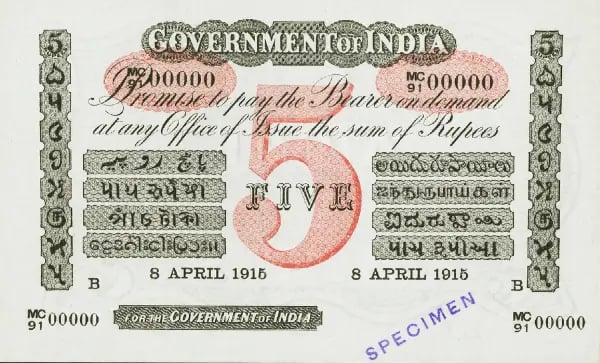
The India Red Underprint 5 Rupee note is an important uniface banknote issued during British India, known for its distinctive red security underprint and multiple design variations. Introduced following legislative changes in the early 20th century, it marked a shift in how ₹5 notes were issued, circulated, and used across British India and Burma.
These banknotes are categorized into several major varieties, including 6 language panel and 8 language panel designs, with differences in serial numbers, circle initials, and signatures. The series reflects both administrative reforms and increasing efforts to standardize currency across regions.
Today, Red Underprint 5 Rupees uniface banknotes are highly collectible due to their complexity, historical significance, and wide range of documented varieties. These notes are also classified in standard references such as the Standard Catalog of World Paper Money (Pick), the Banknote Book (BNB), and The Revised Standard Reference Guide to Indian Paper Money.
Evolution of Red Underprint 5 Rupees Notes
The Red Underprint 5 Rupees notes represent a critical stage in the evolution of Indian paper currency, particularly in the transition from localized circulation to universal usability.
This progression can be understood in three stages:
Green Underprint (Pre-1903):
Payable only at the office of issue, limiting circulation.Red Underprint – 6 Language Panels (1903 Reform):
Payable at any office of issue not situated in Burma — the first step toward wider circulation.Red Underprint – 8 Language Panels (1909 Reform):
Payable at any office of issue across British India, including Burma — full universalization.
This progression highlights how the ₹5 denomination evolved from a regionally restricted note into a fully universal currency across British India.
Overview of Red Underprint 5 Rupees Varieties
The Red Underprint 5 Rupees series is broadly classified into four main varieties based on language panels, serial numbers, and circle initials:
6 language panels
8 language panels with 4 serial numbers
8 language panels with 3 serial numbers (with circle initials)
8 language panels with 3 serial numbers (without circle initials)
These notes were printed by the Bank of England and dispatched to India unsigned, allowing signatures to be added locally. Differences in promissory text, layout, and numbering reflect evolving legal and administrative requirements.
6 Language Panels Variety (Early Red Underprint)
This is the earliest Red Underprint variety and represents the first step toward broader circulation beyond the office of issue. This variety is catalogued as Pick PA4 (India) and BNB B130.
Legislative Background and Underprint Change
The Indian Paper Currency (Amendment) Act, 1903 introduced changes to the legal tender status of ₹5 notes. Notes issued outside Burma became legal tender across British India (excluding Burma), while Rangoon-issued notes were restricted to local circulation.
To distinguish these categories, the underprint color was changed from green to red for notes intended for broader circulation.
Promissory Text and Legal Scope
The promissory text reads:
“I promise to pay the bearer on demand at any office of issue not situated in Burma the sum of five rupees.”
This reflects the reforms introduced under the The Indian Paper Currency (Amendment) Act, 1903, which allowed ₹5 notes to circulate across British India while still excluding Burma.
Although not fully universal, this marked a significant expansion compared to earlier issues.
Language Panels
This variety retains the 6-language panel format introduced in the green underprint series as follows:
Top row: Urdu, Bengali, Telugu
Bottom row: Kaithi, Kannada, Tamil
The language panel is accompanied by numeral denomination panels on the left and right, featuring numerals in 7 styles, including the Western Arabic numeral "5" prominently at the top.
Serial Numbers
Four serial numbers are arranged symmetrically across the note. Prefixes consist of two letters followed by a 5-digit serial number.
Introduction of Circle Initials
Circle initials were introduced to replace full issuing town names, improving clarity and standardization. These initials identified the issuing office but did not define circulation rights.
The initials adopted were as follows: A for Allahabad (later transferred to Cawnpore), B for Bombay, C for Calcutta, K for Karachi, L for Lahore, and M for Madras
Transfer of Office of Issue
The same Act also facilitated the transfer of the office of issue from Allahabad to Cawnpore. Section 29 stated that “For purpsoes of sections 14 and 15, a currency note issued from the office of issue in the town of Allahabad prior to the date of the closing of such office shall, notwithstanding anything herein before contained, be deemed, from the date of the establishment of an office of issue in the town of Cawnpore, to have been issued from such last-mentioned office.” This provision led to the introduction of Cawnpore as a new office of issue.
Known Signatures
Only two signatories are associated with this variety: Arthur Frederic Cox (A.F. Cox) and Oscar Theodore Barrow (O.T. Barrow)
Known Varieties
The Red Underprint 5 Rupees notes with six language panels are known to exist in five documented combinations of issuing circles and signatures, each featuring a single signatory:
B (Bombay): A.F. Cox and O.T. Barrow
C (Calcutta): A.F. Cox
L (Lahore): A.F. Cox
M (Madras): A.F. Cox
These varieties reflect the early steps toward the universalization of 5 Rupees notes across British India, excluding British Burma.
8 Language Panels with 4 Serial Numbers
This variety represents the second and most important stage in the evolution of ₹5 notes, introducing full universal currency. This variety is catalogued as Pick PA5 (India), PA4 (Burma) and BNB B131.
Promissory Text and Legal Scope
The promissory text reads:
“I promise to pay the bearer on demand at any office of issue the sum of rupees five.”
Under the Indian Paper Currency (Amendment) Act, 1909, ₹5 notes became fully universal, meaning they were legal tender and payable at any office of issue across British India, including Burma.
Language Panels
The number of language panels increased to 8, arranged in two columns of four rows:
Left column (top to bottom): Urdu, Kaithi, Bengali, Burmese
Right column (top to bottom): Telugu, Tamil, Kannada, Gujarati
This reflects broader linguistic inclusion and administrative reach. Numeral denomination panels now feature 9 numeral styles.
Serial Numbers
Four serial numbers remain symmetrically placed, maintaining design balance. The alphanumeric prefix and 5-digit serial numbers follow the same format as the 6-language panel variety.
Circle Initials
Circle initials continued to appear on the notes, identifying the issuing office. However, under universal currency, these initials no longer restricted circulation or redemption.
The Indian Paper Currency Act of 1910 (Act 2 of 1910) formally established seven districts as circles of issue. The initials for the seven circles are as follows: A for Cawnpore, B for Bombay, C for Calcutta, K for Karachi, L for Lahore, M for Madras, R for Rangoon.
On the notes, the initials are positioned symmetrically on the right of the left numeral panel and on the left of the right numeral panel. This placement ensured both functionality and visual balance in the overall design.
Known Signatures
There are four known signature varieties for this series: Oscar Theodore Barrow (O.T. Barrow), Robert Woodburn Gillen (R.W. Gillen), Henry Fraser Howard (H.F. Howard), and Moses Mordecai Simeon Gubbay (M.M.S. Gubbay).
These notes were printed in England and dispatched to India unsigned. Sea sunk notes or notes recovered from sea sinkings during transit remain unsigned.
Known Varieties
Excluding unsigned notes, at least 19 documented varieties of these notes exist, each bearing a single signature. For clarity, the known issuing circles are categorized below along with their corresponding signatures:
A (Cawnpore): 2 varieties signed by H.F. Howard and M.M.S. Gubbay
B (Bombay): 4 varieties signed by O.T. Barrow, R.W. Gillen, H.F. Howard, and M.M.S. Gubbay
C (Calcutta): 3 varieties signed by R.W. Gillen, H.F. Howard, and M.M.S. Gubbay
K (Karachi): 2 varieties signed by H.F. Howard and M.M.S. Gubbay
L (Lahore): 3 varieties signed by O.T. Barrow, R.W. Gillen, and M.M.S. Gubbay
M (Madras): 2 varieties signed by R.W. Gillen and M.M.S. Gubbay
R (Rangoon): 3 varieties signed by R.W. Gillen, H.F. Howard, and M.M.S. Gubbay
Unsigned notes recovered from sea sinkings are also known.
8 Language Panels with 3 Serial Numbers (With Circle Initials)
This variety introduces a structural simplification while retaining the universal currency framework. This variety is catalogued as Pick PA6 (India), PA4 (Burma) and BNB B132.
Serial Numbers
The number of serial numbers is reduced from four to three:
Two at the top
One at the bottom left
The bottom-right serial number is removed, simplifying the design.
Each note includes an alphanumeric prefix with two letters positioned above numbers followed by a 6-digit serial number. Between the prefix and the serial number, the word "No." has been added.
Design Adjustments
The signature is repositioned to the lower right corner, and the text “For the Government of India” appears at the bottom center.
Signature
One known signature is attributed to Moses Mordecai Simeon Gubbay (M.M.S. Gubbay).
Circle Initials
All seven main circles of issue are represented in this variety, denoted by their initials: A (Cawnpore), B (Bombay), C (Calcutta), K (Karachi), L (Lahore), M (Madras), and R (Rangoon).
The initials are positioned to the right of the left numeral panel and to the left of the right numeral panel.
Known Varieties
There are seven documented varieties in this series, each corresponding to one of the seven issuing circles, all signed by M.M.S. Gubbay.
8 Language Panels with 3 Serial Numbers (Without Circle Initials)
This final variety represents further design simplification through the removal of circle initials. This variety is catalogued as Pick PA6 (India) and BNB B132.
Design Characteristics
The layout remains largely unchanged, but the removal of circle initials creates a cleaner visual presentation. These notes continue under the universal currency framework.
Signatures
Known signatures include:
M.M.S. Gubbay (Moses Mordecai Simeon Gubbay)
A.C. McWatters (Arthur Cecil McWatters)
H. Denning (Howard Denning)
Known Varieties
There are three varieties for this type, each distinguished by one of the three signatures.
Collectibility and Value of Red Underprint 5 Rupees Notes
The value of Red Underprint 5 Rupees notes depends on rarity, condition, and specific varieties such as language panels, serial number formats, circle initials, and signatures. While some varieties are relatively accessible, others—particularly transitional types or those with limited signatures—are significantly more sought-after by collectors.
Condition plays a critical role, especially given the age and fragility of uniface notes. Well-preserved examples with clear printing and minimal damage are far more desirable than heavily circulated notes.
Understanding how these factors influence pricing is essential, as explained in our guide on understanding banknote values. Collectors can also benefit from learning how to assess condition accurately in how to grade banknotes. Well-preserved examples of rare varieties can command strong premiums in the collector market.
Conclusion
The India Red Underprint 5 Rupee uniface note represents a pivotal stage in the evolution of Indian paper currency, illustrating the transition from regionally restricted notes to a fully universal monetary system. Through successive legislative reforms—particularly those of 1903 and 1909—the ₹5 denomination evolved from limited circulation to becoming legal tender across all of British India.
The progression from Green Underprint notes to Red Underprint issues with 6 and later 8 language panels reflects this transformation clearly. Changes in promissory text, circulation rights, and design elements such as language panels and circle initials demonstrate how the currency system adapted to the growing complexity of the colonial economy.
Today, Red Underprint 5 Rupees notes remain one of the most important and widely studied areas in British India paper money collecting. Their multiple varieties, historical significance, and varying degrees of rarity make them highly collectible, particularly in well-preserved condition. Together with the earlier Green Underprint issues, these notes provide a complete picture of how the ₹5 denomination developed into a standardized and widely accepted form of paper currency in India.
Frequently Asked Questions
What is a Red Underprint 5 Rupees uniface banknote?
It is a British India uniface banknote featuring a red security underprint, introduced after legislative changes in 1903.
What are the main varieties of Red Underprint 5 Rupees notes?
They include 6 language panel notes and 8 language panel notes with different serial number formats and circle initials.
What does “universal currency” mean for Red Underprint notes?
It means the notes were payable at any office of issue across British India, rather than being restricted to the issuing location.
Are Red Underprint 5 Rupees uniface notes rare?
Yes. Some varieties, especially transitional designs and rare signatures, are difficult to find and highly collectible.
What affects the value of these notes?
Value depends on rarity, condition, signatures, serial numbers, and overall collector demand.