
India Green Underprint 5 Rupee Uniface Note: History & Value
Explore the India Green Underprint 5 Rupee uniface note: discover its history, rare varieties, issuing circles, and value for serious paper money collectors.
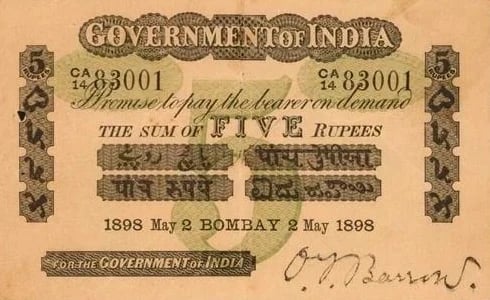
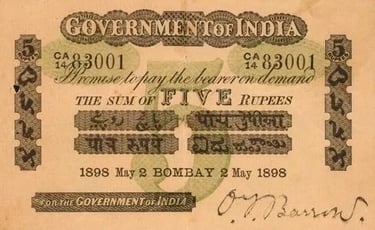
The India Green Underprint 5 Rupee uniface note is a key uniface banknote issued under the Indian Paper Currency Act of 1871. It was the lowest denomination introduced into the uniface series, extending paper currency usage beyond higher-value notes that had already been in circulation since the 1860s.
These notes are distinguished by their green security underprint, multiple language panel varieties, and complex issuing circle system. They played an important role in making paper money more accessible across British India.
Today, Green Underprint 5 Rupees notes are highly collectible due to their historical importance, wide range of varieties, and limited surviving examples, making them a key area of study for collectors of British India banknotes.
History of Paper Currency in British India
Paper currency in British India was formalized under the Paper Currency Act of 1861, which centralized note issuance under the Government of India. This replaced earlier systems where presidency banks issued their own notes, creating a unified and regulated currency system.
Under this framework, only government-issued promissory notes were permitted, reinforcing control over the money supply and establishing trust in paper currency. The Department of Issue was created to manage the printing and circulation of notes.
Initially, paper currency was limited to higher denominations, with ₹10 as the lowest note. Coins continued to dominate everyday transactions, as public confidence remained closely tied to intrinsic metal value.
Introduction of the 5 Rupees Note (1871 Act)
Following the limitations of earlier currency laws, the Indian Paper Currency Act of 1871 enabled the practical introduction of ₹5 banknotes into circulation. This marked a key expansion of paper currency into lower-value transactions, complementing the existing ₹10 and higher denomination notes.
The responsibility for issuing these notes remained with the Department of Issue, which continued to oversee the printing and distribution of government-backed promissory notes. This ensured continuity in administration while adapting to the growing demand for smaller denominations.
By introducing ₹5 notes, the system bridged the gap between coinage and higher denomination paper money. This development supported increased commercial activity and helped integrate paper currency more effectively into everyday transactions across British India.
Evolution of Currency Administration
The Indian Paper Currency Act of 1882 introduced administrative refinements, including renaming the Department of Issue as the Department of Paper Currency. This change reflected a more structured and efficient system for managing currency issuance across British India.
As the monetary system expanded, these adjustments helped support increasing circulation and improved coordination across different issuing regions.
Green Underprint 5 Rupees Note: Main Varieties
The Green Underprint 5 Rupees series is divided into three primary varieties based on the number of language panels. These variations reflect changes in administrative structure, regional requirements, and evolving design practices over time.
1. 4 Language Panels
2. 2 Language Panels (Rangoon issue)
3. 6 Language Panels
All varieties were printed by the Bank of England on paper supplied by Portals Ltd and feature consistent core elements such as the “Government of India” heading, promissory text, alphanumeric prefixes, and 5-digit serial numbers.
These variations make the Green Underprint 5 Rupees note one of the most studied areas in early Indian paper money collecting.
4 Language Panels Variety
This is the earliest and most widely studied variety of the Green Underprint 5 Rupees note and forms an important part of Indian banknote collecting themes. It reflects a decentralized approach, where language panels and issuing circles were tailored to regional needs. This variety is commonly catalogued as Pick PA2 (India) and BNB B108.
Known Circles of Issue
The distribution of these notes was organized through designated issuing circles, primarily based in Bombay, Calcutta, and Madras.
Secondary towns were linked to these main centers, resulting in combined designations such as “Akola or Bombay” or “Lahore or Calcutta.” This system identified both the issuing location and its administrative grouping.
Examples of Known Circles
Bombay
Akola or Bombay
Kurrachee or Bombay
Calcutta
Allahabad or Calcutta
Lahore or Calcutta
Madras
Calicut or Madras
Language Panels
Each Circle of Issue was tasked with distributing notes within its designated region, accommodating India's vast geographic and cultural diversity by dividing the country into three main zones. These major circles, based in Bombay, Calcutta, and Madras, allowed currency to be tailored to the linguistic and cultural nuances of each area. Differences in language and numeral panels were incorporated to reflect the varied languages and scripts of each region, making the currency more accessible and relevant to local populations.
This variety featured four language panels on the obverse of the note, each corresponding to one of the primary Circles of Issue or Presidency. Each language panel also included a corresponding numeral in a script aligned with the language:
Bombay Presidency: Urdu (Top Left), Marathi (Bottom Left), Gujarati (Top Right), Kannada (Bottom Right)
Calcutta Presidency: Urdu (Top Left), Hindi (Bottom Left), Kaithi (Top Right), Bengali (Bottom Right)
Madras Presidency: Telugu (Top Left), Kannada (Bottom Left), Malayalam (Top Right), Tamil (Bottom Right)
Numerals
The numeral denomination panels on the left and right sides of the note reflect the linguistic diversity of the regions, containing five numeral styles that match the corresponding language panels. In all varieties, the Western Arabic numeral "5" is positioned at the top and the remaining four numerals align with the languages represented in the language panels. Additionally, the Western Arabic numeral "5" is prominently displayed in green at the center of the note, adding a unifying visual element across all varieties.
Serial Numbers
This variety features two serial numbers placed symmetrically at the top of the note. The design also allowed the note to be physically divided into two halves for transactional purposes, a practice seen in early paper currency usage.
Initially, single-letter prefixes (A, B, C, etc.) were used. As production increased, double-letter prefixes (AA, AB, etc.) were introduced.
Known Varieties
At least 31 varieties have been documented based on issuing circles and signatures. Below is a simplified breakdown of known combinations:
Bombay (6 known signature varieties): James Law Lushington (J.L. Lushington), Edward Gay (E. Gay), Alfred Cotterell Tupps (A.C. Tupps), Robert Logan (R. Logan), Arthur Frederic Cox (A.F. Cox), Oscar Theodore Barrow (O.T. Barrow).
Akola or Bombay (1 known signature variety): James Law Lushington (J.L. Lushington).
Kurrachee or Bombay (1 known signature variety): Robert Logan (R. Logan).
Calcutta (6 known signature varieties): Edward Francis Harrison (E.F. Harrison), Robert Armitage Sterndale (R.A. Sterndale), James Westland (J. Westland), Edward Gay (E. Gay), Stephen Jacob, Arthur Frederic Cox (A.F. Cox).
Allahabad or Calcutta (4 known signature varieties): Edward Francis Harrison (E.F. Harrison), Robert Armitage Sterndale (R.A. Sterndale), Stephen Jacob, Arthur Frederic Cox (A.F. Cox).
Lahore or Calcutta (6 known signature varieties): Edward Gay (E. Gay), Alfred Cotterell Tupps (A.C. Tupps), Stephen Jacob, Robert Logan (R. Logan), Arthur Frederic Cox (A.F. Cox), Oscar Theodore Barrow (O.T. Barrow).
Madras (5 known signature varieties): Herbert Frederick Clogstoun (H. Clogstoun), Thomas William Rawlins (T.W. Rawlins), Francis Capel Harrison (F.C. Harrison), Thomas Hesketh Biggs (T. Hesketh Biggs), William Herbert Dobbie (W.H. Dobbie).
Calicut or Madras (2 known signature varieties): Franklyn Lushington (F. Lushington), Francis Capel Harrison (F.C. Harrison).
Given the long period of issuance, additional undocumented varieties may still exist. Ongoing research continues to expand the known classification of these notes.
2 Language Panels Variety
This variety was issued specifically for the Rangoon circle following administrative expansion into Burma. It reflects a more localized design approach compared to earlier issues. This variety is catalogued as Pick PA1 (Burma) and BNB B110 (India).
Language Panels
In this variety, only two language panels are displayed on the obverse. However, each panel combines two languages, maintaining linguistic representation but in a condensed format. This format was also applied to the 10 Rupees and 20 Rupees notes issued from the Calcutta circle. The four languages represented in this Rangoon variety are:
Left Panel: Burmese (top), Tamil (bottom)
Right Panel: Urdu (top), Chinese (bottom)
Numerals
The numeral denomination panels on the left and right sides feature the Western Arabic numeral "5" at the top, while the remaining four numerals correspond to the languages represented in the language panels. A bold Western Arabic numeral "5" is also prominently showcased in green at the center of the note.
Known Signatures
The Green under print notes of the Rangoon circle are associated with at least five known signatures, many of which remain unlisted in numerous books and catalogs. The earliest known signatures are Thomas Hesketh Biggs (T. Hesketh Biggs) and Richard Erris Hamilton (R.E. Hamilton). Known banknotes bearing these signatures are characterized by two serial numbers. Later signatures from the 1900s include Frederic James Atkinson (F. Atkinson), Mager Frederic Gauntlett (M.F. Gauntlett), and Herbert James Brereton (H.J. Brereton). Notes with these later signatures are known to have four serial numbers.
6 Language Panels Variety
This variety represents a shift toward standardization, with uniform language panels applied across multiple issuing circles rather than region-specific designs. This variety is catalogued as Pick PA3 (India) and BNB B109.
Standardized Language Panels
Unlike the earlier varieties, this note features six standardized language panels across all Circles of Issue, regardless of location. This standardized language arrangement appears as follows:
Top Row: Urdu, Bengali, Telugu
Bottom Row: Kaithi, Kannada, Tamil
This uniform approach simplified the production process while ensuring broad language representation across regions. The note continued to feature four serial numbers, further enhancing its security.
Serial Numbers
The Green Underprint 5 Rupees notes with 6 language panels are notable for featuring four serial numbers arranged symmetrically across the note. Two of these serial numbers are positioned at the top on opposite sides, maintaining a balanced layout. The additional two serial numbers are placed below the numeral denomination panels, also symmetrically aligned on both sides of the note. Further enhancing the symmetry, the issuing circle is flanked by dates on either side, creating a mirrored layout.
Known Circles of Issue
The 6 Language Panel variety is known to have been issued in the following circles: Bombay, Kurrachee or Bombay, Calcutta, and Lahore or Calcutta.
The broader inclusion of standardized languages suggests a move toward a unified approach in currency issuance, balancing the need for regional accessibility with production efficiency.
Known Signatures
The Green Underprint 5 Rupees notes with 6 language panels are distinguished by having limited signature varieties, with only two known signatories: Arthur Frederic Cox (A.F. Cox) and Oscar Theodore Barrow (O.T. Barrow). These notes, most likely issued between 1901 and 1903, reflect a brief period of issuance, with the limited number of signatures highlighting the constrained timeframe during which they were produced and overseen.
Known Varieties
There are five known combinations of issuing circles and signatures associated with this variety. For the Bombay Circle, notes signed by both O.T. Barrow and A.F. Cox have been documented. Additionally, the circle Kurrachee or Bombay, which is unlisted in many references, is known to have notes bearing A.F. Cox’s signature. The Calcutta Circle includes notes signed by A.F. Cox, and another variety with the issuing circle Lahore or Calcutta is also known, again signed by A.F. Cox.
Collectibility and Value of Green Underprint 5 Rupees Notes
The value of Green Underprint 5 Rupees notes depends on rarity, condition, and specific varieties such as issuing circles, signatures, and language panel types. While some common varieties are relatively accessible, rare combinations—particularly unusual circles, early signatures, or undocumented types—are significantly more sought-after by collectors.
Condition plays a critical role due to the fragile nature of uniface notes. Well-preserved examples with sharp printing, original paper quality, and minimal damage are considerably more desirable than heavily circulated pieces.
Understanding how these factors influence pricing is essential, as explained in our guide on understanding banknote values. Collectors can also benefit from learning how to assess condition accurately in how to grade banknotes. Well-preserved examples of rare varieties can command strong premiums in the collector market.
Conclusion
The India Green Underprint 5 Rupee uniface note represents a significant stage in the evolution of Indian paper currency, marking the introduction of a lower denomination into a system that had previously focused on higher-value notes. Issued under the Indian Paper Currency Act of 1871, it reflects the growing need to expand paper money usage into everyday transactions.
These notes are distinguished by their exceptional variety, including differences in issuing circles, language panels, signatures, prefixes, and serial number formats. From region-specific designs to later standardized issues, the series illustrates both the administrative complexity and cultural diversity of British India.
Today, Green Underprint 5 Rupees notes remain an important and rewarding area of study for collectors. Their value is driven by rarity, condition, and the wide range of documented and undocumented varieties. As part of the broader uniface series, they provide valuable insight into the early development of India’s paper currency system and continue to hold strong collector interest.
Frequently Asked Questions
What is a Green Underprint 5 Rupees note?
It is an early British India uniface banknote featuring a green security underprint and issued under the Paper Currency Act of 1871.
Why is it called a uniface note?
Uniface notes were printed on one side only, unlike modern banknotes which are printed on both sides.
Are Green Underprint 5 Rupees notes rare?
Yes. Many varieties are rare, especially those with uncommon issuing circles, signatures, or language panel combinations.
What affects the value of these notes?
Value depends on rarity, condition, issuing circle, and signature combinations.
Why were multiple language panels used?
Language panels were included to reflect regional diversity, making the notes more accessible across different linguistic areas of British India.