
1000 Rupee Note India: British India Issues Explained
Old 1000 Rupee currency notes of India, covering British India issues, uniface, KGV and KGVI paper money designs, rarity, demonetisation, and collectibility.
11 min read
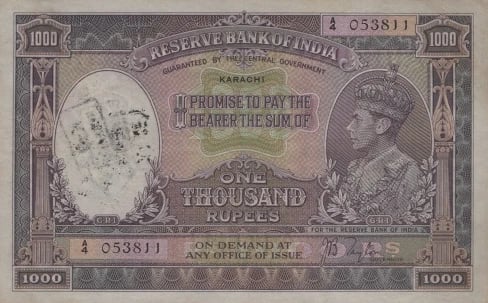
The 1000 Rupee note in India was one of the highest-value currency denominations issued for circulation within the paper currency system and played a significant role in India’s monetary history. First introduced during the British India period, the 1000 Rupee currency note represented an exceptionally large sum at the time, used primarily in wholesale trade, interbank settlements, government finance, and major commercial transactions. Its value far exceeded everyday circulation needs, making it a tool of institutional and high-level economic activity.
Old 1000 Rupee currency notes of India reflect the structure of colonial-era finance, when large payments were settled through paper instruments rather than coin. This article focuses on British India 1000 Rupee notes, tracing their development from the earliest Queen Victoria issues through uniface designs and later King George V and King George VI portrait types. It explains how rarity, demonetisation, and survival rates shape collectibility today, and why these notes occupy a special position in Indian paper money history.
Queen Victoria 1000 Rupee Note
Catalogues: Banknote Book B107 / Pick A1E
The Queen Victoria 1000 Rupee note represents the earliest phase of high-denomination paper money in India and stands among the rarest issues in Indian numismatics. Issued between 1861 and 1867 following the Paper Currency Act of 1861, these notes marked the transition from private bank issues to a government-controlled paper currency system administered by the Paper Currency Department.
Printed by the Bank of England, the note is a uniface design—printed on one side only—with an austere and formal layout. The front features Queen Victoria, flanked by classical ornamental elements, with all text in English. The reverse is completely blank, reflecting early paper money conventions rather than later security-focused design. There is no security thread, and protection relied primarily on high-quality paper and a multi-line watermark incorporating ‘GOVERNMENT OF INDIA’ and ‘ONE THOUSAND RUPEES’.
All examples bear the full name of the issuing city, such as Calcutta or Madras. Signatures are limited, with Henry Hyde being the known signatory for this type.
From a collectibility standpoint, this issue is classified as extremely rare. Survival rates are exceptionally low due to limited issuance, institutional use, and later demonetisation. Even heavily circulated or problem examples are avidly sought after, while high-grade pieces are virtually unobtainable. The Queen Victoria 1000 Rupee note is valued not for condition perfection, but for its historical significance as India’s first government-issued high-value paper money.
Uniface 1000 Rupee Notes of British India
The uniface green underprint 1000 Rupee notes of British India were printed by the Bank of England, London, and represent the principal high-denomination paper money used for institutional, treasury, and large commercial transactions from the late 19th to early 20th century. All examples share the same large format of 208 × 133 mm, are printed on deckle-edged paper, and feature black intaglio text over a green underprint on the front, with a completely blank reverse.
These notes carry four language panels, lack a security thread, and are known with two distinct watermark varieties. The earlier watermark features wavy lines enclosed within a rectangular panel, with INDIA at the top and GOVERNMENT OF INDIA at the bottom. The word RUPEES appears vertically and inverted along both sides of the panel. This variety also includes a plate letter at the lower left and the week and year of paper manufacture printed in four digits at the lower right. A later watermark variety shows a notable change, with “INDIA” at the top of the panel replaced by the denomination “1000”, while retaining the surrounding design elements.
Crucially, all British India 1000 Rupee notes bear the full name of the issuing city. Within this category, two distinct issues exist: the earlier two-serial-number notes and the later four-serial-number notes.
Two-Serial Number Uniface 1000 Rupee Notes
Catalogues: Banknote Book B127 / Pick A19
The two-serial-number uniface notes represent the earliest green underprint 1000 Rupee issues, introduced during the latter half of the nineteenth century. These notes are attributed to the period circa 1867 to 1901, preceding the introduction of the four-serial-number format. They carry two serial numbers, positioned symmetrically at the top of the note.
Known circles of issue for the two-serial variety include Bombay, Calcutta, Allahbad or Calcutta, Lahore or Calcutta, Lahore, and Madras.
Signature availability differs by circle of issue. Bombay examples are known with John Archibald Ballard (J.A. Ballard), Stephen Jacob, and Arthur Frederic Cox (A.F. Cox) signatures, while Calcutta is recorded with Jacob and Cox. Certain dual-circle issues list Jacob alone, and Lahore-only issues are associated with Howard Denning (H. Denning).
Survival rates across all varieties are extremely low. Many examples were redeemed, cancelled, or destroyed during later demonetisation, and very few were preserved intentionally at the time. Today, all two-serial uniface 1000 Rupee notes are considered extremely rare, regardless of condition.
Four-Serial Number Uniface 1000 Rupee Notes
Catalogues: Banknote Book B128 / Pick A19A
Introduced from 1901 to 1927, the four-serial-number uniface notes represent a clear security and administrative upgrade over earlier issues. The presence of four serial numbers, printed at both the top and bottom of the note, made alteration substantially more difficult. During this period, a watermark transition occurred around 1908, with earlier designs featuring a central INDIA inscription later replaced by the denomination 1000.
Known circles of issue for the four-serial variety include Bombay, Calcutta, Allahabad or Calcutta, Cawnpore, Kurrachee, Lahore, Madras, and Rangoon. This expanded list reflects the growing administrative and commercial reach of British India, particularly into Burma.
Signature availability varies significantly by circle of issue. Bombay examples are recorded with a wide range of signatures, including Arthur Montagu Brigstocke (A.M. Brigstocke), Edward Mitchener Cook (E.M. Cook), Moses Mordecai Simeon Gubbay (M.M.S. Gubbay), Arthur Cecil McWatters (A.C. McWatters), Charles William Charteris Carson (C.W.C. Carson), A. V. Venkatasubba Aiyer (A.V.V. Aiyer), Michael, and Howard Denning (H. Denning).
Calcutta issues are known with Arthur Frederic Cox (A.F. Cox), Gubbay, Denning, Charles James Rivett Carnac (C.J.R. Carnac), Aiyer, and Cyril Gwyther. Certain dual-circle issues list Cox alone, while other circles—including Cawnpore, Kurrachee, Madras, and Rangoon—are associated primarily with Denning. Lahore examples are known with both Denning and James Braid Taylor (J.B. Taylor) signatures.
Despite being produced later and in greater administrative scope, four-serial uniface 1000 Rupee notes remain extremely rare today. Demonetisation, institutional redemption, and lack of contemporary collector interest resulted in very limited survival.
King George V Portrait 1000 Rupee Notes
Catalogues: Banknote Book B146 / Pick 12
The King George V portrait 1000 Rupee note, introduced in 1931, marks the shift from the uniface “green underprint” format to a fully engraved, two-sided high-denomination design. Visually, it is one of the most impressive British India notes, combining a formal royal portrait with complex guilloches and an elaborate reverse vignette. The face carries English text and a left-facing portrait of King George V framed by intricate line-work, while the reverse features a detailed agricultural scene with yoked oxen ploughing a field, a lake, trees, houses, and distant mountains, together with a language panel.
A key interesting point is production. Unlike 100 Rupee King George V denominations that were first printed in England and then in India, all King George V 1000 Rupee notes were printed in India by the India Security Press, reflecting the maturation of domestic banknote production after the establishment of India’s currency printing capability.
Physically, the notes measure approximately 200 × 125 mm, slightly smaller than the earlier uniface issues but still imposing in hand. They do not carry a security thread. Security relies instead on high-quality engraving and a watermark incorporating the King George V portrait with “GOVERNMENT OF INDIA” patterns.
These notes were issued only in seven circles — Bombay, Calcutta, Cawnpore, Karachi, Lahore, Madras, and Rangoon — and every example bears the full name of its city of issue. Importantly, all King George V 1000 Rupee notes use prefix “X”.
Two signatories are recorded: James Braid Taylor (appearing as J.B. Taylor) and James William Kelly (appearing as J.W. Kelly). Known circle/prefix pairings include: Calcutta (X/1, X/8, X/10), Lahore (X/2), Bombay (X/3, X/9), Karachi (X/4), Madras (X/5), Rangoon (X/6), and Cawnpore (X/7), with both Taylor and Kelly known across the circles.
Isolated lower-left note portions bearing prefixes X/11 and X/12 have been recorded, but the corresponding circles of issue remain unconfirmed. Similar partial-note survivals are also known in other denominations, particularly in 100 Rupee cut notes.
A point of caution for collectors concerns so-called “Burma overprint” examples on the 1000 Rupee denomination. No genuine overprinted King George V 1000 Rupee notes exist. Any overprints encountered on this denomination are counterfeit additions and are typically crude in execution. This contrasts sharply with the genuine, well-executed Burma overprints found on lower denominations, particularly 5, 10, and 100 Rupees, which are clearly distinguishable in quality and application.
In terms of collectibility, King George V portrait 1000 Rupee notes are considered extremely rare across all circles. Survival rates are exceptionally low due to demonetisation. For collectors of British India paper money, this issue stands as one of the most prestigious and historically important denominations ever produced.
King George VI Portrait 1000 Rupee Notes
Catalogues: Banknote Book B205 / Pick 21
The King George VI 1000 Rupee note, introduced in 1938, represents a major transition in Indian paper money. It was the first 1000 Rupee denomination issued by the Reserve Bank of India (RBI), replacing the earlier Government of India issues and marking the consolidation of currency authority under the RBI following its establishment in 1935.
The design closely follows the established King George V high-denomination format, with key updates reflecting the transition to Reserve Bank of India issuance. The front features King George VI facing left, wearing the Imperial Crown of India, replacing the earlier King George V portrait within a familiar ornamental layout. The reverse retains the formal language panel but introduces a new central vignette of fir trees and snow-covered mountains, alongside the RBI seal featuring the tiger and palm tree—an emblem that would become closely associated with RBI-issued notes. Security features were strengthened through the introduction of a solid security thread. The watermark was also updated, consisting of chains, a right-facing portrait of King George VI, and repeated “RESERVE BANK OF INDIA” text, reinforcing the note’s institutional authority. These notes were printed at the India Security Press on high-quality paper, measuring 204 × 125 mm.
All issued King George VI 1000 Rupee notes carry the signature of James Braid Taylor (J.B. Taylor), who by this time was serving as Governor of the Reserve Bank of India. Taylor had previously signed high-denomination notes under the Government of India, making this issue a symbolic bridge between the two monetary authorities. His role and tenure are discussed in more detail in our article on RBI Governors from 1935 to 1970.
King George VI 1000 Rupee notes were issued for only six circles: Bombay, Calcutta, Cawnpore, Karachi, Lahore, and Madras. Rangoon does not appear on this issue, reflecting the formal separation of Burma from British India that took effect on 1 April 1937. The Calcutta circle is known with prefixes A/0 and A/6, while Bombay appears with prefixes A/3 and A/7. The remaining circles were each issued with a single prefix: Cawnpore (A/1), Lahore (A/2), Karachi (A/4), and Madras (A/5). Although Bombay and Calcutta notes are encountered more often due to their two-prefix allocations, all six circles are genuinely rare.
Two clarifications are important for collectors. First, no Burma overprints exist on the King George VI 1000 Rupee denomination; Burma overprints were never applied to notes of this value. Second, no Government of Pakistan 1000 Rupee notes were issued under King George VI—the highest denomination for Pakistan during this period was 100 Rupees.
Demonetisation of 1000 Rupee Notes
The first demonetisation of Indian banknotes took place on 12 January 1946, marking a turning point in the history of high-denomination currency in India. Introduced during the final phase of British rule, the measure targeted ₹500, ₹1000, and ₹10000 notes, which had become closely associated with wartime finance, black money, and large-scale monetary settlements.
The government announced demonetisation with very limited notice and allowed a short exchange window—initially around ten days, later extended—to surrender or regularise holdings through the banking system. While the policy was intended to expose unaccounted wealth, its most significant long-term effect was the removal of high-denomination notes from circulation. The overwhelming majority of 1000 Rupee notes were returned and cancelled, sharply reducing the surviving population.
From a numismatic perspective, this process permanently altered availability. Notes that were not exchanged—whether retained, misplaced, or preserved—became finite survivors of a withdrawn series. The demonetisation of 1946, therefore, plays a central role in explaining the rarity and collectibility of British India 1000 Rupee notes today.
This event also established the framework for later currency withdrawals in India. For a broader historical overview, see our article on the History of Demonetisation of Indian Banknotes, where the 1946 episode is discussed as the country’s first such measure.
Economic Context & Collectibility of the 1000 Rupee Notes
When introduced, the 1000 Rupee denomination represented an extraordinary concentration of value within the Indian monetary system. It was designed for major financial transactions rather than everyday use, serving roles in wholesale trade, banking settlements, government finance, and large institutional payments. For most individuals, even seeing such a note would have been uncommon.
To understand its economic weight, it helps to view 1000 Rupees in relative terms rather than modern equivalents. During the early twentieth century, a 15 Rupee King George V gold coin, struck in .917 fineness and weighing approximately 7.98 grams, was itself a substantial store of value. By comparison, a single 1000 Rupee note represented the equivalent of more than five dozens of such gold coins, illustrating how concentrated the denomination was within the currency system. Similarly, when compared to circulating silver coinage—such as the 1 Rupee silver coin of .917 fineness—the scale of 1000 Rupees becomes immediately apparent.
This concentration of value had lasting consequences for collectibility. High-denomination notes were more likely to be redeemed, cancelled, or destroyed during demonetisation events, particularly in 1946. Those that survived did so in limited numbers, often bearing evidence of careful handling or long-term storage rather than circulation.
Collectors today value these notes not only for rarity, but for what they represent: the highest tier of pre-independence Indian paper money, issued in an era when 1000 Rupees signified exceptional financial power.
What We Buy – British India 1000 Rupee Notes
We actively buy British India 1000 Rupee notes, including Queen Victoria, uniface green underprint, King George V, and King George VI issues. These notes represent one of the highest denominations of colonial Indian paper money. Condition, originality, and authenticity are key considerations. Each note is assessed individually based on issue type, period, circle of issue, and overall condition.
Collectors or sellers holding genuine British India 1000 Rupee notes are welcome to contact us with clear images and an asking price for review.
Conclusion
The British India 1000 Rupee note occupies a unique position in Indian monetary history. Issued for the highest levels of financial activity, it represents the uppermost tier of colonial-era paper money, spanning the reigns of Queen Victoria through King George VI. Across uniface, portrait, and Reserve Bank issues, the denomination reflects evolving currency administration, printing capability, and economic structure.
Today, these notes are prized not only for their scarcity, but for what they represent—an era when large financial obligations were settled through engraved paper instruments rather than coin. Demonetisation, institutional redemption, and limited survival have ensured that genuine examples remain exceptionally elusive. For collectors of Indian paper money, the 1000 Rupee denomination stands as one of the most historically significant and challenging areas of the field.
Frequently Asked Questions
What is the difference between two-serial and four-serial uniface notes?
Two-serial uniface 1000 Rupee notes are earlier issues (circa 1867–1901) and display only two serial numbers, both placed at the top of the note. Four-serial uniface notes were introduced later (circa 1901–1927) and carry serial numbers at both the top and bottom.
Which circles of issue exist for King George V 1000 Rupee notes?
King George V 1000 Rupee notes were issued for only seven circles: Bombay, Calcutta, Cawnpore, Karachi, Lahore, Madras, and Rangoon. All examples carry prefix “X” and bear the full name of the issuing city.
Which circles of issue exist for King George VI 1000 Rupee notes?
King George VI 1000 Rupee notes were issued for six circles: Bombay, Calcutta, Cawnpore, Karachi, Lahore, and Madras. Rangoon does not appear on this issue, reflecting Burma’s formal separation from British India in 1937.
Do genuine Burma overprints exist on 1000 Rupee notes?
No. There are no genuine Burma overprints on the 1000 Rupee denomination for either King George V or King George VI issues. Any overprints encountered on 1000 Rupee notes are counterfeit additions and are typically crude in execution. This contrasts with the genuine and well-executed Burma overprints found on lower denominations such as 5, 10, and 100 Rupees.
How does demonetisation affect the value of old 1000 Rupee notes?
Demonetisation in 1946 dramatically reduced the surviving population of British India 1000 Rupee notes. The majority were surrendered and cancelled, leaving only a small number unredeemed. This sharp reduction in supply is a major reason these notes are highly collectible today.
Are British India 1000 Rupee notes legal tender today?
No. All British India 1000 Rupee notes were demonetised in 1946 and ceased to be legal tender. Their value today is strictly numismatic and based on rarity, condition, and collector demand.