
1000 Rupee Note India: British India Issues Explained
Old 1000 Rupee currency notes of India, covering British India issues, uniface, KGV and KGVI paper money designs, rarity, demonetisation, and collectibility.
IndiaBanknotes.com Editorial Team
8 min read
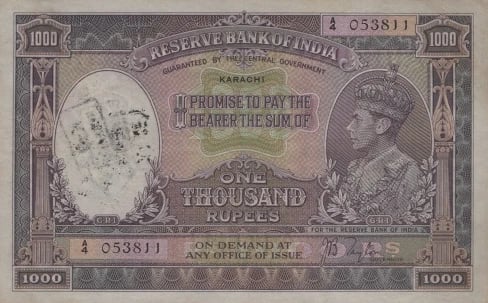
The British India 1,000 Rupee note was one of the highest denomination banknotes issued during the colonial period, used primarily for interbank settlements, government finance, and large commercial transactions. Unlike lower denominations, it rarely circulated among the general public and functioned mainly within institutional and financial networks.
Over time, the 1,000 Rupee note evolved through several major types, including early Queen Victoria issues, uniface designs, and later King George V and King George VI portrait notes. These changes reflect the development of India’s paper currency system from early government-issued notes to more advanced printed designs.
Today, British India 1,000 Rupee notes are highly collectible due to their rarity, historical significance, and the very limited number of surviving examples following demonetisation in 1946.
Overview of British India 1000 Rupee Notes
The 1000 Rupee denomination represented the highest tier of paper money in colonial India. It was designed for high-value transactions rather than everyday use, making it fundamentally different from circulating currency such as 1 Rupee or 5 Rupee notes.
Across its history, the denomination evolved through distinct phases:
Queen Victoria issues
Uniface green underprint notes
King George V portrait notes
King George VI portrait notes
Each phase reflects changes in currency administration, printing technology, and economic structure within British India. These characteristics make the 1000 Rupee note one of the most important high-denomination issues in British India paper money.
Queen Victoria 1000 Rupee Note
Catalogue References: Banknote Book B107 / Pick A1E
The Queen Victoria 1000 Rupee note represents the earliest phase of high-denomination paper money in India and is among the rarest issues in Indian numismatics.
Issued between 1861 and 1867 under the Paper Currency Act of 1861, these notes marked the transition from presidency bank issues to a centralized government-controlled system.
Printed by the Bank of England, the note features a uniface design with all text in English and a portrait of Queen Victoria. The reverse is blank, reflecting early printing conventions rather than later security-focused designs.
Security relied on high-quality paper and watermark features rather than threads or complex devices. All examples display the full issuing city name, such as Calcutta or Madras. Signatures are limited, with Henry Hyde being the known signatory for this type.
From a collectibility perspective, these notes are highly rare. Survival rates are exceptionally low due to institutional usage and later demonetisation, making even lower-grade examples highly desirable.
Uniface 1000 Rupee Notes of British India
The uniface green underprint 1000 Rupee notes formed the backbone of high-denomination currency from the late nineteenth to early twentieth century.
Printed in London by the Bank of England, these notes feature black text over a green underprint on the front and a blank reverse. Their large format and formal design reflect their use in institutional and treasury transactions rather than everyday circulation.
Key Features
Four language panels
Green underprint
No security thread
Full issuing city names
Size: 208 x 133 mm
These notes exist in two major subtypes based on serial number format.
Two-Serial Number Uniface Notes
Catalogues: Banknote Book B127 / Pick A19
These earlier issues (circa 1867–1901) display two serial numbers positioned at the top of the note.
Known issuing circles include Bombay, Calcutta, Lahore, Madras, and combined circles such as Allahabad or Calcutta, and Lahore or Calcutta.
Signature availability differs by circle of issue. Bombay examples are known with John Archibald Ballard (J.A. Ballard), Stephen Jacob, and Arthur Frederic Cox (A.F. Cox) signatures, while Calcutta is recorded with Jacob and Cox. Certain dual-circle issues list Jacob alone, and Lahore-only issues are associated with Howard Denning (H. Denning).
All examples are extremely rare today due to low survival rates and later demonetisation.
Four-Serial Number Uniface Notes
Catalogues: Banknote Book B128 / Pick A19A
Introduced from 1901 to 1927, these notes feature four serial numbers placed at both the top and bottom of the note, improving security and reducing the risk of alteration.
Known circles of issue for the four-serial variety include Bombay, Calcutta, Cawnpore, Kurrachee, Lahore, Madras, Rangoon, and combined circles such as Allahabad or Calcutta.
Signature availability varies significantly by circle of issue. Bombay examples are recorded with a wide range of signatures, including Arthur Montagu Brigstocke (A.M. Brigstocke), Edward Mitchener Cook (E.M. Cook), Moses Mordecai Simeon Gubbay (M.M.S. Gubbay), Arthur Cecil McWatters (A.C. McWatters), Charles William Charteris Carson (C.W.C. Carson), A. V. Venkatasubba Aiyer (A.V.V. Aiyer), Michael, and Howard Denning (H. Denning).
Calcutta issues are known with Arthur Frederic Cox (A.F. Cox), Gubbay, Denning, Charles James Rivett Carnac (C.J.R. Carnac), Aiyer, and Cyril Gwyther. Allahabad or Calcutta is known with Cox.
Other circles—including Cawnpore, Kurrachee, Madras, and Rangoon—are associated primarily with Denning. Lahore examples are known with both Denning and James Braid Taylor (J.B. Taylor) signatures.
Despite being later issues, these notes remain extremely rare due to institutional redemption and lack of contemporary preservation.
King George V Portrait 1000 Rupee Notes
Catalogues: Banknote Book B146 / Pick 12
The King George V 1000 Rupee note, introduced in 1931, marked a major transition from uniface designs to fully printed two-sided banknotes.
The front features a portrait of King George V with intricate engraving, while the reverse displays a detailed agricultural vignette. These notes were printed in India at the India Security Press, reflecting the development of domestic banknote production (see our article on The Birth of India Currency Note Press).
The notes measure approximately 200 × 125 mm, slightly smaller than the earlier uniface issues but still imposing in hand. They do not carry a security thread. Security relies instead on high-quality engraving and a watermark incorporating the King George V portrait with “GOVERNMENT OF INDIA” patterns.
All notes bear prefix “X” and were issued across seven circles, including Bombay, Calcutta, Cawnpore, Karachi, Lahore, Madras, and Rangoon.
No genuine Burma overprints exist for this denomination. Any such overprints are counterfeit additions and are crude, unlike the authentic overprints found on lower denominations.
Two signatories are recorded: James Braid Taylor (appearing as J.B. Taylor) and James William Kelly (appearing as J.W. Kelly).
Known circle/prefix pairings include: Calcutta (X/1, X/8, X/10), Lahore (X/2), Bombay (X/3, X/9), Karachi (X/4), Madras (X/5), Rangoon (X/6), and Cawnpore (X/7), with both Taylor and Kelly known across the circles.
These notes are very rare and are considered among the most prestigious British India issues.
King George VI Portrait 1000 Rupee Notes
Catalogues: Banknote Book B205 / Pick 21
Introduced in 1938, the King George VI 1000 Rupee note represents the transition to Reserve Bank of India-issued currency.
The design retains the general structure of earlier portrait notes but includes updated features such as:
A new central reverse vignette of fir trees and snow-covered mountains
RBI seal (tiger and palm tree)
Security thread
Updated watermark with King George VI portrait
These notes were issued across six circles: Bombay, Calcutta, Cawnpore, Karachi, Lahore, and Madras and carry the signature of J.B. Taylor. The Calcutta circle is known with prefixes A/0 and A/6, while Bombay appears with prefixes A/3 and A/7. The remaining circles were each issued with a single prefix: Cawnpore (A/1), Lahore (A/2), Karachi (A/4), and Madras (A/5).
Rangoon does not appear on this issue due to Burma’s separation from British India in 1937.
Although Bombay and Calcutta notes are encountered more often due to their two-prefix allocations, all six circles are genuinely rare.
Demonetisation of 1000 Rupee Notes
The first demonetisation of high-denomination currency in India took place on 12 January 1946, targeting ₹500, ₹1000, and ₹10000 notes.
The policy aimed to address unaccounted wealth and wartime financial conditions. Most high-value notes were surrendered and cancelled within a short exchange window.
This event dramatically reduced the surviving population of 1000 Rupee notes and is a key factor behind their rarity today.
For a broader perspective, see our article on History of Demonetisation of Indian Banknotes.
Economic Context and Collectibility
The 1000 Rupee note represented an extraordinary concentration of value within the colonial economy. It was primarily used for large-scale financial transactions rather than everyday circulation.
Because of this, most notes were held by institutions and later redeemed or destroyed, leading to very low survival rates.
To understand its economic weight, it helps to view 1000 Rupees in relative terms rather than modern equivalents. During the early twentieth century, a 15 Rupee King George V gold coin, struck in .917 fineness and weighing approximately 7.98 grams, was itself a substantial store of value. By comparison, a single 1000 Rupee note represented the equivalent of more than sixty such gold coins.
Today, collectors value these notes for their rarity, historical importance, and their status as one of the most significant high-denomination issues in British India paper money.
Understanding how rarity and condition affect pricing is essential, as explained in our guide on understanding banknote values.
What Determines the Value of 1000 Rupee Notes
The value of British India 1000 Rupee notes is influenced by several key factors, including rarity, survival rate, condition, historical period, and overall collector demand. Notes from limited issues or with low surviving populations are significantly more sought-after, particularly when tied to important phases of India’s monetary history.
Condition plays a critical role, as these high-denomination notes were rarely preserved with collectors in mind. Well-preserved examples with strong paper quality, clear printing, and minimal damage are considerably more desirable than heavily circulated pieces. Proper storage and handling can also have a direct impact on long-term value, as discussed in our guide on how to preserve and store banknotes.
Accurate evaluation requires a clear understanding of grading standards, which is covered in how to grade banknotes. While earlier uniface issues and certain King George V varieties are generally scarcer than King George VI notes, condition and specific signature combinations can significantly influence value within each type.
Market Context and Value Expectations
British India 1000 Rupee notes are among the most valuable areas of Indian paper money collecting. Well-preserved examples of rare varieties are typically traded within the high-value segment of the market.
In practice, value can differ significantly based on issuing circle, signature, and overall condition. Earlier uniface issues and select King George V notes are generally more sought-after, while later issues are relatively more available but still require careful evaluation. Because of this variability, each note should be assessed individually rather than relying on general price expectations.
Conclusion
The British India 1000 Rupee note represents one of the most important high-denomination issues in the history of Indian paper currency, reflecting the structure of large-scale financial transactions during the colonial period. From early Queen Victoria issues to later Reserve Bank notes under King George VI, the denomination illustrates the evolution of currency design, administration, and monetary policy in British India.
The progression from uniface notes to more advanced portrait designs highlights the gradual modernization of India’s paper currency system. At the same time, limited circulation, institutional usage, and the widespread demonetisation of 1946 have resulted in extremely low survival rates across all types.
Today, British India 1000 Rupee notes remain a cornerstone of advanced collecting, valued for their rarity, historical significance, and wide range of varieties. Whether studied for their design, issuing circles, or signature combinations, these notes continue to hold a central place in Indian paper money research and collecting.
Frequently Asked Questions
Was the 1000 Rupee note the highest value issued in British India?
While it was an incredibly high denomination, it wasn't the absolute highest. The 10,000 Rupee note held that title. However, the 1,000 Rupee note was the primary "workhorse" for massive institutional and government transactions.
Why is it so difficult to find these notes today?
Two reasons: usage and destruction. They weren't meant for the public, so few were issued to begin with. Then, the 1946 demonetisation forced almost everyone to turn them in to the government, where they were systematically destroyed.
How many circles issued the King George V 1000 Rupee note?
Only seven specific circles issued this series: Bombay, Calcutta, Cawnpore, Karachi, Lahore, Madras, and Rangoon.
I’ve seen a 1000 King George V Rupee note with a Burma overprint—is it real?
No. Genuine Burma overprints were never officially produced for the 1000 Rupee denomination. Any "Burma" stamped 1000 Rupee notes encountered today are considered counterfeits.
Can I find a King George VI 1000 Rupee note from Rangoon?
No. By the time the King George VI 1000 Rupee series was introduced in 1938, Burma had already separated from British India (1937). Consequently, Rangoon was no longer an issuing circle for this denomination.
How much is a British India 1000 Rupee note worth?
There is no "fixed" price because they are rare. Value is determined by a combination of the issuing circle, the governor's signature, and the grade (condition).