
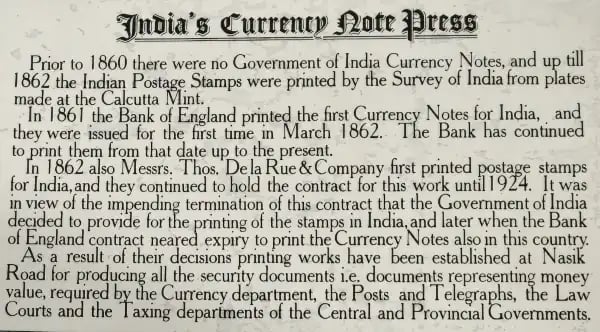
The India Currency Note Press at Nasik Road was established in the 1920s to enable India to print its own currency notes domestically. Before the creation of the press, Government of India banknotes were printed in Britain by institutions such as the Bank of England and Thomas De La Rue & Company. This dependence on overseas printers created logistical difficulties, security concerns, and rising transportation costs for British India.
The establishment of the India Currency Note Press at Nasik Road marked a major milestone in the history of Indian paper money. For the first time, India began developing the infrastructure required to produce its own banknotes within the country instead of relying entirely on British security printers. Located in present-day Maharashtra, the press became the foundation of India’s modern currency printing system and played a central role in the evolution of Government of India banknotes.
This article explores the birth of the India Currency Note Press at Nasik Road, the overseas printing of Indian banknotes, the reasons Nashik was selected for the facility, and the lasting importance of the press in India’s monetary history.
Before Government of India Paper Currency
Before the introduction of Government of India paper currency, the monetary system in India relied mainly on coins issued by the East India Company. Gold, silver, and copper coins circulated across the subcontinent and formed the basis of trade and taxation during the early colonial period. Among the best-known issues were the uniform 1835 coinage of King William IV and the later Queen Victoria series introduced from 1840 onward.
Paper money, however, had already begun to appear in India during the late 18th and early 19th centuries. Several private and commercial banks issued their own banknotes for regional circulation. These included institutions such as the Bank of Hindostan, the Commercial Bank, the Union Bank, and the Oriental Bank. Their notes were primarily used in major trading centers and represented some of the earliest examples of paper money used in India.
The three Presidency Banks — the Bank of Bengal, the Bank of Bombay, and the Bank of Madras — also issued their own paper currency. These Presidency Bank notes circulated mainly within their respective regions and became widely accepted in commercial transactions. However, there was no single standardized paper currency system across British India. Different banks used different designs, denominations, and issuing practices, making interregional trade and administration more complicated.
As British control expanded across India during the 19th century, the need for a centralized paper currency system became increasingly important. The colonial administration required a uniform currency that could circulate throughout British India and support growing trade, taxation, railway expansion, and government expenditure.
This need for monetary uniformity eventually led to the Paper Currency Act of 1861, one of the most important developments in the history of Indian banknotes.
The Paper Currency Act of 1861 and Government of India Notes
The Paper Currency Act of 1861 transformed the monetary system of British India by granting the Government of India the exclusive right to issue paper currency. This legislation ended the note-issuing powers of the Presidency Banks and introduced a centralized paper currency system that could circulate across the country.
Following the Act, the Government of India began issuing standardized banknotes that were valid throughout British India. These early issues featured the portrait of Queen Victoria and represented the beginning of official Government of India paper money. The notes were intended to inspire public confidence and provide a uniform currency system for trade and administration.
Relying on overseas printers also limited the Government of India’s ability to respond quickly to changing currency requirements. Any adjustments to note designs, denominations, or production volumes depended on foreign contracts and shipping schedules. A domestic printing facility would provide far greater flexibility and allow tighter control over the supply of banknotes within India.
The early Queen Victoria portrait notes were printed by the Bank of England in Britain. Later, in 1867, the Government introduced the famous uniface notes printed only on one side, which were also produced by the Bank of England. These notes became an important part of late 19th-century Indian paper money and circulated widely throughout British India.
During the early 20th century, printing responsibilities gradually shifted to Thomas De La Rue & Company, one of the world’s leading security printing firms. The company printed the well-known King George V portrait notes, including the iconic British India One Rupee note introduced in 1917. These portrait issues became some of the most recognizable and historically significant banknotes of the colonial era.
Although the Paper Currency Act successfully centralized note issuance, it also created a long period of dependence on overseas printers. For decades, Indian currency notes continued to be designed and printed in Britain before being shipped to India for circulation. Over time, the costs, logistical difficulties, and security risks associated with this system strengthened the case for establishing a currency printing facility within India itself.
Why India Needed Its Own Currency Note Press
By the early 20th century, British India had become heavily dependent on British firms for the printing of its currency notes. Government of India banknotes were produced overseas and transported thousands of miles by sea before entering circulation in India. Although the system provided access to advanced printing technology, it also created several serious problems for the colonial administration.
One of the biggest concerns was security. Large consignments of printed banknotes had to be shipped from Britain to India, exposing them to risks such as theft, wartime disruption, transportation delays, and maritime losses. These concerns became even more significant during World War I, when global shipping routes faced increasing uncertainty.
The cost of overseas printing was another major issue. Printing currency notes abroad involved substantial expenses related to production contracts, secure transportation, insurance, and storage. As the Indian economy expanded and the demand for paper currency increased, these costs continued to rise.
At the same time, the Government of India had limited flexibility when relying on foreign printers. Any changes to note designs, denominations, or production volumes depended on overseas schedules and contracts. Establishing a domestic printing facility would allow greater control over currency production and improve the ability to respond quickly to changing monetary requirements.
Technological progress also made domestic printing increasingly feasible. By the 1920s, the administration believed India possessed the infrastructure and technical capability needed to handle secure currency printing locally. The growing experience gained through printing government documents and other secure materials strengthened confidence that India could eventually produce its own banknotes.
These economic, logistical, and strategic considerations ultimately convinced the Government of India to establish a domestic Currency Note Press. After evaluating several locations, the administration selected Nasik Road in present-day Maharashtra as the site for India’s future banknote printing facility.
Why Nasik Road Was Chosen
After deciding to establish a domestic Currency Note Press (CNP), the Government of India needed a location that could support secure banknote production and long-term expansion. Following careful evaluation, Nasik Road in present-day Maharashtra was selected as the ideal site for the new printing facility.
Several important factors influenced this decision.
Favorable Climate
Banknote printing required stable environmental conditions for storing specialized paper, inks, and precision machinery. Excessive humidity and extreme temperature fluctuations could damage paper stock and interfere with printing quality. Nasik Road offered a relatively moderate climate, making it well suited for secure printing operations.
Strong Railway Connectivity
Nasik Road was located on an important railway route connecting major cities and administrative centers across British India. Efficient transportation was essential for moving machinery, raw materials, and finished currency notes securely throughout the country. The railway network also made it easier to transport technical staff and equipment to the site.
Security Advantages
Security was one of the most important considerations in selecting the location. Since the facility would handle the printing of currency notes, the government preferred a site away from densely populated commercial centers where risks of theft, sabotage, or political unrest could be more difficult to manage.
Nasik Road provided a balance between accessibility and isolation. Its location offered greater operational security while still maintaining strong transportation links with the rest of India.
Space for Expansion
The government also required sufficient land for building the press complex, staff quarters, storage facilities, and supporting infrastructure. Nasik Road offered enough space to develop a large self-contained printing establishment capable of future expansion.
The selection of Nasik Road marked a major step toward domestic banknote production in India. Once the site had been finalized, the Government of India moved quickly to begin construction and prepare for the establishment of the India Currency Note Press.
Establishment of the India Currency Note Press
Preparatory work for the new printing facility gathered momentum during the early 1920s as the Government of India moved closer to establishing domestic currency production. In 1923, an important demonstration was conducted in Delhi to assess whether India possessed the technical capability to handle secure printing operations locally. The successful outcome strengthened confidence that a full-scale Currency Note Press could be established within the country.
Following this progress, development work at Nasik Road accelerated rapidly. The site was formally opened in September 1924, and extensive efforts were made to install machinery, prepare secure production areas, and build the infrastructure required for large-scale printing operations.
The project extended far beyond the construction of the press itself. Residential quarters were built for technical staff and employees, while essential infrastructure such as power supply systems, water facilities, drainage networks, and railway connections was developed alongside the printing complex. A dedicated railway siding also ensured the secure movement of machinery, paper, and finished currency notes.
Construction of the dedicated Currency Note Press officially began in August 1926. By this stage, the Government of India had committed significant financial resources toward building a modern printing establishment capable of producing Indian currency notes domestically.
The total project cost eventually reached approximately Rs. 20 lakhs, a substantial amount during the 1920s. Specialized machinery and printing equipment were imported to meet the strict standards required for banknote production. The facility was designed with strong security controls and carefully planned operational systems to support the printing, inspection, storage, and distribution of currency notes.
The establishment of the India Currency Note Press at Nasik Road represented a major milestone in the history of Indian paper money. For the first time, India possessed the infrastructure needed to move toward printing its own banknotes within the country rather than relying entirely on overseas printers.
Legacy of the India Currency Note Press
The establishment of the India Currency Note Press at Nasik Road marked a turning point in the history of Indian banknotes. What began as an effort to reduce dependence on British security printers eventually became the foundation of India’s modern currency printing system.
Before the creation of the press, Government of India notes were printed overseas by institutions such as the Bank of England and Thomas De La Rue & Company. The development of a domestic printing facility allowed India to gradually gain greater control over the production of its own currency notes and reduced the logistical challenges associated with importing banknotes from Britain.
The press at Nasik Road also played an important role in strengthening India’s technical expertise in banknote production. Specialized printing machinery, engraving techniques, quality control systems, and security procedures developed at the facility helped establish the operational standards required for modern currency printing.
Over the decades, the Currency Note Press became closely associated with the development of Indian paper money during both the colonial and post-independence eras. The facility also helped lay the foundation for the wider network of security printing institutions that would later support India’s expanding monetary system.
Today, the story of the India Currency Note Press remains an important chapter in Indian numismatic history. It represents the transition from imported Government of India banknotes to domestic currency production and reflects the broader development of India’s monetary infrastructure during the early 20th century.
Nearly a century later, Nasik Road continues to hold a special place in the history of Indian paper money and the evolution of India’s currency printing system.
Frequently Asked Questions (FAQ)
Here are answers to some of the most common questions about the India Currency Note Press at Nasik Road, the history of Government of India banknotes, and the beginnings of domestic currency printing in India.
When was the India Currency Note Press established?
The India Currency Note Press at Nasik Road was established during the 1920s as part of British India’s effort to develop domestic banknote printing capabilities. Construction of the dedicated Currency Note Press officially began in 1926.
Why was Nasik Road chosen for the Currency Note Press?
Nasik Road was selected because of its favorable climate, railway connectivity, security advantages, and availability of land for future expansion. These factors made it well suited for secure banknote printing operations.
Who printed Government of India banknotes before the Currency Note Press was established?
Early Government of India Queen Victoria portrait notes and uniface notes were printed by the Bank of England. Later, many King George V portrait notes were printed by Thomas De La Rue & Company in Britain.
What was the Paper Currency Act of 1861?
The Paper Currency Act of 1861 granted the Government of India the exclusive right to issue paper currency throughout British India. It ended the note-issuing powers of the Presidency Banks and introduced a centralized paper currency system.
Why was domestic banknote printing important?
Printing banknotes within India reduced dependence on overseas printers, improved security, lowered transportation costs, and gave the Government of India greater control over currency production.
Is the India Currency Note Press still historically important today?
Yes. The India Currency Note Press at Nasik Road remains one of the most important institutions in the history of Indian paper money and represents the beginning of domestic currency printing in India.