
Languages on Indian Notes: History of the 17-Language Panel
Discover the history of languages on Indian notes, from British India paper money to today’s 17-language panel, and learn how multilingual banknotes evolved.
IndiaBanknotes.com Editorial Team
23 min read
Indian currency notes display 17 languages to accommodate the country’s extraordinary linguistic diversity and support nationwide circulation. Modern Indian banknotes feature English and Hindi on the obverse, together with a reverse language panel containing 15 additional Indian languages. This multilingual format developed gradually from the British India era, when early paper money relied almost entirely on English, into the standardised system used on Republic India notes today.
The development of language panels on Indian currency closely parallels India’s political, administrative, and constitutional history. From regional four-language panels on uniface notes to the modern 17-language arrangement, each stage reflects changing circulation needs, linguistic inclusion, and national integration. This article explores how language panels evolved on Indian banknotes, why certain languages were added or removed, and why these changes remain important to paper money collectors today.
Why Indian Currency Notes Have Multiple Languages
India’s currency notes use multiple languages because paper money must function across one of the world’s most linguistically diverse populations. Unlike many countries that operate primarily through a single national language, India recognises numerous major languages used across different states and regions. Currency notes therefore needed a structure that could remain understandable, politically neutral, and nationally acceptable while circulating throughout the entire country.
Importantly, India does not have a national language. Hindi and English serve as official languages of the Union government, while many other languages receive constitutional recognition through the Eighth Schedule of the Constitution of India. This linguistic framework strongly influenced the development of Indian currency notes, especially after Independence, when banknote design increasingly aimed to reflect national diversity rather than colonial administrative priorities.
The use of multiple languages on Indian currency notes also serves a practical purpose. Banknotes circulate daily across regions with different scripts, literacy patterns, and linguistic traditions. A multilingual format allows people from different parts of India to identify denominations more easily, particularly in earlier periods when literacy in English was far less widespread than it is today.
At the same time, currency design required balance. Including every regional language directly on the main design would have created overcrowded and impractical banknotes. The solution was the development of structured language panels, where multiple Indian languages could appear together in an organised format without disrupting the core design of the note. English remained the primary administrative language, Hindi gradually gained prominence after Independence, and additional languages were grouped within the reverse language panel.
Over time, these regional multilingual systems evolved into the modern 17-language arrangement seen on Indian currency today. Far from being decorative additions, the language panels were designed to improve usability, maintain inclusivity, and support nationwide circulation across a highly diverse linguistic landscape.
Origins of Language Use on Indian Paper Money
The earliest Indian paper money was not designed as a multilingual public instrument. During the nineteenth century, paper currency in India functioned primarily within the colonial administrative and commercial system, where English dominated banking, government, and long-distance trade. As a result, early Indian banknotes relied almost entirely on English text and contained little consideration for the linguistic diversity of the population using them.
Presidency Bank Notes and English-Only Currency
Before the Government of India centralised paper money issuance, the three Presidency Banks — the Bank of Bengal, the Bank of Bombay, and the Bank of Madras — issued their own banknotes within their respective regions. These early Presidency Bank notes were largely intended for use among merchants, treasuries, and financial institutions already operating within the English-speaking colonial framework.
The designs reflected this limited administrative purpose. English inscriptions dominated the notes, while Indian languages were either absent or extremely limited. At this stage, paper money circulated far less widely among the general public than coinage, which remained the primary medium for everyday transactions across most of India.
Because these notes served a relatively narrow financial environment, multilingual accessibility was not yet considered essential. The colonial authorities prioritised administrative uniformity and banking practicality rather than linguistic representation.
Queen Victoria Notes and Colonial Administrative Design
A major shift occurred after the Paper Currency Act 1861 transferred the authority to issue paper money from the Presidency Banks to the Government of India. This led to the introduction of government-issued Queen Victoria notes, which established a more centralised currency system across British India.
Despite this administrative change, the language structure remained overwhelmingly English-oriented. Queen Victoria notes continued to use formal English inscriptions without organised language panels or broad multilingual features. The notes were designed primarily for administrative clarity within the colonial state rather than mass linguistic accessibility.
This reflected the realities of the period. English functioned as the working language of colonial governance, courts, banking, and interstate administration. Since paper money still circulated mainly among urban commercial networks and government institutions, there was limited pressure to accommodate India’s many regional languages directly on the currency itself.
Why Early Currency Did Not Use Indian Languages
The absence of Indian languages on early banknotes was not simply a design oversight. It reflected the economic and political structure of colonial India during the nineteenth century.
Paper money circulation remained relatively limited compared to coins, especially outside major commercial centres. Many ordinary transactions continued to rely on metallic currency, local accounting traditions, and regional trade systems. As paper notes slowly entered wider circulation, however, the limitations of English-only currency became increasingly apparent in a multilingual society.
Colonial administrators gradually recognised that banknotes intended for broader public use needed to communicate denomination and legitimacy more effectively across linguistic regions. This practical challenge — rather than cultural inclusion alone — laid the foundation for the appearance of structured language panels on later British India banknotes.
The shift from English-only notes to multilingual currency therefore emerged primarily from circulation requirements. As paper money spread across different presidencies and provinces, banknotes needed to communicate denomination and legitimacy more effectively to users familiar with different scripts and regional languages.
The Birth of Language Panels on British India Notes
The introduction of multilingual denomination panels on British India banknotes marked a major turning point in Indian paper money design. As notes circulated more widely across linguistically diverse regions, English-only currency became less practical for everyday transactions. Rather than replacing English, the authorities supplemented it with organised regional language inscriptions that improved denomination recognition across different parts of British India.
These early multilingual panels were introduced gradually rather than through a single unified reform. Language usage initially varied by region, denomination, and circulation purpose before evolving into more standardised systems during the late nineteenth and early twentieth centuries.
Green Underprint Uniface Notes
The first organised use of multiple Indian languages appeared on British India uniface notes during the green underprint period. These notes introduced formal language panels designed to support wider circulation across regional linguistic groups.
For denominations of 10 Rupees and above, four-language panels appeared from 1867 onward. The India Green Underprint 5 Rupee Uniface Note adopted the same structure from 1871. At this stage, there was no standardised national language panel system, and language combinations varied according to the presidency or circle of issue where the note circulated.
The panels functioned as practical regional identifiers rather than symbolic national representations. English remained the dominant administrative language outside the panel, while Indian languages were grouped separately to improve usability among local populations.
Regional Four-Language Panels
The early four-language panels differed across British India depending on circulation region and administrative requirements.
In the Bombay Presidency, notes used Urdu, Marathi, Gujarati, and Kannada. Calcutta Presidency issues included Urdu, Hindi, Kaithi, and Bangla (Bengali). Madras Presidency notes used Telugu, Kannada, Malayalam, and Tamil, while Rangoon issues incorporated Burmese, Tamil, Urdu, and Chinese.
These combinations reflected regional trade networks, literacy patterns, and administrative realities rather than any standardised national language policy. The panels were therefore highly functional in nature, helping notes circulate more effectively within their intended geographic areas.
The First Standardised Six-Language Panel
A major development occurred between 1901 and 1903 with the 5 Rupee green underprint note. Unlike earlier issues tied closely to regional circulation, the 5 Rupee denomination became increasingly universalised, meaning it could be encashed more broadly across British India rather than primarily within a single issuing circle.
This wider circulation created the need for a more consistent language structure. As a result, the earlier region-specific four-language format was replaced with a standardised six-language panel.
The six languages used were Urdu, Kaithi, Bangla (Bengali), Kannada, Telugu, and Tamil.
This was an important milestone in the evolution of Indian currency design because it represented the first deliberate attempt to create a multilingual panel suitable for nationwide circulation rather than regional administrative use. Higher denominations, however, continued using four-language regional panels during much of this period, showing that standardisation remained gradual and denomination-specific.
Red Underprint Notes and the Eight-Language System
The India Red Underprint 5 Rupee Uniface Note further expanded and formalised the multilingual language panel system. Issued between 1903 and 1907, it retained the standardised six-language panel introduced on the earlier green underprint series.
From 1907 onward, the 5, 10, and 50 Rupee red underprint notes adopted an expanded eight-language panel arranged in two vertical columns, creating the most comprehensive multilingual format yet used on Indian currency.
The eight-language panel included:
Urdu
Kaithi
Bangla (Bengali)
Burmese
Telugu
Tamil
Kannada
Gujarati
Importantly, these language panels did not replace English. English remained the principal language of administration and legal authority on the notes themselves. The multilingual panels instead acted as supporting denomination identifiers intended to improve recognition and circulation across India’s multilingual population.
The green and red underprint issues established many of the core principles that later shaped Indian banknote design. Features such as grouped denomination translations, separation between English and regional scripts, and increasingly standardised multilingual layouts continued into the King George V, King George VI, and Republic India series.
King George V Notes and Reverse Language Panels
The King George V portrait series introduced a more organised approach to multilingual banknote design. Although the basic denomination translations established during the uniface period continued, the placement and presentation of regional languages changed significantly. These notes introduced a cleaner separation between English administrative text and multilingual denomination inscriptions, influencing later British India currency issues.
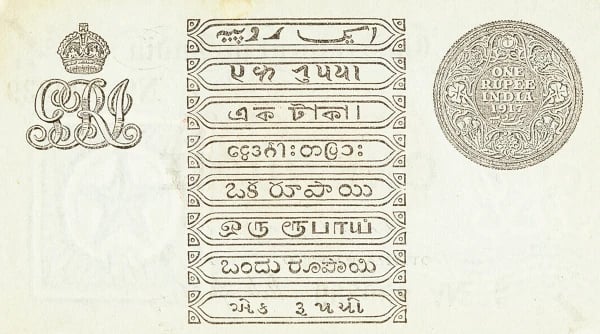
Unlike the earlier uniface notes, where language panels appeared on the front of the note, King George V issues moved the multilingual panel to the reverse. This created a clearer distinction between the primary administrative language and the supporting regional languages used for denomination identification.
Shift from Front Panels to Reverse Panels
King George V portrait notes placed English prominently on the obverse alongside the royal portrait and major design elements. The reverse carried the language panel in a structured vertical arrangement, separating multilingual denomination text from the main administrative face of the note.
This design change improved visual organisation and reflected the growing sophistication of British India banknote printing during the early twentieth century. English remained the dominant language of administration and legal authority, while regional languages served a supporting explanatory role through the reverse panel.
The relocation of the panel also created a more standardised appearance across denominations. Rather than integrating regional scripts directly into the primary design, the multilingual element became a dedicated and recognisable component of the reverse layout.
The Eight Languages Used on King George V Notes
The language panels on King George V notes continued the standardised eight-language structure introduced on later red underprint uniface notes. The languages used were:
Urdu
Kaithi
Bangla (Bengali)
Burmese
Telugu
Tamil
Kannada
Gujarati
Hindi did not appear on King George V notes. Kaithi continued to be used instead, reflecting the linguistic conventions inherited from earlier British India issues.
Why Burmese Appeared on Indian Currency
One of the most misunderstood aspects of King George V language panels is the inclusion of Burmese. Its presence was not experimental or temporary, but a direct result of Burma’s administrative status within British India during much of King George V’s reign.
Because Burma remained part of British India until its formal separation in 1937, Burmese appeared regularly on Indian banknotes intended for circulation within the wider colonial monetary system. The language therefore formed part of the standard eight-language panel across relevant denominations rather than existing as a special regional variation.
This highlights an important feature of British India language panels: they reflected administrative geography and circulation realities more than cultural representation alone.
The Gujarati Inscription Error on the 1917 One Rupee Note
A notable language-related variety appeared on the British India 1 Rupee Note introduced in 1917, the first paper 1 Rupee note issued in India.
Early printings carried an incorrect Gujarati denomination inscription. The mistake was later corrected during the issue period without changing the broader language panel structure. This correction represents one of the earliest well-known linguistic inscription varieties on Indian paper money.
For collectors today, these corrected and uncorrected Gujarati varieties remain significant because they document the growing complexity of multilingual currency production during the British India period.
King George VI Notes and Linguistic Transition
The King George VI series represents a key transitional phase in the history of Indian currency language panels. Issued during the final years of British rule, these notes combined continuity with important linguistic changes, including the growing use of Hindi and the eventual removal of Burmese from Indian banknotes.
The Introduction of Hindi into Currency Panels
One of the most significant linguistic changes during the King George VI period was the replacement of Kaithi with Hindi in the standard language panel.
Earlier British India notes, including the King George V series, had continued using Kaithi alongside Urdu and other regional languages. By the late 1930s, however, Hindi had become increasingly prominent in administration, education, and public usage across northern India. This shift was reflected directly on Indian currency notes.
The replacement of Kaithi with Hindi marked more than a simple script change. It represented a broader transition toward the linguistic structure that would later become standard after Independence. Hindi’s introduction during the King George VI era laid the foundation for its later position alongside English on Republic India banknotes.
Side-Face Portrait Issues
The earliest King George VI portrait notes introduced in 1938 are commonly known as the side-face issues. These included denominations such as 2 Rupees, 5 Rupees, 10 Rupees, 100 Rupees, 1000 Rupees, and 10000 Rupees.
These notes carried a standardised eight-language panel featuring:
Urdu
Hindi
Bangla (Bengali)
Burmese
Telugu
Tamil
Kannada
Gujarati
English remained on the obverse outside the language panel as the principal administrative language of the note.
The continued presence of Burmese reflected the lingering administrative legacy of Burma’s earlier inclusion within British India, even after Burma’s formal separation in 1937.
Removal of Burmese from Indian Banknotes
A major linguistic adjustment occurred during the later King George VI issues introduced in 1944, on lower-denomination notes, namely, 1 Rupee, 5 Rupees (front-face type), and 10 Rupees (front-face type).
These later issues reduced the language panel from eight languages to seven by removing Burmese. The revised panel contained:
Urdu
Hindi
Bangla (Bengali)
Telugu
Tamil
Kannada
Gujarati
The disappearance of Burmese from Indian currency directly reflected the political separation of Burma from British India. Although Burmese had continued appearing on earlier King George VI notes for practical continuity, the later wartime and post-separation issues moved toward a more India-focused language structure.
The King George VI era represents the bridge between colonial multilingual currency systems and the modern language structure of Republic India banknotes. The adoption of Hindi, the removal of Burmese, and the growing emphasis on standardisation together prepared the foundation for the major language panel expansions that followed after Independence.
Republic India and the Ashoka Pillar Language Panels
The introduction of the Ashoka Pillar series after Independence marked a major transformation in the history of languages on Indian currency notes. Colonial portraits disappeared and were replaced by national symbols, while the language structure of Indian paper money began evolving toward a more constitutionally aligned system.
Unlike British India banknotes, Republic India notes were created within a political environment where linguistic representation carried far greater national significance. Independent India had to balance regional identities, administrative practicality, and national unity within a single currency system that circulated across the entire country.
The Ashoka Pillar series became a formative stage in the development of modern Indian banknotes. During this period, multilingual denomination panels expanded, became more standardised, and moved closer to the nationally representative format later used on the Mahatma Gandhi series.
Early Republic Currency After Independence
The earliest Republic India notes retained several structural features inherited from British India currency. English continued to dominate the obverse, while multilingual denomination panels remained grouped separately on the reverse.
Initially, the reverse language panel carried eight languages:
Urdu
Hindi
Bangla (Bengali)
Telugu
Tamil
Kannada
Gujarati
Oriya
Oriya, now officially known as Odia, appeared for the first time on Indian currency during this period. Its inclusion reflected the growing effort to broaden linguistic representation beyond the colonial-era panel system.
At this stage, however, the arrangement of languages was not fully standardised. Different denominations sometimes displayed languages in varying positions, indicating that the multilingual structure was still evolving rather than fixed.
Hindi Appears on the Obverse
One of the most important developments during the early Republic period was the movement of Hindi from the reverse language panel to the obverse alongside English.
This transition occurred gradually around 1950–1951, although timing varied between denominations and printings. Once Hindi appeared prominently on the obverse, it no longer needed to occupy space within the reverse language panel.
The change reflected the growing importance of Hindi within the administrative framework of independent India while still preserving English as an official working language. Together, English and Hindi became the primary languages displayed on the front of Indian banknotes — a structure that continues today.
This redesign also allowed the reverse language panel to focus more specifically on additional regional languages without duplication.
Incorrect Hindi on the Obverse and Its Correction
Early Republic India banknotes initially carried an incorrect Hindi denomination format on the obverse for values above one rupee. These notes used the singular form “रुपया” (Rupaya), even on denominations such as 2 Rupees, 5 Rupees, and higher values where grammatically the plural form should have been used.
This was later corrected to “रुपये” (Rupaye), bringing the denomination text into proper Hindi grammatical usage. The correction appeared gradually across denominations and printings rather than through a single simultaneous redesign.
For collectors, these “Rupaya” and “Rupaye” varieties represent identifiable transitional issues within the Ashoka Pillar series. Although these are sometimes described by collectors as plate errors or inscription varieties, they are not considered conventional banknotes printing errors. Instead, they document an important stage in the linguistic standardisation of modern Indian currency design.
From Eight Languages to Seven
After Hindi moved to the obverse, the reverse panel was reduced from eight languages to seven. The revised structure typically included:
Bangla (Bengali)
Gujarati
Kannada
Oriya
Tamil
Telugu
Urdu
This seven-language format marked an important step toward clearer organisation and standardisation. The reverse panel was no longer simply inherited from colonial practice but was being actively redesigned to suit the linguistic realities of independent India.
During this period, corrections occurred in Gujarati, Kannada, Tamil, and Telugu inscriptions as authorities worked toward greater linguistic consistency across denominations.
Alphabetical Ordering of Languages
Another important development during the Ashoka Pillar era was the gradual adoption of alphabetical ordering within the reverse language panel.
Earlier British India and early Republic issues often displayed languages in inconsistent or historically inherited arrangements. Over time, however, the Reserve Bank of India moved toward a more neutral and systematic presentation.
Alphabetical ordering improved visual consistency while also reducing perceptions of linguistic hierarchy or regional preference. This reflected the broader post-Independence effort to balance national integration with linguistic diversity.
The move toward standardised ordering became especially important as more languages were added during later decades.
Expansion to the 13-Language Panel
The most significant linguistic expansion of the Ashoka Pillar period occurred during the 1960s with the introduction of the thirteen-language panel.
This expanded format closely reflected the original Eighth Schedule of the Constitution of India, which recognised fourteen major languages at the time. Since Hindi already appeared on the obverse, the reverse panel contained the remaining thirteen languages:
Assamese
Bangla (Bengali)
Gujarati
Kannada
Kashmiri
Malayalam
Marathi
Oriya
Punjabi
Sanskrit
Tamil
Telugu
Urdu
This was the most comprehensive multilingual structure yet used on Indian currency notes. For the first time, the language panel clearly aligned with India’s constitutional language framework rather than primarily administrative circulation needs.
This was the broadest linguistic representation yet seen on Indian currency notes. For the first time, the reverse panel closely aligned with India’s constitutional language framework rather than purely administrative circulation needs.
By this stage, the arrangement of languages had become stable and systematically organised. Minor inscription corrections still occurred, however. One notable example involved an incorrect Kashmiri inscription on early 20 Rupees notes introduced in 1972, later corrected in subsequent printings. These varieties remain important to collectors because they document the continuing refinement of multilingual banknote production.
The Mahatma Gandhi Series and the Modern 17-Language System
The introduction of the Mahatma Gandhi Portrait Series in 1996 marked the largest expansion of language representation ever used on Indian currency notes. Building on the multilingual foundation established during the Ashoka Pillar period, the new series introduced the modern 17-language format still seen on Indian paper money today.
Under this arrangement, English and Hindi appear on the obverse, while the reverse language panel contains 15 additional Indian languages. Together, these form the largest multilingual language structure used on any major modern currency.
The series represents the culmination of more than a century of gradual language panel evolution, beginning with the regional multilingual systems of British India and continuing through the constitutional language expansions of the Republic India era.
Why the Language Panel Expanded in 1996
The expansion from thirteen to fifteen panel languages reflected constitutional developments that occurred during the late twentieth century.
The most important influence was the 71st Constitutional Amendment of 1992, which added Konkani, Manipuri, and Nepali to the Eighth Schedule of the Constitution of India. This increased the number of constitutionally recognised languages and created pressure for broader representation on national instruments such as currency notes.
When the Mahatma Gandhi series was introduced in 1996, the reverse language panel expanded accordingly. Konkani and Nepali were added to the panel, increasing the total number of languages displayed on Indian banknotes.
This expansion was not simply symbolic. By the 1990s, Indian currency notes circulated within a far more linguistically aware political environment than during earlier decades. The revised panel reflected efforts to maintain national inclusivity while preserving continuity with earlier Republic India currency structures.
The 15 Languages in the Modern Language Panel
The modern reverse language panel contains the following fifteen languages:
Assamese
Bangla (Bengali)
Gujarati
Kannada
Kashmiri
Konkani
Malayalam
Marathi
Nepali
Odia
Punjabi
Sanskrit
Tamil
Telugu
Urdu
English and Hindi remain outside the panel on the obverse.
This structure differs slightly from the Eighth Schedule itself because the language panel was designed for practical balance rather than strict constitutional duplication. English remains essential as an official working language of India despite not appearing in the Eighth Schedule, while Hindi occupies a separate position on the obverse instead of within the panel.
Why Manipuri Was Not Included
One of the most commonly asked questions about modern Indian currency notes concerns the absence of Manipuri from the language panel.
Although Manipuri was added to the Eighth Schedule alongside Konkani and Nepali in 1992, it was not included in the final fifteen-language panel introduced with the Mahatma Gandhi series.
The Reserve Bank of India has never issued a detailed public explanation for this exclusion. However, the structure of the panel suggests that practical design considerations, continuity with earlier language systems, and space limitations likely influenced the final selection.
Importantly, the language panel does not function as a direct reproduction of the Eighth Schedule. Instead, it represents a balanced multilingual framework intended to combine constitutional recognition, geographic distribution, historical continuity, and nationwide usability.
Relationship Between the Eighth Schedule and Currency Notes
Modern Indian currency notes are closely connected to the constitutional language framework of India, but they do not mirror it exactly.
The Eighth Schedule provides an important reference point for language inclusion because it recognises major Indian languages officially acknowledged by the Union government. Over time, Indian currency language panels increasingly aligned with this constitutional structure, especially after Independence.
At the same time, currency design operates under practical limitations that differ from constitutional language policy. Space, readability, engraving complexity, and design consistency all influence which languages appear and how they are arranged.
Indian banknotes should therefore not be viewed as direct constitutional reproductions. Instead, the language panel represents a practical adaptation of India’s linguistic diversity into a clear, balanced, and functional currency design.
How Modern Indian Currency Balances Language Representation
The modern 17-language arrangement succeeds because it combines administrative practicality with broad linguistic representation. English continues to function as a widely understood language of banking, commerce, and interstate communication, while Hindi occupies a prominent official position on the obverse. The reverse panel then extends representation across additional regional and constitutionally recognised languages without overcrowding the design.
This approach allows Indian banknotes to remain clear and nationally recognisable while still reflecting the country’s extraordinary linguistic diversity. Unlike earlier British India issues, where multilingual text primarily served circulation needs, modern Indian currency also carries symbolic national importance by visibly acknowledging India’s many linguistic communities.
The 17 Languages on Indian Currency Notes Explained
Modern Indian currency notes display text in 17 languages. English and Hindi appear prominently on the obverse, while the reverse language panel contains 15 additional Indian languages arranged in a standardised sequence. Together, these languages reflect a balance between constitutional recognition, geographic coverage, historical continuity, and practical nationwide usability.
Languages on the Obverse
The obverse of modern Indian currency notes contains two languages: English and Hindi.
English
English appears on Indian currency notes as an official working language of India and as the primary administrative language historically used in banking, finance, and interstate communication.
Its continued presence reflects institutional continuity from the British India period as well as practical nationwide usability. Because English functions as a widely understood link language across different states and linguistic regions, it remains central to the design of modern Indian banknotes despite not being listed in the Eighth Schedule.
Hindi
Hindi appears alongside English on the obverse and functions as one of the principal official languages of the Union government.
Its position on the front of Indian banknotes developed gradually during the early Republic India period, replacing its earlier role within the reverse language panel. Once Hindi moved to the obverse, it became structurally separate from the multilingual panel itself, allowing additional regional languages to occupy the reverse side.
The use of Hindi on Indian currency notes reflects both administrative usage and its role as one of the most widely spoken languages in India.
Languages in the Reverse Language Panel
The reverse language panel on modern Indian currency notes contains fifteen languages arranged in a fixed order.
Assamese
Assamese is the official language of Assam and represents the linguistic traditions of northeastern India. Its inclusion reflects the broader effort to ensure national representation across different regions of the country.
Bangla (Bengali)
Bangla, also known as Bengali, is one of the most historically consistent languages used on Indian banknotes. It appeared on early British India language panels and continues to occupy an important place in the modern system.
The language is primarily associated with West Bengal and Tripura, while also used officially in parts of Assam.
Gujarati
Gujarati has appeared on Indian currency notes since the British India period and reflects the historic importance of western India in trade, banking, and commercial activity.
It remains one of the longest continuously represented languages in Indian currency history.
Kannada
Kannada is the official language of Karnataka and has remained part of Indian currency language panels across multiple historical periods, from uniface notes to the modern Mahatma Gandhi series.
Its continued inclusion demonstrates the long-term stability of several southern Indian languages within the multilingual currency framework.
Kashmiri
Kashmiri appears on modern Indian currency notes primarily because of constitutional recognition and national representation.
Its inclusion became especially significant during the expansion to the thirteen-language panel under the Ashoka Pillar series.
Konkani
Konkani was added to the reverse language panel during the introduction of the Mahatma Gandhi series following its inclusion in the Eighth Schedule through the 71st Constitutional Amendment.
It is primarily associated with Goa and parts of the western coast of India.
Malayalam
Malayalam is the official language of Kerala and represents one of the major Dravidian languages included on Indian currency notes.
Like Kannada and Tamil, Malayalam reflects the importance of southern Indian linguistic representation within the national currency system.
Marathi
Marathi is the official language of Maharashtra and one of the most widely spoken regional languages in India.
Its inclusion also reflects the historical economic importance of western India within banking, commerce, and currency circulation.
Nepali
Nepali was introduced into the language panel during the Mahatma Gandhi series after receiving constitutional recognition through the 71st Constitutional Amendment.
It is associated primarily with Sikkim and Nepali-speaking communities in northern India.
Odia
Odia, historically referred to as Oriya on earlier banknotes and official references, is the official language of Odisha.
The language first appeared on Indian currency during the early Republic India period and remains part of the modern panel today.
Punjabi
Punjabi represents one of the major linguistic traditions of northern India and is the official language of Punjab.
Its inclusion in the language panel expanded the geographic and linguistic balance of Indian currency during the Republic India era.
Sanskrit
Sanskrit occupies a unique position on Indian currency notes because it is included primarily for cultural and constitutional significance rather than widespread everyday usage.
Its presence reflects India’s classical linguistic heritage and constitutional recognition under the Eighth Schedule.
Tamil
Tamil is one of the oldest continuously represented languages on Indian banknotes, appearing since the nineteenth-century uniface note period.
Its long-standing inclusion demonstrates the enduring role of Tamil within India’s multilingual currency structure.
Telugu
Telugu has appeared on Indian currency notes since the earliest organised language panels introduced during the British India period.
Today it remains one of the most widely spoken languages represented on Indian paper money.
Urdu
Urdu is among the most historically persistent languages used on Indian banknotes. It appeared in early regional four-language panels and continued through British India, Republic India, and modern Mahatma Gandhi series issues.
Its continued inclusion reflects both historical continuity and constitutional recognition.
How the Language Panel Is Arranged
The modern reverse language panel follows a standardised arrangement designed to maintain consistency across denominations and printings.
Rather than prioritising population size or political status, the arrangement aims to balance readability, visual symmetry, and administrative neutrality. This structured ordering evolved gradually during the Republic India period as language panels became increasingly standardised and constitutionally aligned.
The result is one of the most linguistically diverse currency systems in the world. Modern Indian banknotes combine historical continuity, regional representation, and practical usability within a single multilingual design that has evolved over more than a century of currency history.
Why Language Panels Matter to Paper Money Collectors
For collectors of Indian paper money, language panels are far more than decorative design elements. They provide important clues about when a note was issued, how it circulated, and which administrative or constitutional framework shaped its production. In many cases, small linguistic differences help distinguish major varieties that would otherwise appear visually similar.
Because language panels evolved gradually over more than a century, they allow collectors to trace the historical development of Indian currency with remarkable precision. Changes in scripts, denomination wording, panel structure, and language order often correspond directly to political transitions, administrative reforms, or printing standardisation efforts.
Dating Notes Through Language Panels
One of the most useful aspects of language panels is their ability to help identify the historical period of a banknote quickly.
For example:
regional four-language panels usually indicate early uniface issues
six-language and eight-language systems belong to later British India developments
the appearance of Hindi instead of Kaithi signals the King George VI period onward
thirteen-language panels identify later Ashoka Pillar issues
fifteen-language reverse panels belong to the Mahatma Gandhi series
Even before examining language varieties or the signatures featured in RBI Governors (1935–1970): Signatures on Indian Banknotes, collectors can often narrow down the era of a note simply by studying its language structure.
This makes language panels one of the most practical identification tools in Indian numismatics.
Language Errors and Plate Inscription Varieties
Some of the most interesting varieties on Indian currency notes involve linguistic corrections and inscription changes rather than conventional printing defects.
Examples include:
corrected Gujarati inscriptions on the 1917 One Rupee note
the change from “Rupaya” to “Rupaye” on early Republic notes
corrected Urdu inscriptions on certain early 1970s Republic India notes
corrected Kashmiri text on 20 Rupee 1972 issue
Collectors often describe these notes as plate inscription varieties or minor plate errors because the changes originated from modifications to engraving plates and denomination text rather than accidental production faults.
However, these are generally not classified as conventional “printing errors” caused by mechanical misprints or sheet-production problems. Instead, they represent the gradual refinement and linguistic standardisation of Indian banknote design across different historical periods.
Why Indian Notes Are Unique Globally
Indian currency notes stand apart from most world banknotes because of the scale and continuity of their multilingual design.
Many countries use one or two official languages on currency. Some multilingual states — such as Mauritius, Singapore, or South Africa — include several languages on their banknotes. However, no major modern currency system displays as many languages simultaneously as Indian paper money.
The modern 17-language structure is therefore unique not simply because of its size, but because it emerged through more than a century of gradual evolution rather than through a single redesign.
For collectors, this makes Indian banknotes especially rewarding to study. Few other currencies combine political history, constitutional development, regional representation, and long-term design evolution so visibly within a single feature of the note.
Conclusion
The history of languages on Indian notes reveals far more than changes in banknote design. From the English-only currency of the colonial period to today’s 17-language arrangement, Indian paper money evolved alongside the country’s political, administrative, and constitutional development.
Early British India issues introduced regional denomination panels primarily to improve circulation across different linguistic areas. After Independence, Republic India banknotes gradually transformed those regional systems into a nationally standardised multilingual format. Developments such as the replacement of Kaithi by Hindi, the removal of Burmese, the expansion to thirteen and later fifteen panel languages, and the correction of denomination inscriptions all reflect changing political realities and growing linguistic standardisation.
Today, Indian currency notes remain among the most linguistically diverse banknotes in the world. For collectors, these language panels provide far more than denomination translations — they help identify varieties, document transitional issues, and preserve the historical development of Indian paper money itself.
Frequently Asked Questions
The following questions cover some of the most common topics related to language panels on Indian currency notes, including why multiple languages appear on banknotes, how the system developed, and which languages are used on modern Indian paper money.
Why do Indian currency notes have multiple languages?
Indian currency notes use multiple languages to ensure nationwide usability in a linguistically diverse country. Since India has no national language, banknotes were designed to balance administrative clarity with broad public accessibility across different states and regions.
What is the language panel on Indian banknotes?
A language panel is a designated section on an Indian banknote where the denomination is written in multiple Indian languages. The panel appears on the reverse of modern notes and complements the English and Hindi text shown on the obverse.
How many languages appear on Indian currency notes today?
Modern Indian currency notes display 17 languages in total. English and Hindi appear on the obverse, while the reverse language panel contains 15 additional Indian languages.
Why is Hindi not included in the reverse language panel?
Hindi already appears prominently on the obverse alongside English. Once Hindi was moved to the front of Republic India banknotes during the early 1950s, it no longer needed to appear within the reverse language panel.
Why is English still used on Indian currency notes?
English remains on Indian currency notes because it continues to function as an official working language of India and as a widely understood administrative language in banking, finance, and interstate communication.
When were language panels first introduced on Indian currency?
Language panels first appeared on British India uniface notes during the late nineteenth century, beginning in 1867. Early panels varied by issuing circle before later becoming more standardised.
Which languages appeared on the earliest language panels?
Early British India language panels included combinations of Urdu, Marathi, Gujarati, Kannada, Kaithi, Bangla (Bengali), Telugu, Tamil, Malayalam, Burmese, and Chinese depending on the presidency or issuing circle.
Why did Burmese appear on Indian banknotes?
Burmese appeared on Indian banknotes because Burma was administratively part of British India during much of the colonial period. The language remained on several British India note issues until after Burma’s separation in 1937.
Which language replaced Kaithi on Indian currency notes?
Hindi gradually replaced Kaithi during the King George VI period beginning in the late 1930s. This reflected the growing administrative and public prominence of Hindi in northern India.
Why does the modern language panel contain 15 languages instead of all scheduled languages?
The language panel was designed as a practical multilingual system rather than a direct reproduction of the Eighth Schedule of the Constitution. Space limitations, readability, historical continuity, and design consistency all influenced the final selection.
Why was Manipuri not included on Indian currency notes?
Although Manipuri was added to the Eighth Schedule through the 71st Constitutional Amendment in 1992, it was not included in the modern language panel introduced with the Mahatma Gandhi series. The Reserve Bank of India has not officially explained the exclusion.
Which country has the most languages on its currency?
India is widely regarded as the country with the most linguistically diverse modern currency system. Modern Indian banknotes display 17 languages, more than any other major circulating currency.