
History of Demonetisation of Indian Banknotes
Full history of India’s paper money demonetisations in 1946, 1978 and 2016, with insight into the legislation, outcomes, and notable rare banknotes withdrawn.
8 min read
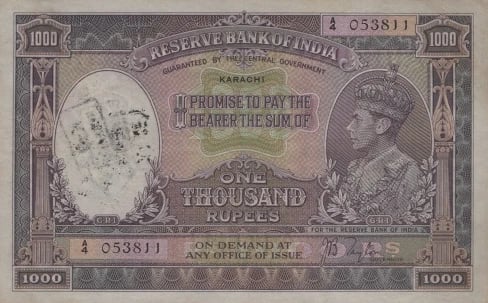
Demonetisation, the official process of stripping a banknote of its legal tender status, has been one of the most dramatic tools in India’s economic and political history. It has been employed only three times—in 1946, 1978, and 2016—yet each instance reshaped the country’s monetary landscape, printed currency, administrative structures, and even public psychology. Although demonetisation is popularly remembered through the 2016 event, the earlier withdrawals in 1946 and 1978 were equally significant in shaping India’s financial governance. For numismatists, the first two demonetisations helped define the surviving landscape of India’s rare high-value currency, including the uniface British India issues, the King George V and VI notes, and the early Ashoka Pillar denominations of the post-Independence era.
This article narrates the complete historical, legislative, and numismatic journey of India’s three demonetisations, weaving together the political motivations, the administrative frameworks, the economic impacts, and the cataloged banknote varieties that make these events central to Indian banknote history.
1946: First Demonetisation of Indian Banknotes
India’s first demonetisation occurred in January 1946, during the final years of British rule. The Second World War had left behind a complex financial environment. War profiteering, speculative commodity dealings, smuggling activities, and illicit currency hoarding had become widespread. High-denomination British India notes— 500 Rupees, 1000 Rupees, and 10000 Rupees—were used almost exclusively by wealthy traders, bullion dealers, princely state treasuries, and members of the colonial administrative elite. These notes rarely circulated among the general public, which relied primarily on lower denominations such as 1 Rupee, 2 Rupees, 5 Rupees, and 10 Rupees.
The Government of India, concerned about unaccounted wealth accumulated during wartime, concluded that demonetisation would force disclosure and reduce hoarding. To prevent last-minute concealment of high-value notes, the government issued two connected ordinances. The first was the Bank Notes (Declaration of Holdings) Ordinance, 1946, which required all banks, treasuries, post offices, and public offices to report their holdings of high-denomination notes as of 11 January 1946. This measure ensured that large institutional holders could not manipulate their inventories or redistribute currency in a way that would interfere with the government’s objectives.
The second ordinance—the High Denomination Bank Notes (Demonetisation) Ordinance, 1946 —came into effect on 12 January 1946, declaring that all ₹500, ₹1000, and ₹10000 notes would cease to be legal tender on the same day. Holders were initially permitted to exchange these notes until 9 February 1946; however, the deadline was extended multiple times as administrative burdens became apparent.
Despite the extraordinary nature of the measure, the volume of notes that returned to the banking system was remarkably high. Out of a total circulation of 143.97 crore Rupees in high-value notes, 134.90 crore Rupees were exchanged, leaving 9.07 crore Rupees unreturned. This meant that more than ninety-three percent of all high-value notes in circulation were eventually surrendered. The relatively orderly return of notes suggested either that illicit wealth was not as widespread as feared, or that holders found ways to regularise or launder their holdings during the exchange window.
From a numismatic standpoint, the 1946 demonetisation marks the beginning of India’s modern demonetisation history. It removed from circulation some of the most visually striking and historically significant British India notes. The uniface series, for example, included 500 Rupees notes cataloged as Banknote Book (BNB) B125 and B126 and listed in the Pick catalog as PA18 and PA18A. The uniface 1000 Rupees notes, B127 and B128 (Pick PA19 and PA19A), and the uniface 10000 Rupees note, B129 (Pick PA20), represent some of the most elusive high-denomination Indian notes ever printed.
Equally significant were the King George V issues. The 1000 Rupees note cataloged as BNB B146 and Pick P12, along with the 10000 Rupees note cataloged as BNB B147 and Pick P13, were withdrawn on the same date. The King George VI high-value notes withdrawn in 1946 also include the 1000 Rupees note listed as BNB B205 (Pick P21) and the 10000 Rupees note listed as BNB B206 (Pick P22). Many of these notes are now museum-grade pieces, with few surviving examples available to collectors.
Although the 1946 demonetisation had limited impact on the general public, it occupies a crucial place in India’s monetary history. It demonstrated the state’s authority to declare notes invalid and established a precedent for future currency reforms.
1978: Second Demonetisation of Indian Banknotes
The second demonetisation of India came more than three decades later, on 16 January 1978. Post-Independence India had transitioned through significant political and economic upheaval, including the 1971 Indo-Pakistan War, the declaration of the Emergency (1975–77), and the subsequent political shift when the Janata Party came to power in 1977.
High-denomination notes of ₹1000, ₹5000, and ₹10000—part of the Ashoka Pillar series—had been in circulation since 1954. These notes were seldom used by ordinary citizens and were associated primarily with high-value cash transactions in gold, real estate, export-import trading, and black-market operations. The new government argued that such notes facilitated illegal transfers and concealed wealth, and thus were harmful to the national economy.
To address these concerns, the Government of India issued the High Denomination Bank Notes (Demonetisation) Ordinance, 1978, which was later replaced by the High Denomination Bank Notes (Demonetisation) Act, 1978, enacted on 30 March 1978. The Ordinance declared that after the expiry of 16 January 1978, all high-value notes would cease to be legal tender. The Act also introduced penalties for holding or transferring demonetised notes after the cut-off date unless such possession fell within specific exemptions.
The government justified the move through the preamble of the 1978 Act, which claimed that high-denomination notes facilitated illicit transfers of money used for transactions harmful to the national economy. The Act, therefore, presented demonetisation as a step in the public interest.
The administrative process of returning and exchanging withdrawn notes was well controlled as only a small segment of society used these high denominations, and thus the general public experienced little disruption. Eventually, ninety-three percent of all withdrawn notes were returned to the banking system.
For numismatists, the 1978 demonetisation is remarkable because it terminated several high-value Ashoka Pillar notes that are now prized in advanced collections. The withdrawn ₹1000 notes included the 1954 issue cataloged as BNB B227 (Pick P46), the P47a-e varieties cataloged as BNB B228, the P47f variety cataloged as BNB B229 introduced in 1964, and the 1975 issue cataloged as BNB B230 (Pick P65). The ₹5000 notes withdrawn included the 1954 series cataloged as BNB B231 (Pick P48) and the 1960 series cataloged as BNB B232 (Pick P49). Among the most impressive of all was the ₹10000 denomination, represented by BNB B233 (Pick P50) and BNB B234 (Pick P50A).
Although the demonetisation itself passed smoothly, its constitutional validity was challenged. Petitioners claimed that the Act violated the Fundamental Right to property as guaranteed under the Constitution at that time. The Supreme Court rejected the challenge and upheld the validity of the demonetisation, affirming Parliament’s authority to enact such measures in the public interest.
Interestingly, although 1000 Rupee notes were withdrawn in 1978, they would return two decades later. An amendment in 1998 paved the way for the reintroduction of the 1000 Rupee note in 2000, setting the stage for what would later be withdrawn again in 2016.
2016: Third Demonetisation of Indian Banknotes
The demonetisation of 8 November 2016 was the most dramatic, far-reaching, and controversial monetary event in independent India. Unlike the earlier demonetisations that affected only high denominations used by a narrow section of society, the 2016 initiative impacted the entire country, affecting day-to-day cash-dependent living for hundreds of millions of citizens.
On 8 November 2016, Narendra Modi, the Prime Minister of India announced that, beginning at midnight, all ₹500 and ₹1000 notes of the Mahatma Gandhi Series would cease to be legal tender. These two denominations constituted 86.9 percent of India’s total currency in circulation, amounting to ₹15.44 trillion.
The government declared that the objectives of the demonetisation were to eliminate black money, reduce counterfeit currency, curtail terror financing, and promote a transition toward a digital economy. Unlike in 1978, the government did not pass a dedicated demonetisation act. Instead, the withdrawal was executed using Section 26(2) of the Reserve Bank of India Act, 1934, which allows the central government to declare any series of banknotes invalid based on the recommendation of the RBI Central Board.
Preparations for the new currency began months before the announcement. In May 2016, printing processes were initiated, and by August that year, the design for the new ₹2000 note was finalized. The new ₹500 note, introduced as part of the Mahatma Gandhi New Series, was also prepared in advance, although widespread distribution took time, resulting in significant cash shortages.
Exchanging the demonetised notes became a national challenge. Long queues formed outside banks and ATMs, withdrawal limits were imposed, and ATM recalibration delayed access to smaller denominations. Deposits were permitted until 30 December 2016, with additional scrutiny for deposits exceeding certain thresholds. On 28 December, the government issued the Specified Bank Notes (Cessation of Liabilities) Ordinance, 2016, which officially ended the government’s liability for the withdrawn notes. This ordinance became law through the Specified Bank Notes (Cessation of Liabilities) Act, 2017, notified on 1 March 2017.
The demonetisation was challenged in the Supreme Court on grounds of excessive delegation of power and inadequate parliamentary oversight. In January 2023, a five-judge constitutional bench delivered a 4:1 majority ruling upholding the validity of the 2016 demonetisation. The judgment confirmed that the government had the authority to initiate demonetisation via Section 26(2) and that the process did not violate constitutional principles.
For numismatists, the 2016 demonetisation marked the end of the original Mahatma Gandhi Series. Withdrawn ₹500 notes included the 1997 issue cataloged as BNB B276 (Pick P92), the 2000 issue cataloged as BNB B277 (Pick P93), the 2005 design revision cataloged as BNB B284 (Pick P99), the variant starting in 2011 cataloged as BNB B290 (Pick P106), and variant starting in 2015 cataloged as BNB B296 (Pick P106 later). Withdrawn ₹1000 notes included the early issue cataloged as BNB B278 (Pick P94), the major 2005 redesign cataloged as BNB B285 (Pick P100), the variant starting in 2011 cataloged as BNB B291 (Pick P107), and the variant starting in 2015 cataloged as BNB B297 (Pick P107 later).
The 2016 demonetisation permanently altered India’s banknote design system. It introduced a new generation of currency—the Mahatma Gandhi New Series—characterized by bold colours, new size dimensions, updated security features, and improved printing technology. The withdrawal of the old series closed an important chapter in modern Indian banknote history.
Conclusion
India’s demonetisation history spans colonial governance, post-Independence nation-building, and modern financial reform. The 1946 demonetisation reflected wartime pressures and British administrative strategies. The 1978 demonetisation was shaped by post-Emergency politics and concerns about illicit wealth. The 2016 demonetisation was a sweeping, publicly disruptive event tied to modern governance and digital transformation goals.
For numismatists, demonetisations create natural historical boundaries. The withdrawn high-value British India notes of 1946, the Ashoka Pillar high denominations of 1978, and the Mahatma Gandhi Series notes of 2016 form three distinct eras of collectible currency, each with its own cataloged varieties, printing peculiarities, and survival rates. Many of these notes, especially those of 1946 and 1978, are today museum-grade rarities whose value stems not only from their aesthetic and historical appeal but also from their abrupt removal from circulation.
As a subject of national memory, demonetisation remains controversial. Yet as a subject of numismatic scholarship, it provides one of the richest terrains for understanding India’s evolving monetary design, legislative power, and financial history. Across the three demonetisation events, nearly every high denomination ever issued—₹500, ₹1000, ₹5000, and ₹10000—was withdrawn at least once. These episodes have shaped the trajectory of India’s currency and produced some of the most compelling and sought-after notes in the Indian numismatic record.
Frequently Asked Questions
Q: How many times has India carried out demonetisation of its paper money?
A: India has implemented demonetisation three times: first in 1946, when ₹500, ₹1000 and ₹10000 British India notes were withdrawn; again in 1978, with the removal of ₹1000, ₹5000 and ₹10000 Ashoka Pillar notes; and most recently in 2016, when the ₹500 and ₹1000 original Mahatma Gandhi Series notes were declared invalid.
Q: Why were high-denomination notes targeted in the 1946 and 1978 demonetisations?
A: In both 1946 and 1978, the government believed that high-value notes were used mainly for hoarding, black-market activity, and tax evasion. These denominations circulated primarily among traders, bullion merchants, and large financial institutions, making them the focus of anti–black money measures.
Q: What was the legal basis for the 2016 demonetisation?
A: Unlike the 1946 and 1978 demonetisations, which relied on special ordinances and an Act of Parliament, the 2016 measure was carried out under Section 26(2) of the Reserve Bank of India Act, 1934, allowing the government to declare any series of banknotes invalid on the recommendation of the RBI Central Board.