
King George V Burma Overprint Banknotes: Types & Prefixes
Discover 1937 King George V Burma overprint banknotes on British India notes - 5, 10, and 100 Rupee issues, prefixes, varieties, rarity, and collecting tips.
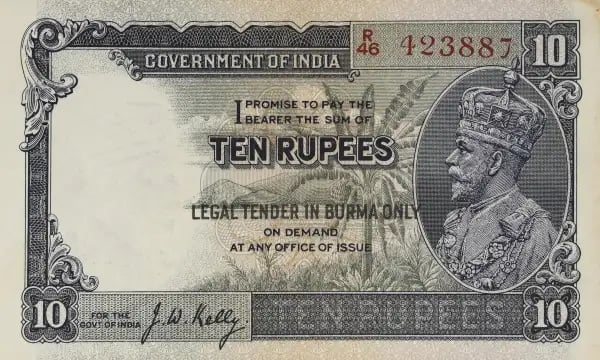
The King George V Burma overprint banknotes were provisional issues introduced in 1937 after Burma separated from British India under the Government of India Act 1935. Since Burma did not yet have its own dedicated currency, existing British India banknotes featuring King George V were overprinted with the phrase “LEGAL TENDER IN BURMA ONLY” for exclusive circulation within Burma. These overprinted notes were issued by the Government of India and used temporarily until new Burma-specific banknotes could be produced.
The overprints appeared on 5 Rupees, 10 Rupees, and 100 Rupees banknotes, with both black and red overprint varieties known. Each denomination was issued within specific prefix ranges, which today play an important role in authentication and counterfeit detection. Although some references mention a 1000 Rupees Burma overprint, no officially issued examples are known, and all recorded pieces are considered forgeries.
Today, King George V Burma overprint banknotes are among the most collectible British Burma banknotes and provisional issues of British India. Their short period of circulation, historical significance, distinct overprint varieties, and scarcity have made them highly desirable among collectors of rare Indian paper money, British Commonwealth banknotes, and Southeast Asian currency. This guide explores the history, types, prefixes, varieties, rarity, and known counterfeits of the 1937 Burma overprint issues.
Burma’s Separation from British India
Before 1937, Burma was administered as part of British India and used the same monetary system as the rest of the Indian Empire. British India banknotes circulated widely throughout Burma, including uniface issues and later banknotes featuring King George V. These notes were issued under the authority of the Government of India and remained legal tender across both India and Burma for decades.
During the early twentieth century, growing Burmese nationalist movements increasingly demanded greater political and administrative autonomy. Many Burmese leaders opposed Burma being governed as a province of British India, while economic and social tensions further strengthened calls for separation. These developments eventually led the British government to reorganize the administration of the region.
Government of India Act 1935
The formal separation of Burma from British India was implemented under the Government of India Act 1935, one of the most significant constitutional reforms introduced by the British Empire in Asia. Under this act, Burma officially became a separately administered British colony on 1 April 1937.
The separation immediately created monetary and financial challenges. Burma had always relied on British India currency, banking systems, and note-issuing infrastructure. Designing, approving, printing, and distributing an entirely new currency for British Burma would take considerable time. Until dedicated Burma banknotes could be produced, the colonial administration required a temporary monetary solution that would allow the Burmese economy to continue functioning smoothly.
Burma Monetary Arrangements Order 1937
To address this transition, the British authorities introduced the Burma Monetary Arrangements Order 1937. Rather than immediately replacing all existing currency, the Government of India continued using King George V British India banknotes but overprinted them with the phrase “LEGAL TENDER IN BURMA ONLY.”
These overprints transformed ordinary British India banknotes into provisional Burma issues that could circulate exclusively within Burma. The overprinted notes were not legal tender in India and were intended solely for use within British Burma during the transitional period.
This temporary measure allowed the authorities to maintain financial stability while new Burma-specific banknotes were being designed and prepared for production. It also minimized public confusion, since people in Burma were already familiar with the existing King George V Indian banknotes being used in daily transactions.
The provisional overprints remained in circulation until they were gradually replaced by the King George VI Peacock Series, the first regular banknotes specifically issued for Burma rather than adapted from British India currency.
1937 Provisional Burma Overprint Issues
Following Burma’s separation from British India in 1937, the Government of India introduced a temporary series of overprinted banknotes for exclusive use within British Burma. Since dedicated Burma banknotes were not yet ready for production, existing King George V British India notes held by the Rangoon Currency Department were overprinted with the phrase “LEGAL TENDER IN BURMA ONLY.” These provisional issues allowed Burma to continue using familiar British India currency during the transition to a separate monetary system.
The phrase “LEGAL TENDER IN BURMA ONLY” restricted the circulation of the overprinted notes to British Burma following its separation from British India in 1937. Although issued by the Government of India, these overprinted banknotes could no longer be legally used within India and were intended exclusively for circulation within Burma during the transitional monetary period.
The overprints were applied to KGV India 5 Rupees, 10 Rupees, and 100 Rupees banknotes. All notes retained their original British India designs, signatures, watermarks, and serial numbering systems, with the overprint serving as the distinguishing feature restricting their use to Burma.
Why Overprinted Notes Were Needed
The overprints allowed Burma to continue using familiar British India banknotes while establishing a separate monetary system after the 1937 separation. By using familiar British India banknotes already available at the Rangoon Currency Department, the colonial administration ensured a smooth financial transition without disrupting trade, banking, or daily commerce within Burma.
These provisional issues remained in circulation until they were gradually replaced by the King George VI Peacock Series, the first regular banknotes specifically issued for Burma.
Black Overprints
The earliest provisional issues were overprinted in black ink. The phrase “LEGAL TENDER IN BURMA ONLY” was applied to both the front and back of the banknotes, although the exact placement varied by denomination.
On the 5 Rupees and 10 Rupees notes, the black overprint was positioned near the center of the front design below the denomination. For the 100 Rupees note, the overprint appeared below the issuing circle “Rangoon.”
On the reverse side, the 5 Rupees and 100 Rupees notes displayed the overprint at the lower center, while the 10 Rupees note carried the overprint at the upper center.
Although effective, the black overprint often blended into the intricate printed designs of the banknotes, making it difficult to identify quickly in circulation.
Red Overprints
To improve visibility, a second overprint type was later introduced using red ink. Unlike the earlier black overprints placed within the main design area, the red overprints were positioned prominently in the upper margins on both the front and back of the banknotes.
The brighter color and clearer placement made the territorial restriction much easier to recognize. These red overprint varieties are among the most visually distinctive Burma provisional issues and remain especially popular among collectors today.
KGV 5 Rupees Burma Overprint
The King George V 5 Rupees Burma overprint banknote was the lowest denomination issued as part of the 1937 provisional Burma currency series. These notes were overprinted with “LEGAL TENDER IN BURMA ONLY” and adapted from the British India 1935 issue 5 Rupees banknotes bearing the signature of J.W. Kelly.
The note measures 127 × 73 mm and was printed by the India Security Press. Its color scheme consists of brown, violet, orange, and green. The obverse features a portrait of King George V facing left, while the reverse contains a multilingual language panel, including Burmese text. The watermark consists of the Star of India and “5 GOVERNMENT OF INDIA 5.” Like other British India issues of the period, the note does not contain a security thread.
Black Overprint Variety
The first Burma overprint variety for the 5 Rupees denomination used black ink. On the front, the overprint “LEGAL TENDER IN BURMA ONLY” was positioned near the center below the denomination. On the reverse, the overprint appeared at the lower center within the design.
The black overprint variety was issued with prefixes S/88 serial numbers 200001 to 1000000, S/89, and S/90.
This variety is cataloged as Banknote Book B101a and Standard Catalog of World Paper Money (Pick) 1b.
Red Overprint Variety
A second variety was later introduced using a red overprint placed prominently in the upper margins on both the front and back of the note.
The red overprint variety was issued with prefixes T/18, T/19, T/20, T/21, and T/22.
This variety is cataloged as Banknote Book B101b and Standard Catalog of World Paper Money (Pick) 1a.
Collectors should note that the Standard Catalog of World Paper Money reversed the numbering order of the black and red overprint varieties, while the Banknote Book numbering follows the actual chronological order of issue, with the black overprint introduced first.
KGV 10 Rupees Burma Overprint
The King George V 10 Rupees Burma overprint banknote was issued as part of the 1937 provisional currency series created following Burma’s separation from British India. Like the 5 Rupees and 100 Rupees denominations, these notes were overprinted with “LEGAL TENDER IN BURMA ONLY” for exclusive circulation within British Burma.
The 10 Rupees note was adapted from the British India 1935 issue bearing the signature of J.W. Kelly. It measures 133 × 79 mm and was printed by the India Security Press. The note is predominantly blue, violet, and olive green in color. The obverse features King George V facing left together with a palm tree design, while the reverse depicts elephants with mahouts alongside a multilingual language panel containing Burmese text. The watermark consists of King George V and “TEN RUPEES GOVERNMENT OF INDIA.” Like the other Burma provisional issues, the note was printed on paper without a security thread.
Black Overprint Variety
The earliest 10 Rupees Burma overprint notes used a black overprint. On the front, the phrase “LEGAL TENDER IN BURMA ONLY” was positioned near the center below the denomination. On the reverse, the overprint appeared below the title “GOVERNMENT OF INDIA” within the main design.
The black overprint variety was issued with prefixes R/42, R/43, R/44, R/45, R/46, R/47, R/48, and R/49.
This variety is cataloged as Banknote Book B102a and Standard Catalog of World Paper Money (Pick) 2b.
Red Overprint Variety
A later variety introduced a red overprint positioned prominently in the upper margins on both the front and back of the banknote.
The red overprint variety was issued with prefixes R/82, R/83, R/84, R/85, R/86, R/87, R/88, and R/89.
This variety is cataloged as Banknote Book B102b and Standard Catalog of World Paper Money (Pick) 2a.
As with the 5 Rupees issue, the Standard Catalog of World Paper Money reversed the numbering order of the black and red overprint varieties.
KGV 100 Rupees Burma Overprint
The King George V 100 Rupees Burma overprint banknote was the highest denomination officially issued as part of the 1937 provisional Burma currency series. These notes were overprinted with “LEGAL TENDER IN BURMA ONLY” for circulation exclusively within British Burma following its separation from British India.
The 100 Rupees denomination was adapted from the British India Rangoon Circle issue bearing the signature of J.W. Kelly. Unlike the 5 Rupees and 10 Rupees notes, the 100 Rupees banknote already carried the issuing circle “Rangoon” on the obverse, reflecting its connection to Burma even before the 1937 separation.
The note measures 172 × 108 mm and was printed by the India Security Press. Its color scheme consists primarily of violet and green. The obverse features King George V facing left together with the Rangoon issuing circle, while the reverse contains a multilingual language panel including Burmese text. The watermark consists of King George V and “GOVERNMENT OF INDIA.” Like the lower denominations, the note was printed on paper without a security thread.
Black Overprint Variety
The earliest 100 Rupees Burma overprint notes used a black overprint. On the front, the phrase “LEGAL TENDER IN BURMA ONLY” was positioned below the issuing circle “Rangoon.” On the reverse, the overprint appeared at the lower center.
The black overprint variety was issued with prefix T/32 serial numbers 700001 to 1000000 and T/41 serial numbers 000001 to 100000.
This variety is cataloged as Banknote Book B103a and Standard Catalog of World Paper Money (Pick) 3b.
Red Overprint Variety
A later variety introduced a red overprint placed prominently in the upper margins on both the front and back of the banknote.
The red overprint variety was issued with prefix T/41 serial numbers 100001 to 1000000 and T/47 serial numbers 000001 to 606000.
This variety is cataloged as Banknote Book B103b and Standard Catalog of World Paper Money (Pick) 3a.
As with the lower denominations, the Standard Catalog of World Paper Money reversed the numbering order of the black and red overprint varieties.
The 100 Rupees Burma overprint is especially significant among collectors due to its large format, Rangoon Circle connection, and historical association with wartime Burma. Surviving examples are scarce as they were destroyed during World War II and the Japanese occupation of Burma. Some surviving notes were later cut into quarters, which are today collected as the famous British Burma King George V 100 Rupee Quarter Cut Note.
KGV 1000 Rupees Burma Overprint
No officially issued King George V 1000 Rupees Burma overprint has been confirmed through archival records or contemporary official documentation. Unlike the 5 Rupees, 10 Rupees, and 100 Rupees denominations, the 1000 Rupees issue was not listed in The Coins and Banknotes of Burma by Michael Robinson and L.A. Shaw published in 1980, nor was it included in the 2000 edition of The Standard Reference Guide to Indian Paper Money by Kishore Jhunjhunwalla. The Standard Catalog of World Paper Money (Pick) also does not list a 1000 Rupees Burma overprint.
However, a 1000 Rupees Burma overprint was later illustrated in the 2012 revised edition of The Standard Reference Guide to Indian Paper Money by Kishore Jhunjhunwalla and Rezwan Razack. The illustrated note is one of approximately ten examples that appeared in the market around the mid-2000s. The note was subsequently listed in the Banknote Book as B104 with the description “Crude red stamped.”
The known examples differ significantly from the officially issued Burma provisional overprints. The red overprints appear crude in style, and their placement does not match the genuine red overprints used on the 5 Rupees, 10 Rupees, and 100 Rupees notes. On the known examples, the reverse overprint is positioned below the title “GOVERNMENT OF INDIA” within the main design rather than in the upper margin used on genuine red overprint varieties. In addition, an extra red ink mark appears below the text “LEGAL TENDER IN BURMA ONLY” on the reverse, a feature not seen on officially issued Burma overprints.
Most researchers and advanced collectors consider these 1000 Rupees overprints to be contemporary forgeries. Under 20× magnification, the red overprints show noticeable differences in style and execution compared to the officially issued Burma overprints.
Counterfeit Burma Overprint Notes
Counterfeit Burma overprint banknotes are well known within the numismatic market and remain one of the most important areas of study for collectors of British Burma and British India paper money. Forged overprints exist for the 5 Rupees, 10 Rupees, and 100 Rupees denominations, with both contemporary and modern counterfeits known. Because genuine Burma overprints command substantial premiums over ordinary British India notes, counterfeit overprints have appeared in the market for decades.
Contemporary Overprint Forgeries
Contemporary forgeries were produced during the period when the Burma provisional issues circulated in British Burma. Their purpose was primarily commercial, allowing ordinary British India notes to be passed within Burma as legal tender after the 1937 separation.
Some contemporary forgeries are crude and easily distinguishable, while others were produced with greater care. In many cases, counterfeiters attempted to imitate the official overprint font and placement, but differences in ink quality, spacing, alignment, and sharpness often reveal the overprints to be unofficial.
These contemporary counterfeits are themselves now part of Burma numismatic history and are occasionally collected as collateral material alongside genuine overprint issues.
Modern Collector-Market Forgeries
A second wave of counterfeit Burma overprints appeared during the 1980s and early 1990s as interest in Indian paper money and British Burma banknotes increased internationally.
During this period, ordinary British India King George V notes without overprints traded at substantially lower prices than genuine Burma overprint notes. This large price difference created strong incentives for counterfeiters to apply fake “LEGAL TENDER IN BURMA ONLY” overprints to ordinary British India banknotes.
At the time, detailed information regarding genuine prefix ranges and overprint characteristics was also not widely available, allowing many forged notes to enter the collector market.
J.B. Taylor Signature Counterfeits
One of the clearest indicators of a counterfeit Burma overprint is the signature. Official Burma provisional overprints were issued only on notes bearing the signature of J.W. Kelly.
Overprinted 5 Rupees and 10 Rupees notes with the signature of J.B. Taylor are known in the market and are considered counterfeit overprints. These notes were created by applying fake Burma overprints to later British India issues that were never officially used for the Burma provisional series.
Because many collectors focus primarily on the overprint itself, signature verification is often overlooked. However, checking the signature remains one of the simplest and most reliable methods of identifying counterfeit Burma overprints.
Prefix Authentication
Authentic Burma provisional overprints were issued only within specific prefix ranges. Prefix verification therefore remains one of the most important methods of authentication.
Collectors should be cautious of notes bearing prefixes outside the known official ranges for each denomination and overprint type. Many counterfeit notes were produced using ordinary British India banknotes with unrelated prefixes, making prefix analysis essential when examining Burma overprint issues.
Detecting Fake Overprints
Collectors examining Burma overprint banknotes should carefully study the style, placement, and quality of the overprint itself. Genuine overprints display consistent font characteristics, alignment, and ink application across known authentic examples.
Counterfeit overprints often show irregular spacing, blurred lettering, uneven ink density, or incorrect placement. Many forged overprints also appear noticeably slanted compared to the straight alignment seen on genuine Burma overprints. Under magnification, differences in printing quality and ink structure become even more apparent.
Prefix verification also remains one of the most important methods of authentication, as genuine Burma provisional overprints were issued only within specific known prefix ranges.
Collecting King George V Burma Overprints
King George V Burma overprint banknotes are among the most historically important provisional issues of British India and colonial Southeast Asian paper money. Issued during Burma’s transition following its separation from British India in 1937, these notes were used only for a short period before being replaced by the King George VI Peacock Series. Their temporary nature, combined with their distinctive “LEGAL TENDER IN BURMA ONLY” overprints, has made them highly desirable among collectors of British India, British Burma, and rare world banknotes.
The series is also closely associated with the turmoil of the Second World War. Large quantities of banknotes were lost, damaged, or destroyed during the Japanese occupation of Burma and the wartime disruptions that followed. As a result, surviving examples are scarce today, particularly in higher grades and original condition. These historical circumstances have contributed significantly to the reputation of the Burma overprints as desirable rare world paper money issues.
Black vs Red Overprints
Collectors generally divide the series into black overprint and red overprint varieties. The black overprints were introduced first but were later replaced by the more visible red overprints positioned in the upper margins.
Many collectors attempt to assemble a complete six-note set consisting of:
5 Rupees black overprint
5 Rupees red overprint
10 Rupees black overprint
10 Rupees red overprint
100 Rupees black overprint
100 Rupees red overprint
Among the six major varieties, the 10 Rupees black overprint is generally considered the most affordable entry point for collectors. In contrast, the 5 Rupees black overprint is regarded as one of the rarest low denomination King George V Indian paper money issues, as it was issued only within the limited S/88, S/89, and S/90 prefix ranges.
Condition and Rarity
Condition plays a major role in determining the value of Burma overprint banknotes. Many surviving examples show heavy circulation, repairs, stains, folds, rust, or damage associated with Burma’s tropical climate and wartime conditions.
The 100 Rupees black overprints are especially difficult to obtain in higher grades due to their large size and relatively low survival rate. Original examples are highly sought after by advanced collectors.
Even lower denomination notes can be extremely difficult to locate in original condition. Because the overprints were issued only as a temporary measure during a brief transitional period, all genuine Burma provisional issues are considered scarce today compared to ordinary British India circulation notes.
Frequently Asked Questions
Why were King George V banknotes overprinted for Burma?
King George V British India banknotes were overprinted with “LEGAL TENDER IN BURMA ONLY” after Burma separated from British India on 1 April 1937 under the Government of India Act 1935. The overprints served as a temporary monetary solution while dedicated Burma banknotes were being designed and produced.
What denominations were officially overprinted for Burma?
The officially issued Burma provisional overprints were applied to 5 Rupees, 10 Rupees, and 100 Rupees King George V banknotes issued by the Government of India.
Were 1000 Rupees Burma overprints officially issued?
No confirmed official records of a 1000 Rupees Burma overprint are currently known. Although examples have appeared in the market and were later illustrated in some references, most researchers and advanced collectors consider them contemporary forgeries due to differences in overprint style and placement.
What is the difference between black and red overprints?
The earliest Burma overprints were printed in black ink and positioned within the main design area of the banknotes. Because these were sometimes difficult to distinguish, later issues used red overprints placed prominently in the upper margins on both the front and back of the notes.
Which Burma overprint is the rarest?
Among the commonly collected denominations, the 5 Rupees black overprint is regarded as one of the rarest low denomination King George V Indian paper money issues due to its limited prefix ranges. High-grade 100 Rupees overprints are also extremely scarce.
How can collectors identify genuine Burma overprints?
Collectors typically authenticate Burma overprints by examining the prefix ranges, signature, overprint placement, font style, and ink characteristics. Genuine notes were issued only within specific known prefixes and display consistent overprint alignment and printing quality.
Are Burma overprint banknotes commonly counterfeited?
Yes. Counterfeit overprints exist for the 5 Rupees, 10 Rupees, and 100 Rupees denominations. Both contemporary counterfeits and modern collector-market forgeries are known.
Why are Burma overprint notes important to collectors?
The Burma provisional overprints represent a unique transitional period in Southeast Asian monetary history following Burma’s separation from British India. Their short period of use, wartime history, scarcity, and distinctive overprints have made them highly collectible among collectors of British India, British Burma, and rare world paper money.
What replaced the Burma provisional overprints?
The provisional overprints were later replaced by the King George VI Peacock Series, the first regular banknotes specifically issued for Burma rather than adapted from British India notes.
Conclusion
The King George V Burma overprint banknotes represent one of the most fascinating provisional issues of British India and colonial Southeast Asian paper money. Introduced in 1937 following Burma’s separation from British India, these notes served as a temporary monetary solution while dedicated Burma banknotes were being prepared. By overprinting existing British India notes with “LEGAL TENDER IN BURMA ONLY,” the colonial administration created a distinct currency for Burma during an important transitional period in its monetary history.
Today, the 5 Rupees, 10 Rupees, and 100 Rupees overprints are highly regarded among collectors of British India, British Burma, and rare world banknotes. Their historical importance, limited period of issuance, wartime association, and numerous counterfeit overprints have made them an important area of study within numismatics. The series also remains closely connected to later Burma currency issues, including the King George VI Peacock Series that replaced the provisional overprints, as well as the later Military Administration of Burma and Burma Currency Board overprint issues introduced during and after the Second World War.
Whether collected for their historical significance, rarity, overprint varieties, or connection to Burma’s evolving monetary system, the King George V Burma overprints remain among the most iconic provisional banknotes of the British colonial era.