
British Burma King George V 100 Rupee Quarter Cut Note
Learn about the British Burma King George V 100 Rupee quarter cut note, accounting purpose, Japanese chop marks, wartime history, and collector significance.
IndiaBanknotes.com Editorial Team
13 min read
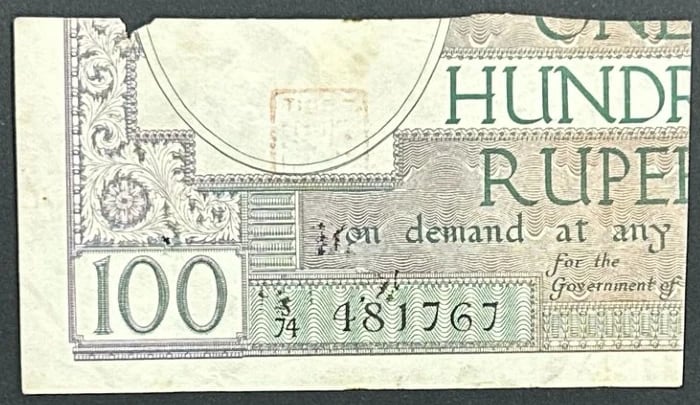
The British Burma King George V 100 Rupee quarter cut note is one of the most unusual and historically significant remnants of colonial paper money from South Asia. These surviving fragments, usually consisting of the lower-left quarter of a 100 Rupee banknote, were not emergency currency or circulating fractional notes as once believed. Instead, they were accounting remnants retained by the British administration after high denomination banknotes were officially canceled, redeemed, or destroyed. Many surviving examples are associated with wartime Burma and some bear rare Japanese chop marks applied during the Japanese occupation of Burma in World War II.
The original 100 Rupee notes were issued for British India and Burma under the Government of India and included the important Rangoon Circle issues used extensively within Burma before and after the 1937 separation from British India. Later examples also originated from the provisional Burma overprint issues carrying the “LEGAL TENDER IN BURMA ONLY” overprint.
For decades, the function of these quarter cut fragments remained uncertain. Some collectors believed they circulated as emergency wartime money or unofficial fractional currency during the collapse of British administration in Burma. Later archival research and treasury records, however, demonstrated that the pieces were retained primarily as financial verification records after the remainder of the banknote had been destroyed.
Today, British Burma quarter cut notes are highly prized among collectors of British India, British Burma, wartime currency, and rare world banknotes. Their unusual appearance, historical mystery, overprint varieties, and wartime associations make them among the most fascinating surviving artifacts of colonial Asian numismatics.
What Is a British Burma 100 Rupee Quarter Cut Note?
A British Burma 100 Rupee quarter cut note is a surviving fragment of a King George V 100 Rupee banknote originally issued for British India or British Burma. In all known examples, only the lower-left quarter of the banknote survives, preserving the serial number and key identifying portions of the original design. These fragments were created as part of official accounting and cancellation procedures rather than for circulation as currency.
For many years, collectors and dealers debated the purpose of these unusual note fragments. Some believed they were emergency wartime issues used as fractional currency during shortages in Burma after the Japanese invasion in 1942. Others thought they represented unofficial local issues or temporary “25 Rupee” notes created during the collapse of the colonial monetary system.
Modern research into Reserve Bank of India records and British administrative procedures has clarified their true purpose. When high denomination notes such as the 100 Rupees, 1000 Rupees, and 10000 Rupees were officially redeemed, canceled, or withdrawn, the British authorities often destroyed most of the banknote while retaining the serial number section for accounting verification and audit purposes. This explains why the surviving quarter pieces almost always preserve the same portion of the original note.
Many surviving fragments originated from Rangoon Circle King George V 100 Rupee notes issued for circulation in Burma before the 1937 monetary separation. Later examples are also known from the provisional Burma overprint issues carrying the “LEGAL TENDER IN BURMA ONLY” overprint.
Some quarter cut notes also bear Japanese chop marks applied during the occupation of Burma in World War II. Together with treasury stamps, overprint remnants, and surviving serial numbers, these markings provide valuable evidence of the financial and administrative upheaval that accompanied the wartime collapse of British rule in Burma.
Burma and British India Before 1937
Before 1937, Burma formed part of British India and shared the same monetary and banking system used throughout the Indian Empire. Banknotes issued under the authority of the Government of India circulated widely across Burma, including in Rangoon, Mandalay, and other important commercial centers.
Among the most important large denomination issues used in Burma was the King George V 100 Rupee note. Unlike lower denomination British India notes, the King George V 100 Rupees denomination identified its issuing authority through regional issuing circles rather than just the standard “Government of India” heading found at the top center of Indian banknotes. One of these issuing circles was Rangoon, reflecting Burma’s importance within the British India financial system.
Rangoon Circle 100 Rupee Notes
The Rangoon Circle King George V 100 Rupees notes are especially significant to collectors of British Burma paper money because they were specifically issued for circulation within Burma before the monetary separation of 1937.
Collectors today recognize five varieties of the Rangoon Circle King George V 100 Rupees note. The earliest H. Denning signature issues exist in three forms: a black “Rangoon” circle variety, a small green “Rangoon” circle variety, and a large green “Rangoon” circle variety. Later issues signed by J.B. Taylor retained the large green “Rangoon” circle design. The final Rangoon Circle variety bears the signature of J.W. Kelly and also features the large green “Rangoon” circle.
These differences in typography, ink color, and signatures now serve as important classification features for collectors and researchers studying surviving full notes and quarter cut fragments.
Burma’s Monetary Separation
Burma officially separated from British India on 1 April 1937 under the Government of India Act 1935. Since Burma did not yet have its own dedicated currency, the colonial authorities temporarily continued using existing King George V Indian banknotes for circulation within Burma.
To distinguish these notes from ordinary British India currency, selected King George V 5 Rupees, 10 Rupees, and 100 Rupees notes were overprinted with the phrase “LEGAL TENDER IN BURMA ONLY.” These provisional issues later became known as the famous King George V Burma Overprint Banknotes.
The Burma overprint issues were eventually replaced by the RBI Burma Issue Banknotes – King George VI Peacock Series, the first regular banknotes specifically issued for Burma rather than adapted from British India currency.
Why Were the Notes Cut Into Quarters?
The appearance of quarter sections from King George V 100 Rupee banknotes long puzzled collectors and researchers. Because many surviving fragments originated from wartime Burma and occasionally carried Japanese chop marks or treasury stamps, early theories suggested that the pieces may have circulated as emergency currency or unofficial fractional notes during the disruptions of World War II.
Modern archival research has shown that these quarter cut notes served a very different purpose. They were not circulating currency and never represented “25 Rupee” denominations. Instead, they were accounting remnants retained by the British administration after high denomination banknotes had been officially redeemed, canceled, exchanged, or destroyed.
Reserve Bank Accounting Procedures
Under British Indian and colonial treasury procedures, large denomination banknotes required strict accounting controls when withdrawn from circulation. When notes such as the 100 Rupees, 1000 Rupees, and 10000 Rupees denominations were officially canceled, the entire note was not always destroyed immediately.
Instead, treasury officials often destroyed most of the banknote while preserving a section containing the serial number for accounting verification and audit purposes. Retaining part of the original note created a physical record confirming that the note had been withdrawn and processed correctly.
This accounting procedure explains the remarkable uniformity of surviving quarter cut notes, as virtually all known examples retain the same lower-left section of the original banknote.
Why the Lower-Left Quarter Was Retained
The lower-left section of the King George V 100 Rupee note contained several important identifying features, including the serial number and portions of the design necessary for treasury verification. By retaining this section, officials could maintain an accurate accounting record while ensuring that the remainder of the note could no longer circulate
An important feature of these quarter cut notes is that the other three sections of the original banknotes are never encountered in the numismatic market. This strongly supports the conclusion that the remaining portions were deliberately destroyed under official treasury procedures.
Quarter Notes and Burma Overprints
Quarter cut fragments are known from both ordinary Rangoon Circle 100 Rupee notes without overprint and later Burma overprint issues. Fragments from black overprint notes may display portions of the “LEGAL TENDER IN BURMA ONLY” overprint because the black text was positioned within the main design area of the note.
By contrast, quarter fragments from red overprint notes show no visible overprint text. This is because the red overprint was placed prominently in the upper margins of the original banknote, a section removed during the cutting process.
These differences in overprint placement now help collectors identify the original note type from which the surviving quarter fragment was derived.
World War II and Japanese Chop Marks
The history of the British Burma quarter cut notes became even more complex during World War II and the Japanese invasion of Burma in 1942. As the Imperial Japanese Army advanced rapidly through Burma, British colonial authorities faced a major financial and administrative crisis. Banks, treasury offices, and government departments were forced to evacuate or destroy sensitive financial materials before they could fall into Japanese hands.
To prevent large quantities of currency from being captured and potentially reused by the occupying forces, British officials ordered the destruction of paper money held in treasuries and financial institutions throughout Burma. Arthur Potter, the Financial Controller of Burma, instructed district officials to burn or shred banknotes and dispose of coins in rivers, wells, and other water bodies during the retreat from Burma.
Many King George V 100 Rupee notes were destroyed during these emergency wartime measures. However, some quarter cut fragments survived because they had already been separated and retained for accounting purposes before the destruction process took place. Others may have survived among abandoned treasury records, captured financial documents, or wartime collections removed during the evacuation.
Japanese Occupation of Burma
Following the British retreat, Burma came under Japanese occupation between 1942 and 1945. During this period, the Japanese military administration introduced its own occupation currency while also handling captured financial records, treasury assets, and surviving colonial banknotes.
Some surviving quarter cut notes from British Burma bear Japanese chop marks applied during the occupation period. These markings are usually found in red ink and remain one of the most intriguing features associated with the quarter note series.
Meaning of the Japanese Chop Marks
The precise purpose of the Japanese chop marks remains uncertain, but most researchers believe they were applied by Japanese administrative or military authorities after the occupation of Burma.
Several theories have been proposed regarding their function. The marks may have been used to identify captured treasury material, record processed financial documents, authenticate seized currency remnants, or classify accounting records inherited from the British administration. Unlike the original British treasury procedures behind the quarter cuts themselves, no surviving official Japanese records have yet fully explained the exact purpose of the chop marks.
Among collectors today, quarter cut notes bearing clear Japanese chop marks are especially desirable because of their direct connection to the occupation period. The combination of treasury handling, surviving serial numbers, overprint varieties, and wartime markings gives these pieces exceptional historical importance within British Burma numismatics.
Types and Varieties of Quarter Cut Notes
British Burma King George V 100 Rupee quarter cut notes exist in several distinct varieties depending on the original banknote type, overprint status, treasury markings, and wartime features. These differences allow collectors to classify surviving fragments and better understand the administrative and historical context in which they were created.
Although all known quarter cut notes preserve the lower-left section of the original banknote, the surviving details on each fragment can vary considerably. Factors such as issuing circle type, signature, overprint placement, treasury stamps, and Japanese chop marks all contribute to the identification and desirability of individual pieces.
Quarter Notes Without Burma Overprints
Some quarter cut notes originate from ordinary Rangoon Circle King George V 100 Rupees banknotes issued before Burma’s separation from British India in 1937. These fragments do not display the “LEGAL TENDER IN BURMA ONLY” overprint because the original notes themselves were never overprinted.
Examples are known from the J.B. Taylor and J.W. Kelly signature Rangoon Circle varieties. The easiest way to distinguish these non-overprint fragments from Burma overprint quarter notes is through the prefix ranges. Notes falling outside the known black and red overprint prefix ranges can generally be identified as ordinary Rangoon Circle issues rather than Burma overprint notes.
These non-overprint quarter notes are historically important because they represent the original British India currency system used in Burma before the introduction of the provisional Burma overprint issues.
Black Overprint Quarter Notes
Quarter cut notes from the black overprint series are among the easiest Burma overprint fragments to identify because portions of the overprint often remain visible on the reverse of the surviving fragment.
On genuine black overprint 100 Rupees notes, the phrase “LEGAL TENDER IN BURMA ONLY” was positioned within the main design area below the “Rangoon” issuing circle on the front and at the lower center on the reverse. Since the lower-left section of the note was retained during the accounting process, portions of the reverse overprint are preserved on surviving quarter fragments.
Authentic black overprint quarter notes are found within the known prefix ranges T/32 serial numbers 700001 to 1000000 and T/41 serial numbers 000001 to 100000.
Red Overprint Quarter Notes
Quarter cut notes from the red overprint series are more difficult to identify visually because the overprint itself is usually absent from the surviving fragment.
Unlike the black overprints, the red “LEGAL TENDER IN BURMA ONLY” text was positioned prominently in the upper margins of the original banknote. Since the upper portion of the note was destroyed during the cutting process, surviving lower-left quarter fragments show no visible red overprint.
As a result, identification depends primarily on the prefix range together with the surviving signature and design characteristics. Genuine red overprint quarter notes are known within prefix T/41 serial numbers 100001 to 1000000 and T/47 serial numbers 000001 to 606000.
Treasury Date Stamps
Many quarter cut notes display black treasury date stamps applied during the accounting or cancellation process. Examples with dates such as “31,” “34,” and “37” are known and are generally believed to represent treasury verification or cancellation dates.
These date stamps provide additional evidence that the fragments were retained as accounting records rather than circulating wartime currency. The placement, style, and clarity of the treasury stamps can vary significantly between surviving examples.
Japanese Chop Mark Varieties
The most sought-after quarter cut notes are usually those bearing Japanese wartime chop marks. These marks are generally found in red ink and were likely applied during the Japanese occupation of Burma between 1942 and 1945.
Collectors value these examples for their direct association with the wartime occupation period and the dramatic circumstances surrounding the collapse of British administration in Burma. Clear, well-preserved chop marks are considerably scarcer than ordinary unstamped fragments and often command significant premiums in the collector market.
Collecting British Burma Quarter Cut Notes
British Burma King George V 100 Rupee quarter cut notes occupy a unique place in South Asian numismatics. Their connection to British India, Burma’s monetary transition, World War II, and the Japanese occupation has made them highly sought after by collectors of British Burma currency, wartime banknotes, and rare world paper money.
Unlike ordinary banknotes, quarter cut notes were never intended to survive as collectible items. They originated as accounting remnants retained after high denomination notes had been officially canceled or destroyed. Their accidental survival through wartime Burma has given them a unique place within South Asian numismatics.
Rarity and Survival
Surviving quarter cut notes are scarce, particularly examples with clear overprints, treasury markings, or Japanese chop marks. Many fragments were likely destroyed during wartime evacuations, treasury clearances, or the chaotic conditions surrounding the Japanese invasion of Burma.
Because the quarter cut fragments preserve only a portion of the original banknote, condition standards differ somewhat from ordinary paper money collecting. Collectors typically focus more heavily on historical features, overprint visibility, treasury markings, chop marks, and overall preservation of the surviving fragment rather than complete note centering or aesthetic balance.
Authentication and Identification
Collectors generally authenticate quarter cut notes through a combination of prefix ranges, overprint characteristics, treasury markings, and wartime chop marks. The known prefix ranges for the black and red Burma overprint issues are especially important when identifying fragments derived from provisional Burma notes.
Fragments with clear provenance, visible overprint remnants, or well-preserved Japanese chop marks are especially desirable among collectors. Because each quarter cut note survives with different combinations of signatures, prefixes, treasury markings, and wartime features, no two examples are exactly alike. An original British Burma King George V 100 Rupee quarter cut note from our collection illustrates several of the characteristics discussed in this article, including wartime chop marks and treasury handling features.
Historical Importance
The British Burma quarter cut notes represent far more than damaged fragments of colonial currency. They provide direct physical evidence of British treasury accounting procedures, Burma’s separation from British India, wartime destruction policies, and the Japanese occupation of Burma during World War II.
For many collectors, the appeal of these quarter notes lies in the stories preserved within each fragment. Although only a small section of the original banknote survives, these pieces reflect a broader history of colonial administration, wartime destruction, monetary transition, and survival during one of the most dramatic periods in Burma’s modern history.
Frequently Asked Questions
Below are answers to some of the most common questions collectors ask about British Burma King George V 100 Rupee quarter cut notes.
What is a British Burma 100 Rupee quarter cut note?
A British Burma 100 Rupee quarter cut note is a surviving lower-left fragment of a King George V 100 Rupee banknote originally issued for British India or British Burma. These fragments were retained for accounting and treasury verification purposes after the remainder of the banknote had been destroyed.
Were quarter cut notes used as currency?
No. Although collectors once believed these fragments may have circulated as emergency wartime currency or unofficial “25 Rupee” notes, archival research has shown that they were accounting remnants and not legal tender.
Why were only the lower-left quarters preserved?
The lower-left section of the King George V 100 Rupee note contained the serial number and important identifying details. Retaining this section allowed treasury officials to maintain accounting records after the rest of the banknote had been canceled or destroyed.
Do all quarter cut notes have Burma overprints?
No. Some fragments originated from ordinary Rangoon Circle King George V 100 Rupees notes issued before Burma separated from British India in 1937, while others came from the later King George V Burma Overprint Banknotes issued with the “LEGAL TENDER IN BURMA ONLY” overprint.
What are Japanese chop marks on quarter cut notes?
Japanese chop marks are wartime markings believed to have been applied during the Japanese occupation of Burma between 1942 and 1945. Their exact purpose remains uncertain, but they are generally associated with wartime treasury or administrative handling.
Why are British Burma quarter cut notes important?
These fragments provide direct evidence of colonial treasury procedures, Burma’s monetary separation from British India, wartime destruction policies, and the Japanese occupation of Burma during World War II. They are considered among the most historically significant surviving remnants of British Burma paper money.
Conclusion
The British Burma King George V 100 Rupee quarter cut notes are among the most fascinating surviving remnants of colonial Asian paper money. What were once misunderstood as possible emergency issues or wartime fractional currency are now recognized as official accounting fragments preserved through British treasury procedures. Their survival provides a rare insight into the monetary administration of British India and Burma during a period marked by political separation, wartime destruction, and the collapse of colonial rule in Southeast Asia.
Today, these quarter cut notes are valued not only for their rarity, but also for the insight they provide into Burma’s complex monetary and wartime history. From the Rangoon Circle issues of British India to the later Burma overprint varieties, each piece reflects the administrative, political, and military upheavals that shaped Burma during the final decades of British rule. Examples bearing treasury stamps, overprint remnants, or Japanese chop marks are especially prized among collectors of British Burma currency and wartime paper money.
Although only a small portion of the original banknote survives, these quarter cut notes remain powerful historical artifacts linking British India, Burma, and one of the most turbulent periods in modern Asian monetary history.
See Also
Military Administration of Burma overprints
Burma Currency Board overprints