
RBI Burma Issue Banknotes – King George VI Peacock Series
Explore RBI-issued Burma Peacock banknotes of 1938–1939 under King George VI, covering denominations, design features, varieties, rarity, and collector value.
11 min read
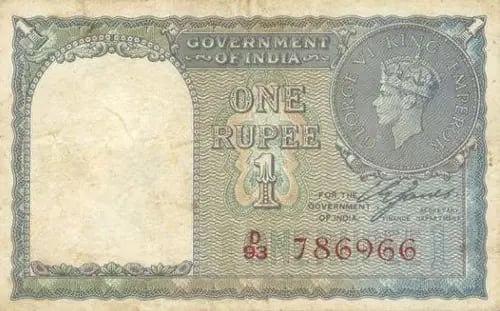
RBI Burma Issue Banknotes of 1938–1939 (Burma Peacock Banknotes), commonly known as the King George VI Burma Peacock series, were paper currency notes issued by the Reserve Bank of India for circulation in British Burma following its separation from British India on 1 April 1937. Although administratively managed by the RBI, these notes were a distinct monetary issue, created specifically for Burma and issued only during a brief pre-Second World War period.
Introduced between May 1938 and July 1939, the series comprised five denominations—5, 10, 100, 1000, and 10000 Rupees—all bearing the portrait of King George VI in side-face format and featuring uniquely Burmese design elements such as peacocks, elephants in forest, and river scene with boats. Unlike contemporary Indian banknotes, the Burma issues incorporated Burmese and Shan scripts, reflecting Burma’s separate administrative and cultural identity within the British Empire.
All denominations of the series were printed for a short and finite period, carried a single signature (J. B. Taylor), and were issued with limited prefix ranges, factors that would later play a decisive role in their scarcity. The outbreak of the Second World War and the Japanese invasion of Burma abruptly ended circulation and disrupted currency survival, making the Burma Peacock banknotes one of the most compact yet historically significant RBI-issued series.
Today, these notes occupy a unique position in Indian and Burmese numismatics, valued not only for their design and rarity but also for the geopolitical circumstances that shaped their brief existence.
Legal & Monetary Background of the RBI Burma Issue
Following Burma’s formal separation from British India on 1 April 1937, the responsibility for Burma’s currency did not immediately pass to a local central bank. Instead, under the India and Burma (Burma Monetary Arrangements) Order, 1937, the Reserve Bank of India was mandated to continue managing Burma’s monetary system on an interim basis. This arrangement ensured financial continuity during Burma’s administrative transition while avoiding disruption to trade, banking, and government finance.
As an immediate temporary solution, the RBI authorised the use of existing King George V Indian banknotes overprinted specifically for circulation in Burma. These overprinted notes constituted a provisional issue, intended solely to bridge the gap between Burma’s separation from India and the introduction of a fully distinctive Burmese paper currency. This short-lived interim series represents the first post-separation paper money issued for Burma and directly preceded the King George VI Peacock banknotes (see our detailed study on King George V British Burma Banknotes).
While the RBI retained administrative control, continued use of standard Indian banknotes was no longer appropriate for a territory that was constitutionally separate from India. Burma, therefore, required distinct paper currency, clearly identifiable in design, language, and legal promise, while still remaining within the RBI’s institutional framework. This led to the introduction of purpose-designed Burma banknotes beginning in 1938.
A dual structure, therefore, emerged. Indian coinage continued to circulate in Burma for practical and logistical reasons, as coin production and supply chains were already well established. In contrast, paper currency was localised, with notes expressly payable in Burma and bearing inscriptions and scripts relevant to Burmese administration. This separation of coin and note policy highlights the transitional nature of Burma’s monetary system in the late 1930s.
Importantly, the Burma Peacock banknotes were not issued by a Burmese central bank, as none existed at the time. They were an official RBI issue, printed by the India Security Press, governed by Indian currency law, and signed by the Governor of the Reserve Bank of India. This legal and administrative framework places the 1938–1939 Burma Peacock series firmly within the corpus of RBI-issued paper money, while simultaneously marking it as a distinct and short-lived monetary issue shaped by constitutional change rather than independent monetary sovereignty.
Design Continuity with the 1938 KGVI India Side-Face Series
The RBI Burma Peacock banknotes of 1938–1939 were conceived within the same production and administrative framework as the 1938 King George VI India Side-Face series, resulting in clear points of continuity alongside deliberate design divergence. Both issues were prepared under the authority of the Reserve Bank of India and reflect a shared RBI denomination policy prevailing in the late 1930s.
Notably, neither series included a 1 Rupee denomination. Instead, both the India and Burma issues comprised 5, 10, 100, 1000, and 10000 Rupees, indicating a consistent approach to paper money structure at the time. All denominations in both series were initially issued with the signature of J. B. Taylor, the second Governor of the Reserve Bank of India, reinforcing their contemporaneous origin and common administrative oversight. The use of a side-face portrait of King George VI, together with the same watermark paper stock, further suggests coordination in design philosophy and production planning.
Despite these similarities, the Burma Peacock series was not a derivative or variant of the Indian side-face notes. While both issues featured English-only text on the obverse and the familiar “RESERVE BANK OF INDIA” heading, their artistic treatment diverged significantly. The Indian notes retained a standardised imperial style, whereas the Burma series incorporated distinctly local motifs, including peacocks, elephants, rural scenes, and landscapes, thereby establishing a separate visual identity for Burmese circulation.
It is also worth noting that a 2 Rupees denomination was introduced later in the King George VI India side-face series in 1943, reflecting wartime currency requirements. This denomination did not form part of the original 1938 RBI issue framework and therefore has no counterpart in the Burma Peacock series, which remained limited to five denominations throughout its brief issuance.
Denominations Issued under the RBI Burma Peacock Series
The RBI Burma Peacock series, issued between 1938 and 1939, consisted of a complete and self-contained set of five denominations produced exclusively for circulation within Burma. All denominations formed part of a single unified issue bearing the portrait of King George VI, sharing common production characteristics, administrative authority, and overall design philosophy under the Reserve Bank of India. While consistent in structure, each denomination was distinguished by its colour palette and vignette treatment.
5 Rupees
The 5 Rupee denomination, issued in May 1938, was the first of the Burma Peacock banknotes to enter circulation and served as the principal note for everyday transactions. It is printed predominantly in violet and green, giving it a visually distinctive yet restrained appearance. The obverse features a side-face portrait of King George VI alongside a central peacock flanked by stylised lion heads, while the reverse depicts an elephant in a forest setting. The note bears the signature of J. B. Taylor, Governor of the Reserve Bank of India, and was issued with serial number prefixes ranging from A/0 to A/36.
Catalog references: Banknote Book (BNB) B201; Standard Catalog of World Paper Money (Pick) 4; The Revised Standard Reference Guide to Indian Paper Money (IPM) 5.4.1
10 Rupees
The 10 Rupee banknote followed in June 1938 and was intended as the higher-value companion to the 5 Rupee for routine commercial use. Its design is more multi-coloured, appearing predominantly green, with additional elements in violet, blue, and orange. The obverse illustrates a farmer ploughing with oxen and a bullock cart, symbolising Burma’s agrarian economy, while the reverse shows a sailing vessel associated with river and coastal trade. As with all denominations in the series, it carries the signature of J. B. Taylor and was issued with prefixes from A/0 to A/50.
Catalog references: BNB B202; Pick 5; IPM 5.4.2
100 Rupees
Introduced in May 1939, the 100 Rupee denomination was designed to facilitate higher-value commercial and banking transactions. The note is predominantly blue, accented with green, orange, and violet, giving it a markedly richer appearance than the lower denominations. The obverse returns to the peacock motif alongside a larger portrait of King George VI, while the reverse depicts elephants engaged in teak logging, a key industry in colonial Burma. Serial numbers appear on both sides of the note, a feature that facilitated banking practices such as note splitting. Prefixes are known from A/0 to A/2, with recorded examples of the A/2 prefix observed only up to serial number 500000, underscoring the limited scale of issue.
Catalog references: BNB B203; Pick 6; IPM 5.4.3
1000 Rupees
The 1000 Rupee denomination was issued in June 1939 and was intended primarily for institutional and inter-bank transactions. It is printed predominantly in brown, complemented by blue, violet, and green elements. The obverse places the portrait of King George VI prominently at the centre with the promise text and signature below, while the reverse features a walking tiger framed by peacock imagery. Only a single prefix, A/0, is known for this denomination.
Catalog references: BNB B204; Pick 7; IPM 5.4.4
10000 Rupees
The 10000 Rupee note represents the highest denomination issued for British Burma and entered circulation in May 1939. It is printed in a striking combination of violet, brown, yellow, and orange. The obverse features a central portrait of King George VI flanked by watermark windows, while the reverse depicts a waterfall scene, framed by peacock motifs. Like the 1000 Rupee note, only the A/0 prefix is recorded.
Catalog references: BNB B205; Pick 8; IPM 5.4.5
Signature, Series Structure & Administrative Context
The RBI Burma Peacock series of 1938–1939 is characterised by an unusually simple administrative structure, consisting of a single signature, a single series format, and no recognised design or signature varieties. All denominations in the series bear the signature of J. B. Taylor, who served as the second Governor of the Reserve Bank of India. This uniformity reflects the narrow time frame within which the notes were conceived, printed, and issued.
Unlike many RBI issues of the period, the Burma Peacock banknotes did not progress through multiple signature phases. The absence of additional signatures or revised series was not the result of simplified policy or limited administrative oversight, but rather a consequence of historical interruption. The entire series was planned and completed before the outbreak of the Second World War in Southeast Asia, leaving no scope for later modifications or administrative revisions.
A comparison with contemporary Indian banknotes highlights this distinction. The King George VI India Side-Face series, initially issued with J. B. Taylor’s signature in 1938, later appeared with the signature of C. D. Deshmukh, who assumed office as Governor of the Reserve Bank of India in August 1943. As a result, no Burma Peacock banknotes exist bearing later signatures, nor were revised series contemplated.
The single-signature structure of the Burma Peacock series, therefore, stands as evidence of a prematurely terminated currency program, shaped by geopolitical events rather than by deliberate monetary design.
Collectibility, Rarity & Market Value
The RBI Burma Peacock series occupies a distinctive position in the market for British Indian and Southeast Asian paper money. Although structurally simple—lacking multiple signatures or recognised varieties—the series is regarded as scarce across all denominations due to its limited print volume, short circulation life, and abrupt historical termination. As a result, collectibility is driven less by conventional variety hunting and more by quantitative and historical evidence.
Prefix Evidence & Comparative Print Volume
In the absence of multiple design or signature varieties, prefix analysis provides the most reliable proxy for assessing relative scarcity within the Burma Peacock series. Each denomination was issued with a restricted and clearly documented prefix range, allowing collectors to estimate production scale with a high degree of confidence.
When compared with contemporary Indian issues, the contrast is striking. The King George VI India 5 Rupee side-face note bearing the J. B. Taylor signature is known across approximately 900 prefixes, reflecting sustained wartime production. In contrast, the Burma 5 Rupee Peacock note is confined to just 37 prefixes. A similar disparity is evident at the 10 Rupee level, where the Indian issue spans approximately 712 prefixes, compared with only 51 prefixes for the Burma counterpart.
Impact of the Japanese Invasion on Survival Rates
Although all Burma Peacock denominations were fully issued by mid-1939, their survival was severely affected by events that followed. The outbreak of war in Southeast Asia soon disrupted administrative control. The Japanese invasion of Burma beginning in late 1941 led to the rapid collapse of British authority, with major cities falling by mid-1942. As a result, currency stocks were destroyed, abandoned, or lost, and circulation was abruptly curtailed. Unlike Indian banknotes, which continued to be printed and circulated in India throughout the war, Burma Peacock notes had an exceptionally short functional lifespan.
Collector Demand & Condition Sensitivity
Collector demand for the RBI Burma Peacock series remains strong across all denominations, driven by its finite issue size, historical importance, and distinctive visual design. As with all paper money, condition plays a significant role in value differentiation, with higher-grade examples commanding clear premiums. However, unlike more commonly encountered King George VI Indian banknotes, the Burma Peacock series remains scarce across all grade levels, reflecting restricted production and limited survival rather than selective condition rarity.
Demand for the series is further strengthened by its broad cross-collecting appeal. The Burma Peacock banknotes are sought after by collectors of Indian and Burma paper money, Southeast Asian and Commonwealth issues, world paper money, and thematic collections focused on animal imagery, including peacocks, elephants, and tigers. This wide collector base, combined with consistently lower market availability compared to Indian side-face equivalents, firmly establishes the series as one of the most desirable and enduring pre-war RBI currency issues.
Post-War Treatment & Demonetisation
Following the Japanese surrender on 14 August 1945, Allied forces re-established control over Burma, and British military administration resumed responsibility for the territory’s currency system. In the immediate post-war period, Indian currency notes overprinted “Military Administration of Burma” were introduced to address acute shortages of circulating paper money. At the same time, existing RBI-issued Burma Peacock banknotes remained legal tender and continued to circulate alongside these overprint issues, with their status later formalised under the Currency Notes Act, 1946 (Burma Act XXV of 1946).
Despite this temporary reuse, the Burma Peacock series was never reinstated as an active currency program. The higher denominations of 1000 and 10000 Rupees were formally demonetised in May 1945, reflecting their limited relevance in the post-war economy and their primarily institutional function. The remaining 5, 10, and 100 Rupee denominations retained legal tender status for a longer transitional period but were ultimately demonetised in June 1950.
The Burma Peacock banknotes did not transition into Burma’s post-independence currency system because they were RBI-issued instruments rooted in colonial administrative structures, rather than products of a sovereign Burmese monetary authority. With new national institutions and monetary frameworks in place, the series concluded as a closed pre-war issue, shaped by wartime disruption and post-colonial realignment rather than by deliberate replacement or redesign.
Conclusion
The RBI Burma Peacock banknotes of 1938–1939 (King George VI Burma Issue) represent one of the most clearly defined and historically self-contained currency issues administered by the Reserve Bank of India. Issued during a narrow pre-war window following Burma’s separation from British India, the series combined institutional continuity with deliberate local distinction, producing a complete five-denomination set that was never expanded, revised, or reissued.
Unlike many contemporaneous RBI issues, the Burma Peacock series was shaped less by evolving monetary policy than by geopolitical disruption. Limited production, a single-signature structure, and restricted prefix ranges reflect the brevity of the program, while the Japanese invasion of Burma abruptly curtailed circulation and severely reduced survival rates. Post-war reuse of surviving notes did not lead to continuation, and subsequent demonetisation confirmed the series as a closed colonial issue rather than a transitional national currency.
Today, the Burma Peacock banknotes occupy a unique position within Indian and regional numismatics. They are collected across multiple disciplines—Indian paper money, British colonial and Commonwealth issues, Southeast Asian currency, and thematic collections—yet remain united by a common narrative of administrative intent interrupted by history. As a result, the series stands as a compelling example of how political change and wartime events can decisively shape both the structure and legacy of a paper money issue, ensuring its enduring significance to collectors and researchers alike.
Frequently Asked Questions
What are Burma Peacock banknotes?
Burma Peacock banknotes are paper currency issued by the Reserve Bank of India between 1938 and 1939 for circulation in British Burma, featuring King George VI and distinctive Burmese motifs.
Why did the Reserve Bank of India issue banknotes for Burma?
After Burma separated from British India in 1937, the RBI was legally mandated to manage Burma’s currency on an interim basis until a separate monetary system was established.
Which denominations were issued in the Burma Peacock series?
The series consisted of five denominations: 5, 10, 100, 1000, and 10000 Rupees. No other denominations were issued.
Why are Burma Peacock banknotes considered rare?
They were printed for a short period, issued in limited prefix ranges, and suffered heavy losses due to the Japanese invasion of Burma during World War II.
Did Burma Peacock banknotes have multiple signatures or varieties?
No. All denominations carry a single signature (J. B. Taylor) and have no recognised design or signature varieties.
Were Burma Peacock banknotes used after World War II?
Yes, surviving notes remained legal tender temporarily after the war but were gradually demonetised between 1945 and 1950.