
Private Banknotes of British India
Guide to Bank of Hindostan, Commercial Bank, Oriental Bank, Calcutta Bank, Union Bank, Asiatic Bank, Bank of Western India & Madras Government currency notes
IndiaBanknotes.com Editorial Team
16 min read
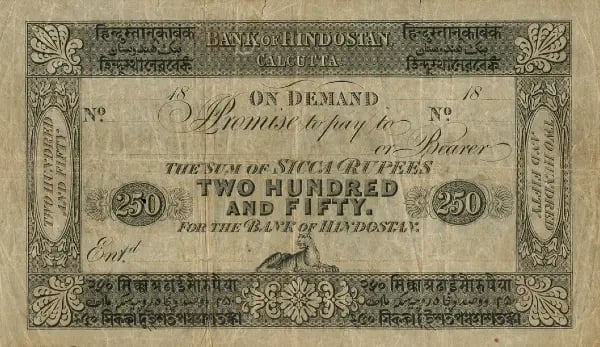
While the three great Presidency Banks—Bengal, Bombay, and Madras—dominated Indian banking history and produced the most prestigious banknotes of the colonial era (as explored in our comprehensive guide to The Presidency Banknotes of British India), they were far from the only institutions issuing paper currency in British India. The remarkable value that private banknotes can achieve was demonstrated when a Bank of Hindostan unissued 250 Sicca Rupees note from Calcutta (ND 1823-27) sold for £50,000 at Spink Auction 20009, Lot 188—proving that these lesser-known institutions produced banknotes of extraordinary collector significance.
A fascinating array of private banks, commercial houses, and regional institutions issued banknotes that today represent some of the rarest and most intriguing pieces in Indian numismatic history. From the pioneering Bank of Hindostan, which survived for over six decades and achieved record auction prices, to regional specialists like the Bank of Western India, these institutions played crucial roles in financing trade, supporting colonial administration, and meeting the currency needs of a rapidly developing economy.
For collectors, private banknotes offer unique opportunities to own pieces of Indian financial history that are often rarer than their Presidency Bank counterparts. Many of these institutions operated for relatively brief periods, issued limited quantities of notes, and left behind minimal surviving examples. Understanding their histories, identifying their issues, and recognizing their significance requires specialized knowledge that can reward dedicated collectors with exceptional discoveries.
The period from 1770 to 1861 represents the golden age of private banking in India, ending with the Paper Currency Act of 1861 that granted the Government of India exclusive rights to issue banknotes. During these nine decades, private banks experimented with different approaches to currency design, security features, and commercial operations, creating a diverse and fascinating collecting field that remains largely underexplored by many numismatists.
The Rise of Private Banking in British India
The emergence of private banking in India coincided with the East India Company's expansion from a trading enterprise to a governing power. As British control extended across the subcontinent, the need for sophisticated financial services grew exponentially. The Company's own financial resources, while substantial, were insufficient to handle the complex requirements of colonial administration, military operations, and expanding trade networks.
Private banks filled this crucial gap by providing credit facilities, currency exchange services, and local financial expertise that the East India Company could not efficiently provide on its own. These institutions typically emerged from successful trading houses, agency firms, or partnerships between British entrepreneurs and local financial experts who understood regional commercial practices.
The relationship between private banks and the East India Company was generally collaborative rather than competitive. The Company recognized that private banking institutions could provide essential services while bearing the associated risks. In return, successful private banks often enjoyed unofficial government patronage, including acceptance of their notes for tax payments and other official transactions.
This symbiotic relationship created an environment where well-managed private banks could thrive for decades, as demonstrated by institutions like the Bank of Hindostan. However, it also meant that private banks were vulnerable to changes in Company policy, economic crises, and political upheavals that could instantly transform supportive relationships into hostile regulatory environments.
Bank of Hindostan: The Pioneer of Indian Private Banking
The Bank of Hindostan stands as the most significant and longest-lived private banking institution in early British India. Established in 1770 by the agency house of Alexander and Company, this remarkable institution survived for 62 years, weathering numerous crises that destroyed other banks and establishing many precedents that influenced later Indian banking development.
Foundation and Early Success
Alexander and Company, founded by Scottish entrepreneurs, recognized the enormous potential for banking services in Bengal following the East India Company's victory at the Battle of Plassey in 1757. The agency house had already established successful trading operations and possessed the local knowledge, capital, and government connections necessary to launch a banking venture.
The Bank of Hindostan's initial success stemmed from its ability to bridge the gap between British commercial needs and Indian financial practices. The bank offered services familiar to European merchants while adapting to local customs, currency systems, and commercial relationships that were essential for conducting business in the subcontinent.
From its headquarters in Calcutta, the Bank of Hindostan quickly established correspondent relationships with merchants and trading houses throughout Bengal and beyond. The bank's notes gained acceptance not only among European traders but also with Indian merchants who appreciated the institution's reliability and the convenience of paper currency for large transactions.
Notable Resilience and Crisis Management
The Bank of Hindostan's most remarkable characteristic was its ability to survive financial panics that destroyed other institutions. The bank successfully weathered three separate panic runs, demonstrating management skill and financial strength that became legendary in Indian commercial circles.
During these crises, the bank's strategy typically involved maintaining adequate specie reserves, carefully managing credit relationships, and leveraging its strong reputation to maintain depositor confidence. The bank's survival of multiple panics enhanced its reputation and attracted customers who valued stability above all other considerations.
The bank's banknotes reflected this reputation for reliability. Early Bank of Hindostan notes featured elegant typography and distinctive design elements that made them immediately recognizable in commercial transactions. The bank experimented with various security features and denominations, adapting its currency offerings to meet changing market demands.
Collecting Bank of Hindostan Notes
Today, Bank of Hindostan notes represent some of the most sought-after pieces in Indian private banking numismatics. The bank's 62-year operating history created multiple series and varieties that appeal to different collecting specialties.
Early Bank of Hindostan notes, particularly those from the 1770s and 1780s, are extraordinarily rare. The bank's unifaced notes from this period feature distinctive typography and ornamental borders that reflect 18th-century design aesthetics. These early issues are among the oldest surviving banknotes issued by any Indian institution and command premium prices when they appear at auction.
Later issues, while still rare, are more accessible to collectors. The bank's experimentation with bilingual text, security features, and denomination structures created interesting varieties that appeal to specialists. Some notes feature both English and local language text, reflecting the bank's adaptation to India's multilingual commercial environment.
The bank's final issues, produced in the years leading up to its 1832 collapse, often show signs of the financial stress that ultimately destroyed the institution. These notes sometimes feature modified designs, different paper stocks, or altered security features that reflect the bank's attempts to maintain operations despite mounting difficulties.
Commercial Bank: Early Commercial Banking Pioneers
The Commercial Bank represents one of several institutions that adopted straightforward commercial banking names, reflecting the practical approach of early private banks to institutional branding. While detailed records of this bank's operations are limited, surviving evidence suggests it played an important role in financing trade and commercial activities in one of the major commercial centers.
Commercial banks in early India typically focused on providing credit facilities to trading houses, currency exchange services for international commerce, and deposit banking for wealthy merchants and colonial officials. Their banknotes served both as convenient currency substitutes and as symbols of institutional reliability in an era when personal reputation and institutional credibility were paramount.
The name "Commercial Bank" itself suggests a focus on business rather than speculative activities, appealing to conservative merchants and officials who valued stability over high returns. This positioning strategy proved successful for many early banks, as it aligned with the East India Company's preference for reliable financial partners rather than aggressive competitors.
From a collecting perspective, Commercial Banknotes are particularly interesting because they represent the practical, business-focused approach that characterized much of early Indian banking. The notes typically featured conservative designs emphasizing the bank's name and denomination rather than elaborate artistic elements.
Calcutta Bank: Serving the Colonial Capital
As the capital of British India and the East India Company's primary commercial center, Calcutta naturally attracted numerous banking institutions competing for the business of government officials, European merchants, and wealthy Indian traders. The Calcutta Bank represented one of several local institutions that focused specifically on serving this crucial market.
Calcutta Banknotes typically featured design elements that emphasized the bank's connection to the colonial capital. Some issues included architectural vignettes of prominent Calcutta buildings, while others featured symbolic elements representing commerce, trade, or British authority in India.
The bank's strategic location in Calcutta provided significant advantages, including proximity to government offices, major trading houses, and the East India Company's administrative headquarters. This positioning allowed the bank to develop relationships with key decision-makers and participate in major commercial transactions that smaller, more remote institutions could not access.
However, competition in Calcutta was intense, with the Bank of Bengal (established 1806) eventually dominating the market through its semi-governmental status and substantial capital resources. Private institutions like the Calcutta Bank faced the ongoing challenge of competing with government-sponsored banks that enjoyed official patronage and regulatory advantages.
Union Bank: Collaborative Banking Ventures
The Union Bank name suggests an institution formed through the combination or collaboration of multiple smaller banks or trading houses. This approach was common in early Indian banking, where individual firms often lacked sufficient capital to establish major banking operations independently.
Union banks typically offered several advantages over single-proprietor institutions. They could pool larger amounts of capital, spread risk across multiple partners, and combine different areas of expertise and market access. These collaborative ventures often proved more resilient than single-owner banks during financial crises.
The banknotes of union-style institutions often reflected their collaborative nature through design elements that balanced the interests of different partners. Some Union Banknotes featured multiple vignettes or symbolic elements representing different aspects of the bank's operations or partner firms.
From a collecting standpoint, Union Banknotes are particularly interesting because they represent an alternative organizational approach to early Indian banking. The collaborative model influenced later Indian banking development and provides insights into the business relationships and financial structures that supported colonial commerce.
Bank of Western India: Regional Specialization
The Bank of Western India represents the trend toward regional specialization that emerged as India's economy became more complex and geographically diverse. Rather than attempting to compete directly with major institutions in established centers like Calcutta, regional banks focused on serving specific geographic markets where they could develop expertise and relationships.
Western India, including the Bombay Presidency and surrounding regions, offered enormous opportunities for banks that understood local commercial patterns, agricultural cycles, and trading relationships. The region's cotton trade, in particular, generated substantial financial services demand that local institutions were better positioned to serve than distant Calcutta-based banks.
Bank of Western India notes typically featured design elements reflecting regional identity and commercial focus. Some issues included vignettes related to cotton trade, maritime commerce, or regional landmarks that would be familiar to local users. This regional identity helped distinguish the bank's notes from generic designs used by institutions operating in multiple markets.
The bank's specialization strategy proved prescient, as the Bombay region eventually became one of India's most important commercial centers. However, the success of regional specialization also attracted competition from larger institutions, including the establishment of the Bank of Bombay as a Presidency Bank in 1840.
Oriental Bank: International Connections
The Oriental Bank name reflects the international perspective that characterized many successful private banks in British India. These institutions recognized that Indian commerce was increasingly connected to global markets and positioned themselves to serve customers engaged in international trade and finance.
Oriental banks typically offered sophisticated services including foreign exchange, letters of credit, and correspondent banking relationships with institutions in London, China, Australia, and other markets important to Indian traders. Their banknotes often reflected this international orientation through design elements and multilingual text that appealed to cosmopolitan users.
The Oriental Bank's operations likely extended beyond India to other parts of the British Empire and Asian trading networks. This geographic diversity provided advantages during regional economic downturns but also exposed the bank to risks from distant markets and political developments.
From a numismatic perspective, Oriental Banknotes are particularly valuable because they represent the international dimension of early Indian banking. The notes often feature sophisticated security features and artistic elements that reflect the bank's exposure to global design trends and printing technologies.
Commercial Bank of India: National Ambitions
The Commercial Bank of India's name suggests broader ambitions than purely regional institutions, indicating an intention to operate across multiple Indian markets rather than focusing on a single presidency or commercial center. This ambitious approach required substantial capital resources and sophisticated management capabilities.
Institutions with "India" in their names typically sought to position themselves as alternatives to the Presidency Banks, offering similar services and geographic coverage without the governmental connections that limited pure commercial flexibility. This positioning appealed to customers who preferred dealing with purely private institutions.
The bank's banknotes likely emphasized its national scope through design elements that avoided overly specific regional references. Instead, the notes probably featured symbols of commerce, trade, or general Indian identity that would be recognizable and acceptable to users across different regions and communities.
However, the ambitious scope that made the Commercial Bank of India attractive to some customers also created significant operational challenges. Managing banking operations across multiple regions required extensive correspondent networks, sophisticated communications, and substantial capital reserves that few private institutions could sustain indefinitely.
Asiatic Bank: Continental Scope
The Asiatic Bank represents the most ambitious geographic scope among Indian private banks, with a name suggesting operations extending beyond India to other parts of Asia. This continental approach required extraordinary resources and management capabilities but offered access to the most lucrative and sophisticated commercial opportunities.
Banks operating at the "Asiatic" level typically served major trading houses, government contractors, and other clients engaged in large-scale commercial operations spanning multiple countries and currencies. Their banknotes needed to be recognizable and acceptable across diverse markets with different languages, customs, and regulatory environments.
The Asiatic Bank's notes likely featured universally recognizable design elements such as allegorical figures, architectural motifs, or symbolic representations that would be familiar to educated users regardless of their specific cultural background. Multilingual text was probably essential for operations across diverse Asian markets.
From a collecting perspective, Asiatic Banknotes represent the pinnacle of private banking ambition in colonial India. Their rarity, sophisticated design features, and connection to major historical commercial operations make them particularly valuable to collectors interested in international banking history and Asian commercial development.
Madras Government Bank: Quasi-Official Status
The Madras Government Bank occupies a unique position among private Indian banks due to its name suggesting official government connections while operating as a private institution. This quasi-official status provided significant advantages but also created regulatory complexities and competitive challenges.
The bank's "Government" designation likely reflected either official patronage, government participation in ownership, or authorization to handle certain government transactions. This status provided credibility and market access that purely private institutions could not match, while avoiding the full regulatory constraints that applied to the Presidency Banks.
Madras Government Banknotes probably emphasized the institution's official connections through design elements that suggested governmental authority without explicitly claiming government status. Royal symbols, official architectural motifs, or other elements associated with British administration in the Madras Presidency likely featured prominently.
The bank's operations in the Madras Presidency put it in direct competition with the Bank of Madras after that institution's establishment in 1843. The competitive pressure from a true government bank probably contributed to whatever difficulties ultimately ended the Madras Government Bank's operations.
Design Evolution and Security Features
Private banknotes in British India evolved significantly during the nearly century-long period before centralized government control. Early issues were typically unifaced, featuring primarily typographic elements with minimal ornamental decoration. As counterfeiting became a more serious concern and printing technology improved, private banks adopted increasingly sophisticated design approaches.
The evolution from simple typography to elaborate vignettes reflects both technological advancement and competitive pressure among banks. Institutions that could produce more attractive and secure notes gained advantages in customer acceptance and institutional prestige. This competitive dynamic drove continuous innovation in banknote design and security features.
Many private banks collaborated with or commissioned work from the same London engraving firms that produced notes for the Presidency Banks. However, private institutions often had more flexibility to experiment with innovative designs, unusual denominations, or locally relevant imagery that official banks might consider inappropriate.
Color printing represented a particular challenge for private banks, as the technology was expensive and required specialized expertise. Banks that successfully incorporated multiple colors into their notes gained significant security advantages, but at substantial cost that smaller institutions often could not afford.
Authentication and Collecting Challenges
Collecting private banknotes from British India presents unique authentication challenges that require specialized knowledge and careful attention to detail. Unlike the Presidency Banks, which maintained detailed records and produced notes in relatively standardized formats, private banks often modified their designs frequently and maintained less comprehensive documentation.
The rarity of most private banknotes means that collectors have limited opportunities to compare genuine examples with questionable pieces. This scarcity makes authentication particularly challenging, as even experienced collectors may have limited exposure to authentic examples of specific issues.
Paper quality provides one of the most reliable authentication criteria for private banknotes. Genuine examples typically used high-quality paper with distinctive watermarks or other security features that are difficult to reproduce convincingly. However, the age of these notes means that paper condition can vary dramatically based on storage conditions and handling over more than a century.
Printing quality represents another crucial authentication factor. Genuine private banknotes typically exhibit the high engraving quality characteristic of legitimate banking institutions. Details in vignettes, text clarity, and overall production values should meet standards appropriate for institutions handling substantial financial transactions.
Rarity and Value Considerations
Private banknotes from British India represent some of the rarest pieces in Indian numismatics, with survival rates often far lower than Presidency Bank issues. The combination of limited original production, shorter operating periods, and less systematic preservation efforts means that many private banknotes are unique or nearly unique survivals. Recent auction results provide concrete evidence of the extraordinary values these rarities can achieve in today's market.
The Bank of Hindostan, despite its 62-year operating history, left behind remarkably few surviving notes relative to its historical importance. The bank's market appeal was dramatically illustrated when its unissued 250 Sicca Rupees note (ND 1823-27) achieved £50,000 at Spink Auction 20009 in 2020, followed by a 100 Sicca Rupees remainder that sold for US$17,000 at Heritage Auctions in 2023. These results demonstrate that even unissued and remainder notes from private banks can command prices that rival or exceed many Presidency Bank issues. Early issues from the 1770s and 1780s are extraordinary rarities that would command even higher prices if authentic examples appeared at auction.
The strength of the private banknote market extends beyond the Bank of Hindostan to lesser-known institutions. An India British Commercial Bank 5 Sicca Rupees front proof from Calcutta (ca. 1820s) realized US$17,000 at Heritage World Paper Money Signature Auction in 2020, proving that even smaller denomination proofs from obscure private banks can achieve substantial values when they represent unique survivors from documented institutions.
Regional banks like the Bank of Western India and institutions with shorter operating periods often left even fewer surviving examples. Some private banks may be represented by only a handful of known notes, making any new discoveries potentially significant additions to the numismatic record. The recent auction results suggest that previously unknown notes from private institutions could achieve exceptional prices if they emerged from old collections or archives, particularly given the growing recognition of Indian banking history among international collectors.
The market for private banknotes has evolved from a specialized niche to attract serious international attention, as evidenced by strong results at both British and American auction houses. The £50,000 result for the Bank of Hindostan note represents one of the highest prices ever achieved for any Indian private banknote, while the consistent US$17,000 results for different institutions demonstrate depth in collector demand rather than isolated interest in a single bank.
Values for private banknotes are supported by several factors that distinguish them from more common numismatic material. Their extreme rarity provides natural price support, as supply is essentially fixed while demand continues to grow among increasingly sophisticated collectors. The historical significance of these institutions in India's commercial development adds scholarly interest that enhances collector appreciation beyond pure rarity value.
However, the specialized nature of the market means that authentication expertise is crucial, and values can vary significantly based on the specific knowledge and interests of potential buyers. The strong auction results achieved by professionally graded and authenticated examples suggest that collectors are willing to pay premium prices for notes with established provenance and confirmed authenticity.
Investment and Market Perspectives
The market for Indian private banknotes has shown steady growth as collectors increasingly recognize their historical significance and extreme rarity. Unlike more common Indian notes that trade regularly at auction, private banknotes often represent once-in-a-lifetime collecting opportunities.
The scholarly interest in early Indian banking history has enhanced collector appreciation for private banknotes as historical documents rather than merely numismatic curiosities. Academic research and publication have helped identify previously unknown issues and provided context that increases collector understanding and appreciation.
International recognition of Indian private banknotes has grown substantially in recent years, with major auction houses increasingly featuring significant examples in their world banknote sales. This global exposure has introduced these notes to collectors who might not specialize in Indian material but recognize their importance in world banking history.
The extreme rarity of most private banknotes provides natural price support, as supply is essentially fixed while demand continues to grow among increasingly sophisticated collectors. However, the specialized nature of the market means that liquidity can be limited, and values may fluctuate based on the specific knowledge and interests of available buyers.
Research Resources and Documentation
Collecting private banknotes from British India requires access to specialized research resources that go beyond standard numismatic references. Banking histories, commercial directories, and colonial administrative records often provide crucial information about institutions and their note issues.
The India Office Records, held at the British Library in London, contain extensive documentation about early Indian banking institutions and their relationships with colonial authorities. These records often include correspondence, regulatory documents, and financial reports that provide insights into bank operations and note issues.
Contemporary commercial directories and almanacs published in India during the 19th century sometimes contain information about private banks and their services. These sources can help establish operating periods, locations, and business relationships that are crucial for understanding and authenticating banknote issues.
Numismatic literature specific to Indian banking history remains limited, creating opportunities for collectors to contribute original research through careful documentation of newly discovered notes or institutions. The scholarly community generally welcomes well-documented contributions from knowledgeable collectors.
The End of Private Note Issuance
The Paper Currency Act of 1861 marked the definitive end of private banknote issuance in British India, consolidating currency control under government authority. This legislation reflected the colonial administration's desire for greater monetary control and standardization across the diverse regions of the subcontinent.
Private banks that survived the transition continued operating as commercial and exchange banks but lost their most distinctive function as currency issuers. Some institutions, like the Oriental Bank, continued operating internationally while maintaining Indian branches focused on traditional banking services rather than note issuance.
The transition period following 1861 created interesting collecting opportunities, as some private banks continued using existing note stock or modified existing designs for other purposes. These transitional pieces represent the final chapter in private currency issuance and often exhibit unique characteristics that appeal to specialized collectors.
The consolidation of currency authority under government control marked a fundamental shift in Indian banking that paralleled similar developments in other countries during the mid-19th century. The end of private note issuance represented both the loss of an entrepreneurial tradition and the beginning of more systematic monetary policy.
Legacy and Modern Significance
Private banknotes from British India represent far more than historical curiosities for modern collectors. They serve as tangible connections to the entrepreneurial energy and commercial innovation that characterized India's early integration into global economic systems.
These notes document the crucial role that private financial institutions played in supporting colonial commerce, facilitating trade, and providing essential services that larger, more bureaucratic institutions could not efficiently deliver. Their survival reminds us that financial innovation and entrepreneurship have deep roots in Indian commercial culture.
For collectors interested in Indian financial history, private banknotes offer opportunities to own pieces of genuine historical significance while participating in a collecting field that remains relatively unexplored compared to government issues. The combination of extreme rarity, historical importance, and continuing research potential makes private banknotes particularly rewarding for serious collectors.
The study of private banknotes also contributes to broader understanding of Indian economic development, colonial administration, and the evolution of modern banking practices. Each surviving note represents a piece of evidence about commercial relationships, regulatory environments, and business practices that shaped India's financial development.
As India continues its emergence as a global economic power, interest in the historical foundations of Indian commerce and banking continues to grow. Private banknotes from the colonial period provide unique insights into these foundations and serve as bridges between India's commercial past and its dynamic present.
The remarkable diversity of private banking institutions that operated in British India demonstrates the entrepreneurial creativity and commercial sophistication that characterized Indian business culture even under colonial constraints. For collectors who appreciate this heritage, private banknotes will always represent exceptional opportunities to own authentic pieces of Indian commercial history.
Image courtesy of Spink Auctions. The Bank of Hindostan banknote photograph is used for educational purposes to illustrate the blog content. This usage is intended as fair use for educational commentary on numismatic collecting.