
Languages on Indian Currency Notes: History and Panels
Learn how language panels evolved on Indian currency notes from British India to Republic India, and why 17 languages appear on India’s paper money today.
16 min read
Indian currency notes reflect the country’s linguistic structure more clearly than almost any other public document. From the British India period to the Republic of India era, language panels on Indian currency notes have evolved to balance administration, accessibility, and constitutional recognition. Today, Indian paper money carries text in 17 languages, combining English, Hindi, and fifteen other constitutionally recognised languages.
The inclusion of multiple languages on Indian currency notes was a deliberate and gradual process. Early issues relied almost entirely on English, while later notes introduced language panels to reflect India’s diverse linguistic landscape. Over time, these panels became standardised, expanded, and reorganised in response to practical monetary needs, political change, and constitutional developments.
This article explains the history of languages on Indian currency notes, how language panels developed across different periods, and why the modern 17-language system appears on India’s paper money today.
Why Indian Currency Notes Use Multiple Languages
India does not have a national language, a reality that strongly shapes how language appears on public instruments such as currency notes. Instead, India functions with Hindi and English as official languages of the Union, while recognising a wide range of other major languages used across the country. This linguistic structure required a careful and neutral approach when designing banknotes intended for nationwide use.
The constitutional framework acknowledges linguistic diversity through the Eighth Schedule, which lists languages officially recognised by the Government of India. While this schedule does not dictate currency design directly, it provides an important reference point for inclusion. Over time, the languages appearing on Indian currency notes increasingly aligned with those recognised under this framework, ensuring that no single region or linguistic group was privileged over others. The Official Languages Act of 1963, which provided for the continued use of English alongside Hindi in Union government function, is an arrangement that continues to be reflected on Indian currency notes.
For banknotes, neutrality was essential. Currency circulates across state borders, linguistic regions, and social groups, making it one of the few everyday objects shared by all citizens. Including multiple languages helped ensure clarity, accessibility, and acceptance, particularly in a country where linguistic identity carries deep cultural significance. At the same time, excessive complexity had to be avoided to preserve legibility, security, and consistency.
As a result, Indian currency notes developed a balanced structure: English remained a stable administrative reference, Hindi represented official national usage, and additional languages were incorporated through structured language panels. This approach allowed currency design to reflect India’s linguistic diversity without becoming politically or legally prescriptive. The modern multi-language system on Indian paper money is therefore best understood as a practical and inclusive solution rather than a constitutional statement.
Presidency Banks & Queen Victoria Notes
The earliest Indian paper money issued under the Presidency Banks and during the Queen Victoria period relied almost entirely on English-only text. These notes were produced primarily for administrative convenience within the colonial financial system, where English functioned as the working language of government, banking, and trade. At this stage, paper currency was not designed for broad public circulation but for use among banks, treasuries, and commercial entities familiar with English documentation.
Queen Victoria notes continued this approach after the introduction of government-issued paper money under the Paper Currency Act of 1861. Their layouts were formal and minimal, with English inscriptions dominating the design and no structured language panels. This reflected both the administrative priorities of the colonial state and the limited role of paper money in everyday transactions for the general population, which still relied heavily on coinage.
As paper currency gradually became more widespread and began circulating across linguistically diverse regions, the limitations of English-only notes became increasingly apparent. A system designed solely for administrative efficiency was no longer sufficient for a country with multiple scripts and languages. This tension between centralised control and practical usability laid the foundation for the gradual introduction of language panels on later British India banknotes.
Uniface Notes and the Birth of Language Panels
The introduction of uniface banknotes in British India marked a decisive turning point in how languages were presented on Indian currency. As paper money moved beyond narrow administrative use and into wider circulation, it became essential for notes to communicate value and legitimacy across multiple linguistic regions. This need led to the gradual appearance—and later standardisation—of language panels.
Green Underprint Uniface Notes
During the green underprint era, language usage on uniface notes followed a denomination-based structure, not a uniform system across all values.
For denominations of 10 Rupees and above, green underprint uniface notes consistently carried four language panels from their introduction in 1867, while the 5 Rupee denomination followed the same format from 1871 until 1901. These four-language panels were not standardised nationally but varied by presidency or circle of issue, reflecting regional administrative realities. Typical language groupings included:
Bombay Presidency: Urdu, Marathi, Gujarati, Kannada
Calcutta Presidency: Urdu, Hindi, Kaithi, Bangla (Bengali)
Madras Presidency: Telugu, Kannada, Malayalam, Tamil
Rangoon: Burmese, Tamil, Urdu, Chinese
English remained the primary language outside the panel on all notes, serving as the central administrative medium.
A major shift occurred between 1901 and 1903 with the 5 Rupee green underprint. As the 5 Rupee note was universalised—meaning it could be encashed at any government office rather than only at the issuing circle—it transitioned from region-specific four-language panels to a standardised six-language panel used across all circles of issue.
The six standardised languages were:
Urdu, Kaithi, Bangla (Bengali), Kannada, Telugu, and Tamil
This development marks the true beginning of language panel standardisation on Indian currency, driven by practical circulation needs rather than political or symbolic considerations. Higher denominations continued with four-language panels during this period, underscoring that standardisation was gradual and denomination-specific rather than system-wide.
Red Underprint Uniface Notes
The red underprint notes expanded and formalised standardised developments.
Between 1903 and 1907, only the 5 Rupee red underprint note was issued, and it retained the standardised six-language panel introduced during the green underprint period. This confirmed the Reserve authorities’ preference for consistency on a widely used denomination.
From 1907 onwards, red underprint notes were issued in 5, 10, and 50 Rupee denominations. These notes introduced a further evolution: a standardised eight-language panel, arranged in two columns of four languages each. This format represented the most comprehensive language inclusion seen on Indian currency up to that time.
The eight languages used in the panel were Urdu, Kaithi, Bangla (Bengali), Burmese, Telugu, Tamil, Kannada, and Gujarati. English continued to appear prominently outside the language panel, maintaining its administrative role while allowing regional languages to serve an explanatory function.
Together, the green and red underprint uniface notes established the core principles that would guide language use on Indian currency for decades: English as the central administrative language, supported by structured language panels designed to reflect India’s linguistic diversity in a practical and recognisable way.
King George V Portrait Notes
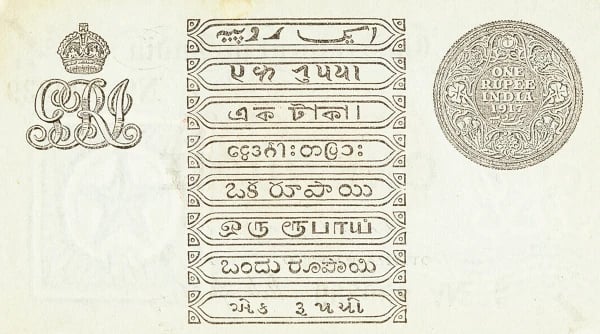
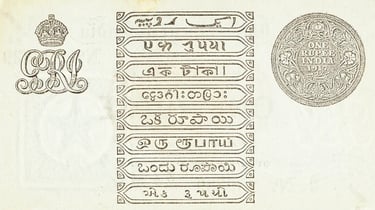
With the introduction of King George V portrait notes, Indian paper money entered a new design phase that also reshaped how languages were presented. Unlike the uniface series, where language panels appeared on the front, King George V portrait notes moved the language panel to the reverse, where it was arranged in a single vertical column. The obverse carried English text only, reinforcing English as the primary administrative language while allowing linguistic inclusion to be handled separately.
Importantly, Hindi does not appear on King George V portrait notes. The standardized language panel used during this period closely followed the model established under the red underprint uniface notes, reflecting continuity rather than experimentation. The eight languages used on the reverse language panel were Urdu, Kaithi, Bangla (Bengali), Burmese, Telugu, Tamil, Kannada, and Gujarati.
These languages were presented consistently across denominations, providing a uniform linguistic structure for the series. English continued to appear outside the panel, maintaining its role as the dominant language of issue.
A key point often misunderstood is the presence of Burmese. Burmese appears throughout the King George V portrait series, across all relevant denominations. Its inclusion reflects Burma’s administrative status as part of British India during most of King George V’s reign and should not be treated as an anomaly or short-lived experiment.
One notable language-related issue occurred with the King George V 1 Rupee note of 1917, the first paper 1 Rupee issued in India. Early printings carried an incorrect Gujarati inscription. This error was identified and corrected within the same issue, without altering the broader language panel structure. Crucially, it was not a systemic failure of standardisation but a limited linguistic correction confined to a single denomination.
Overall, King George V portrait notes represent a period of stability rather than expansion in language policy on Indian currency. The shift of language panels to the reverse, the absence of Hindi, and the continued inclusion of Burmese together illustrate how language usage on banknotes closely followed administrative realities rather than political symbolism during this phase.
King George VI Portrait Notes
The King George VI portrait series represents a pivotal stage in the evolution of language panels on Indian currency notes. Issued during the final years of British rule, these notes reflect both linguistic transition and geopolitical change, bridging late colonial administration and the approach of Independence.
Earlier Side-Face Issues
The side-face portrait issues of King George VI include the 2 Rupees, 5 Rupees, 10 Rupees, 100 Rupees, 1000 Rupees, and 10000 Rupees denominations. With the exception of the 2 Rupees note—which was introduced in 1943—all other denominations in this group were introduced in 1938.
These notes carried a standardised eight-language panel, marking an important linguistic shift. For the first time, Hindi replaced Kaithi in the language panel, reflecting the growing administrative and public prominence of Hindi during the 1930s. The eight languages used were Urdu, Hindi, Bangla (Bengali), Burmese, Telugu, Tamil, Kannada, and Gujarati. English continued to appear outside the language panel on the obverse.
This period also saw refinements in linguistic accuracy. Telugu inscriptions were corrected from singular to plural usage, and Kannada plural forms were standardised on the 2 Rupees denomination. These changes indicate a maturing approach to language representation rather than ad-hoc modification.
Later Lower-Denomination Issues
A distinct linguistic adjustment occurred with the introduction of lower-denomination notes in 1944, including the 1 Rupee, 5 Rupees (front face), and 10 Rupees (front face). These issues reduced the language panel from eight to seven languages.
At this stage, Burmese was removed from the language panel, leaving Urdu, Kaithi, Bangla (Bengali), Telugu, Tamil, Kannada, and Gujarati. This change reflects Burma’s formal separation from British India, which had taken effect earlier, even though Burmese had continued to appear on side-face King George VI notes.
The King George VI series, therefore, illustrates both continuity and transition: the introduction of Hindi into standardised panels, the final appearance of Burmese on Indian banknotes, and a gradual movement toward the linguistic framework that would later be formalised in Republic India currency.
Ashoka Pillar Notes
The introduction of the Ashoka Pillar series marked a decisive shift in how language was represented on Indian currency notes. Issued after Independence, these notes replaced colonial portraits with national symbolism while also redefining the linguistic balance between English, Hindi, and other constitutionally recognised languages. Unlike British India issues, Republic India banknotes were designed in a political and cultural environment that required greater sensitivity to language representation across regions.
Language panels during the Ashoka Pillar period evolved rapidly. Early Republic issues experimented with structure, ordering, and placement before settling into a more stable and constitutionally aligned system. This period laid the foundation for the modern multi-language framework seen on Indian currency today.
Early Republic Language Panels
In the initial phase of Republic India banknotes, the obverse carried English text only, continuing an administrative convention inherited from British India. Linguistic representation appeared on the reverse, where an eight-language panel was introduced. This panel included Urdu, Kaithi, Bangla (Bengali), Telugu, Tamil, Kannada, Gujarati, and Oriya, the latter appearing for the first time on Indian paper money.
At first, the arrangement of languages within the panel was non-standardised. Languages were placed in varying positions without a fixed sequence, reflecting a transitional stage rather than a settled policy. Over time, this gave way to alphabetical ordering, improving consistency across denominations and printings.
A further major change occurred around 1950–1951, although the exact timing varied by denomination. Hindi was added to the obverse, appearing alongside English for the first time on Republic India banknotes. With Hindi now present outside the language panel, the structure of the reverse panel was revised, resulting in a seven-language panel, as one language slot was no longer required on the reverse.
During this early Republic phase, the Hindi denomination text for values of 2 Rupees and above initially appeared in the singular form “रुपया” (Rupaya). This usage was later corrected to the grammatically accurate plural “रुपये” (Rupaye). At the same time, corresponding corrections were made to several other language inscriptions in the reverse panel, reflecting a process of linguistic standardisation rather than a redesign of the language system itself.
The seven-language panels, when arranged alphabetically, were in the order of Bangla (Bengali), Gujarati, Kannada, Oriya, Tamil, Telugu, and Urdu. This structure represented a clearer division of roles: English and Hindi as primary administrative languages on the obverse, and other major Indian languages grouped together on the reverse.
These early Ashoka Pillar issues, therefore, represent a formative phase, balancing continuity with innovation. The movement from random placement to alphabetical order, and from eight languages to seven, reflects a conscious effort to bring order and neutrality to language representation on Indian currency notes.
Expansion to 13 Languages
A more substantial expansion followed in the 1960s with the introduction of thirteen-language panels. This configuration closely matched the original Eighth Schedule of the Constitution of India, which listed fourteen languages at the time. Hindi was excluded from the language panel because it already appeared prominently on the obverse.
The thirteen languages shown in the panel were Assamese, Bangla (Bengali), Gujarati, Kannada, Kashmiri, Malayalam, Marathi, Oriya, Punjabi, Sanskrit, Tamil, Telugu, and Urdu. This represented the most comprehensive linguistic inclusion yet seen on Indian currency notes and signalled a mature, constitutionally aligned approach to language representation.
During this phase, minor linguistic corrections continued to occur. A notable example involves the 20 Rupees note introduced in 1972, which initially carried an incorrect Kashmiri inscription that was later corrected. Such adjustments reflect refinement rather than instability, as the overall panel structure remained unchanged.
Some varieties from this period also experimented with single-column language panels on the obverse. Collectively, the thirteen-language panel era represents the clearest expression of India’s constitutional language framework on paper money, setting the stage for later expansions in the modern era.
Mahatma Gandhi Portrait Notes
The introduction of the Mahatma Gandhi Portrait Series in 1996 marked the most comprehensive and final expansion of language representation on Indian currency notes. This series introduced a 15-language panel on the reverse, replacing the earlier 13-language format used during the Ashoka Pillar period. With Hindi and English already present on the obverse, this resulted in 17 languages appearing simultaneously on Indian currency notes, a structure that remains in use today.
The expanded 15-language panel reflects developments following the 71st Constitutional Amendment of 1992, which added Konkani, Manipuri, and Nepali to the Eighth Schedule. Of these, Konkani and Nepali were incorporated into the language panel, while Manipuri was not included. Instead, the panel retained a balance of widely used and historically established languages. The fifteen languages shown are Assamese, Bangla (Bengali), Gujarati, Kannada, Kashmiri, Konkani, Malayalam, Marathi, Nepali, Odia, Punjabi, Sanskrit, Tamil, Telugu, and Urdu.
This selection does not replicate the Eighth Schedule verbatim. Rather, it represents a practical and symbolic balance, combining constitutional recognition, geographic spread, and continuity with earlier currency issues. English, although not listed in the Eighth Schedule, remains on the obverse as an official working language, while Hindi continues as the primary national administrative language. Their presence outside the panel allows the reverse to function as a dedicated multilingual display without redundancy.
The Mahatma Gandhi series therefore represents the culmination of more than a century of linguistic evolution on Indian paper money. Unlike earlier phases—where language panels changed in response to administrative needs, political transitions, or denomination-specific usage—this structure reflects a mature, stabilised system. The result is a currency design that visibly communicates India’s linguistic plurality while maintaining clarity, consistency, and nationwide usability.
The 17 Languages on Indian Currency Notes
India’s modern currency notes display text in 17 languages, combining English and Hindi on the obverse with 15 languages in the reverse language panel. The set is designed to reflect broad national coverage and constitutional recognition—so the note can “speak” across regions without changing the core design.
Assamese
Assamese is the official language of Assam. Its presence on the language panel reflects the currency’s intent to represent major linguistic regions, not just the largest national languages.
Bangla (Bengali)
Bangla is an official language in West Bengal and Tripura, and also used officially in parts of Assam (Barak Valley). Bangla has appeared on Indian banknotes across multiple eras, making it one of the most continuously represented panel languages.
English
English appears on the obverse of Indian currency notes as an official working language and an administrative bridge across India’s linguistic landscape. Importantly, it sits outside the language panel system—so the panel complements English/Hindi rather than replacing them.
Gujarati
Gujarati is the official language of Gujarat, and also holds official status in Dadra and Nagar Haveli and Daman and Diu. Its long-standing inclusion fits the historical role of western India in trade and banking networks.
Hindi
Hindi appears prominently on the obverse and functions as a major lingua franca in North India, alongside being an official language in many states and Union Territories. On banknotes, Hindi’s role is structural: once it moved onto the obverse with English, it reshaped what the reverse language panel needed to contain.
Kannada
Kannada is the official language of Karnataka. Kannada is also a good example of how language panels preserve continuity—remaining present through major design transitions from British India formats to Republic issues.
Kashmiri
Kashmiri is an official language of Jammu and Kashmir. In the banknote context, Kashmiri’s inclusion is more about constitutional recognition and national representation than day-to-day cash usability.
Konkani
Konkani is the official language of Goa. Its appearance on the language panel is closely tied to modern constitutional additions reflected later in banknote language expansions.
Malayalam
Malayalam is the official language of Kerala, and is also an additional official language in Puducherry. Malayalam’s presence underscores how India’s currency integrates major southern languages into a single national template.
Marathi
Marathi is the official language of Maharashtra and also an additional official language in Goa. On currency notes, Marathi strengthens the panel’s representation of large population centers and major economic regions.
Nepali
Nepali is the official language of Sikkim, and also holds additional official status in parts of West Bengal (Gorkhaland region). Its inclusion is a clear signal of modern-era policy aiming for wider linguistic coverage on national instruments.
Oriya (Odia)
Odia is the official language of Odisha, and also has additional official recognition in parts of Jharkhand and West Bengal. You may still see the older label “Oriya” in older references—modern usage is “Odia.”
Punjabi
Punjabi is the official language of Punjab and is additionally used officially in places such as Delhi, Haryana, and West Bengal. Its presence reinforces the panel’s breadth across northern India’s major linguistic communities.
Sanskrit
Sanskrit is a classical and scriptural language, included for cultural and constitutional significance rather than everyday use. It also holds additional official language status in Himachal Pradesh and Uttarakhand, which makes its appearance on currency symbolically consistent with official recognition.
Tamil
Tamil is the official language of Tamil Nadu and Puducherry. Tamil’s consistent inclusion across the evolution of language panels makes it one of the most stable anchors in the multilingual system.
Telugu
Telugu is the official language of Andhra Pradesh and Telangana, and also an additional official language in Puducherry and West Bengal. Historically, Telugu is also notable because it was included since 1867.
Urdu
Urdu is one of the most historically persistent languages on Indian banknotes, appearing from early four-language panel systems and remaining part of the modern set. Its presence reflects both administrative heritage and ongoing constitutional recognition across regions where it is used officially.
Why this set works: taken together, these languages map strongly onto languages that are official or additionally official in at least one Indian state or Union Territory, which is exactly the kind of neutral and balanced coverage a national currency needs.
At the same time, the panel includes several of India’s most widely spoken native languages—such as Hindi, Bangla (Bengali), Marathi, Telugu, Tamil, and Urdu—ensuring that linguistic representation aligns not only with constitutional recognition but also with real-world usage.
Why Language Panels Matter to Paper Money Collectors
For collectors of Indian paper money, language panels are far more than decorative features. They are one of the clearest indicators of when, why, and under what policy framework a note was issued. Subtle changes in language usage often correspond to shifts in administration, printing standards, or constitutional alignment that are not immediately visible from denomination or overall design alone.
From a collecting standpoint, language panels help define distinct types and sub-types within otherwise similar notes. The transition from four-language to six-language panels, later expansion to eight languages, and eventual reorganisation into seven, thirteen, and fifteen-language formats allow collectors to place a note precisely within a developmental sequence.
In Republic India issues, changes outside the language panel are equally important. The correction of Hindi from “Rupaya” to “Rupaye” on the obverse, and the subsequent correction of Gujarati, Kannada, Tamil, Telugu, and later Kashmiri text, illustrate how linguistic standardisation unfolded gradually rather than instantaneously.
These differences are especially valuable for identifying transitional issues, where older conventions coexist briefly with newer standards. Such notes often represent short-lived stages in policy implementation and are prized not because they are “errors,” but because they document institutional refinement in real time.
In a global context, Indian banknotes stand out for carrying more languages than any other modern currency. The presence of 17 languages on contemporary notes is not a novelty, but the outcome of decades of structured evolution. For collectors, this makes Indian paper money uniquely rewarding: each language panel reflects not just regional diversity, but a conscious effort to balance inclusivity, practicality, and national identity across time.
Conclusion
Indian currency notes offer one of the clearest everyday records of how a multilingual nation governs itself. From English-only colonial issues to carefully structured language panels, the evolution of languages on Indian banknotes reflects administrative necessity, constitutional recognition, and practical inclusivity rather than symbolism alone. Each change — whether the introduction of new panels, reordering of languages, or correction of linguistic forms — marks a specific moment in India’s political and monetary development.
Understanding these language panels adds depth to the study of Indian paper money. They transform banknotes from simple instruments of exchange into documents of governance, cultural balance, and national identity. For collectors and historians alike, language panels provide a framework for interpreting types, transitions, and policy shifts — making Indian currency not just diverse in appearance, but uniquely informative in structure.
Frequently Asked Questions
Why do Indian currency notes have multiple languages?
Indian currency notes use multiple languages to ensure nationwide usability in a linguistically diverse country. Since India has no national language, banknotes were designed to balance administrative clarity with broad public accessibility, allowing people across regions to recognise denominations regardless of script or language familiarity.
What is a language panel on Indian banknotes?
A language panel is a designated area on an Indian banknote where the denomination is written in multiple Indian languages. It complements the main obverse text and allows a single note design to communicate value across different linguistic regions without altering the core layout.
When were language panels first introduced on Indian currency?
Language panels were first introduced on British India uniface notes in the late 1860s, beginning in 1867. Initially, they varied by issuing region, but standardisation began in the early 1900s—most notably with the 5 Rupee uniface notes—marking the start of a structured multilingual system on Indian currency.
How many languages appear on Indian currency notes today?
Modern Indian currency notes display text in 17 languages. English and Hindi appear on the obverse, while the reverse language panel contains 15 additional constitutionally recognised languages, arranged in a standardised format.
Why is English still used on Indian currency notes?
English remains on Indian currency notes as an official working language of India and as a neutral administrative reference across linguistic regions. Its continued use reflects practical governance rather than cultural preference and ensures consistency in financial documentation nationwide.
Why does Hindi appear on the obverse but not in the language panel?
Hindi appears on the obverse because it functions as a widely used language of India. Once Hindi was placed alongside English on the obverse, it was intentionally excluded from the reverse language panel to avoid duplication and to allow space for other major Indian languages.
Why are Indian banknotes considered the most linguistically diverse in the world?
Indian banknotes are considered the most linguistically diverse because they display more languages on a single note than any other modern currency. The current 17-language system reflects decades of structured evolution aimed at balancing constitutional recognition, administrative clarity, and nationwide usability.